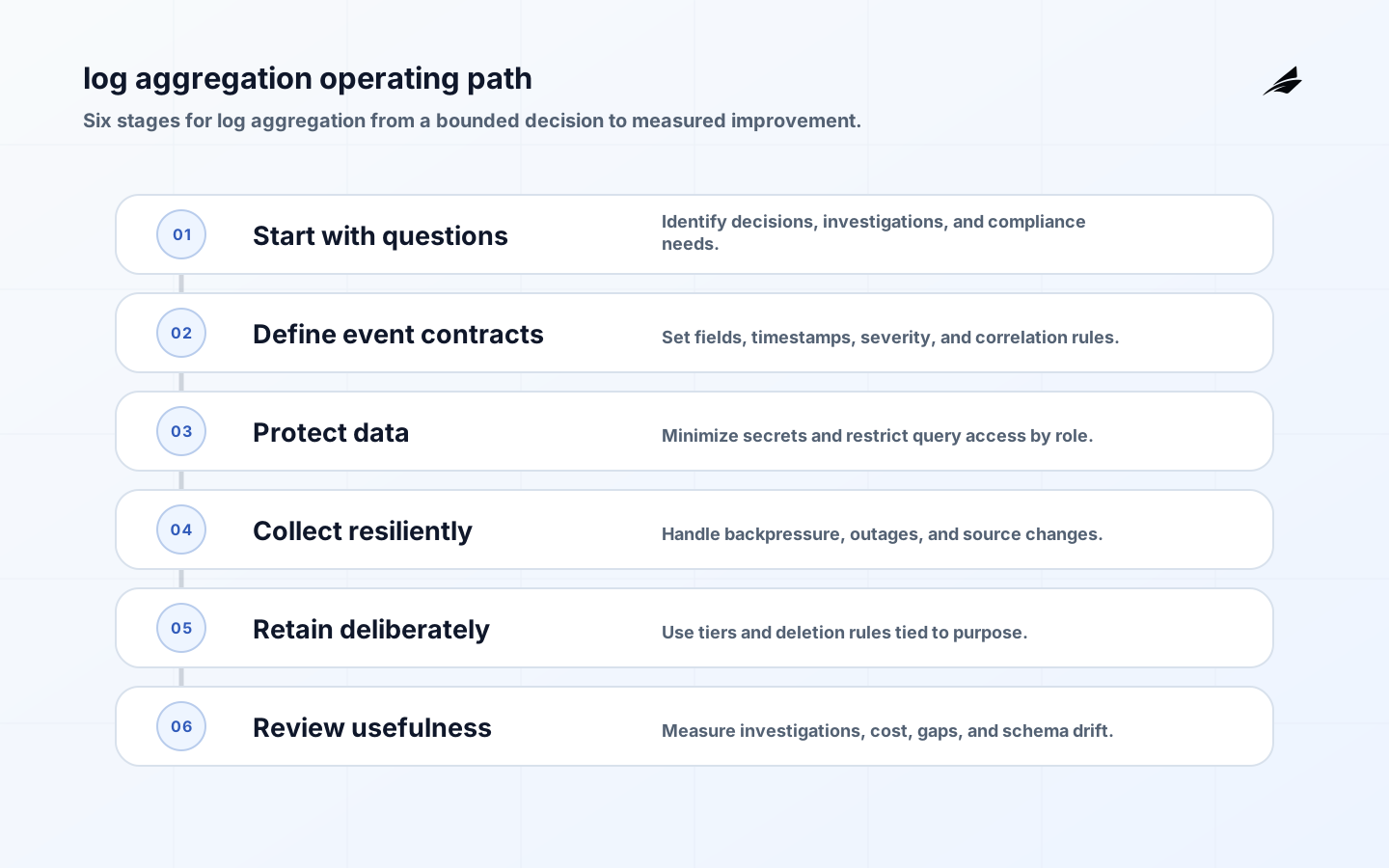
Log Aggregation: Operations Playbook is useful when a team treats it as an operating decision rather than a product label. Log aggregation concerns the records needed to answer operational questions while protecting sensitive data and controlling retention cost. The practical question is whether people can make a bounded change, explain the evidence, and recover without relying on memory. OpenTelemetry Logs data model and NIST SP 800-92 provide technical anchors; this guide turns them into choices an IT manager or operations team can use in planning and review.
Key takeaways
- Define log aggregation around a specific boundary, accountable owner, and user or business outcome.
- Make structured events, stable timestamps, correlation identifiers, collection resilience, access controls, retention tiers, and query-ready fields visible before automating a broad policy or workflow.
- Use a stop rule: do not centralize every byte by default; decide which events answer a question, who may read them, and how long they are justified.
- Treat creating an expensive, sensitive data lake that is still too inconsistent to support an incident investigation as a design risk, not an afterthought.
- Measure collection lag, dropped-event rate, query time, schema adoption, sensitive-data findings, retention cost, and investigation time together, because one measure rarely explains the whole outcome.
- Exercise the recovery or exception path before standardizing the approach.
- Turn recurring exceptions into a small owned improvement with a due date and a review.
Start with the questions logs must answer
Log aggregation should answer named operational questions, not promise that every technical concern disappears. Treat it as a bounded evidence practice: state what is included, what sits outside the boundary, and which records are authoritative. That framing prevents a local optimization from becoming an unowned system-wide change. The published guidance from OpenTelemetry Logs data model is useful here because it emphasizes controls and operating evidence rather than a one-time tool choice.
| Decision area | Question to settle | Evidence to retain |
|---|---|---|
| Outcome | What customer, service, or operational result does the practice protect? | A named journey, baseline, and owner for log aggregation. |
| Scope | Which systems, environments, and exceptions are included? | A boundary statement and dependency map for the records needed to answer operational questions while protecting sensitive data and controlling retention cost. |
| Authority | Who can proceed, pause, or approve an exception? | A role, escalation route, and dated decision record. |
| Verification | What observation proves the change is acceptable? | collection lag, dropped-event rate, query time, schema adoption, sensitive-data findings, retention cost, and investigation time over an agreed observation window. |
Name the evidence boundary
A boundary is more than a diagram. For log aggregation, it identifies the actor, trigger, records, actions, and recovery authority. Separate facts from assumptions: a dashboard trend may suggest a problem, while a trace, billing record, policy evaluation, or user report can establish what happened. Record the version and time context as well. That discipline matters when several changes occur at once, because it lets the next reviewer distinguish correlation from a cause worth acting on.
Make event quality observable
Start with the smallest useful path and make its control points explicit. The core mechanics are structured events, stable timestamps, correlation identifiers, collection resilience, access controls, retention tiers, and query-ready fields. Assign an owner for each external dependency and state what happens when its input is absent, late, or contradictory. A controlled first implementation should keep actions attributable, make the expected result observable, and allow a human to pause safely. NIST SP 800-92: Guide to Computer Security Log Management supplies a useful reference for details that should be adapted to the consequence of the work, rather than copied as a generic checklist.
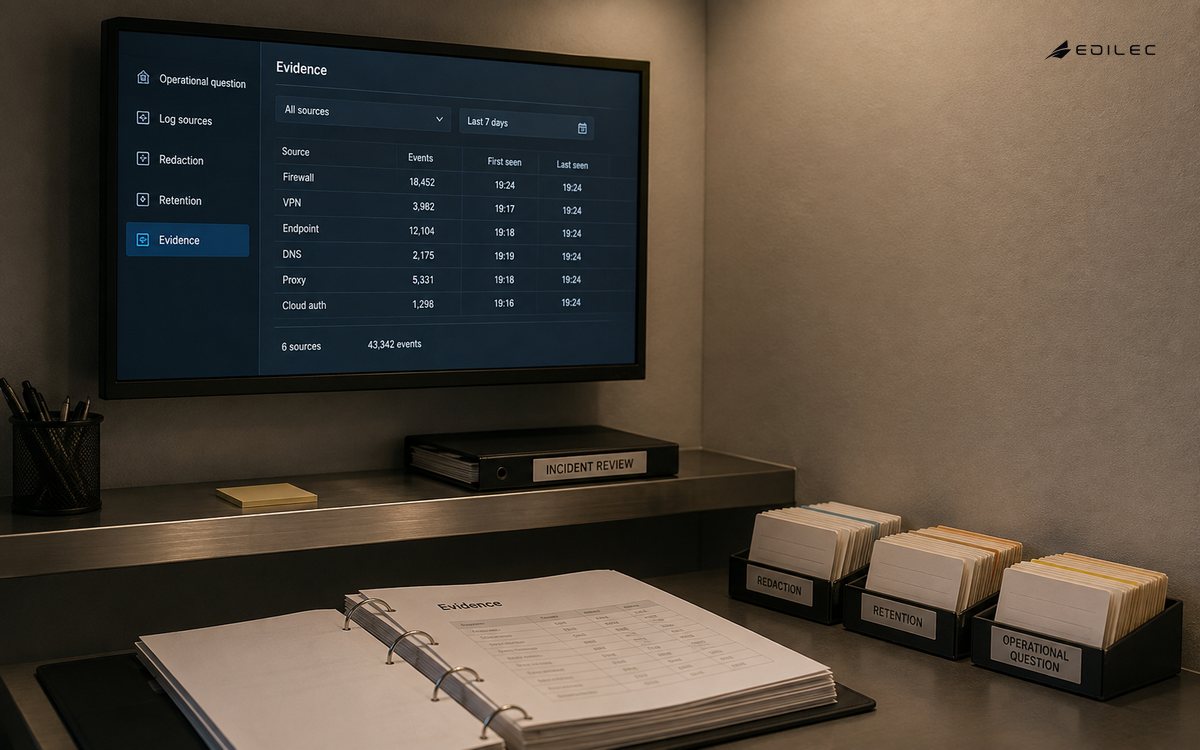
| Stage | Control | Decision rule |
|---|---|---|
| Prepare | Confirm scope, identity, prerequisites, and a baseline. | Do not proceed when ownership or required evidence is missing. |
| Act | Apply the smallest change that tests the assumption. | Stop when the agreed guardrail is crossed. |
| Observe | Compare technical signals with the expected user outcome. | Expand only when evidence remains within bounds. |
| Recover | Reverse, compensate, or reconcile the affected state. | Close only after recovery evidence is recorded. |
Where collection plans break
The dangerous failure mode is often not an obvious outage; it is a plausible-looking result with missing context. The most damaging version is an expensive, sensitive data lake that remains too inconsistent to support an incident investigation. Counter this by preserving identifiers, control decisions, and the source of each important input. Make exceptions visible instead of turning them into silent workarounds. A temporary bypass may be justified during an incident, but it needs a named authority, an expiry, and a review that restores the normal control. Otherwise the bypass quietly becomes the actual operating model.
Signals that change an operator's next move
Review collection lag, dropped-event rate, query time, schema adoption, sensitive-data findings, retention cost, and investigation time with a concrete case, not as a dashboard ritual. Pair a leading indicator, such as an invalid configuration or denied request, with an outcome measure such as a failed journey, delayed completion, or excess spend. Set an observation window that matches the workload: a synchronous request may show harm in minutes, whereas a batch or retention policy may need days. A short recurring review should ask what changed, which signal moved, and whether the existing rule still fits reality.
A service-path example
An order system emits structured events for acceptance, payment authorization, fulfillment handoff, and completion with an order reference that is safe to log. The collector buffers a short outage and labels the source and schema version. During a missing-order report, support can trace the business states without exposing card data or guessing which of several unstructured messages came first. This is the shape of a useful log aggregation experiment: a named assumption, limited blast radius, observable result, and an explicit next decision. It is more valuable than a large rollout that produces activity but no dependable evidence.
Assign the decision rights
The owner of log aggregation is not expected to know every implementation detail. They are responsible for the decision record: why the boundary exists, which evidence is trusted, who can change the control, and how exceptions are handled. Engineering should keep implementation and observability usable; operations should own the readiness and recovery routine; security or finance should participate where the consequence requires it. This division helps a team avoid both centralized bottlenecks and unaccountable self-service.
Design for investigations, not volume
Begin with a small incident question such as whether an accepted order reached fulfillment, then identify the event fields and correlation needed to answer it. Include event time and observed time when collectors or clocks may differ. Define who may search a sensitive field and whether a redacted derivative is sufficient for routine support. This approach limits ingestion cost while producing records that are ordered, attributable, and usable when an incident spans several services.
A staged route to wider coverage
Start log aggregation with one bounded, representative case and a named person who can decide whether it is ready to expand. Capture the baseline, the assumption, the guardrail, and the recovery action before changing production behavior. Review the result with the people who build and support the service, then make one precise improvement to the routine. This sequence is deliberately modest: it reveals missing dependencies and unclear authority while the consequence is small, and it gives later standardization a real operational record rather than an aspirational policy.
Keep an evidence sample with every log aggregation review. Select one normal case, one boundary case, and one exception; trace the decision from input to outcome; and note whether the records answer the next operator's question. This is a practical quality check because it catches controls that exist on paper but are difficult to use during ordinary work. When the sample reveals ambiguity, improve the smallest relevant contract, alert, permission, runbook, or ownership rule before widening the practice.
Frequently asked questions
Does log aggregation require a new platform? Not necessarily. Start with the evidence and control you need; a spreadsheet, runbook, policy, or existing tool may be enough for the first bounded path. When should the practice expand? Expand only after the team can show that the initial path protects the intended outcome, that exceptions have an owner, and that recovery has been tested. RFC 5424: Syslog Protocol and Kubernetes logging architecture are good references for a deeper technical review.
Operator notes for the first 30 days
During the first month, review log aggregation with the people who investigate incidents rather than only the people who installed the collector. Ask them to complete three tasks: find a known request across services, distinguish a delayed source from an absent event, and export a bounded evidence set under the approved access role. Record the time, queries, missing fields and workarounds. These observations reveal practical gaps that a schema review misses, such as a region label that is inconsistent only during failover or an event body that contains a useful business key but cannot be filtered safely. Turn the smallest repeated workaround into a contract, parser rule or runbook improvement.
Also establish a change rhythm. Every new service should supply a source owner, sample events, expected heartbeat and privacy classification before it joins the shared route. Every temporary increase in verbosity should have an expiry and a storage estimate. After an incident, compare the evidence that operators wanted with the evidence they actually had, then decide whether to change instrumentation, collection, retention or training. This makes log aggregation an improvement loop and avoids buying more search capacity when the real failure is that event meaning, ownership, or collection loss were never visible.
Keep one investigation pack as a regression case. It should include the source records, query route, expected correlation, privacy-safe export and the decision the operator made. Rerun it after collector changes, schema changes and retention changes. If the answer becomes slower or less complete, the team can see exactly which boundary moved. This small evidence pack is more useful than a long list of supported integrations because it shows whether the service still works for the people who depend on it.
Give the pack a clear expiry and owner. Evidence that is useful for one incident may become sensitive or misleading after a schema or policy change. Store the query assumptions with it, limit access to the people who need the case, and note whether the result is complete, sampled or delayed. That small discipline keeps investigations repeatable without turning every historical export into a permanent second log store.
The owner should also confirm when the case is no longer representative. Retire or refresh it after a major service change so a passing regression does not mask a new path.
For adjacent practice, read the plain-language guide to log aggregation, observability engineering notes and incident response planning.
Use a definition-change check before release
When a metric definition changes, the checklist should force a comparison with the decision that uses it. Capture the old and new grain, filters, time basis, source version, affected consumers, and effective date. Re-run accepted examples across the dashboard, semantic layer, and downstream export; then ask the business owner whether the change is a correction, a new metric, or a restatement of history. If a consumer must migrate, name the deadline and the fallback. If the metric is no longer maintained, mark it deprecated rather than allowing a familiar label to outlive its owner. This review makes the checklist specific to semantic-layer operations: it protects meaning, change visibility, and accountable recovery instead of becoming a generic set of approval steps.
Define the handoff when a run is late
A late ELT run should produce a clear handoff, not a silent blank or a misleading green tile. Put the source cutoff, last complete period, current run state, affected decisions, and next check beside the published result. The workflow owner decides whether to delay, publish a labelled prior value, or issue a qualified result; the consumer-facing message should say which action is safe. For an invoice report, preserve the run identifier and source extract so a later correction can be reconciled to the period people already reviewed. This small operating contract reduces duplicate manual calculations and gives support a consistent answer while the technical owner investigates the cause.
Conclusion
Log aggregation earns its place when a responder can answer a defined question without exposing unnecessary data. Start with one service path, record the event contract and access boundary, then widen coverage only when investigation evidence and retention cost support the next step.
A log aggregation practice earns trust when an operator can find the right evidence, understand its limits and act without exposing more data than necessary. Keep the first path narrow, measure it during a real investigation and improve the record or control that failed.
Keep a small investigation pack with sample records, expected timestamps, correlation fields, access role and the safe export route. Rerun it after collector, schema or retention changes. If the result becomes slower, incomplete or too broad, the owner has a concrete case for correcting instrumentation or policy.