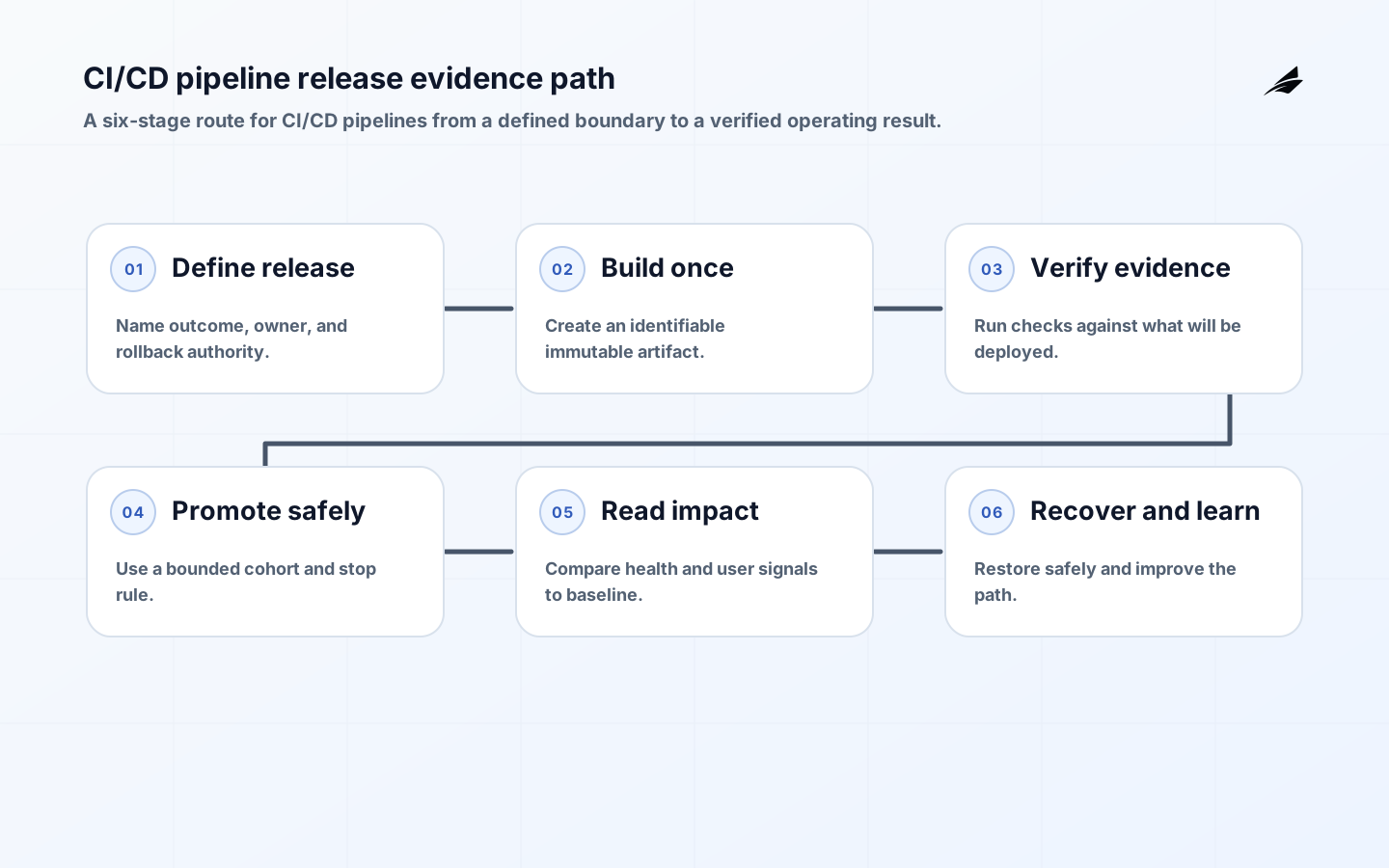
CI/CD pipelines are valuable when they help a team turn a reviewed change into a known, reversible production outcome. The practical unit is a versioned build artifact, not a vendor dashboard or a collection of commands. Start by naming the user-facing outcome, the release owner, and the point at which a change becomes consequential. That gives engineering, security and operations one shared boundary. Without it, teams tend to automate the happy path while leaving approval, investigation and recovery to memory. This guide treats CI/CD pipelines as an operating capability: a repeatable way to decide, act, observe and correct.
Key takeaways
- Design CI/CD pipelines around a versioned build artifact; make the owner and authority visible.
- Use source revision, dependency lockfiles, test results and deployment configuration as explicit inputs, with a record of which revision or event governed the decision.
- Choose tests that exercise the released artifact, policy checks, and a human decision for elevated risk before broadening exposure.
- Watch service-level indicators, error budget consumption, deployment events and customer-impact reports; metrics should trigger a decision, not become a wall of charts.
- Practice halt promotion, return to the previous known-good revision, and capture the evidence behind that decision while the team has time to think.
Set the decision boundary for CI/CD pipelines
The first design choice is scope. Decide exactly which outcome is being protected and which dependencies are only observed. For this topic, begin with source revision, dependency lockfiles, test results and deployment configuration. Each item needs a source of truth, an owner and an expected freshness or revision rule. A vague boundary creates false confidence: a team may see a successful technical step while the business action it enabled has failed or been applied twice. The boundary should also say who may approve expansion, who may stop it, and what evidence they need. This turns CI/CD pipelines from a platform initiative into an accountable service.
| Decision | Question to settle | Evidence to retain |
|---|---|---|
| Outcome | What user or operator result must remain true? | A named transaction, service objective or recovery condition. |
| Authority | Who can advance, pause or reverse the work? | Role, approval rule and time-stamped decision. |
| Inputs | Which facts must be trusted before action? | source revision, dependency lockfiles, test results and deployment configuration |
| Stop rule | What makes continued exposure unsafe? | service-level indicators, error budget consumption, deployment events and customer-impact reports |
Build an operating design, not a tool chain
A credible design makes the normal and exceptional paths equally clear. In the normal path, the release owner receives defined inputs, executes a bounded action and records a result that another person can inspect. In the exception path, the system must preserve enough context to explain what happened without exposing information indiscriminately. Tests that exercise the released artifact, policy checks, and a human decision for elevated risk are valuable because they catch a mismatch before it reaches a larger audience, but no check is universal proof. Match the evidence to the consequence: a low-risk internal improvement can use lighter controls than a change that can lose money, expose data or interrupt a regulated workflow.
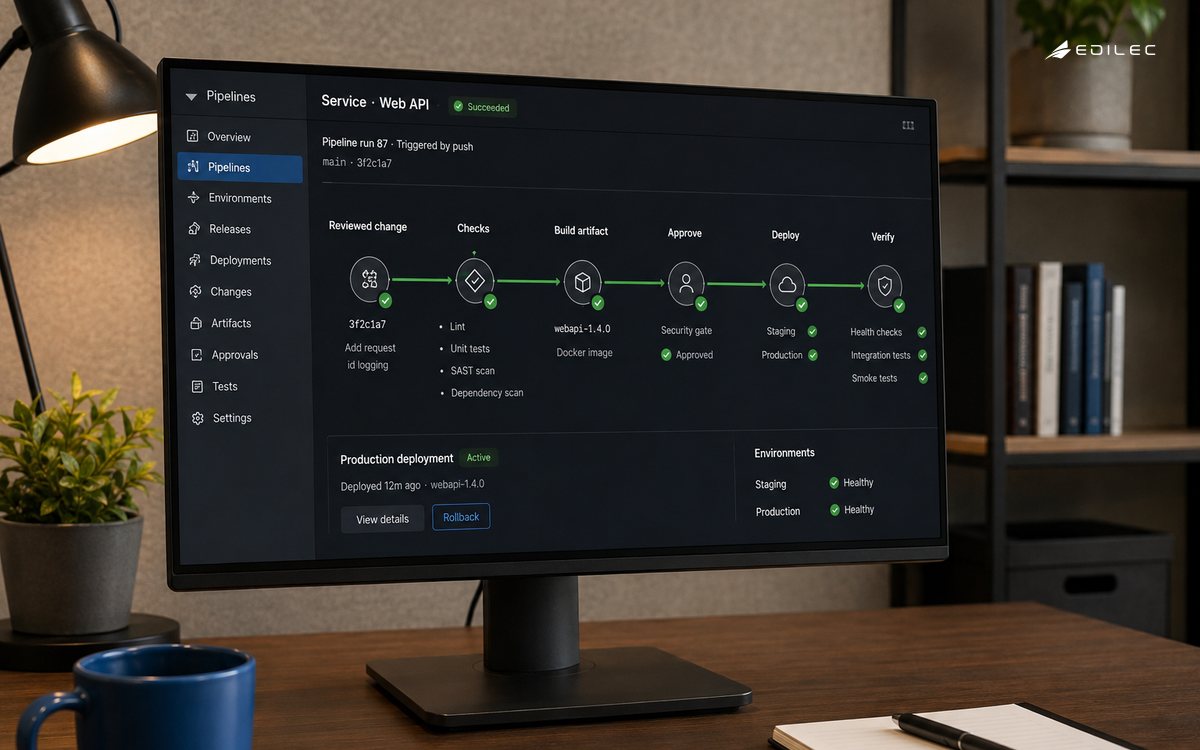
The hard part is rarely the first automation. It is keeping the declared behavior aligned with reality as dependencies, teams and traffic change. Treat configuration, permissions and ownership as part of the product. Make versions identifiable; avoid relying on a mutable label or a private message as the explanation for a change. In this context, treating a green build as proof that the production change is safe. A design review should ask what a responder can see, what they can safely do, and what must be escalated. Those questions expose fragile assumptions earlier than a generic architecture diagram.
| Control area | Useful implementation | What to observe |
|---|---|---|
| Identity | Grant the executor only the permissions required for this boundary. | Unexpected denials, privilege changes and break-glass use. |
| Evidence | Keep an immutable reference to the action inputs and result. | Missing revisions, incomplete records and untraceable changes. |
| Exposure | a small cohort or low-consequence environment before broad traffic | Impact compared with the agreed baseline. |
| Recovery | halt promotion, return to the previous known-good revision, and capture the evidence behind that decision | Time to decide, restore and verify the outcome. |
Implement CI/CD pipelines in a thin vertical slice
Build one complete path before generalizing. Select a case where the outcome is observable and the impact can be bounded. Define the entry event, the identity that performs each action, the state transitions, the dependencies and the final verification. Then deliberately exercise an unhappy path: missing input, a slow downstream service, an authorization denial or a partial success. The goal is not to simulate every disaster. It is to prove that the team can distinguish normal delay from a condition that needs intervention. A small cohort or low-consequence environment before broad traffic is a better first rollout than a large migration because it creates interpretable evidence.
For CI/CD pipelines, make the artifact the center of the conversation. A release record should identify the source revision, dependency set, build environment, checks, approvers and destination. Deploy the same artifact that was tested; rebuilding during promotion breaks the evidence chain. For configuration changes, record the effective values separately from secrets and confirm the running version exposes a safe build identifier. A canary is useful only when the team knows which signals will halt it and who is awake to interpret them. This is how delivery speed becomes a controlled capability rather than a sequence of optimistic pushes.
- Write the contract for a versioned build artifact in plain language before encoding it.
- Connect source revision, dependency lockfiles, test results and deployment configuration to named owners and version or freshness expectations.
- Automate tests that exercise the released artifact, policy checks, and a human decision for elevated risk where the rule is stable; preserve review where judgment is material.
- Record how to enact halt promotion, return to the previous known-good revision, and capture the evidence behind that decision, including access, approvals and verification.
- Run a controlled release, inspect service-level indicators, error budget consumption, deployment events and customer-impact reports, then either expand, correct or stop.
Measurement must support a specific action. Service-level indicators, error budget consumption, deployment events and customer-impact reports should be visible together with the deployment, configuration or incident context that explains a change in behavior. Prefer a small set of indicators with thresholds and owners over a broad collection that nobody reviews. Separate leading signs, such as rising retries or delayed work, from outcome signs, such as failed customer transactions or missed recovery objectives. Review the indicators after a routine change as well as after an incident. That habit reveals whether instrumentation, alerting and runbooks help a new responder reach the same conclusion as an experienced one.
For CI/CD pipelines, cost and privacy belong in the review, too. High-cardinality telemetry, retained payloads or overly broad diagnostics can create avoidable exposure and bills. Minimize captured data, classify operational records and define retention before collection spreads. When a signal is no longer tied to an owner or decision, retire it intentionally. The same discipline applies to exceptions: an override is not a workaround to forget, but evidence that the operating model may need a better rule, interface or escalation path. The most useful improvement is usually the one that removes repeated ambiguity.
Frequently asked questions about CI/CD pipelines
How much should be automated? Automate deterministic, reversible work once its inputs and outcomes are understood. Keep a human approval where the consequence is high, facts are ambiguous, or the decision cannot be safely undone. How do we know the design is ready to expand? A healthy first slice has an accountable owner, evidence for its checks, a tested recovery procedure and signals that distinguish expected variation from meaningful harm. What should leaders ask for? Ask to see one real record from entry to outcome, the current stop rule, and the last time halt promotion, return to the previous known-good revision, and capture the evidence behind that decision was practiced. Those answers are more revealing than a tool inventory.
Conclusion: make CI/CD pipelines dependable in ordinary work
Consider a service that changes how it calculates an invoice total. A useful pipeline builds the application once, runs the contract tests that protect the billing interface, and deploys the same digest to a restricted cohort. The team watches calculation mismatches, request failures and support contacts against a baseline. If a mismatch appears, the release owner has a defined way to stop expansion and restore the prior behavior. This is stronger than a pipeline that reports every test green but cannot show which artifact, migration or feature setting changed the result.
Configuration deserves equal treatment. A binary can be correct while a changed endpoint, timeout, feature flag or access policy produces an outage. Keep configuration changes reviewed and attributable, and decide whether they travel with the artifact or through a separately controlled path. The decision should be recoverable at the same speed as code. When the two paths are decoupled, the release record needs to make that relationship explicit so an investigator can reconstruct the production state without comparing several unrelated systems.
For a small team, a credible first release path may be a pull request, required checks, an artifact registry, a protected deployment command and a short post-release observation window. That is enough to establish the evidence chain. Add progressive delivery, automated policy checks and more environments when a demonstrated risk or volume justifies them. The goal is neither zero-touch deployment nor ceremonial approval; it is a reliable way to make an informed change decision.
At a regular review, select one failed deployment, slow rollback or near miss and trace it from change request through production observation. Ask where a human had to infer missing state, where a tool produced an ambiguous result and which guardrail would have changed the decision. Assign the improvement to the release path rather than relying on a reminder to be more careful next time.
CI/CD pipelines earns trust through explicit ownership, bounded exposure and evidence that survives a handoff. Keep the first scope narrow enough to learn from, then extend it only when the team can explain the path, detect a problem and recover with confidence. For further context, see the companion operating guide, the adjacent implementation guide and a related reliability guide.