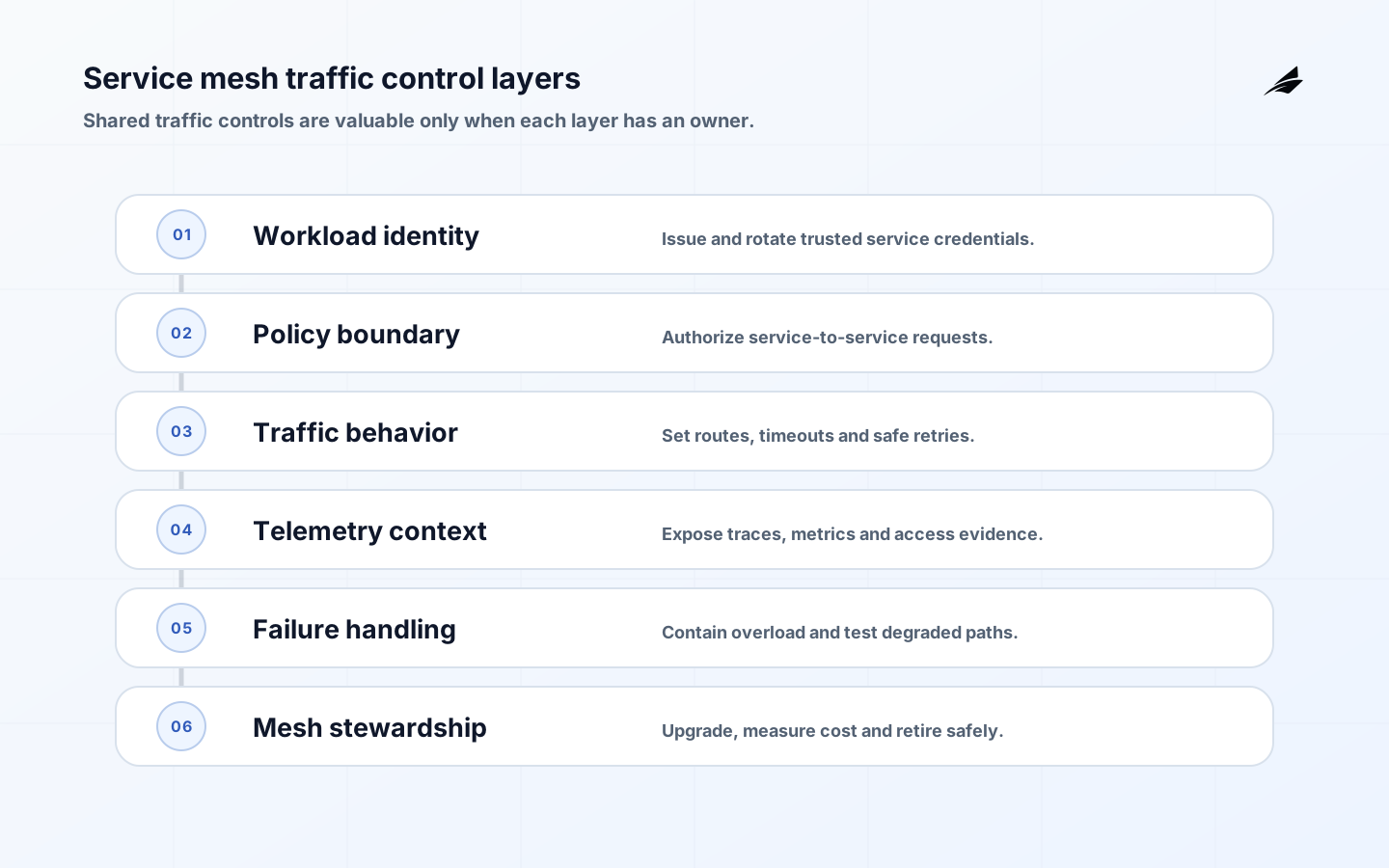
A service mesh can make east-west traffic more observable and controllable, but it also introduces a distributed control plane, data-plane components, certificates, policies, upgrades, and new failure modes. The buyer question is not whether it has attractive features. It is whether the organization has a recurring service-to-service problem that deserves a shared layer. Look for evidence in incidents, access requirements, traffic experiments, and the burden of implementing cross-cutting behaviour separately in every service.
Establish the service meshes operating boundary
Write the jobs a mesh would perform: workload identity, mutual TLS, authorization, retries and timeouts, traffic splitting, telemetry, or multi-cluster routing. For each, document the current mechanism, owner, risk, and a viable alternative such as libraries, gateway, managed load balancing, or network policy. Name what stays out of the first rollout. A mesh should not become a reason to redesign every service or introduce policy that nobody can maintain.

| Decision area | Working rule | Evidence to keep |
|---|---|---|
| Workload identity | Many services need consistent mTLS and authorization. | Few integrations can use platform IAM. |
| Traffic control | Teams need internal routing and resilience rules. | Ingress or application library covers path. |
| Telemetry | Diagnosis lacks correlated context. | Existing tracing meets the need. |
| Multi-cluster | Policy and identity span managed boundaries. | Topology is stable and interaction limited. |
Design service meshes for safe change
Evaluate the data path before features. It must fit network topology, DNS, workload types, latency budget, and cluster constraints. Decide how workloads receive trust, how policies express service intent, how external services are represented, and how certificates rotate. Analyze control-plane degradation: what keeps serving, what stops receiving configuration, and how operators find current policy state? Identity design matters as much as encryption.
Control the risks around service meshes
Mesh policy can centralize intent, so change control and identity hygiene matter more. Separate policy creation from workload deployment, version policies, and make defaults explicit. Keep telemetry aligned with privacy and retention rules. Avoid retries or timeouts that amplify dependency failure. A mesh should make behaviour easier to reason about, not hide application faults behind opaque automatic recovery.
| Scenario | Expected response | Verification |
|---|---|---|
| Policy change | Review, apply, and observe authorization. | Owner explains new decision. |
| Certificate rotation | Rotate trust without outage. | Old trust retires visibly. |
| Component failure | Degrade per documented data path. | Impact and recovery understood. |
| Upgrade | Test compatibility before rollout. | Rollback route is viable. |
Test service meshes under pressure
Deny a legitimate dependency call, rotate a certificate, introduce a slow upstream, and simulate data-plane failure. Observe whether events are expressed in terms service owners can act on, whether policy rollback is clear, and whether customer behaviour matches expectations. Benchmark the relevant path, not generic overhead claims. Test upgrades in a representative environment with the same CNI and workload limits as production.
Operate and improve service meshes
Budget for policy ownership, platform support, security review, telemetry storage, education, and upgrades. Track services that benefit from promised controls, not only enrollment count. Compare capabilities with managed features and simpler alternatives as architecture changes. Keep an exit criterion: if operational burden outweighs the solved problem, reduce scope or retire deliberately.
- Describe the cross-service problem first.
- Model policy ownership with identity.
- Pilot a narrow workload set.
- Test rollback and certificate rotation.
- Budget lifecycle cost and exit path.
Implementation field notes for service meshes
Architecture review for service meshes starts with the workload identity, certificate, authorization policy, data plane, traffic rule, telemetry, and upgrade path. For service-mesh adoption, give each element an owner, an authoritative source, and expected failure behavior. For service-mesh adoption, follow a normal request across automation, people, and vendor boundaries, then test late, denied, stale, and partial outcomes. For mesh operating model, that turns a feature list into an operating design. For service-mesh adoption, it makes the route from ordinary work to accountable recovery visible and reveals assumptions that belong in a runbook, configuration review, or smaller scope rather than in private memory.
Acceptance evidence must be practical. For service-mesh adoption, define what proves the intended control works in representative conditions, who reads the proof, and what result stops expansion. For service-mesh adoption, evidence can be a versioned configuration comparison, scoped identity decision, customer-safe synthetic transaction, audit event, or reconciliation record. Keep it with the release or operating decision. For service-mesh adoption, when an operator must gather proof from dashboards, chat threads, and private notes, the control becomes slow exactly when speed and clarity matter. Mesh acceptance covers authorization, certificate rotation, policy rollback, and a meaningful request-path benchmark. A useful pilot leaves the service team able to explain its traffic rules without relying on platform specialists.
Decision rights are part of service meshes. Separate authority to observe, change, approve, and override. For service-mesh adoption, the person running routine work needs a fast supported path; the person accepting a material exception needs context and a durable record. For service-mesh adoption, define the escalation route before the exception, including the point at which work pauses rather than silently continuing. For service-mesh adoption, this avoids broad permanent privilege and makes handoffs inspectable by engineering, security, product, and support without forcing each group to master every implementation detail.
For service-mesh adoption, use a failure exercise that crosses the boundary instead of a healthy-path demonstration. In the operating model, a retry rule safe for reads can multiply writes against a struggling downstream service. For service-mesh adoption, the response should name containment, stakeholder communication threshold, evidence preservation, and the reconciliation action that proves closure. For service-mesh adoption, rehearse it in non-production where possible, then run a tabletop with the people who would decide and communicate. For service-mesh adoption, these exercises expose unavailable permissions, incomplete audit context, undocumented dependencies, and unclear ownership before customers depend on the path.
Measure behavior rather than activity volume. Combine an outcome relevant to service meshes with a review of operator confusion, support contacts, recurring overrides, and workarounds. For service-mesh adoption, version the calculation and alert separately when evidence is incomplete; a quiet chart is not proof of health if collection failed or people stopped recording exceptions. For service-mesh adoption, this lets the team distinguish genuine improvement from a reporting change and gives leadership a defensible reason to prioritize a repair, investment, or retirement.
Cost and capacity belong in the operating review. For service-mesh adoption, estimate direct infrastructure spend alongside release delay, support demand, training, investigation time, and recurring exception cost. For service-mesh adoption, start with one representative workflow and a success and stop criterion rather than a broad commitment based on feature lists. For service-mesh adoption, expand only when teams can explain the value, operate the path without private expertise, and show that it removes a meaningful risk or handoff instead of moving it to another queue. For service meshes, review the economic trade-off with the owner who experiences it.
For service-mesh adoption, publish what changed, what stays deliberately out of scope, the evidence collected, and the date owners will retest the assumption. Revisit after architecture, ownership, customer-commitment, or incident changes. This keeps service meshes connected to live operations and makes continual improvement normal delivery work rather than a retrospective promise that disappears after the immediate problem has passed.
Field application: Mesh acceptance covers authorization, certificate rotation, policy rollback, and a meaningful request-path benchmark. The pilot is incomplete when only the platform team can explain the traffic rules. For service-mesh adoption, in the next operating review, compare that evidence with the stated risk boundary and decide whether the control can expand, needs correction, or remains limited. For service-mesh adoption, record the decision with its accountable owner so later changes do not recreate the same uncertainty.
Pilot example: select two owned services with a stable dependency and introduce one policy that is easy to observe, such as allowing a specific service identity to call a narrow route. Verify the denied case, rollback the policy, rotate the related trust material, and measure the request path under normal and degraded conditions. The pilot should include the on-call team, not only mesh specialists. Its exit review must say whether the new control removed repeated application work and whether its operational signals were understandable during failure.
Key takeaways for service meshes
- Define the customer, service, or risk boundary before implementing service meshes.
- Make the normal path observable and exceptions attributable.
- Use rehearsals to prove recovery, not dashboards to claim readiness.
- Review the model when architecture, ownership, or commitments change.
Frequently asked questions about service meshes
Question: When does a service mesh justify its operational cost? Answer: A mesh is more defensible when teams need consistent service identity, encrypted service-to-service traffic, policy, retries, or telemetry across many services and can support the added control plane. A small system may prefer simpler library or gateway controls.
Question: Does a service mesh replace an API gateway? Answer: Usually not. A gateway handles edge-facing concerns such as ingress, authentication integration, and public routing, while a mesh focuses on service-to-service communication. The boundaries can integrate but should remain explicit.
Question: How should mesh changes be rolled out? Answer: Begin with one representative path, observe latency and failure behavior, stage policy changes, and keep a documented bypass or rollback. Treat sidecar or ambient dataplane upgrades as production changes with ownership and recovery evidence.
Does a mesh replace a gateway?
Usually no. Gateways manage external entry while meshes focus on service-to-service behaviour. They can complement each other when architecture defines policy placement.
Will it automatically improve reliability?
No. Unsafe retries, poor timeouts, weak service design, and overload remain problems. Reliability needs configuration and operation against real objectives.
When should a small team defer it?
When interactions are simple, platform controls meet the need, and the team cannot support another distributed system. Use the smallest dependable mechanism.
Conclusion: make service meshes an operating capability
Service meshes earn their place when they solve an identified cross-service control problem better than simpler tools. Buy on evidence, pilot a narrow workload set, and include upgrade, failure, and exit costs.
Make the buying decision operational
A service mesh evaluation should include a narrow workload, a clear success measure and an exit condition. Test identity, authorization, timeout, retry, traffic split, telemetry and upgrade behavior with the actual platform team that will support them. NIST SP 800-204A treats secure service-to-service communication, discovery, resilience and monitoring as related requirements; that is a better frame than choosing a mesh from a feature checklist. Istio documentation also exposes the operational surface across traffic management, security, observability and upgrades.
Avoid enabling retries by default. A retry can multiply load or repeat a non-idempotent operation, while a timeout can turn a slow dependency into an apparently healthy response path. Define which policies belong in the mesh, which remain in application code and which are owned by an ingress gateway. Then measure proxy resource cost, control-plane health, certificate rotation, policy-denied requests and time-to-diagnose alongside user-facing latency and error objectives. See the service mesh practical guide, observability engineering notes, and SLO planning.
Further Edilec context: Service mesh practical guide, Observability engineering notes, SLO planning guide. The production path applies those references specifically to service meshes: a buyer and cto guide to operational trade-offs.
Source trail: NIST SP 800-204A connects identity, resilience and monitoring; NIST SP 800-204C places infrastructure, policy and observability code in one delivery model; Istio documentation exposes operational surfaces; and the Linkerd overview provides a second implementation perspective. These references make support cost part of the buying decision.