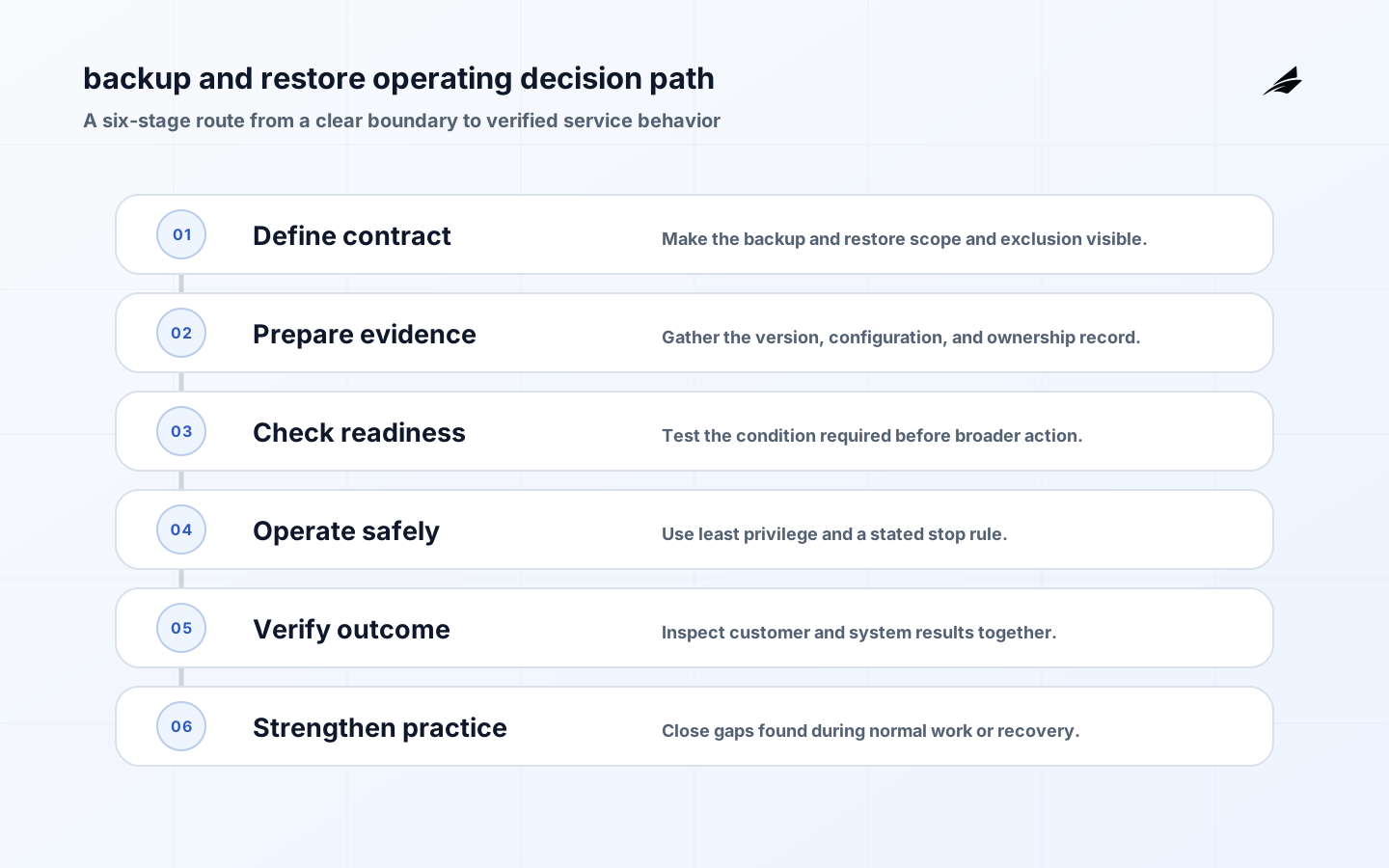
Backup and restore deserves a plain-language operating model because IT managers need to make choices that remain understandable after the first implementation. Backup and restore is the capability to recover the right data and service state within an agreed time and loss window. A backup is only a copy with a retention policy; restore is the proof that the copy can be located, accessed, reconstructed, validated, and returned to use. The two objectives that shape the design are recovery point objective, the maximum tolerable data loss measured in time, and recovery time objective, the maximum tolerable time to restore service. Both must be chosen with the business owner, not inferred from storage settings.
Key takeaways
- Set recovery point and recovery time objectives with the service owner.
- Back up data, configuration, identities, keys, and artifacts required for usable recovery.
- Use separated and, where appropriate, immutable copies across failure domains.
- Test restore end to end in an isolated target, not only backup completion.
- Measure actual recovered point and elapsed restoration time.
- Protect backup deletion and key access with deliberate controls.
What backup and restore means in practice
Inventory data stores, configuration, encryption keys, identities, application artifacts, and dependencies that a service needs to return to an acceptable state. Some systems require point-in-time database recovery; some need immutable object versions; some require infrastructure configuration and secrets to be restored in a particular order. The NIST contingency-planning guidance is a sound starting point because it frames recovery as a system and business process, not a storage product selection. Define who can authorize restore, where recovery runs, and how the restored result is verified before an emergency occurs.
| Decision area | Question to settle | Useful evidence |
|---|---|---|
| Recovery point objective | How much recent data may be lost? | Business-approved time window and tested recovery point. |
| Recovery time objective | How long may service be unavailable? | Measured drill duration with named recovery steps. |
| Copy isolation | What failure can erase this copy? | Separate account, region, credentials, or immutable retention. |
| Verification | How is usable state proven? | Integrity plus application-level checks by an owner. |
An operating model for backup and restore
Use layered copies and separate failure domains. A common practical pattern is production data with local or nearline recovery, an offsite copy, and an immutable or access-isolated copy that resists accidental or malicious deletion. Encrypt backups in transit and at rest, but ensure key recovery is part of the tested procedure; encrypted data with inaccessible keys is not a recoverable backup. Set retention to meet recovery, legal, and cost requirements, then monitor expiration and replication failures. Include configuration and schema versions so restored data can be served safely by the application revision available during recovery.

A practical implementation path
A restore drill starts with a scoped scenario: recover one database to a point before an accidental deletion, restore one object version, or rebuild a service in an isolated account. Identify the source backup, authorize access, restore into a safe target, run integrity and application-level checks, compare expected records or hashes, and decide how the recovered state reaches users. Do not test only whether a provider reports success. A database can restore successfully yet fail application migrations, lack a required key, or contain data outside the agreed recovery point. Connect recovery evidence to incident response so roles and communications are ready.
Risks and controls to make explicit
The dangerous assumptions are that snapshots are backups, that replication protects against all failure, and that one successful test proves every service can recover. Replication can faithfully copy deletion or corruption. Snapshots may be unavailable in a regional or account compromise. A retention setting can silently expire the only useful recovery point. Protect backup deletion with separate privileges, multi-party controls where appropriate, monitoring, and a documented break-glass route. Restore testing must cover the dependencies that make data meaningful, including schema, credentials, DNS, and application configuration.
| Stage | What to check | Decision rule |
|---|---|---|
| Prepare | Inventory dependencies and choose a scoped drill. | Authorize a safe recovery target and named validator. |
| Restore | Locate copy, keys, configuration, and artifacts. | Stop if the selected point or identity is not provable. |
| Validate | Check integrity, application behavior, and expected records. | Measure actual RPO and RTO against the objective. |
| Improve | Record gaps in access, sequence, or documentation. | Update controls and schedule the next drill. |
Signals that show whether it is working
Track backup completion and age, replication lag, immutable-copy status, restore-test frequency, measured recovery point and recovery time, integrity-check failures, storage growth, failed deletions, and the percentage of critical systems with named recovery owners. Report tested RPO and RTO rather than only configured values. The useful question in a leadership review is not "do we have backups?" but "when did we last restore this critical service, how long did it take, and what data point did we reach?"
A backup and restore checklist for the next change
Schedule a restore drill for the highest-impact service first. Use an isolated target so the test cannot overwrite production, include an application owner who can validate real behavior, and capture the timing at each stage. Resolve the smallest missing dependency before declaring the run successful. When containerized workloads are involved, verify that the image and Kubernetes deployment configuration needed to serve the restored data are also available.
Recovery tests should account for identity dependencies. A restored database may be intact but unusable if the service account, network policy, certificate, or key grant needed to reach it is absent from the recovery environment. Include these dependencies in the drill checklist and make their ownership visible. The goal is to restore a functioning service boundary, not to celebrate a successful storage operation that cannot yet support a real user request.
A worked decision example
An administrator deletes records at 14:07 from a customer database with a fifteen-minute recovery-point objective and a two-hour recovery-time objective. The team selects a pre-deletion copy, restores it into an isolated environment, makes it usable with the application schema and recovery key, and compares the affected records with a reconciliation report. Only after that application-level check does an approved recovery path return data to users. The measured point and elapsed time become evidence for the next review.
How to phase adoption
Phase backup and restore through one bounded service or workflow first. Establish the owner, evidence record, access boundary, and stop rule before standardizing a template or expanding automation. The first implementation should expose its awkward dependency, not hide it behind a happy-path demonstration. After the team can explain why the control exists and show its outcome, reuse only the conventions that made the decision clearer. This avoids turning a local tool choice into a broad platform mandate before its operating assumptions are tested.
Keep the working record close to the change. For backup and restore, that means retaining the version or configuration involved, the person or automated identity that acted, the signal examined, the exception if there was one, and the recovery decision. This is not paperwork for its own sake. During a later failure, those few facts prevent responders from confusing an old condition with a new one or repeating an action whose effect is still unknown.
A useful review cadence
Review backup and restore with real examples rather than a generic scorecard. Sample one normal outcome, one unexpected outcome, and one manual exception. Ask whether a new owner could locate the relevant evidence, understand the boundary, and decide what to do next without relying on private memory. A repeated exception points either to a missing capability or to a constraint that should be made explicit. In both cases, the review should create a small, owned improvement.
Run a deliberately limited exercise before widening use. Change one safe input, observe the stated signals, invoke the documented containment or recovery step, and verify that the intended service behavior returns. Record where access, timing, or ownership was unclear. An exercise is successful when it reveals a practical weakness early enough to repair it, not when every participant follows the expected script. That habit makes backup and restore more dependable under ordinary pressure as well as during an incident.
Frequently asked questions
A snapshot can be part of a backup strategy, but its retention, isolation, and restoration route determine whether it is sufficient. Backups need encryption, yet the encryption-key recovery procedure must be tested separately. The right testing interval depends on the criticality and change rate of the system; test often enough that a new dependency, access policy, or schema change does not make the runbook fictional.
Conclusion
Backup and restore is confidence earned through recovery evidence. Set RPO and RTO with the business, isolate copies from the failures they must survive, protect the ability to delete or decrypt them, and repeatedly restore a real service into a usable state. A tested recovery path turns an unpleasant event into a managed operation.