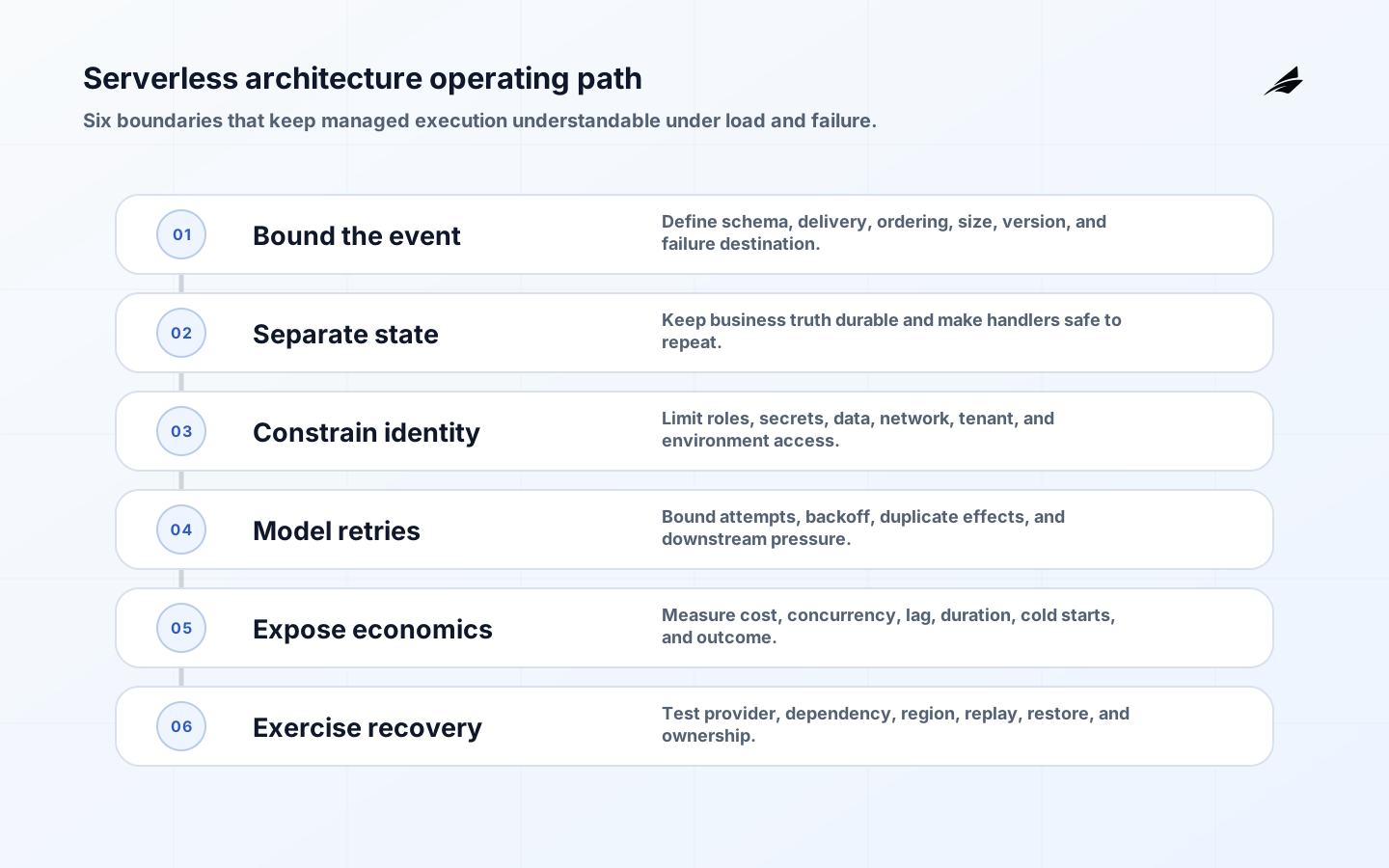
Serverless architecture does not mean an application has no servers or no operations. It means the provider manages more of the underlying capacity and execution environment, while the team pays for and controls a higher-level service boundary. That can reduce infrastructure toil, but it makes event semantics, retries, state, observability, permissions, and cost especially important. AWS Lambda best practices and the AWS Well-Architected Serverless Lens treat those concerns as part of the design. The companion serverless architecture mistakes and fixes is useful after the first deployment.
What serverless moves and keeps
A managed function or event service can shift provisioning, patching, and some availability work to the provider. The application team still owns code, configuration, identity, data contracts, dependency behavior, quotas, observability, and the user outcome. The boundary also introduces provider-specific limits such as execution duration, concurrency, payload size, cold-start behavior, and event delivery semantics. Define which responsibilities move and which remain before adopting the pattern. This prevents the common mistake of assuming that a provider-managed runtime makes the entire workflow automatically reliable or inexpensive.
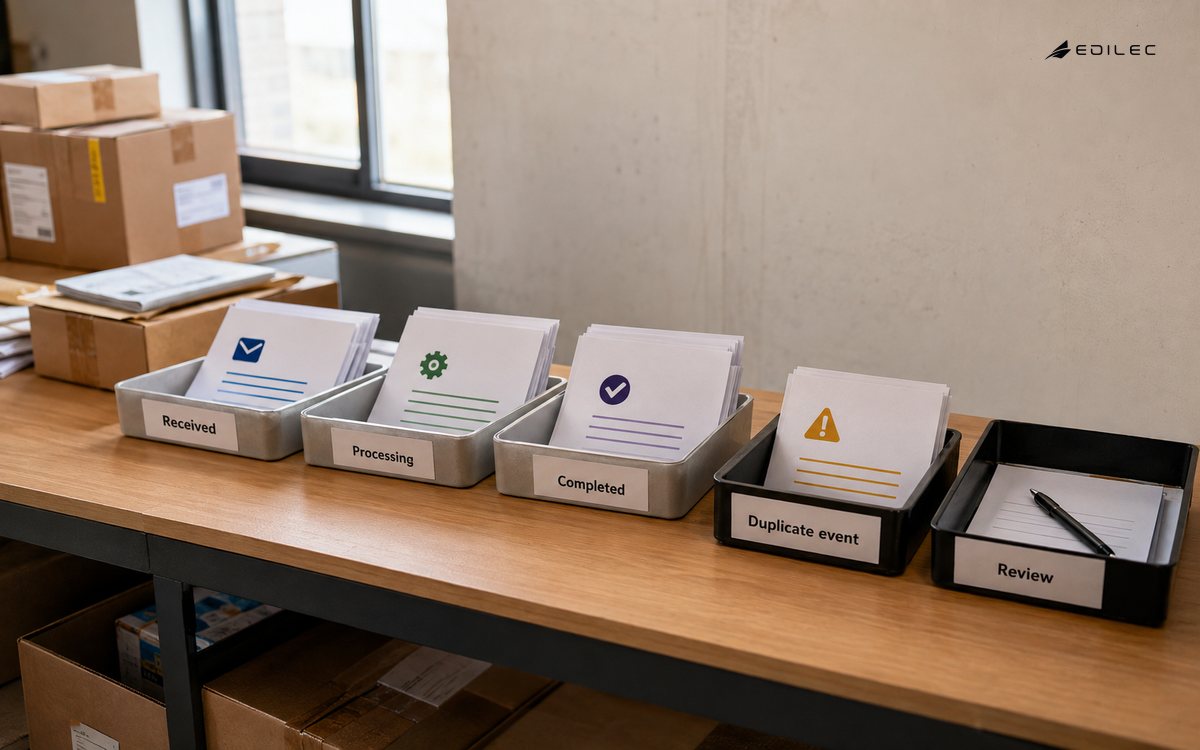
| Concern | Provider may manage | Application team still owns |
|---|---|---|
| Compute | Host provisioning and runtime infrastructure | Function behavior, limits, dependencies, and capacity settings. |
| Availability | Service-level infrastructure and regional mechanisms | Failure handling, retries, fallbacks, and user-facing outcomes. |
| Scaling | Infrastructure capacity for invocation | Concurrency, quotas, downstream protection, and cost. |
| Security | Platform controls and service primitives | Identity, least privilege, data access, and code behavior. |
| Operations | Some metrics and platform events | Logs, traces, alerts, runbooks, and recovery evidence. |
Design the event boundary
Serverless workflows are often event-driven, so the event contract is the first operational interface. Define the producer, schema, versioning rule, ordering assumption, delivery guarantee, maximum size, and failure destination. Make handlers idempotent because retries and duplicate delivery can occur. AWS Lambda retry guidance explicitly warns that duplicate processing is possible in event-source workflows. A handler should be able to determine whether it has already applied an operation, and a poison event should move to a controlled path rather than retry indefinitely. Treat a schema change as a deployment concern even when no function code changes.
- Document event ownership, schema, versioning, ordering, and delivery assumptions.
- Use idempotency keys or durable state for operations with side effects.
- Set retry limits and define a dead-letter or quarantine path.
- Protect downstream systems with concurrency limits and backpressure.
- Test duplicate, delayed, malformed, and out-of-order events.
Separate state from execution
A function instance is disposable. Do not rely on local memory or filesystem state for business truth. Store durable state in an appropriate data service and define consistency, transaction, and recovery behavior. The Twelve-Factor App principles are still relevant: configuration belongs outside the code, logs are event streams, and build, release, and run should be distinct. Serverless adds a further concern: a function may be reused, paused, or run concurrently in ways that are invisible to the business logic. Clear state boundaries make retries and scaling safer and simplify a later move between providers or execution models.
Control identity and secrets
Give each function or workflow the minimum identity it needs and separate deployment permissions from runtime permissions. Restrict access by resource, action, tenant, and environment. Keep secrets in a managed mechanism rather than source, images, or plain configuration, and define rotation behavior for long-running event flows. Review third-party libraries and outbound network access because a small function can still reach a large data estate. Provider-managed infrastructure does not change the consequences of an overbroad role. The serverless security review should include logs, event payloads, error messages, and dead-letter queues because each may contain sensitive data.
Model retries and failure
Retries can improve resilience and multiply side effects. Define which errors are transient, which are permanent, and which require human investigation. Use exponential backoff, bounded attempts, idempotency, and a failure destination. If a downstream system is unavailable, protect it from a retry storm and preserve enough context for replay. AWS Lambda best practices emphasizes reuse, initialization, and function design, but the operational principle is broader: a function's success includes what happens after an error. Test partial completion and timeout behavior, not only a clean invocation.
Make cost and capacity visible
Serverless billing can look simple until invocation volume, duration, memory, concurrency, provisioned capacity, data transfer, queues, logs, and downstream services are combined. Assign cost to a workflow or product unit and monitor cost per successful outcome rather than invocations alone. Set concurrency and quota controls that protect both the budget and dependencies. Watch cold-start or queue latency where it affects the user journey, and avoid optimizing duration by increasing failure or retry rates. A managed platform gives elasticity, not infinite capacity; quotas and regional limits remain part of the design.
| Signal | Why it matters | Action |
|---|---|---|
| Cost per successful outcome | Connects spend to product value | Review memory, duration, retries, and downstream cost. |
| Retry and duplicate rate | Shows failure amplification | Fix idempotency, backoff, or dependency health. |
| Concurrency saturation | Signals quota or downstream pressure | Apply limits, queues, and capacity planning. |
| Queue age or event lag | Shows user-visible delay | Scale consumers or change the workflow contract. |
| Cold-start or tail latency | Reveals experience impact | Tune initialization, memory, routing, or user expectations. |
Instrument the whole journey
A function dashboard is not an application view. Correlate the original request, event, function execution, downstream call, retry, and final business outcome. Make logs structured and safe, traces cross asynchronous boundaries where possible, and alerts reflect user-facing service objectives. Include provider throttles, timeouts, event age, dead-letter volume, and permission failures. Recovery evidence should show which events were replayed and whether the operation remained idempotent. If the team cannot answer how one customer request moved through the event chain, the architecture is not yet operationally transparent.
Plan for provider and region failure
Decide what the service promises during an outage of a function, event bus, data store, identity provider, or region. A multi-region design is not automatically a recovery plan; it must define state replication, duplicate handling, traffic switching, secrets, observability, and operator access. Test restore and replay with realistic event volumes. Record which provider features create lock-in and which abstractions are worth preserving. The right choice may be a deliberately narrow single-region system with a tested backup path rather than a distributed design the team cannot operate. Recovery should be evaluated against the user outcome, not only infrastructure availability.
Plan development and migration
Serverless development should reproduce important production semantics locally or in a representative environment. Test event envelopes, retries, timeouts, permissions, and downstream failures rather than mocking every provider behavior away. Keep infrastructure and application configuration versioned together, and make deployment differences explicit. A local function that succeeds because it has broad credentials or unlimited time is not evidence that the production workflow is correct. Development speed is useful when it exposes the same contracts that protect the live system.
Cold starts and initialization can affect both latency and correctness. Keep initialization work bounded, reuse safe clients, and avoid placing mutable global state where concurrent invocations can share it unexpectedly. Measure tail latency by workload and execution environment rather than assuming one average. If a user journey cannot tolerate variable startup time, choose an explicit strategy such as pre-warming, asynchronous processing, or a different execution model. Document the trade-off so cost and experience decisions are visible.
Long-running workflows may need orchestration rather than a chain of independent functions. Define checkpoints, compensation, timeout, human waiting, and replay behavior. A workflow engine can make state transitions clearer, but it does not remove the need to make each side effect idempotent and authorized. For data processing, record the input version and output status so a failed step can resume without duplicating earlier work. The correct abstraction is the one that makes the business process and recovery path easiest to reason about.
Tenant isolation deserves an explicit decision in shared serverless systems. Carry tenant context in a verifiable form, enforce it at the data and tool boundary, and avoid relying on a function's in-memory state to separate requests. Test a sequence that alternates tenants, retries an event, and invokes a failure handler. Review logs and dead-letter queues for cross-tenant exposure. Elastic scaling is only an advantage when the identity and data boundaries remain stable as concurrency increases.
Migration to serverless should be staged around a user outcome rather than a wholesale rewrite. Start with a bounded component, characterize its event and data contracts, and run it beside the existing path where duplicate effects can be prevented. Compare cost, latency, failure, support burden, and recovery evidence. Keep the old path available until the new one has passed normal and exceptional cases. A migration plan should also name the provider-specific features the team is accepting and the cost of leaving them later.
Provider limits should be part of design review, not discovered by production traffic. Document maximum execution time, payload size, concurrency, queue depth, connection behavior, regional availability, and quota increase process. Map each limit to the user journey and decide whether to split, queue, batch, or choose another runtime. A serverless service can scale quickly into a limit or dependency failure if the team has not modeled its burst behavior. Capacity is still an engineering responsibility even when the provider supplies the machines.
Governance should follow the event and data boundary. Identify which functions handle personal, financial, operational, or security-sensitive records, then apply retention, access, audit, and region rules to the workflow rather than only to the code repository. Review third-party integrations and provider logs for data duplication. Keep a service map that shows owners, event sources, data stores, permissions, and recovery paths. This map becomes especially valuable when a managed service changes defaults or when an incident crosses several provider products.
Operational ownership should include the provider relationship. Record service limits, support contacts, status dependencies, maintenance behavior, and the process for requesting quota or region changes. An application team may not control the provider's runtime, but it still needs a decision path when the provider changes a default or reports an incident. Review provider documentation as part of significant architecture changes and keep a tested fallback for the user journeys whose loss would exceed the accepted recovery window.
Frequently asked questions
Question: Does serverless remove the need for operations? Answer: No; the provider manages more infrastructure, but the team still owns event contracts, identity, retries, data, observability, quotas, cost, and recovery. Question: What should a first migration prove? Answer: It should show bounded user value, safe duplicate handling, observable failure behavior, and a recovery path that operators can execute.
What does serverless architecture change?
Answer: It reduces direct infrastructure management while increasing attention to event contracts, retries, state, identity, provider limits, observability, and cost per invocation.
How should serverless retries be designed?
Answer: Use idempotent handlers, bounded retry policies, dead-letter or failure destinations, deduplication, and a recovery owner for events that cannot complete.
When is serverless a poor fit?
Answer: It is a poor fit when execution, latency, state, networking, or provider constraints cannot meet the workload's contract without excessive complexity.
Does serverless eliminate operations? No; it changes which layer the team operates and makes event, identity, observability, and cost decisions more important. Compare Terraform modules and cloud cost optimization when provider configuration and spend become part of the architecture. Is serverless always cheaper? No. It is often attractive for variable workloads, but retries, idle provisioned capacity, logs, data transfer, and downstream systems affect total cost. Can a function assume one invocation at a time? No; design for reuse, concurrency, and duplicate delivery. Is serverless only for small applications? No, but larger workflows need stronger contracts, quotas, tracing, and recovery design. What is a good first use? Choose a bounded, event-driven task with clear idempotency and a measurable user outcome.
Key takeaways
- Serverless shifts infrastructure responsibility but does not remove application ownership.
- Design event schemas, retries, idempotency, state, and failure destinations before coding handlers.
- Keep identity, secrets, data access, and runtime permissions explicit and least-privileged.
- Measure cost, concurrency, event age, retries, and user outcomes together.
- Test provider, dependency, and regional failure against a documented recovery promise.
Conclusion
Serverless architecture is a trade: less infrastructure management in exchange for more attention to events, state, retries, permissions, and provider boundaries. Make those choices explicit, instrument the full journey, and test recovery and cost at the workflow level. The result is a managed runtime that remains understandable and dependable under real operating conditions.