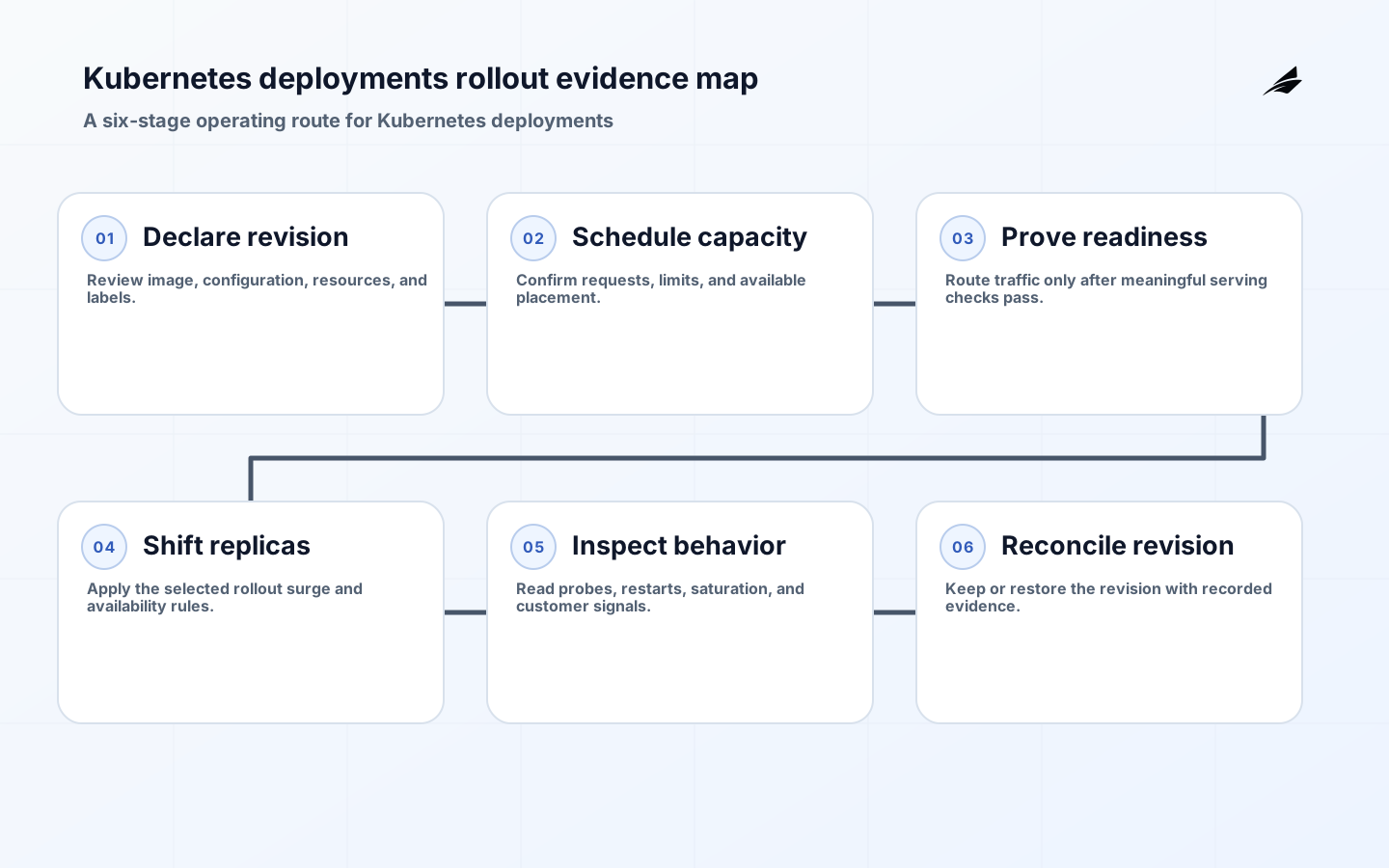
Kubernetes deployments needs an operating model, not a loose collection of tools. Kubernetes deployments declare a desired replica set and coordinate changes between revisions. They are not a guarantee that an application is ready for traffic. A deployment is dependable when the workload definition, service contract, readiness behavior, capacity assumptions, and rollback decision can be inspected together. This guide focuses on the choices that make the work inspectable by the people who build, operate, and support it.
Key takeaways
- Define the boundary and accountable owner before standardizing Kubernetes deployments.
- Keep the records that explain an outcome close to the action that created it.
- Use controls that match the consequence of failure instead of copying generic checklists.
- Test an uncomfortable but realistic failure path while impact is bounded.
- Measure recovery and operating effort alongside speed or throughput.
- Turn repeated exceptions into an owned improvement rather than private knowledge.
What Kubernetes deployments means in practice
The deployment controller creates and scales ReplicaSets; a Service sends traffic to ready endpoints selected by labels. A pod can be running while still unready for a real request, so readiness probes should represent whether it can serve the traffic the Service will route. Liveness and startup probes have different jobs and should not be copied blindly from another workload. For adjacent operating decisions, compare Docker images and observability.
| Decision area | Question to settle | Useful evidence |
|---|---|---|
| Boundary | What part of Kubernetes deployments is in scope? | Named owner, entry point, and expected outcome. |
| Identity | Which version, record, or state is authoritative? | An inspectable identifier tied to the action. |
| Control | What condition must hold before expansion? | A test, review, or policy result with a decision rule. |
| Recovery | How will the team verify a safe outcome? | A documented action, check, and accountable responder. |
An operating model for Kubernetes deployments
Keep the desired state in a reviewed manifest or a controlled release system. Set explicit resource requests and limits, labels that express the service boundary, probes that test useful dependencies, and a rollout strategy with surge and unavailable capacity selected for the service. Record which image digest, configuration revision, namespace, and policy context produced the replica set. The design should make the next decision easier for someone who did not create the original implementation.
A practical implementation path
Pilot with a service whose health can be tested end to end. Add a readiness probe that catches the conditions that should prevent traffic, a startup probe when initialization is slow, and a graceful termination path that stops accepting new work before the process exits. Use a pre-production load test to expose scheduling, autoscaling, and connection-draining assumptions before a busy release window. Prefer a sequence that creates evidence at every stage rather than a broad first release that makes causality difficult to recover.
Risks and controls to make explicit
The dangerous shortcut is a manifest that succeeds syntactically but omits the operating contract. Missing resource requests invite unpredictable scheduling; an over-eager liveness probe can restart a slow but healthy process; mutable tags obscure the revision under investigation. Namespaces and RBAC help isolate access, but they do not replace workload identity, network policy, and a review of privileged settings. Write the exception route down as well: an emergency action may be necessary, but it should leave an attributable record and return to normal control once the immediate condition is resolved.
| Stage | What to check | Decision rule |
|---|---|---|
| Prepare | Scope, identity, access, and prerequisites. | Do not proceed when ownership or required evidence is unclear. |
| Change | The control that addresses the main failure mode. | Pause when a required test, policy, or review fails. |
| Observe | Technical and user-facing consequences. | Expand only when the agreed signals remain inside bounds. |
| Recover | State, data, and follow-up work. | Close only after the relevant verification is recorded. |
Signals that show whether it is working
Read rollout status together with unavailable replicas, probe failures, restart counts, scheduling delays, request saturation, and user-facing error or latency signals. A completed rollout only proves that the controller reached its declared state. It does not prove that the API dependency is reachable, a queue consumer is keeping up, or the customer journey has remained intact. Review the signals with a real example, because a metric becomes useful only when it changes a decision or confirms that an earlier decision was sound.
A Kubernetes deployments checklist for the next change
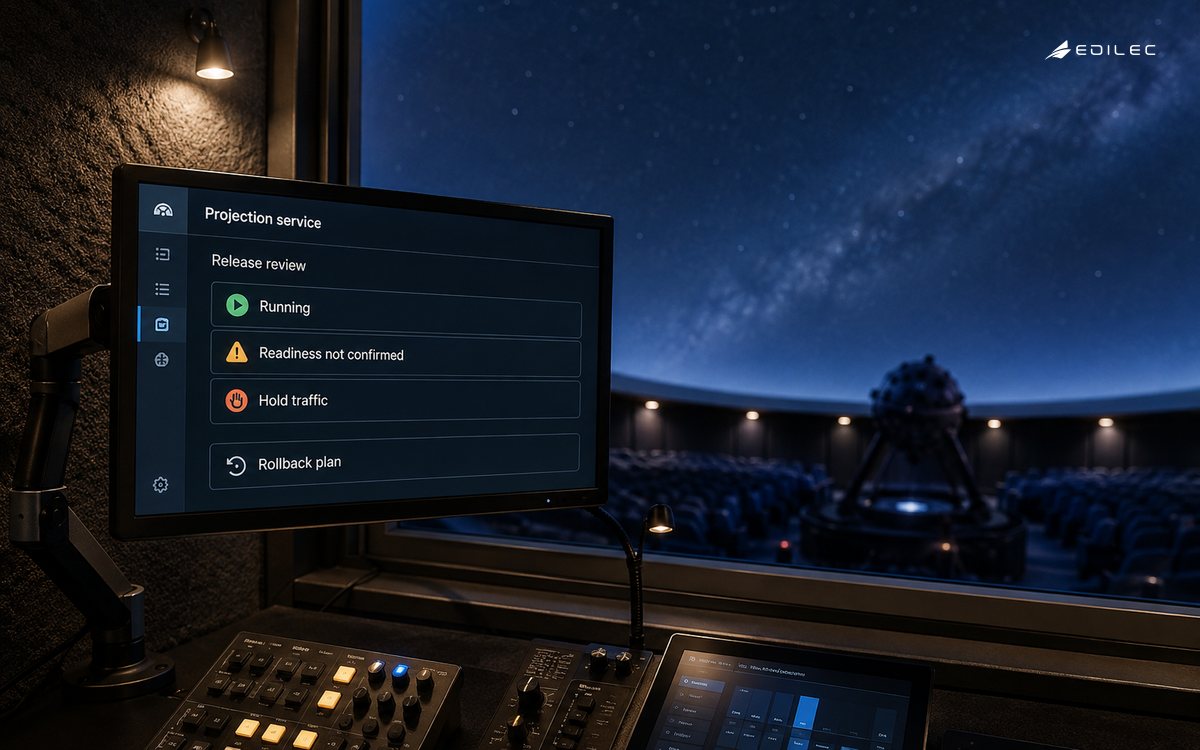
Before widening a deployment pattern, simulate an unavailable dependency and a slow startup. Confirm that traffic stays away from unready pods, that the rollout waits in a diagnosable state, and that operators can identify the prior revision. The point is to make an unsafe expansion obvious while impact is limited. The result should be a short, owned change to the routine, not a retrospective statement that the team should have been more careful.
A worked decision example
An API increases its memory use during cache warmup. A deployment with only a liveness probe repeatedly restarts the pod before warmup finishes. The corrected manifest sets a startup probe with a realistic failure threshold, a readiness probe for the serving path, resource requests based on observed use, and a maxUnavailable value that preserves enough healthy replicas during an update.
How to phase adoption
Introduce Kubernetes deployments with a workload that has a clear request path and enough spare capacity for a controlled rollout. Establish labels, resource requests, probes, and termination behavior before relying on automation. Run the initial rollout during a period when the responsible team can observe it, then preserve the manifest and revision evidence that explains the outcome. After the pattern survives a slow startup, an unavailable dependency, and a rollback, it is suitable for reuse by another service.
Decision records and ownership
A deployment decision record should identify the container digest, manifest or chart revision, namespace, service selector, configuration and secret references, rollout strategy, and operator who changed or approved it. Include the dashboards or queries used for verification. This detail prevents a familiar failure during incidents: a team sees healthy pods but cannot tell which configuration, service endpoints, or network policy is actually receiving customer traffic. The record turns a controller status into an accountable service decision.
Design boundaries that matter
Rollout settings are capacity decisions. MaxSurge and maxUnavailable determine how much extra demand the cluster must absorb and how much service capacity may disappear while an update proceeds. Choose them with the service owner, using measured traffic and startup behavior rather than an inherited percentage. A workload that takes several minutes to warm may need a slower rollout and a startup probe; a stateless edge service with ample headroom may tolerate a larger surge. The right configuration is the one that preserves the customer-facing service objective while still letting the controller make progress and surface a failing revision.
Deeper operating considerations
Do not confuse Kubernetes object health with application correctness. A pod can have a passing HTTP response while serving stale data, rejecting a key authorization flow, or saturating a dependency pool. Pair controller and probe evidence with a small synthetic or real journey that exercises the critical contract. During a rollout, compare that journey across the old and new revisions and define who may halt expansion when it regresses. This extra check matters most for systems with background jobs, asynchronous writes, or dependencies outside the cluster, where the visible replica count says little about the work customers expect to complete.
A useful review cadence
Review deployment behavior through three samples: a routine update, a rollout that paused, and an availability or capacity exception. Confirm that the health probes still represent serving readiness, resource limits match observed demand, and the old revision remains compatible with any external changes. Assign ownership for the smallest correction, such as a probe, termination grace period, or rollout threshold. Repeated review makes the manifest a living operating contract instead of a file remembered only when a release fails.
Frequently asked questions
A Deployment suits stateless replicated workloads; stateful systems often need StatefulSets and storage-specific planning. Rolling updates are not automatically safer than a recreate strategy: the right choice depends on compatibility, capacity, and connection behavior. Roll back a Kubernetes revision only after checking whether configuration, schemas, or external side effects are also compatible with the older application.
Before expanding the practice
Before reusing a deployment template, compare the workload lifecycle rather than its programming language or repository layout. A web API, queue consumer, scheduled worker, and batch task can each need different probes, disruption behavior, autoscaling signals, and shutdown rules even when they share a container base. Provide a small set of reviewed patterns with explicit assumptions instead of one manifest full of optional fields. The template should surface the decisions a service owner must make and enforce the controls that should not vary casually. This produces faster delivery because teams start from a credible contract rather than from a generic object they must reverse-engineer under release pressure.
A final field test
Field test: hold a pod unready during a rollout and verify that traffic, controller status, and the service journey each show the intended state. Correct the probe or rollout rule that creates a conflicting answer. Record the finding with the workload owner before the rollout pattern is reused. Preserve the result with the workload record.
Conclusion
Kubernetes deployments should make a service change inspectable rather than merely automated. Define readiness, capacity, revision identity, and recovery evidence before treating a rollout as routine.