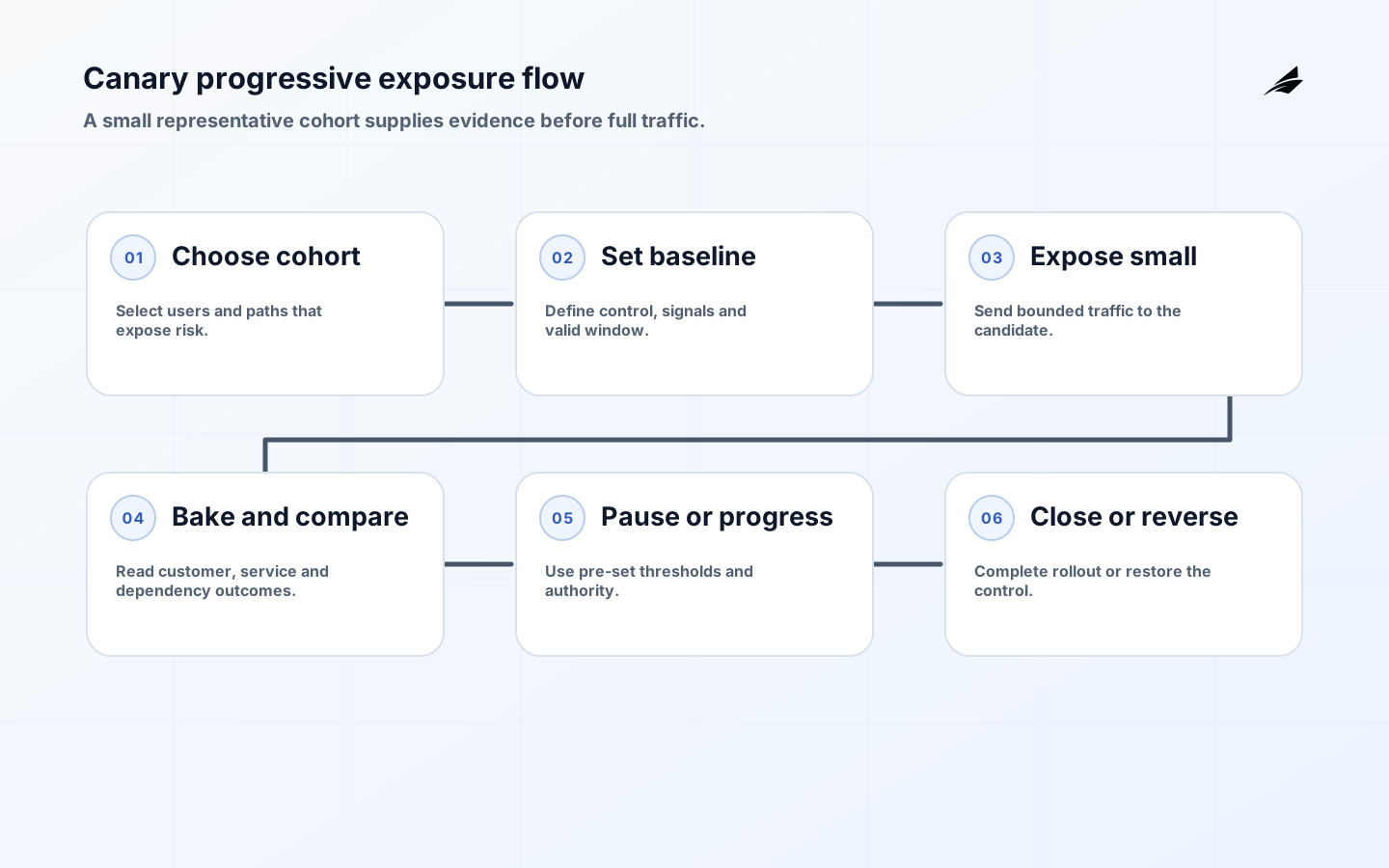
Canary releases expose a new version to a limited share of production traffic, compare it with a control, and promote only when evidence supports the next step. They are useful when teams need to learn from real behavior without assigning every customer to the first release. A small percentage alone is not a canary strategy. The cohort must be meaningful, the control must be observable, and the team must know who pauses or reverses promotion. Google's release engineering guidance explains why controlled release processes improve reliability; canary analysis turns that principle into an explicit decision loop.
Choose a representative cohort
Select traffic that can reveal the risk you are trying to manage. Random request weighting may work for a stateless API with broad traffic, while a customer or tenant cohort is safer for a workflow where one customer needs consistent behavior. Avoid choosing only friendly internal users if their traffic, permissions, data size, or feature mix differ from production. State exclusions clearly, including regulated customers, high-value transactions, or regions with different dependencies. A canary cohort should be small enough to limit impact yet large enough to include the operations that could fail. Revisit this choice when the service's traffic mix changes.

| Cohort method | Best fit | Risk to manage |
|---|---|---|
| Request percentage | High-volume stateless service | Uneven traffic or cache effects |
| Tenant allowlist | Multi-tenant application | Tenant-specific data or contracts |
| Region or cell | Regional architecture | Confusing regional dependency faults |
| Feature flag audience | Behavioral change | Artifact remains broadly deployed |
Define a baseline and decision signals
Measure outcomes that represent the change, then add guardrails that protect the wider service. For a checkout change, success rate and payment errors matter more than average CPU. For a search change, result latency and abandonment may matter alongside error rate. Compare candidate and control over the same period, segment, and dependency condition. Set a minimum observation duration, a promotion threshold, and a rollback threshold before deployment. Azure safe deployment practices recommends health models and progressive exposure; the practical test is whether an on-call engineer can explain why the next step is permitted from the available data.
- Use tail latency, error rate, and business completion where they reflect the release risk.
- Label candidate and control consistently in metrics, logs, traces, and deployments.
- Account for scheduled events, low traffic periods, and delayed asynchronous outcomes.
- Specify how missing telemetry affects promotion; unknown evidence should not mean automatic advance.
Progress through named gates
Write rollout steps as gates rather than a timer: 1 percent after smoke checks, 5 percent after stable critical transactions, then a larger cohort once the agreed window closes without breach. The numbers should reflect traffic volume and recovery cost, not a fashionable template. Automation can pause or promote based on configured analysis, but humans should retain authority for ambiguous outcomes, customer communication, and high-consequence changes. Argo Rollouts canary documentation shows how weighted traffic and analysis can be expressed in a controller. Use tooling to enforce a decision you can explain, not to hide the decision behind a green pipeline.
| Gate | Evidence | Action |
|---|---|---|
| Initial exposure | Smoke tests and route correctness | Hold or begin small cohort |
| Early comparison | Candidate/control outcome signals | Promote, pause, or reverse |
| Expanded cohort | Stability across a representative window | Increase exposure |
| Full release | No unresolved safety signal | Complete and retain observation |
Pause and roll back without losing evidence
A pause is a useful result when the data is inconclusive. Freeze exposure, capture the candidate version and cohort, investigate the difference, and decide whether more observation, a configuration change, or rollback is appropriate. If the threshold is breached, shift traffic to the control or disable the behavior, then verify the affected outcome recovers. Amazon ECS deployment strategies illustrates a canary as a defined small traffic phase followed by a larger shift; your service may require several stages instead. Keep failed candidate evidence until analysis is complete, especially traces and logs that show divergence.
Turn release learning into better defaults
After full exposure, retain a short stabilization window and review the rollout record. Was the cohort representative? Did the signal arrive in time? Did a manual override reveal an automation gap? Store these answers with the release template. Repeated pauses around one dependency may justify contract tests or a separate availability control; repeated false alarms may mean a threshold lacks context. Canary releases are most valuable when they improve the system's ability to make the next change safely, rather than becoming a ritualized sequence of percentages.
Turn canary evidence into action
- Define the operating boundary for canary releases in terms of eligible cohort, control group, release version, promotion gate, and asynchronous-work treatment; this turns a broad technical theme into work that an accountable team can review and improve.
- Name the user outcome and safety signals before changing anything. For this practice, compare customer success, candidate error rate, latency, saturation, and control comparison with an explicit baseline rather than relying on a tool status alone.
- Record assumptions that affect the decision, including demand, dependencies, time windows, and ownership. An assumption that stays implicit cannot be tested when conditions change.
- Choose a reversible first action and document the recovery path. This limits the cost of learning and gives the responder a known control when the observed result differs from expectation.
- Keep the evidence close to the service: versioned configuration, a short decision record, relevant dashboards, and the runbook used by the person who receives the alert.
- Review the change at a cadence that matches its risk. Look for a nonrepresentative cohort, a noisy gate, or incompatible work across versions; treat recurring exceptions as design feedback rather than as a reason to normalize manual work.
- Separate what the service team owns from what a shared platform or partner owns. The boundary should state who acts, who supplies evidence, and who approves an exception.
- Test the uncomfortable path deliberately. A quiet success case is not enough; exercise degraded dependencies, delayed work, recovery, and the handoff between ordinary operation and incident response.
- Use a small representative pilot before broad rollout. Capture what users actually did, which controls confused them, and whether the intended guardrail was visible at the moment of decision.
- Make exceptions visible, time-bound, and reviewable. An exception is useful when it reveals a real constraint; it becomes debt when it quietly replaces the supported path.
- Avoid measuring activity as proof of value. Count completed, safe outcomes and the effort required to achieve them, then use both quantitative evidence and operator feedback to choose the next improvement.
- Preserve context after an incident or failed change: identifiers, configuration state, timing, observed behavior, and the recovery action. This is more useful than a generic summary when the pattern returns.
- Review interfaces and contracts at the same time as the primary control. Many failures appear at boundaries: a client behavior, a delayed message, an identity assumption, or a shared dependency.
- Give the normal path a clear owner and a usable escalation route. Teams adopt controls that help them act quickly under pressure and abandon ones that require private knowledge to recover.
- Retire outdated rules when architecture, product demand, or customer commitments change. Keeping old controls without their original context can create risk as surely as leaving a system unconfigured.
- Turn the result into the next default for canary releases: keep what protected the outcome, simplify what caused friction, and schedule the next review while the evidence is still fresh.
Key takeaways
- A canary cohort must be representative enough to reveal the intended risk.
- Compare customer outcomes and guardrails with a labeled control.
- Use named evidence gates instead of automatic time-based promotion.
- Treat pause as a valid outcome and preserve evidence for diagnosis.
- Feed rollout results back into service and release design.
Frequently asked questions
Question: How large should a canary cohort be? Answer: It should be representative enough to expose important behavior while remaining bounded enough that a failed release limits user impact and leaves room for diagnosis.
Question: What should pause a canary? Answer: Predefined user-impact signals, rapid error-budget burn, dependency failures, security findings, or data inconsistency should pause progression until an owner reviews the evidence.
What percentage should a canary start at? The smallest cohort that provides useful evidence within the observation window. Can we canary a database migration? Only with a compatible migration plan; traffic weighting cannot undo shared-state changes. Do we need a service mesh? No, but you need a reliable mechanism to segment exposure and compare telemetry. When should we avoid a canary? Avoid it where customers cannot safely receive divergent behavior or traffic is too low to support timely evidence.
Conclusion
Canary releases trade a little release complexity for much better evidence about production risk. Use a representative cohort, an observable control, and clear authority to promote or reverse. The result is progressive delivery that serves customers rather than merely protecting a deployment pipeline.
Make the canary decision evidence-based
A canary is a partial, time-limited deployment and evaluation, not merely a small percentage in a dashboard. Google SRE Canarying Releases recommends comparing the change-bearing cohort with a control and using real production inputs to expose faults that tests may miss. Azure safe deployment practices adds the need for progressive exposure and enough bake time for different users and regions.
Choose a cohort that exercises the risky path and is observable separately. Define progression and pause thresholds before traffic moves, include customer outcomes and dependency signals, and make the rollback action safe for in-flight work. A canary that is too short, too homogeneous or measured only by infrastructure health can create false confidence. For adjacent release strategies, compare blue-green deployment, deployment rollbacks, and the rollback checklist.
Further Edilec context: Blue-green checklist, Deployment rollback guide, Deployment rollback checklist. The operating decision applies those references specifically to canary releases: evidence before full exposure.
Source trail: Google SRE Canarying Releases defines partial, time-limited deployment and evaluation; AWS CodeDeploy configurations shows canary and linear choices; Azure safe deployment practices emphasizes bake time; and Kubernetes rolling updates documents monitoring and pause controls. Evidence must decide progression.