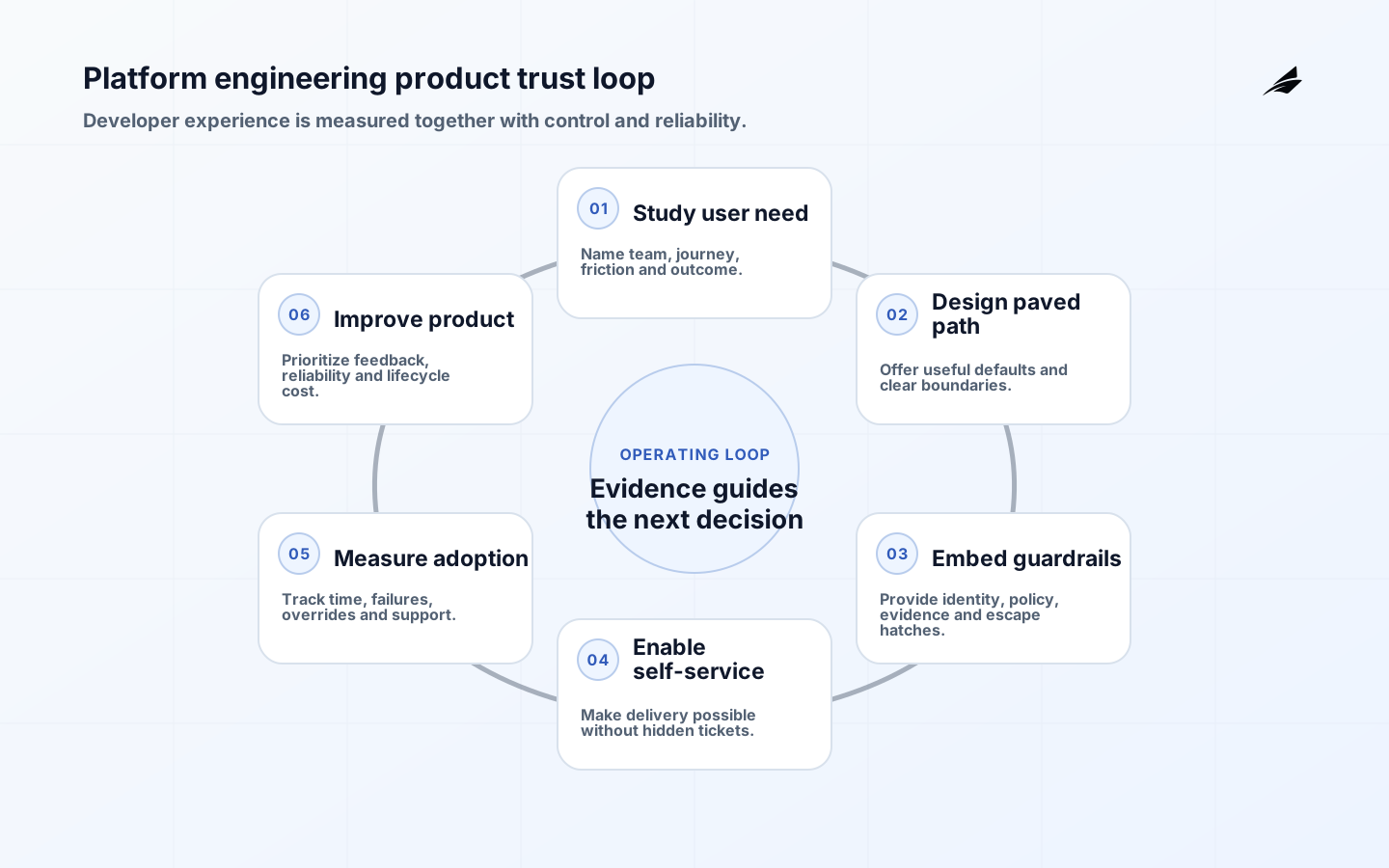
Platform engineering is the work of providing internal capabilities that let application teams deliver safely with less repeated operational effort. It is not a renamed infrastructure team and it is not a portal full of links. A useful internal developer platform has customers, supported journeys, an ownership model, and evidence that it improves a real delivery outcome. The CNCF Platforms whitepaper describes platforms as curated capabilities rather than a single product. That distinction matters: a team may begin with a deployment path, service catalog, or identity integration rather than attempting to centralize every tool at once.
Start with a platform product boundary
Find a high-frequency developer task with recurring risk or delay. Examples include creating a service with secure defaults, obtaining a production environment, shipping a compatible release, or finding ownership during an incident. Interview the teams performing that task and map the current handoffs, not just the intended architecture. Then state the platform promise in observable terms: a new service receives a repository, runtime identity, telemetry, and deployment pathway within a defined lead time; or an existing service can adopt a standard logging path without losing operational context. The boundary should be narrow enough that the platform team can support it end to end.
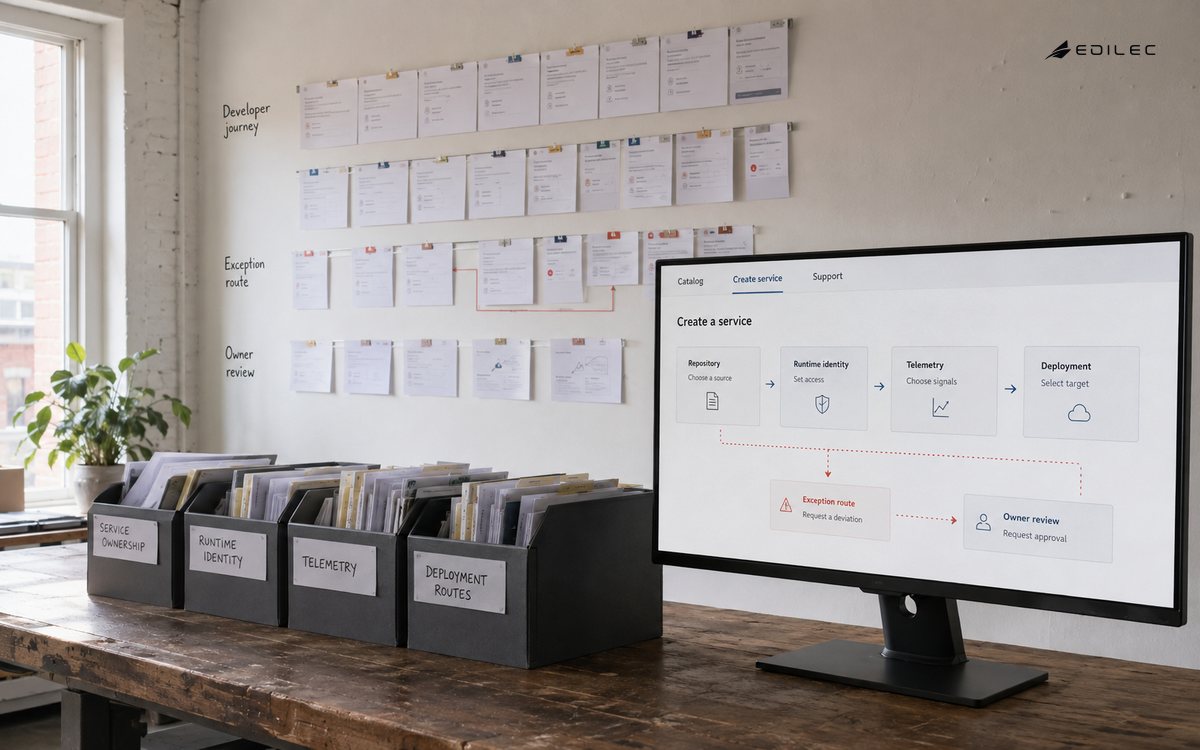
| Platform capability | Customer outcome | Avoid |
|---|---|---|
| Service template | Safe, consistent start | A template nobody can update |
| Deployment path | Repeatable promotion and recovery | One pipeline for incompatible workloads |
| Service catalog | Clear ownership and discoverability | An inventory without maintenance |
| Observability integration | Useful default telemetry | Mandatory dashboards with no service context |
Build golden paths, not a maze of mandates
A golden path is a supported way to complete a common task with sensible defaults and a documented escape route. It reduces cognitive load without pretending every service is identical. Put security, logging, policy checks, and deployment evidence inside the path where possible, then make the generated configuration visible and versioned. Backstage's overview is useful for understanding a developer portal's role, but a portal alone does not create a platform. The platform earns adoption when a team can complete meaningful work faster and can understand what the abstraction is doing on its behalf.
- Treat templates and APIs as supported product interfaces with versioning and deprecation plans.
- Expose the underlying resource and configuration choices to users who need to debug them.
- Provide an exception route with clear cost, review, and ownership rather than forcing workarounds.
- Measure time to first successful use, not just portal visits or template count.
Design the platform operating model
Platform engineering needs explicit boundaries between enabling, owning, and governing. Application teams remain accountable for their services and customer outcomes. The platform team owns the reliability and usability of the offered capability. Security, networking, and data teams contribute policies and specialist controls through stable interfaces rather than ticket-only relationships. The CNCF Platforms whitepaper describes platforms as an internal product; put that into practice with published service levels, support hours, change windows, and a backlog shaped by user evidence.
| Role | Owns | Needs from others |
|---|---|---|
| Application team | Service behavior and adoption | Reliable supported interfaces |
| Platform team | Platform roadmap and operations | Usage feedback and compatible needs |
| Security or governance | Policies and risk decisions | Implementable integration points |
| Leadership | Investment and priority trade-offs | Outcome and adoption evidence |
Measure adoption and operational value
Measure both experience and system health. Experience signals include time to create or change a service, success rate through the golden path, support effort, and documented exceptions. Operational signals include platform availability, provisioning failure, upgrade completion, policy drift, and recovery time. Avoid counting adoption by coercion: a migration that moves every repository to a platform but leaves teams slower and less able to diagnose incidents is not product success. The Backstage software catalog documentation illustrates how discoverable ownership information can support reusable foundations, while local measurements should connect to the delivery work your teams actually perform.
Sequence investment before building a broad portal
Start with one or two journeys where the platform can remove repeated toil and encode a valuable default. Instrument the path, run a pilot with willing teams, correct usability and reliability gaps, then widen adoption. Resist the urge to make every tooling decision centrally before the first workflow has evidence. A small platform product can later compose into a larger ecosystem; an oversized foundation built without real users tends to become another integration project. Preserve room for diverse runtimes and service needs, but require that exceptions remain observable and do not quietly bypass the controls that the standard path supplies.
Run the platform product review
- Define the operating boundary for platform engineering in terms of user journey, golden-path default, support boundary, exception route, and adoption evidence; this turns a broad technical theme into work that an accountable team can review and improve.
- Name the user outcome and safety signals before changing anything. For this practice, compare successful completion, delivery lead time, support demand, repeat use, and shared-service health with an explicit baseline rather than relying on a tool status alone.
- Record assumptions that affect the decision, including demand, dependencies, time windows, and ownership with an internal platform product. An assumption that stays implicit cannot be tested when conditions change.
- Choose a reversible first action and document the recovery path. This limits the cost of learning and gives the responder a known control when the observed result differs from expectation with an internal platform product.
- Keep the evidence close to the service: versioned configuration, a short decision record, relevant dashboards, and the runbook used by the person who receives the alert with an internal platform product.
- Review the change at a cadence that matches its risk. Look for a mandated tool without user value, unclear support ownership, or hidden exceptions; treat recurring exceptions as design feedback rather than as a reason to normalize manual work.
- Separate what the service team owns from what a shared platform or partner owns with an internal platform product. The boundary should state who acts, who supplies evidence, and who approves an exception with an internal platform product.
- Test the uncomfortable path deliberately. A quiet success case is not enough; exercise degraded dependencies, delayed work, recovery, and the handoff between ordinary operation and incident response with an internal platform product.
- Use a small representative pilot before broad rollout. Capture what users actually did, which controls confused them, and whether the intended guardrail was visible at the moment of decision with an internal platform product.
- Make exceptions visible, time-bound, and reviewable. An exception is useful when it reveals a real constraint; it becomes debt when it quietly replaces the supported path with an internal platform product.
- Avoid measuring activity as proof of value. Count completed, safe outcomes and the effort required to achieve them, then use both quantitative evidence and operator feedback to choose the next improvement with an internal platform product.
- Preserve context after an incident or failed change: identifiers, configuration state, timing, observed behavior, and the recovery action with an internal platform product. This is more useful than a generic summary when the pattern returns with an internal platform product.
- Review interfaces and contracts at the same time as the primary control with an internal platform product. Many failures appear at boundaries: a client behavior, a delayed message, an identity assumption, or a shared dependency with an internal platform product.
- Give the normal path a clear owner and a usable escalation route with an internal platform product. Teams adopt controls that help them act quickly under pressure and abandon ones that require private knowledge to recover with an internal platform product.
- Retire outdated rules when architecture, product demand, or customer commitments change. Keeping old controls without their original context can create risk as surely as leaving a system unconfigured with an internal platform product.
- Turn the result into the next default for platform engineering: keep what protected the outcome, simplify what caused friction, and schedule the next review while the evidence is still fresh.
Key takeaways
- Platform engineering is product work for internal developers, not a tool inventory.
- Start with a frequent delivery journey and a clear customer outcome.
- Golden paths need usable defaults, transparency, and a governed escape route.
- Keep ownership of applications with application teams and ownership of platform capabilities with the platform team.
- Measure adoption through successful work and operational outcomes, not forced migration counts.
Frequently asked questions
Question: What is a platform product? Answer: It is an internal service with named users, supported journeys, ownership, documentation, reliability expectations, and a feedback loop—not just a portal or collection of tools.
Question: How should platform adoption be measured? Answer: Measure safer delivery, lead time, recovery, toil reduction, and user satisfaction rather than portal clicks or the number of teams onboarded.
Is a platform the same as Kubernetes? No. Kubernetes may be an implementation component; a platform is the supported set of capabilities and user journeys. Do we need a portal? Not at first. Begin with a valuable interface or workflow, then add discovery when it solves a real problem. Will standards slow teams down? Poorly designed standards can; supported defaults and transparent exceptions usually reduce repeated work. Who funds it? Leadership should fund it against demonstrated delivery and reliability outcomes, with user teams shaping priority.
Conclusion
Platform engineering succeeds when developers can complete important work with fewer risky handoffs and more predictable operations. Build one supported journey, learn from its users, and grow the platform through evidence. That is much more durable than declaring a platform and waiting for adoption.
Review the platform as a product
An internal platform should reduce cognitive load for a specific group of developers while preserving the controls that operations, security and finance require. The CNCF Platforms White Paper frames a platform as a product with capabilities and user experience, not merely a collection of infrastructure services. The CNCF maturity model adds people, process, technology and product dimensions that help expose an unstaffed promise.
Start with one paved path and measure time to first useful deployment, failed handoffs, support requests, override rate, adoption, recovery time and cost per consumer. Make defaults safe but escape hatches explicit. A portal or catalog is useful only when its ownership, freshness and action links are maintained. Test a path under dependency failure and an upgrade, then review whether the platform helped a team recover or merely moved the complexity. Related context is in platform engineering, GitOps decisions, and CI/CD pipelines.
Further Edilec context: Platform engineering guide, GitOps guide, CI/CD pipelines guide. The operating decision applies those references specifically to platform engineering: build a product developers can trust.