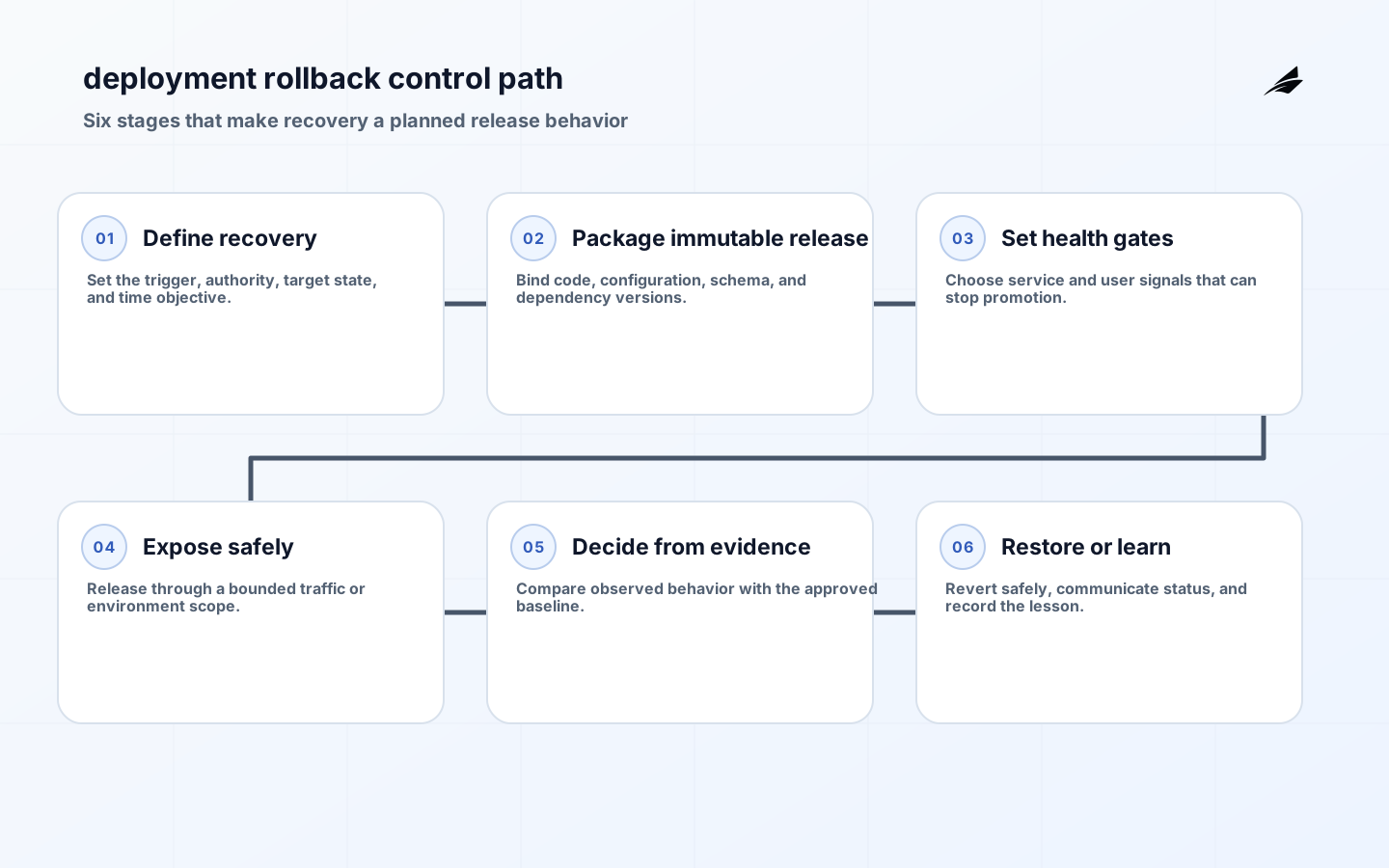
Deployment rollbacks are a recovery capability, not evidence that a team expects to fail. They answer a practical question: when a release harms a user journey or destabilizes a dependency, can the team return to a known state quickly, safely, and with enough context to explain what happened? A rollback button alone does not provide that answer. The previous application image may exist while the database schema has changed, a feature flag may have advanced independently, an external contract may have been altered, or the original configuration may no longer be available. Before the first build, define the recovery unit and the acceptable target state. A recovery unit may be an immutable release bundle, a traffic route, a feature behavior, or a compensating operation; it is rarely just a source-code revision.
Define the rollback contract
Write the contract in terms that an on-call engineer and a product owner can use under pressure. It should state the triggering signals, the authority to act, the first safe action, the required communications, the maximum acceptable recovery time, and the conditions that make an automated reversal inappropriate. For example, an elevated error rate on checkout may justify stopping promotion automatically, while a data correction workflow may require an operator because reversal could duplicate financial effects. Identify the dependencies included in the contract: artifact digest, runtime configuration, schema version, migration state, queue consumers, feature flags, and routing policy. The deployment rollback architecture guide offers a useful companion view of the technical pieces, but the contract is the operating decision that keeps them aligned.
Version the full release boundary
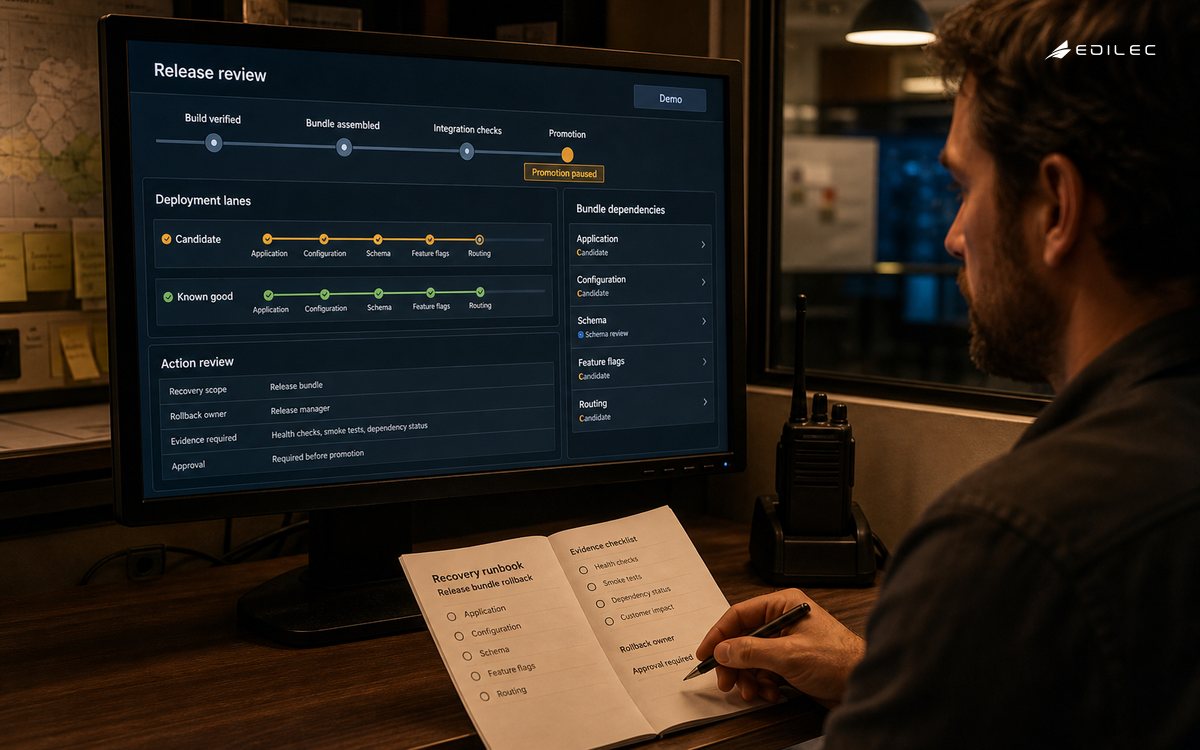
An application version is recoverable only when the compatible state around it is known. Record the container or package digest, the configuration reference, the migration identifier, the dependency policy, and the deployment manifest used for the release. Do not copy secrets into that record; retain references and access paths instead. Data changes deserve special treatment. Prefer additive, backward-compatible schema changes that let old and new application versions coexist during a transition. When an irreversible migration is unavoidable, the release plan should name a forward-fix or restore procedure rather than promise an impossible rollback. This distinction keeps a team from discovering during an incident that its nominal recovery command restores code but not behavior.
| Release element | Question before promotion | Recovery evidence |
|---|---|---|
| Artifact | Can the exact prior artifact be redeployed? | Immutable digest and provenance. |
| Configuration | Is the prior configuration available and compatible? | Versioned reference and change record. |
| Data | Can old and new code coexist with the schema? | Migration plan and restore decision. |
| Traffic | Can exposure be stopped or redirected quickly? | Routing policy and owner. |
| Dependencies | What happens if a partner API changed? | Contract test and fallback behavior. |
Use health evidence that reflects the decision
A deployment should not be declared healthy because pods are running. Readiness checks matter, but they do not prove that users can complete the affected journey. Choose a small set of indicators with an explicit baseline: successful requests, latency at a chosen percentile, queue lag, payment authorization outcomes, or another service-level signal. Combine them with deployment telemetry so an investigator can compare candidate and stable behavior over the same window. Avoid a single global error threshold for every service. Low-volume or asynchronous paths need different evaluation periods and may need a human review gate. The objective is a signal that is fast enough to prevent material harm and specific enough to avoid needless reversals.
| Signal type | Useful when | Failure mode to avoid |
|---|---|---|
| Readiness or startup | A process cannot serve safely until dependencies are ready. | Treating process health as customer success. |
| Service indicator | A known request path has enough traffic to compare. | Using an average that hides a broken cohort. |
| Business event | A release changes a measurable user action. | Waiting too long for a sparse outcome. |
| Operator review | The consequence is high or data effects are complex. | Leaving authority unclear during a pause. |
Choose the right recovery action
Rollback is one of several responses. Stopping a rollout prevents wider exposure; shifting traffic restores a stable version; disabling a flag narrows a behavior; reverting a configuration may be sufficient; and a forward fix can be safer after a data or compatibility change. The runbook should present these as distinct choices, each with preconditions and expected side effects. For instance, rolling traffic back may retain writes made by the newer version, so the stable version must tolerate them. A team that rehearses only a command path has not tested recovery. Rehearse the judgment path: who receives the alert, how evidence is checked, who approves a high-impact action, and how status reaches support and stakeholders.
Implement and rehearse recovery
Begin with one service whose release boundary is manageable. Make artifacts immutable, store deployment metadata with the release, and add a manual pause before broad exposure. Next, choose one user-facing indicator and one technical guardrail, then test a deliberately bad candidate in a non-production environment that resembles production closely enough to exercise routing and permissions. Run a game-day where a person other than the original author follows the runbook. Capture the elapsed time to recognize, decide, and restore, not just the command duration. After each rehearsal, simplify the handoffs and remove assumptions that required insider knowledge. Recovery quality improves through practice, not by lengthening the runbook.
Key takeaways
- Define deployment rollbacks as a contract for a full release boundary.
- Version code, configuration, routing, and migration context together.
- Use health evidence that represents the changed user journey.
- Distinguish stop, traffic shift, flag disablement, rollback, and forward fix.
- Rehearse the human decision path as well as the technical command.
Frequently asked questions
Should every deployment be instantly reversible? No. Some data migrations and external side effects require a forward-fix or compensating action; plan that explicitly. How long should an old version remain available? Keep it for the period needed to evaluate the release and complete the recovery decision, subject to capacity and security constraints. Can feature flags replace rollbacks? They can reduce exposure for a specific behavior, but they do not restore an incompatible artifact, configuration, or schema. Who owns the final decision? Name an on-call operational authority and escalation path before release, with product input for user-impact trade-offs.
Decision criteria for deployment rollback
A team should make deployment rollback decisions from a written comparison, not an intuition that a tool or pattern is generally safer. For a checkout release that begins creating duplicate authorization retries, state the baseline, the change being considered, the expected benefit, and the condition that would make the action unsafe. The decision record should name the release bundle and its compatible state; it should also identify the smallest reversible step. That creates a practical distinction between a hypothesis and an approved change. A useful reviewer can then ask whether a traffic reversal, feature disablement, or forward fix is possible without creating an unowned side effect, whether a user-facing success rate, dependency behavior, and error-budget burn will be available in time, and whether the affected people understand the service consequence. The record does not need ceremony. A short change note with links to the release, owner, measurement, and recovery path is enough to make later investigation much faster.
Use an explicit example before automating the rule. Consider a checkout release that begins creating duplicate authorization retries. Walk through the normal case, the delayed case, and the failure case with the people who operate it. Identify which input is authoritative, what a missing or stale input looks like, and what an operator can safely do while evidence is incomplete. For deployment rollback, this exercise often exposes a hidden assumption about timing, identity, or compatibility that a happy-path demonstration never reaches. It also clarifies what must be visible to support: current state, change owner, linked evidence, and the next action. Build those details into the workflow or runbook before increasing automation. A reliable default is useful only when its exceptions are observable and recoverable.
Failure analysis and recovery for deployment rollback
Plan for rolling back code while leaving an incompatible schema, queue consumer, or flag state behind. Detection should route to the on-call service owner with a stated escalation authority, but the alert or review item must contain enough context to start an investigation without manual archaeology. Include the relevant version or policy identifier, affected scope, timestamp, correlation reference, and the last known healthy comparison where available. The first response should reduce further harm while preserving evidence; the second should validate whether the apparent fault is data quality, a dependency condition, an operator change, or the design itself. Recovery does not always mean returning to the previous state. Sometimes it means a forward correction, an access restriction, a narrower cohort, or a temporary manual procedure. Document which action is safe for the case and who may authorize it.
- Define a precondition for a traffic reversal, feature disablement, or forward fix and test it with a representative non-production or limited-production case.
- Keep the identifiers needed to connect the release bundle and its compatible state to the change, investigation, and owner.
- Make a user-facing success rate, dependency behavior, and error-budget burn visible at the point where a release or operator decision is made.
- Treat an exception as data: capture why it was needed, who approved it, and when it expires.
- Review recurring failures with the on-call service owner with a stated escalation authority and convert the strongest lesson into a control, contract, or runbook improvement.
Operating review for deployment rollback
Set a review cadence that matches the risk and rate of change. The review should ask whether the current approach still produces the promised outcome, whether a user-facing success rate, dependency behavior, and error-budget burn is trustworthy, and whether the exception path is being used as a substitute for a missing capability. Examine a small number of real cases instead of only aggregate charts: one successful change, one delayed or rejected change, and one recovery. This evidence makes trade-offs concrete. If the pattern repeatedly depends on expert intervention, reduce the scope or improve the supported path before expanding it. If the outcome is stable, publish the decision criteria so adjacent teams can reuse the model without copying assumptions that do not apply to them.
Conclusion
A recoverable release is designed before traffic moves. When the recovery unit, evidence, authority, and rehearsal are clear, deployment rollbacks become a controlled way to protect users rather than a frantic search for a previous version.