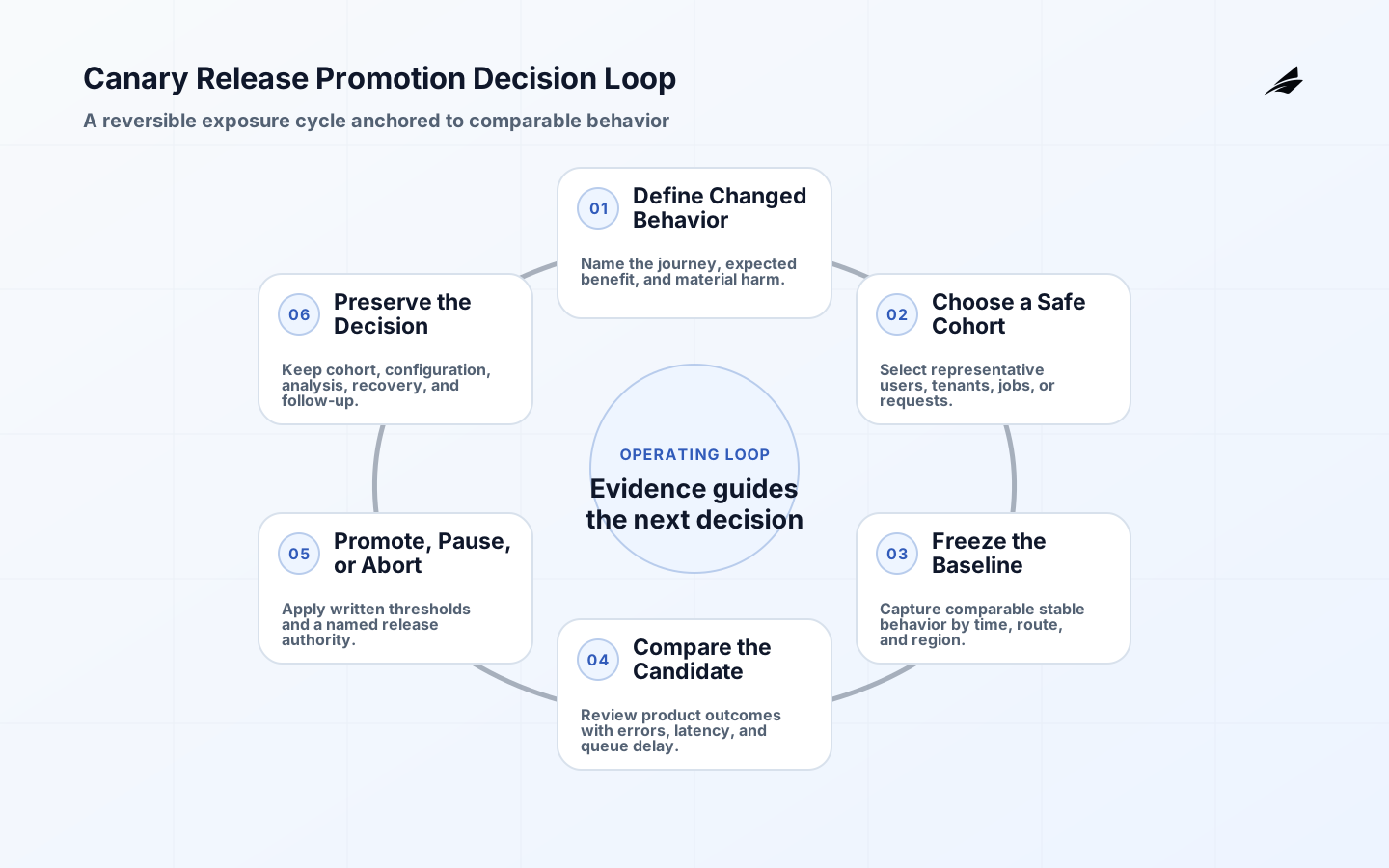
Canary releases are a way to learn from production under controlled exposure. A candidate version reaches a deliberately bounded share of traffic or users, its behavior is compared with a baseline, and a pre-agreed rule decides whether to promote, pause, or abort. The percentage is the least interesting part. A five percent canary is not safer if it receives only bot traffic, misses the changed feature, or has too little volume to distinguish chance from a regression. Before the first build, define the cohort, the unit of exposure, the indicators that will be compared, and who has authority to advance the release. The result should be a release experiment with an accountable decision, not a decorative progress bar in a deployment system.
Design the release before selecting a percentage
Start with the changed behavior. If a release affects a checkout flow, the cohort should include representative checkout traffic and the analysis should include successful completion, latency, and errors around that path. If it affects an internal batch worker, traffic percentage may be irrelevant; use a bounded message set, tenant, or scheduled run instead. Decide whether users remain pinned to a version during a session, whether staff or opted-in users are suitable early cohorts, and how sensitive populations are excluded. Explicitly rule out cohorts that should not be used for experimentation, such as contractual customers, regulated workflows, or high-impact regions, unless an agreed control makes that appropriate. The canary releases security review is a helpful adjacent read when routing and identity policies shape who sees a release.

Establish a comparable baseline
A candidate signal has meaning only beside comparable behavior. Capture a baseline for the stable version over a similar traffic, time, and region window. Then define the comparison method: absolute threshold, relative difference, statistical test, or an operator review of a small set of signals. Keep it simple enough to explain during an incident. Include service indicators such as error rate or latency, but do not ignore the product outcome the release changes. A recommendation endpoint may have healthy HTTP responses while returning obviously degraded results; a billing change may be technically available while creating duplicate invoices. Instrument the release version, cohort identifier, and relevant business event so investigators can join the effect to the deployment without relying on guesswork.
| Design choice | Question to answer | Example |
|---|---|---|
| Exposure unit | What is being limited? | Users, tenants, requests, region, or jobs. |
| Cohort | Is it representative and ethically suitable? | Employee users before a low-risk external segment. |
| Baseline | What stable behavior is comparable? | Prior version on the same route and time window. |
| Indicators | What would show material harm? | Errors, latency, completion, or queue delay. |
| Authority | Who can promote or abort? | Named on-call owner with escalation path. |
Write promotion and abort rules
A canary should not expand because a timer elapsed alone. Write a sequence of increments and the evidence required at each one. For a high-volume service, a small first step may gather enough data quickly; for a low-volume workflow, hold longer or use a different validation method. Define hard stops for clear regressions and review conditions for ambiguous results. An abort should redirect future exposure and preserve the diagnostic evidence: release configuration, artifact, metrics, logs, traces, and any user reports. Be careful with retries and sticky sessions, which can make the actual cohort larger or different from the intended cohort. Promotion rules should consider saturation and dependency limits too; a candidate may look healthy at two percent but create a nonlinear failure at twenty percent.
| Rule | Purpose | Example response |
|---|---|---|
| Hard stop | Protect users from a known serious regression. | Abort on sustained increase in failed payments. |
| Review gate | Handle ambiguous or low-volume evidence. | Pause for an on-call comparison of traces and outcomes. |
| Expansion gate | Confirm the current share is stable before growth. | Move from 5% to 20% after the agreed window. |
| Completion gate | Confirm the full release is ready. | Promote after post-release indicators remain in bounds. |
| Recovery rule | State what happens after abort. | Restore stable routing and open a release investigation. |
Account for traffic and state behavior
Traffic management is not always a percentage slider. Load balancers may hash on a cookie, service mesh policies may route by headers, and asynchronous systems may need a different mechanism entirely. Make sure the selected rule does not accidentally create an unrepresentative cohort or leak the candidate to a user who should remain stable. Versioned APIs, caches, and database writes need compatibility assumptions documented. If the canary writes data the stable version cannot read, aborting traffic does not restore the service. The release needs either a compatible state design or a forward-recovery plan. This is why progressive delivery belongs with deployment rollback planning, not as an isolated routing feature.
Implement one measurable canary
Pick a change with a clear behavioral signal and a reversible traffic path. Add release-version and cohort attributes to the existing telemetry, then verify that stable and candidate data can be compared before changing production routing. Run a dry rehearsal using an internal or non-critical cohort and make the team practice pause, promote, and abort. Add automated analysis only for signals that have shown themselves to be reliable in manual review. Keep the first policy short: initial share, observation window, indicators, stop condition, owner, and communication channel. Once the pattern is trusted, platform automation can make the default path easier without hiding the service-specific choices.
Key takeaways
- Canary releases are controlled learning, not merely percentage-based routing.
- Choose a cohort that sees the changed behavior and is safe to expose.
- Compare candidate behavior with an explicit, comparable stable baseline.
- Pre-agree promotion, review, abort, and recovery decisions.
- Design traffic and state compatibility so an abort actually limits harm.
Frequently asked questions
What percentage should a canary start at? There is no universal number; use the smallest cohort that is representative and can produce useful evidence in the planned window. Can a canary replace testing? No. It complements pre-production checks by observing conditions that cannot be fully reproduced. What if traffic is too low for a comparison? Extend the observation period, use a bounded internal cohort, or rely on stronger pre-release validation rather than pretending the data is decisive. Should all users be eligible? No. Exclusions should be intentional for high-risk, contractual, or sensitive workflows.
Decision criteria for canary releases
A team should make canary releases decisions from a written comparison, not an intuition that a tool or pattern is generally safer. For a search ranking change that affects a bounded set of authenticated users, state the baseline, the change being considered, the expected benefit, and the condition that would make the action unsafe. The decision record should name the exposure cohort, baseline, and promotion rule; it should also identify the smallest reversible step. That creates a practical distinction between a hypothesis and an approved change. A useful reviewer can then ask whether an incremental expansion, pause, or abort is possible without creating an unowned side effect, whether candidate-versus-stable outcomes for the changed journey will be available in time, and whether the affected people understand the service consequence. The record does not need ceremony. A short change note with links to the release, owner, measurement, and recovery path is enough to make later investigation much faster.
Use an explicit example before automating the rule. Consider a search ranking change that affects a bounded set of authenticated users. Walk through the normal case, the delayed case, and the failure case with the people who operate it. Identify which input is authoritative, what a missing or stale input looks like, and what an operator can safely do while evidence is incomplete. For canary releases, this exercise often exposes a hidden assumption about timing, identity, or compatibility that a happy-path demonstration never reaches. It also clarifies what must be visible to support: current state, change owner, linked evidence, and the next action. Build those details into the workflow or runbook before increasing automation. A reliable default is useful only when its exceptions are observable and recoverable.
Failure analysis and recovery for canary releases
Plan for using a convenient but unrepresentative traffic percentage as proof that the release is safe. Detection should route to the release owner with product and operational reviewers, but the alert or review item must contain enough context to start an investigation without manual archaeology. Include the relevant version or policy identifier, affected scope, timestamp, correlation reference, and the last known healthy comparison where available. The first response should reduce further harm while preserving evidence; the second should validate whether the apparent fault is data quality, a dependency condition, an operator change, or the design itself. Recovery does not always mean returning to the previous state. Sometimes it means a forward correction, an access restriction, a narrower cohort, or a temporary manual procedure. Document which action is safe for the case and who may authorize it.
- Define a precondition for an incremental expansion, pause, or abort and test it with a representative non-production or limited-production case.
- Keep the identifiers needed to connect the exposure cohort, baseline, and promotion rule to the change, investigation, and owner.
- Make candidate-versus-stable outcomes for the changed journey visible at the point where a release or operator decision is made.
- Treat an exception as data: capture why it was needed, who approved it, and when it expires.
- Review recurring failures with the release owner with product and operational reviewers and convert the strongest lesson into a control, contract, or runbook improvement.
Operating review for canary releases
Set a review cadence that matches the risk and rate of change. The review should ask whether the current approach still produces the promised outcome, whether candidate-versus-stable outcomes for the changed journey is trustworthy, and whether the exception path is being used as a substitute for a missing capability. Examine a small number of real cases instead of only aggregate charts: one successful change, one delayed or rejected change, and one recovery. This evidence makes trade-offs concrete. If the pattern repeatedly depends on expert intervention, reduce the scope or improve the supported path before expanding it. If the outcome is stable, publish the decision criteria so adjacent teams can reuse the model without copying assumptions that do not apply to them.
Conclusion
A canary release earns its safety through a representative cohort, a comparable baseline, and a clear decision rule. Build those parts first, then let traffic exposure become a measured release decision instead of a hopeful percentage.