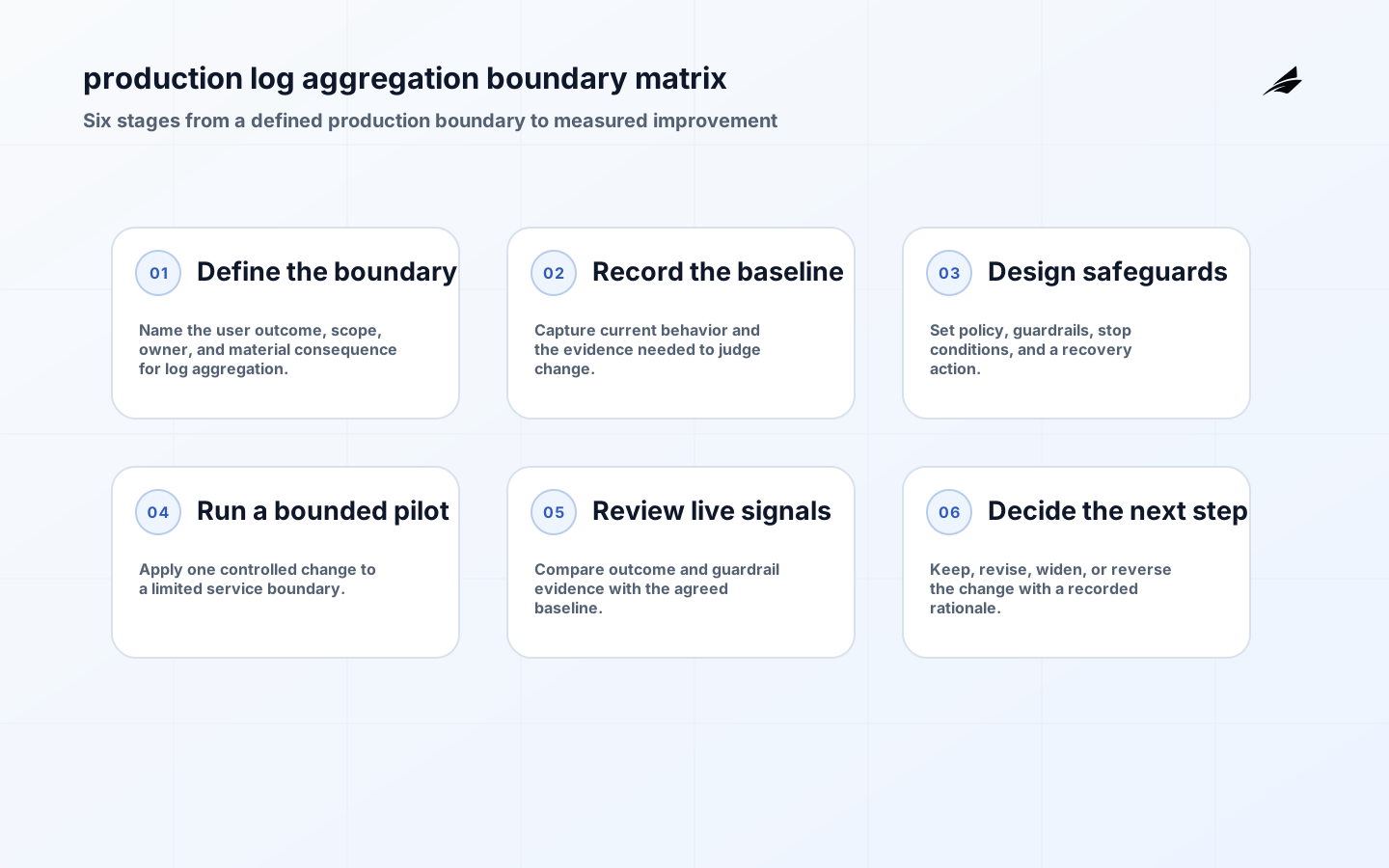
Log aggregation is useful when it turns scattered application, infrastructure, and audit events into evidence an operator can query during a real decision. It is not useful merely because every component writes to one expensive destination. The OpenTelemetry Logs data model provides a shared structure for timestamped event records and resource context, while NIST SP 800-92 frames logging as an operational and security-management process. Production logging needs a contract for meaning, access, and retention before it needs another collector.
Choose the production logging boundary
The first production artifact is a logging contract that defines required event fields, severity semantics, redaction rules, retention tiers, access roles, query ownership, and incident-use cases. It turns an abstract initiative into a boundary that someone can operate for production logging. Write the user outcome, the systems included, the named owner, the decision cadence, and the condition that stops the change in production logging, with event loss and safe expansion in view. For log aggregation, the important risk is centralizing a large volume of inconsistent or sensitive messages that cannot answer an incident question and may create privacy, cost, or access problems. A boundary is useful only when it makes that risk visible before customers discover it for production logging.
Begin with incident questions. For a failed customer action, what identifier connects the request to a service, deployment version, tenant-safe context, and downstream result? For a security event, who accessed what, from where, and under which authorization? Define a small set of required fields and severity meanings, then provide libraries and examples so teams do not invent incompatible formats. Avoid placing raw sensitive values in logs; redaction after ingestion is too late for many exposure paths.
| Decision element | Question to settle | Evidence to retain |
|---|---|---|
| Outcome | What user or operator result should log aggregation improve or protect? | A baseline, target, and named service owner. |
| Scope | Which services, environments, and actors are included? | A current inventory and explicit exclusions. |
| Guardrail | What harm must stop the work? | Thresholds, alert query, and stop authority. |
| Recovery | How is normal behavior restored? | A tested runbook and decision record. |
Make the event path legible
A dependable pipeline separates collection, transport, enrichment, storage, and query access. Each boundary needs backpressure and failure behavior: a busy log backend should not take down an application, and a collector restart should not silently lose the only evidence for a critical path. Attach resource attributes and trace correlation where they help investigation. Kubernetes logging architecture is useful for understanding node, container, and cluster-level sources, but application event design remains the service team’s responsibility.
For log aggregation, keep the architecture legible to the person on call. Show the entry point, authoritative records, identities, policy or control points, telemetry, and the path to a safe state in production logging, with event loss and safe expansion in view. NIST SP 800-92 Guide to Computer Security Log Management is a useful reference for the underlying mechanisms. In local design reviews, ask a practical question: when the expected result is absent, which component, owner, and record will establish what happened in production logging, with event loss and safe expansion in view. That question usually exposes missing dependencies sooner than an elaborate diagram does for production logging.
Pilot the controls on one service
Pilot the contract on one service and use an incident rehearsal to query it. Verify timestamps, identifiers, redaction, access restrictions, and retention rules with real records. Introduce structured logging alongside legacy text when necessary, then retire fragile parsers only after consumers have migrated. Make logging changes reviewable like API changes: a renamed field can break a detection rule or an operational dashboard just as surely as a changed response schema.
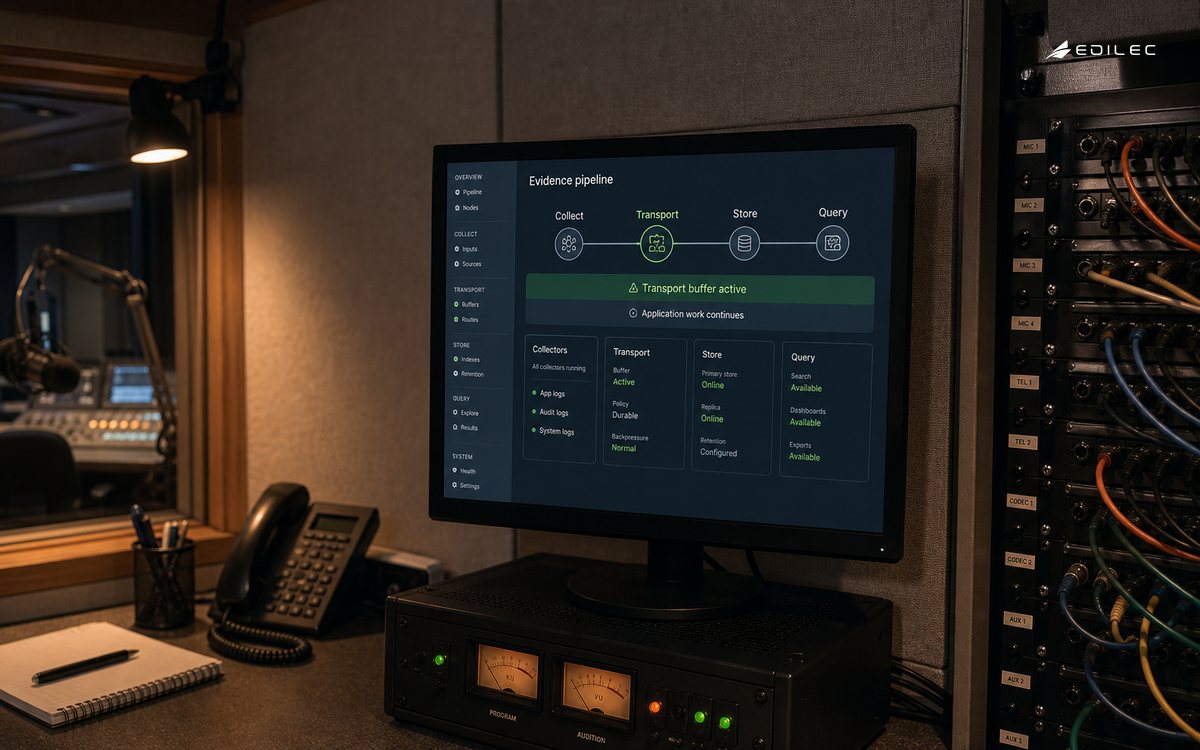
For log aggregation, make the release record specific enough for another operator to continue the work: baseline, exact configuration or revision, expected effect, affected cohort, observation window, guardrail queries, and recovery action. Use observability engineering notes to keep the surrounding change process clear. A small pilot is not a ceremonial prelude; it is how the team learns whether its measurement and response assumptions survive production conditions in production logging, with event loss and safe expansion in view.
| Stage | Minimum output | Decision gate |
|---|---|---|
| Discover | Current boundary, baseline, owner, and known constraints. | The problem can be measured without guessing. |
| Design | Controls, evidence path, and recovery action. | The main consequence has a practical safeguard. |
| Pilot | A limited change with explicit stop conditions. | Observed behavior supports a wider use. |
| Operate | Runbook, alert owner, and review cadence. | Normal turnover will not erase knowledge. |
| Improve | A recorded lesson and next hypothesis. | Evidence, rather than urgency, selects the next change. |
Pair incident evidence with guardrails
Use coverage of required fields, ingestion delay, query success during incidents, redaction findings, retention cost, and volume of dropped or malformed records. Pair a direct outcome measure with a guardrail so a local improvement cannot hide a broader regression in production logging, with event loss and safe expansion in view. Segment by the boundary that matters, such as revision, region, workload, cohort, or service route for production logging. Each query should have an owner who understands its limitations and a written action for breach for production logging. AWS CloudWatch Logs best practices provides authoritative context, but the threshold must reflect the consequence and operating capacity of this service.
Assign owners for pipeline health and for the event schemas that matter to services. Monitor ingestion lag, rejected records, index or storage pressure, and query performance. Retention should match operational and legal needs, with different tiers for high-value audit data and verbose debugging output. AWS CloudWatch Logs best practices provides useful guidance on access control, monitoring, and cost-aware use. Review access because logs often contain more business context than their creators realize.
Find the gaps that block safe expansion
The usual failure is collecting everything and understanding nothing. Unstructured messages, missing request IDs, inconsistent clocks, and unrestricted access turn a central log store into a costly haystack. The other failure is suppressing too aggressively and losing the event needed to reconstruct harm. Let incident scenarios set the minimum signal, then use sampling, tiers, and retention rules to manage volume. A log is valuable when it shortens an accountable investigation without exposing data it was never meant to hold.
A sound log aggregation review separates evidence from explanation. Confirm the timeline, scope, and customer effect; then identify the assumption, control, or handoff that failed in production logging, with event loss and safe expansion in view. Use observability and incident context to improve the investigation path rather than adding vague monitoring. Close the review with one owned correction, a due date, and an explicit decision about whether the operating boundary can widen in production logging, with event loss and safe expansion in view.
Keep the production decision traceable
Logging schemas need version discipline. When a field changes meaning, retain compatibility or coordinate every detection rule, dashboard, and incident query that depends on it. Sample verbose success events rather than high-value failure or audit evidence, and test the pipeline under surge conditions. These choices protect query usefulness when an incident produces the exact volume and urgency that ordinary tests do not.
For log aggregation, test the critical queries with the same restricted roles that responders use. A perfect administrator query is not an operational capability if the on-call engineer cannot access it during a real incident.
Key takeaways
- Log aggregation should begin with a defined user outcome and a named operating boundary.
- Keep the first production change small enough to observe, stop, and reverse for production logging.
- Use an outcome signal with guardrails so apparent improvement does not conceal harm for production logging.
- Treat ownership, evidence, and recovery as implementation requirements, not documentation afterthoughts.
- Expand only when the team can explain the result and sustain the operating work for production logging.
Frequently asked questions
When is log aggregation ready for production? When the scope, accountable owner, evidence, control, and recovery action are explicit and have been exercised for a bounded use. What should a small team do first for log aggregation? Pick one meaningful journey, record a baseline, and make one reversible change; broad programs create evidence gaps. How often should it be reviewed? Review after a material change or incident and on a cadence proportionate to the consequence. What if the data is incomplete? Make the uncertainty visible, narrow the action, and improve the measurement before making an irreversible decision. Secrets management implementation checklist can help establish the surrounding reliability practice.
Make production acceptance observable
A useful acceptance review begins with a real question and a real role. Have an on-call engineer find a known request, have a security reviewer inspect a bounded administrative trail, and have a platform operator induce a short collection gap. For each exercise, record which source timestamps were visible, whether correlation worked, whether the user could see only the intended data, and how quickly the owner recognized a missing path. Include a query that crosses the service boundary and a case where an event is delayed. This tests the evidence boundary instead of rewarding a polished demo that only works when every source is healthy.
Keep the acceptance evidence with the decision record and repeat it after material changes. A provider integration, agent version, schema migration, new region, retention policy or identity model can alter production behavior without changing the search interface. Review the affected sources, rerun the smallest meaningful case and update the runbook. This makes production readiness a maintained condition rather than a one-time approval and gives managers a clear basis for widening coverage or pausing a rollout.
A production review should also check the human path. Can an incident commander request evidence without granting permanent broad access? Can support receive a useful explanation without receiving raw customer data? Can an engineer recognize that a quiet source is actually a collector failure? These questions connect technical controls to the organization’s ability to act safely. If the answer depends on a single person remembering a query or exception, the capability is not yet durable.
Use an admission test for the first production boundary
Before accepting a new source into production logging, ask three roles to perform a bounded test. The service owner emits or identifies a known event, the on-call role searches it under normal permissions, and the security or privacy reviewer confirms that the event contains no prohibited value. Introduce one delayed or dropped path and check that the status is visible to the person who must act. Record the event schema version, source timestamp, observed timestamp, query scope, and recovery decision. This test is deliberately smaller than a platform launch: it tells the team whether a source has meaning, ownership, access, and loss detection at the boundary where incidents occur. Repeat it after an agent change, retention change, or account move.
Conclusion
Production logging is ready when a named operator can answer a defined question, see missing or unsafe evidence, and invoke a tested control without guessing. Treat the boundary as a living contract: review it after service, schema, access, or retention changes and record why the next expansion is safe.
Production log aggregation is ready when a real role can answer a defined question, missing evidence is visible and access, cost and retention controls survive an adverse test. Treat that readiness as maintained, not permanent.
A useful operating decision for What Changes When Log Aggregation Moves into Production begins with a specific boundary. Name the service, workflow, data set, or team in scope; then state which outcome matters and which trade-off is acceptable in production logging, with event loss and safe expansion in view. For log aggregation, that means separating the design choice from the controls that make it safe to operate. A small pilot should expose the assumptions most likely to fail: ownership, dependency order, permissions, capacity, timing, or evidence quality in production logging, with event loss and safe expansion in view. Record those assumptions before implementation and revisit them after real traffic or real decisions arrive in production logging, with event loss and safe expansion in view. When the result differs from the plan, classify the gap rather than hiding it for production logging. Is the issue a missing control, an incorrect model, an unmeasured dependency, or a changed requirement in production logging, with event loss and safe expansion in view. Each answer leads to a different next action. Keep the corrective action narrow enough to test, give it an owner and review date, and preserve the evidence in the team’s normal working record in production logging, with event loss and safe expansion in view. This approach keeps the practice useful as systems evolve because it connects day-to-day execution with a repeatable decision loop in production logging, with event loss and safe expansion in view.