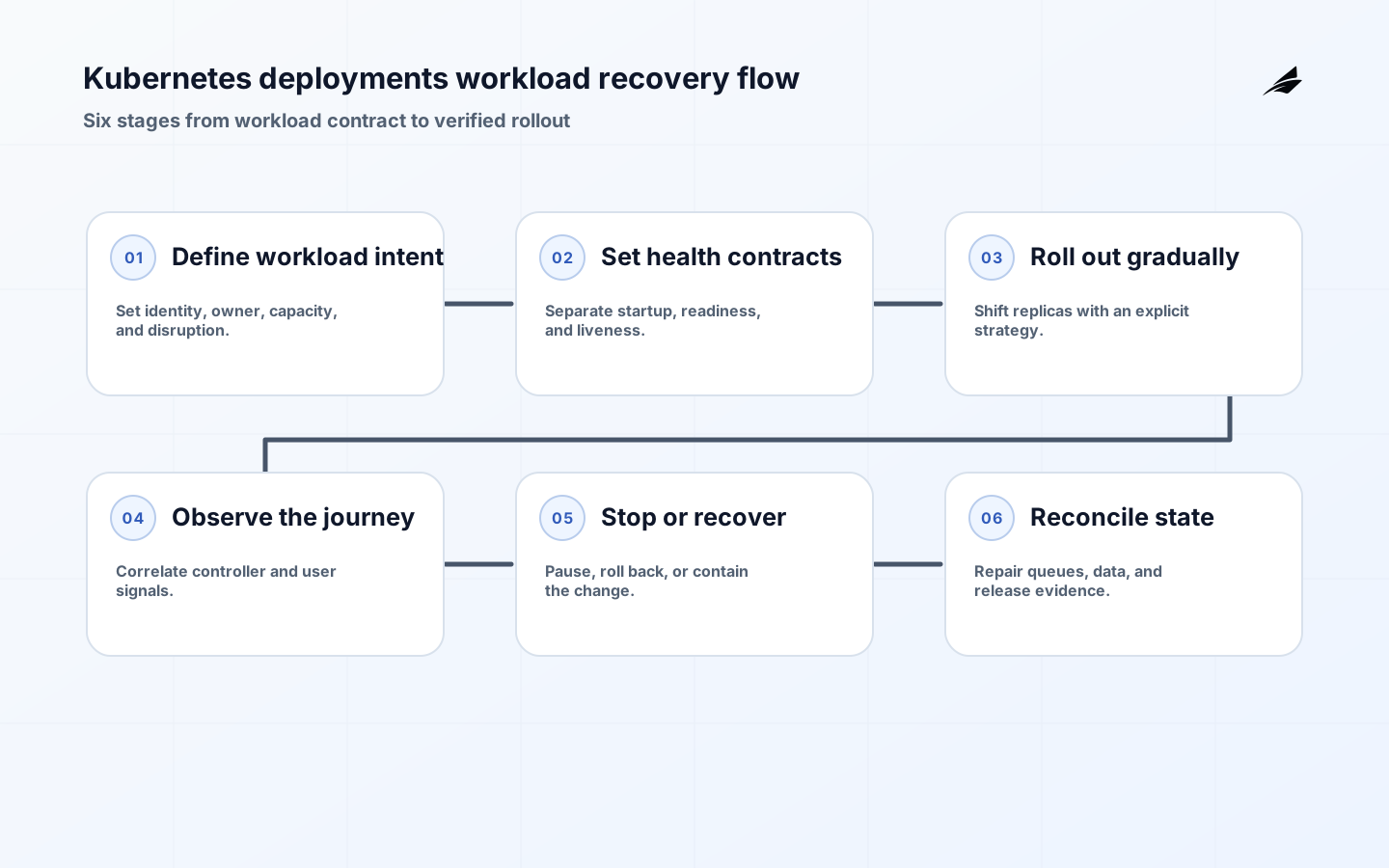
Kubernetes deployments should be treated as a workload contract, not as a tool purchase or a YAML exercise. Before the first build, an engineering team needs to decide what it is trying to protect: the controller state and the service state can be interpreted together. That decision changes the design. The important record is not a screenshot of a successful run; it is deployment revision plus the context that explains its effect. Green Pods are mistaken for a healthy customer path while readiness, capacity, or shutdown behavior is wrong. The practical goal is a repeatable path that makes the next action clear to the person on call, the service owner, and the customer-facing team, especially when revision health must be reconciled with user impact.
A Kubernetes Deployment is a declarative workload contract, not a complete release strategy. Kubernetes Deployment documentation describes controlled updates, rollout status, progression, and revision rollback. Probe documentation distinguishes readiness, liveness, and startup behavior, including the risk that careless liveness checks create cascading failures. Google SRE release engineering supplies the broader discipline of repeatable release work, while OpenTelemetry supports correlated traces, metrics, and logs. Connect the production path to Edilec Docker images, deployment rollbacks, and container security. Define workload identity, ownership, resource requests, disruption tolerance, probe contract, dependency behavior, and recovery authority. Test quota shortage, image pull failure, slow startup, readiness loss, dependency overload, and mixed-version compatibility. Keep rollout evidence tied to the user journey rather than replica counts alone. A deployment is ready when the team can explain availability, stuck-rollout detection, traffic protection, and data or queue reconciliation after recovery.
Key takeaways
- Start kubernetes deployments with one accountable owner and one customer-facing outcome.
- Use deployment revision as durable evidence rather than relying on memory or a mutable label.
- Design resource requests, appropriate probes, a rollout budget, graceful termination, and version-labelled telemetry before scaling the workflow.
- Pair technical evidence with available replicas, request success, queue delay, saturation, and a user-visible completion measure.
- Make the recovery action and its authority explicit before normal operation begins, especially when revision health must be reconciled with user impact.
Define a workload contract before implementation
The first design conversation for kubernetes deployments should produce a small, reviewable contract. State the system boundary, the trigger or change that crosses it, the owner who may decide, and the evidence required to proceed, especially when revision health must be reconciled with user impact. Then identify the unhappy path: dependencies that time out, invalid state, untrusted input, capacity pressure, and a person who is unavailable, especially when revision health must be reconciled with user impact. This is where teams turn a vague reliability ambition into operating choices, especially when revision health must be reconciled with user impact. Resource requests, appropriate probes, a rollout budget, graceful termination, and version-labelled telemetry are valuable because they reduce the number of assumptions a responder must reconstruct during pressure. Write the service acceptance and shutdown behavior before choosing probe values. A report API should not become ready until it can accept traffic, while a slow startup should use a startup probe instead of repeatedly failing liveness; rollout settings must leave capacity for the old and new revisions.

| Decision area | Evidence to retain | Why it matters |
|---|---|---|
| Readiness | When the Pod may receive traffic | Prevents endpoints from routing to an unprepared process |
| Startup | How long initialization may take | Stops liveness from killing a slow but valid start |
| Resources | Expected CPU and memory under load | Lets scheduling and autoscaling make meaningful choices |
| Termination | Drain and shutdown period | Reduces dropped in-flight work |
Make risk visible in the normal path for Kubernetes deployments
Kubernetes deployments work best when the safest route is also the easiest routine. Put the required checks and ownership near the action instead of relying on a separate document, especially when revision health must be reconciled with user impact. A team should be able to see the current deployment revision, the scope of change, and the next required decision from the same operational record. This does not mean every modification needs the same ceremony. It means the controls should match consequence: a bounded, reversible change needs fast automated evidence, while an irreversible or cross-system change needs compatibility checks, explicit authority, and a repair plan, especially when revision health must be reconciled with user impact. The purpose is not to slow delivery; it is to remove preventable ambiguity, especially when revision health must be reconciled with user impact.
Use operational evidence, not proxy success for Kubernetes deployments
Control-plane health can look good while the user's journey is failing. Available replicas, request success, queue delay, saturation, and a user-visible completion measure should be examined together, over an agreed comparison window. Label or correlate the evidence with the relevant deployment revision where that is practical, and keep a baseline that represents normal behavior. Good evidence supports a decision with a short explanation: what changed, who is affected, which dependency is involved, and whether the impact is improving, especially when revision health must be reconciled with user impact. This is also why Kubernetes deployments need a named owner for the signal, not merely a dashboard maintainer. The owner decides what response protects the service promise.
| Situation | Evidence and control | Decision rule |
|---|---|---|
| New revision is crash-looping | Deployment revision and events | Pause rollout and inspect image, config, and logs |
| Latency rises during rollout | Capacity, saturation, and request outcomes | Hold expansion or add capacity before proceeding |
| Readiness stays false | Probe result and dependent service state | Fix the acceptance contract, not merely the threshold |
| Older revision is needed | Retained ReplicaSet and compatible data path | Roll back only after checking migrations and flags |
Start with one real path for Kubernetes deployments
Avoid beginning with a broad platform mandate. Pick a service or workflow that has an accountable team, a known customer outcome, and enough existing telemetry or records to compare before and after, especially when revision health must be reconciled with user impact. Run the new kubernetes deployments path through ordinary work, then through a controlled adverse case. Record what required manual judgment and why. That result is more useful than a generic scorecard because it exposes missing permissions, unclear handoffs, fragile dependencies, and inaccessible evidence, especially when revision health must be reconciled with user impact. The relevant production companion, Kubernetes rollout guide, gives additional operating detail once the first path is in use, especially when revision health must be reconciled with user impact.
Evaluate Kubernetes deployments trade-offs
Probe settings should describe application behavior, not mask it. A readiness endpoint that only returns process uptime can route traffic to a service that cannot reach its required datastore; one that performs a costly dependency check can create a self-inflicted outage. Define the smallest condition for accepting new requests and observe dependencies separately. Resource requests are equally consequential: under-requesting invites contention and unpredictable eviction, while over-requesting wastes schedulable capacity. Use production measurements to adjust them, but avoid treating automatic scaling as a substitute for a capacity decision. Finally, test termination during a real request and verify that load balancing, connection draining, and worker shutdown preserve the service promise.
Treat recovery as a separate design for Kubernetes deployments
Recovery is not always the inverse of execution. A previous revision may be available while data, external side effects, or declared state have already moved forward, especially when revision health must be reconciled with user impact. Separate immediate containment from restoration and reconciliation. Define what can be disabled or paused, what evidence must be preserved, and what customer condition proves recovery, especially when revision health must be reconciled with user impact. For changes that touch durable records, a compatible transition and a reconciliation query are often safer than a hurried reversal, especially when revision health must be reconciled with user impact. The deployment rollback guide explains this distinction for releases; the same discipline applies whenever kubernetes deployments changes a live system.
Review checklist for Kubernetes deployments
- Name the service owner, operational owner, and decision authority for kubernetes deployments.
- Confirm that deployment revision is retained with enough context to reconstruct an event.
- Exercise one realistic failure without relying on the original implementer.
- Check that permissions are scoped to the action and target actually required, especially when revision health must be reconciled with user impact.
- Compare one customer outcome with technical telemetry before widening use.
- Write the containment action separately from the repair or reconciliation action.
- Set an expiry and an owner for every exception to the normal route, especially when revision health must be reconciled with user impact.
- Use the next review to remove a repeated manual step or unclear handoff, especially when revision health must be reconciled with user impact.
Frequently asked questions
Question: What is the best first investment in Kubernetes deployments? Answer: Define one workload contract covering health, readiness, capacity, rollout, ownership, dependencies, and recovery. Then test it through a bounded deployment so the team can observe user impact rather than only replica status.
Question: How should a deployment handle an unhealthy revision? Answer: Use readiness gates and observable rollout signals to stop promotion, preserve the last known-good revision, and make rollback or forward repair explicit. Recovery should account for data compatibility and external side effects, not only pod replacement.
Question: Which deployment signals deserve regular review? Answer: Review availability, latency, error rate, saturation, rollout progress, probe failures, revision age, rollback frequency, and user-facing completion. Segment by workload and release so aggregate cluster health does not hide a broken path.
What is the best first investment in Kubernetes deployments?
Start with the evidence that makes a single important path understandable after a handoff: its deployment revision, responsible owner, change or trigger, and customer outcome. That foundation makes later automation and standardization safer because teams can investigate a failure without relying on a particular person, especially when revision health must be reconciled with user impact.
Does Kubernetes deployments remove human judgment?
Kubernetes can automate replica management and rollout mechanics, but it cannot choose an acceptable availability trade-off. Humans must set the service contract, assess migration compatibility, and decide how much capacity to retain during a rollout.
How should a team measure success for Kubernetes deployments?
Track rollout duration, availability, readiness failures, saturation, and the customer transaction that the workload serves. A stable replica count is not a substitute for a successful user request.
Practice a Kubernetes workload with a real scenario
A service that slowly initializes a cache should use a startup probe so it is not restarted before it has a chance to become ready. During a revision rollout, compare available replicas with request success and queue delay; a controller can report progress while the service still lacks capacity for real traffic.
Conclusion
A useful workload contract includes shutdown behavior and state handling as well as startup probes. Define termination grace, connection draining, retry behavior, disruption budget, and what happens to in-flight or queued work when a Pod leaves service. Test a rollout while a dependency is slow and while the new version and old version serve traffic together. Capture the controller status, application telemetry, user outcome, and recovery action in one release record. This evidence makes readiness more than a green probe: it shows whether the workload can change without surprising the people who depend on it.
Kubernetes deployments become dependable when their decisions are visible before the first build. Define a workload contract, retain evidence around the deployment revision, match controls to consequence, and rehearse the action that contains harm. That approach creates faster engineering work because people do not have to rediscover the system while it is failing, especially when revision health must be reconciled with user impact. For closely related reading, see Kubernetes Deployments in Production: Readiness, Capacity and Safe Rollout, Docker Images in Production: Build Identity, Runtime Discipline and Updates, CI/CD Pipelines in Production: Evidence, Exposure and Recovery, Deployment Rollbacks: Architecture Guide.