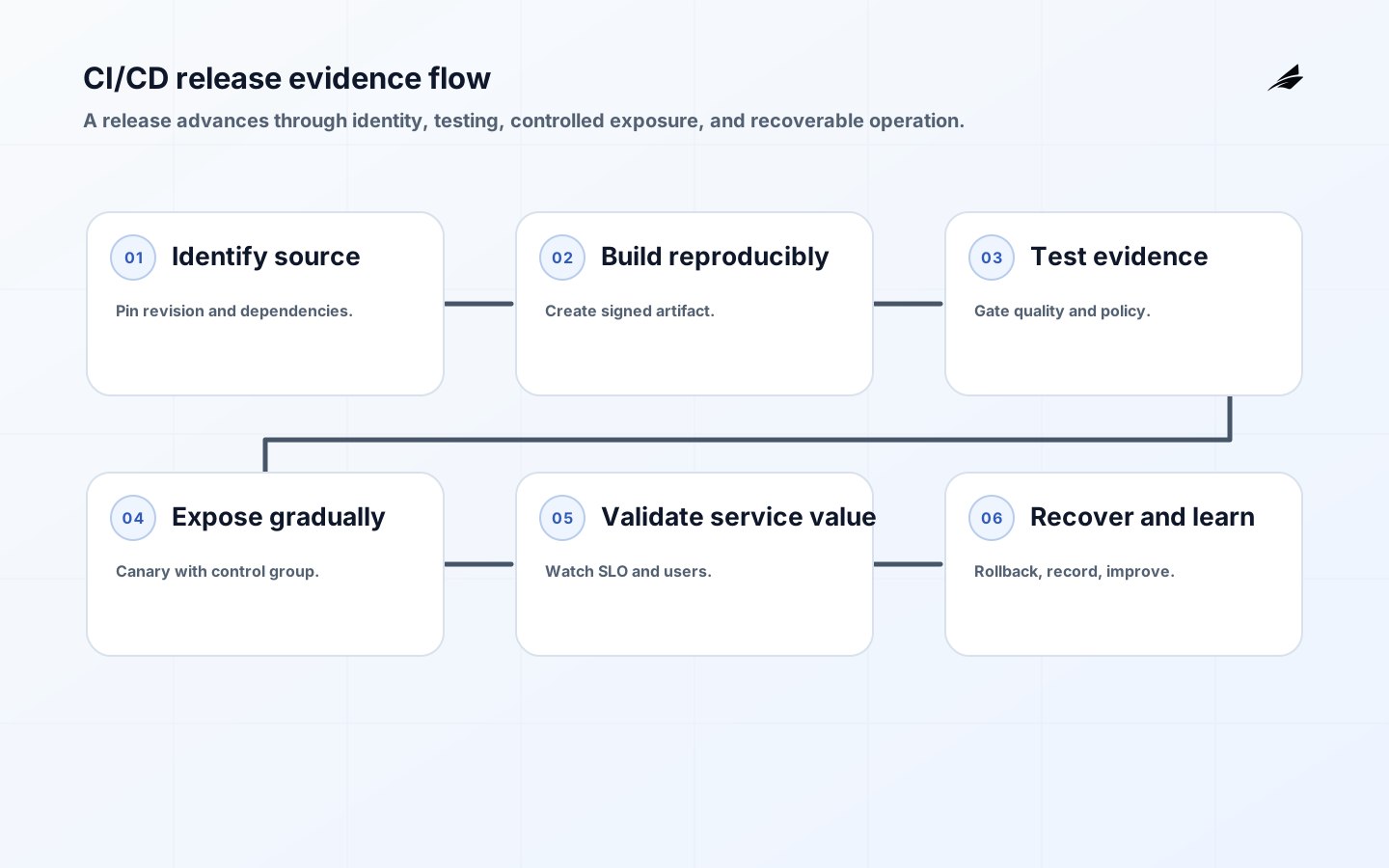
CI/CD pipelines become a production capability when they let a responder answer four questions without reconstructing history: what changed, what artifact ran, who or what approved the exposure, and how can the customer effect be contained? A successful build only proves that one sequence completed in one environment. Production delivery also joins configuration, secrets references, database compatibility, traffic policy, and business-side effects. Treat the pipeline as a decision record that moves a specific immutable artifact through evidence and progressively wider exposure. That is the practical foundation of CI/CD pipeline design, not a mandate to deploy every commit instantly.
Make every release attributable
A production CI/CD pipeline should make the released state easier to identify than the source state it came from. Keep a stable link between commit, dependency resolution, build inputs, test results, artifact digest, configuration version, approval, deployment target, and observed exposure. This is more than an audit trail. It shortens recovery because an operator can name the exact artifact and configuration to compare or restore. Google SRE's release engineering chapter emphasizes repeatable builds and policy enforcement; SLSA provides a supply-chain vocabulary for provenance and integrity. Adapt the level of evidence to the consequence of the service.

Use canaries as an evidence gate, not as a decorative deployment shape. Define the control population, exposure window, success measures, and abort authority before the change reaches production. Include user-visible outcome, error budget, dependency health, and rollback time, not only pipeline status. The Google SRE canarying guidance describes canarying as a partial and time-limited deployment whose evaluation decides whether to proceed. Add NIST SSDF practices to the pipeline where they improve source, build, and release discipline without creating an approval queue nobody can sustain.
Connect the decision with Edilec's deployment rollback guide, Docker images in production guide, and GitOps guide. These related workflows should share artifact identity and recovery language. A pipeline is ready for broader autonomy when its evidence lets a different operator understand what changed, what is exposed, what remains safe, and which bounded action returns the service to a known state.
- Bind source, dependencies, artifact, config, approval, and deployment.
- Define canary control, exposure time, measures, and abort authority.
- Keep provenance useful to the person responding to failure.
- Exercise rollback with the same artifact identity used to release.
For a connected Edilec reading path, see Edilec CLD-0062, Edilec CLD-0068, Edilec CLD-0080. These related guides keep the implementation detail close to the operating decision and help teams compare ownership, evidence, and recovery across adjacent systems (for CI/CD release evidence make every).
Key takeaways
- Build once, identify the artifact by digest, and promote that same artifact between environments.
- Make checks answer a defined risk, such as unsafe dependency use, broken compatibility, or a failed customer journey.
- Use a small audience, feature flag, or traffic slice before a high-consequence change reaches everyone.
- Keep rollback, forward repair, and data reconciliation separate because they solve different failures.
- Record the signals and decision authority needed to stop or expand a release.
Define the release boundary before automating it
Start with one service promise and its failure boundary. For an order service, that might be: a confirmed order produces one durable order record and no duplicate charge. The release record should link a source revision, artifact digest, configuration revision, target cohort, migration version, and observability links. It should also name changes that sit outside the application image, including feature flags, managed policy, and scheduled jobs. This boundary prevents a team from declaring a release healthy because pods are ready while the order workflow is failing downstream. It also makes ownership concrete: a service owner decides expansion, a platform owner maintains shared controls, and an on-call responder has authority to contain customer impact.
| Release item | Evidence to retain | Why it changes the decision |
|---|---|---|
| Artifact | Digest, source revision, build result | Identifies exactly what can be promoted or replaced |
| Configuration | Reviewed revision and scoped secret reference | Separates code identity from environment behavior |
| Exposure | Cohort, time, and traffic rule | Defines who may be affected and what to compare |
| Recovery | Rollback, repair, and reconciliation runbook | Prevents an urgent response from becoming improvisation |
Build a CI/CD pipeline around evidence, not ceremony
A useful pipeline has stages with distinct jobs. Source review and tests establish change intent; a reproducible build creates an artifact; policy checks examine dependencies, credentials, provenance, and configuration; deployment introduces the artifact to a bounded target; and service signals determine the next action. Avoid a single universal approval gate. A documentation-only update, a new payment integration, and a destructive schema change have different failure modes. Instead, classify the change and require evidence that addresses its blast radius. For stateful releases, use expand, migrate, switch, and contract steps: old and new code must coexist before a destructive cleanup. This sequencing is often more important than the deployment tool.
Match controls to change risk
CI/CD pipelines should remove repeatable manual work while preserving review where intent cannot be inferred safely. Keep approvals tied to risk, not ceremony, and make exceptions visible.
| Change class | Practical treatment | Release decision |
|---|---|---|
| Stateless behavior | Automated tests and limited traffic exposure | Expand when service and product signals remain normal |
| Schema expansion | Compatibility checks with both application versions | Proceed only when old readers and writers continue to work |
| External side effect | Idempotency key and reconciliation query | Pause when duplicates, omissions, or rejects appear |
| Urgent repair | Recorded exception with bounded credential and review | Close after repair evidence and retrospective follow-up |
Operate the signals that protect customers
Deployment health must combine technical and customer-facing evidence. Error rate, latency, saturation, and restart activity can identify a fault quickly, but they do not prove that a user completed a transaction. Pair them with one outcome signal such as completed checkout, accepted upload, or successful entitlement assignment. Label telemetry with a release revision and cohort where cardinality permits, so an operator can compare the new path with a baseline. Decide in advance who can halt expansion and who validates recovery. The companion deployment rollback guide explains why rollback is only one recovery option when data or external effects are involved.
Introduce the path in deliberate increments
Begin with one customer-facing service that has an owner and observable outcomes. Make the build reproducible, identify the artifact, and verify the customer path before widening deployment.
Frequently asked questions about CI/CD pipelines
Question: Must continuous delivery automatically deploy to production? Answer: No. Automatic promotion is one option; the required boundary depends on change risk, evidence quality, approvals, and recovery readiness. Question: What evidence supports a release decision? Answer: Link commit, dependencies, build inputs, tests, artifact digest, configuration, approval, target, exposure, and observed health.
Must continuous delivery mean automatic production deployment?
No. Continuous delivery means a change can be released reliably with current evidence. An organization may choose a deliberate release decision for high-impact changes. Automating artifact creation, validation, and audit evidence still shortens the decision and reduces transcription errors.
What is the best first investment?
Make the production artifact traceable to source and tests, then make deployment repeatable. These capabilities reduce the time needed to investigate a bad change and create a firm base for later policy checks and progressive delivery.
When is rollback unsafe?
Rollback alone may be unsafe after a migration changes stored meaning or an integration creates an external effect. Keep compatibility during the migration, disable new behavior when possible, and use an explicit reconciliation process for records or partner actions.
Release evidence checklist
- Verify that a release can be reconstructed from the artifact digest, configuration revision, and target cohort without asking the original author.
- Exercise a failed dependency check to confirm the pipeline stops before deployment credentials are used.
- Deploy a harmless change to a limited cohort and compare one customer outcome with its baseline.
- Practice disabling new behavior independently of reverting code so operators understand the faster containment route.
- Test a compatible schema expansion with old and new application versions running together.
- Confirm the release record names the person allowed to expand traffic and the person allowed to halt it.
- Inspect whether deployment credentials can act only on the intended target and only for the required duration.
- Review a scanner exception for owner, rationale, expiry, and a follow-up that can be checked later.
- Measure the time from a failed production signal to containment during a controlled exercise.
- Check that an external side effect has an idempotency key and a reconciliation query before it is exposed.
- Compare logs, metrics, and traces by release revision to ensure the change is visible in operations.
- Make a rollback drill include configuration and flags, not only the application artifact.
- Record the business condition that proves the service is restored after a technical rollback.
- Review failed pipeline runs for controls that are noisy rather than decisions that prevent harm.
- Keep a known-good artifact available for the defined recovery window and test that it remains accessible.
- Publish a narrow exception route so urgent repair is recorded rather than performed through a hidden bypass.
- Check the release record after a shift change, when the original developer is unavailable.
- Make the customer outcome query usable by an on-call engineer without ad hoc database access.
- Review the next release after an incident to prove the improvement changed the real path.
Conclusion
Production CI/CD pipelines earn trust by making change understandable and recoverable. Build immutable artifacts, connect controls to real risks, widen exposure only with evidence, and rehearse the action that protects customers. The outcome is not a more elaborate build system; it is a calmer, faster way to make production decisions.
Rehearse the pipeline under pressure
A pipeline is not production-ready because it deploys the happy path. Rehearse a failed build, a revoked credential, a dependency outage, and a customer-visible rollback.
Keep deployment confidence separate from deployment speed. Faster delivery is valuable when it reduces manual work and makes small, attributable changes easier to reverse. It is not valuable when teams bypass checks or when canary signals arrive after full exposure. Review stage duration, approval friction, failure recovery time, and complete-provenance coverage. Use those measures to simplify the path so the safe action is easier than improvisation.
Make recovery a release feature
The recovery path deserves the same attention as release. Name the last known-good artifact and configuration, define who can invoke it, and verify durable state before declaring recovery.
After a recovery exercise, turn the result into one bounded improvement, such as a clearer signal, smaller change, or tested rollback step.
A short release review should answer whether the exact artifact is known, exposure can be limited, recovery is tested, and the customer outcome was verified.