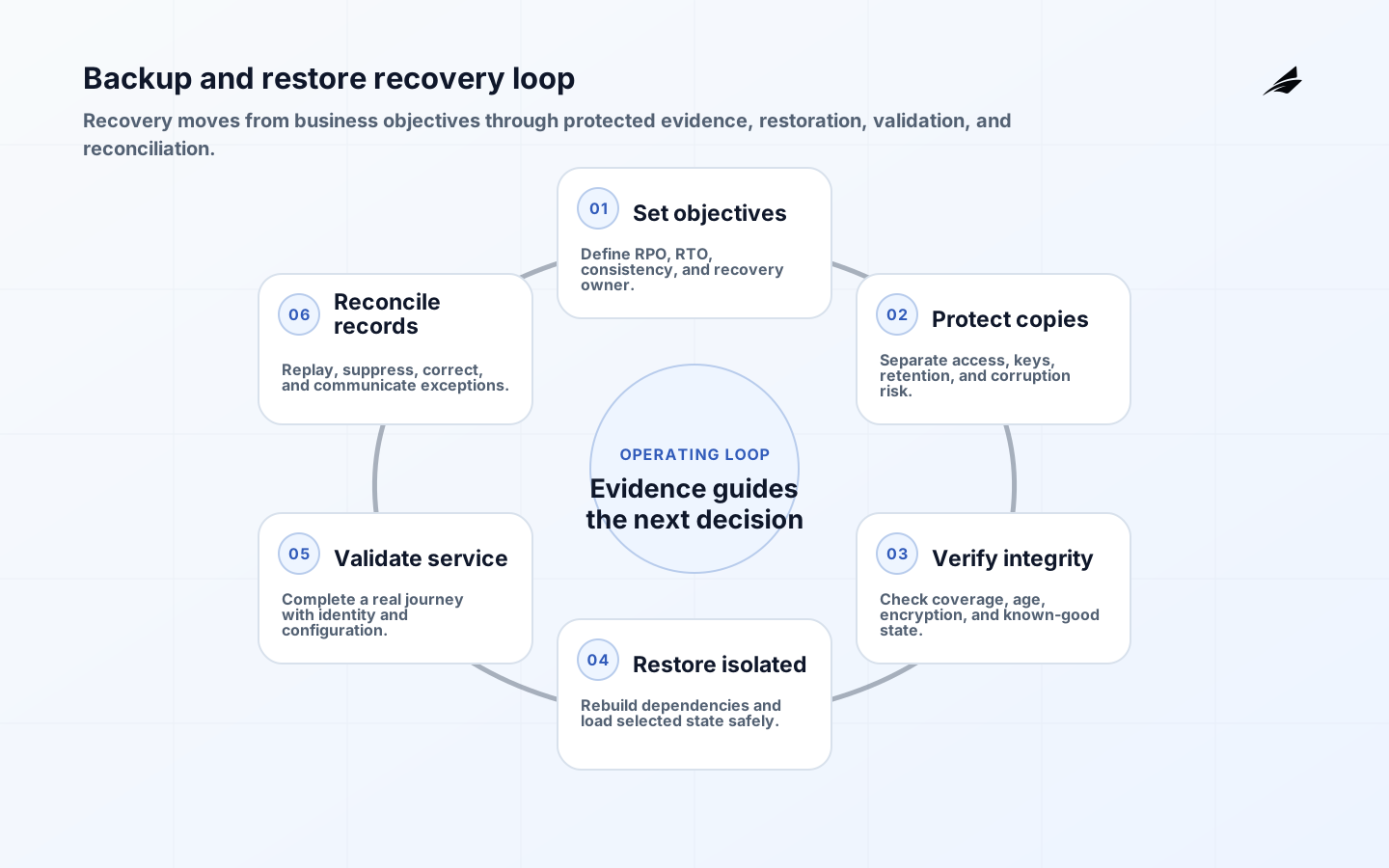
Backup and restore is a recovery capability, not a retention setting. A backup is useful only when the right state can be found, trusted, restored into a safe environment, and reconciled with the business. The NIST contingency planning guide connects recovery priorities to system and organisational planning. Google’s disaster recovery planning guide similarly treats recovery as scenario design across applications, data, infrastructure, and locality.
Start with the business journeys that must resume: accepting orders, serving a customer record, processing a queue, or publishing a regulated report. Edilec’s backup production guide, incident response guide, and Terraform modules guide help connect backup decisions to live operations. Backups should protect the authoritative state and the evidence needed to know whether recovery actually worked.
Define recovery objectives before tooling
Recovery point objective describes how much recent data the business can lose; recovery time objective describes how quickly a service must resume. Add a recovery consistency objective: what must be true across databases, object stores, queues, identity, configuration, and external records after restoration? Also define maximum tolerable downtime, recovery order, acceptable degraded mode, and a named decision-maker. An objective without a scenario and owner is a target that cannot guide architecture.
| Decision | Question | Evidence |
|---|---|---|
| Scope | Which data and configuration are essential to the journey? | Dependency map and authoritative-source record. |
| RPO | What loss is acceptable for each data class? | Business-approved point-in-time requirement. |
| RTO | When must the user journey resume? | Timed recovery sequence and owner. |
| Consistency | How are related systems reconciled after restore? | Replay, deduplication, and validation procedure. |
| Isolation | Can a compromised backup be prevented from restoring harm? | Separate account, access, and recovery test. |
Protect backup integrity and access
Separate backup administration from production administration where the consequence justifies it. Protect backups against accidental deletion, ransomware, unauthorised reads, and silent corruption. Encrypt sensitive data, but retain the ability to recover keys and permissions as part of the recovery plan. Record backup source, version, time, retention, encryption state, and verification result. A backup that exists but cannot be decrypted, located, or trusted is not evidence of resilience.

Test restoration, not just backup completion
Run restores at a frequency matched to the consequence and change rate. Test a full service, a selected record, a corrupted object, a point-in-time recovery, and a recovery into an isolated account or region. Time each stage and record failures. Verify checksums or equivalent integrity, permissions, application startup, data relationships, and a user-level transaction. Use a clean environment where possible so a test does not accidentally depend on the production system it is meant to replace.
| Test | What it reveals | Pass condition |
|---|---|---|
| Inventory check | Whether expected sources and retention policies are covered. | Every critical dependency has a current recovery path. |
| Restore check | Whether the data can be located, decrypted, and loaded. | Restored state is readable and integrity-verified. |
| Application check | Whether services, identity, configuration, and dependencies work. | A representative user journey completes. |
| Reconciliation check | Whether queues, payments, replicas, and external records agree. | Exceptions are identified, owned, and corrected. |
| Security check | Whether recovery access or artifacts widen exposure. | Temporary access is controlled and removed. |
Design for corruption and ransomware
The CISA ransomware guidance makes recovery planning part of cyber resilience. Assume that an attacker or faulty process may reach online backups, credentials, indexes, and restore tooling. Keep independent copies where appropriate, protect administration, monitor unusual deletion or encryption activity, and choose restore points based on known-good evidence rather than newest timestamp. The AWS Backup best-practices guidance is a useful provider reference for organising backup controls, but the recovery design still needs local objectives, ownership, and validation. Recovery must include credential rotation, containment, legal or customer communication, and validation that restored systems are not reintroducing the compromise.
Sequence recovery around dependencies
A database restore may be useless if identity, network, keys, schema, or application configuration is missing. Define recovery waves and dependency order. Separate infrastructure provisioning, data restoration, service start, traffic admission, queue replay, and business reconciliation. Keep an operator view that shows what is complete, what is waiting, and which evidence supports the next step. A safe degraded mode can be better than a premature full restart that creates duplicates or publishes inconsistent state.
Measure readiness and learn from exceptions
Track backup success, coverage, age, verification, restore duration, restore success, recovery-point choice, access anomalies, and unresolved reconciliation items. Review these with service owners, not only infrastructure teams. A passing backup job can coexist with an expired key, a missing queue, a changed schema, or an unowned external dependency. After every exercise or incident, update the smallest necessary policy, automation, runbook, or ownership rule and schedule another test while the evidence is fresh.
A bounded rehearsal should restore a representative service into isolation, apply the documented identity and configuration, replay or suppress queued work, and complete one business transaction. Ask a second operator to follow the record without private knowledge. If they cannot determine the authoritative state or recovery owner, the issue is not simply training; it is a design gap that belongs in the recovery contract.
Review evidence from a real restore
A recovery review should include the business owner, service owner, platform operator, security representative, and the person who actually followed the runbook. Start with the declared RPO, RTO, consistency requirement, and recovery order. Compare them with observed backup age, restore duration, key and identity availability, application startup, data validation, and reconciliation time. Record every manual workaround and every assumption that was not visible in the recovery environment. These details determine whether the next incident will be faster or merely more stressful.
For an order system, restoring the database is only one step. The team may need to restore object attachments, recreate service identities, re-establish payment references, decide which queued notifications were sent, and reconcile orders accepted by an external provider. A recovery that returns the web page but still duplicates charges is not complete. Define a safe degraded mode, preserve idempotency, and make business reconciliation an explicit owner-led step rather than an informal postscript.
Review coverage and restore evidence on a cadence, and trigger an additional test after schema, provider, region, retention, encryption, or ownership changes. Use a small set of representative restores so the practice remains affordable and repeatable. Track unresolved exceptions to a date and owner. A backup programme becomes credible when a team can show a current, verified path for the journeys it promises to recover—not when it can report a high count of successful backup jobs.
Decide what restored state means
Recovery is not always a binary return to the latest state. A team may restore to a known-good point, replay accepted events, exclude corrupted objects, or provide a read-only service while reconciliation continues. Write these possibilities into the recovery design and tell users which records are authoritative during each phase. The recovery owner should be able to explain what may be missing, duplicated, delayed, or manually corrected. This protects trust because a partial recovery is safer when its limits are visible.
Include dependencies that are easy to forget: DNS, certificates, key-encryption keys, identity providers, third-party callbacks, feature flags, scheduled jobs, and support access. A clean database restore can still produce a wrong outcome if a job replays a notification or a callback is accepted twice. Test idempotency and suppression rules with the restored application. Keep a reconciliation ledger that distinguishes restored records, replayed work, external confirmations, and unresolved exceptions so closure is evidence-based.
Recovery ownership must include the person who can prioritise the business journey, the operator who can provision and restore, the security owner who can judge whether the environment is trusted, and the data owner who can validate records. Write the escalation route and decision authority into the plan. During an incident, this prevents a technically complete restore from being declared successful before the people who own customers, transactions, or reporting have reconciled the result.
Recovery plans should be usable by a rested operator during a stressful incident, not only by the engineer who designed them. Keep prerequisites, commands or service actions, decision points, evidence checks, communications, and stop conditions in the order they will be used. Link to current inventories and owners, but preserve enough context to recognise when a dependency has changed. A short, exercised plan is safer than a long catalogue of capabilities that no one has tested. After each exercise, remove obsolete steps and promote successful manual corrections into automation only after their authority and side effects are understood.
Keep recovery evidence separate from recovery optimism. A status page that says a database restored is not enough; record the point in time, integrity result, application version, permissions, representative transaction, and unresolved business exceptions. Give the business owner a clear statement of what is available and what remains under reconciliation. This makes partial service safer because users and operators can make decisions from the same known state.
Key takeaways
- Set RPO, RTO, consistency, recovery order, and ownership from business journeys.
- Protect backups, keys, identities, and restore tooling from the same threats as production.
- Test real restoration, application startup, user transactions, and reconciliation.
- Prepare for corruption and ransomware with independent evidence and controlled access.
- Treat every restore exercise as evidence that should improve the next recovery path.
Frequently asked questions
Question: Does a successful backup job prove recoverability? Answer: No; restoration, integrity, permissions, dependency order, and reconciliation must be exercised. Question: How should ransomware readiness be judged? Answer: Test clean recovery points, isolated access, recovery objectives, and the evidence needed to know restored data is trustworthy.
What proves that backups are useful?
Answer: A restore exercise that rebuilds the required data, access, dependencies, and business state within the agreed recovery objectives proves more than a successful copy job.
How often should restore tests run?
Answer: Set cadence from data criticality, change rate, compliance, and recovery risk; repeat after architecture, credentials, retention, or provider changes.
What belongs in a ransomware recovery plan?
Answer: Protected copies, isolated access, trusted recovery points, dependency order, identity and key recovery, validation criteria, and an owner who can make the restoration decision.
Is a daily backup enough? Only if its point, coverage, integrity, and restore time fit the business objective. Does replication replace backup? No; replication can copy deletion or corruption and may not provide historical recovery. Should every service have the same RPO and RTO? No; set them by consequence and dependency. What is the first restore test? Choose a representative, important journey and restore it into isolation with the evidence and permissions an incident would actually have.
Conclusion
Backup and restore becomes dependable when the team can prove more than “the job succeeded.” Define the recovery decision, protect the evidence, restore into a controlled environment, validate the user journey, and reconcile business state. Resilience is the tested path from loss to trustworthy service.