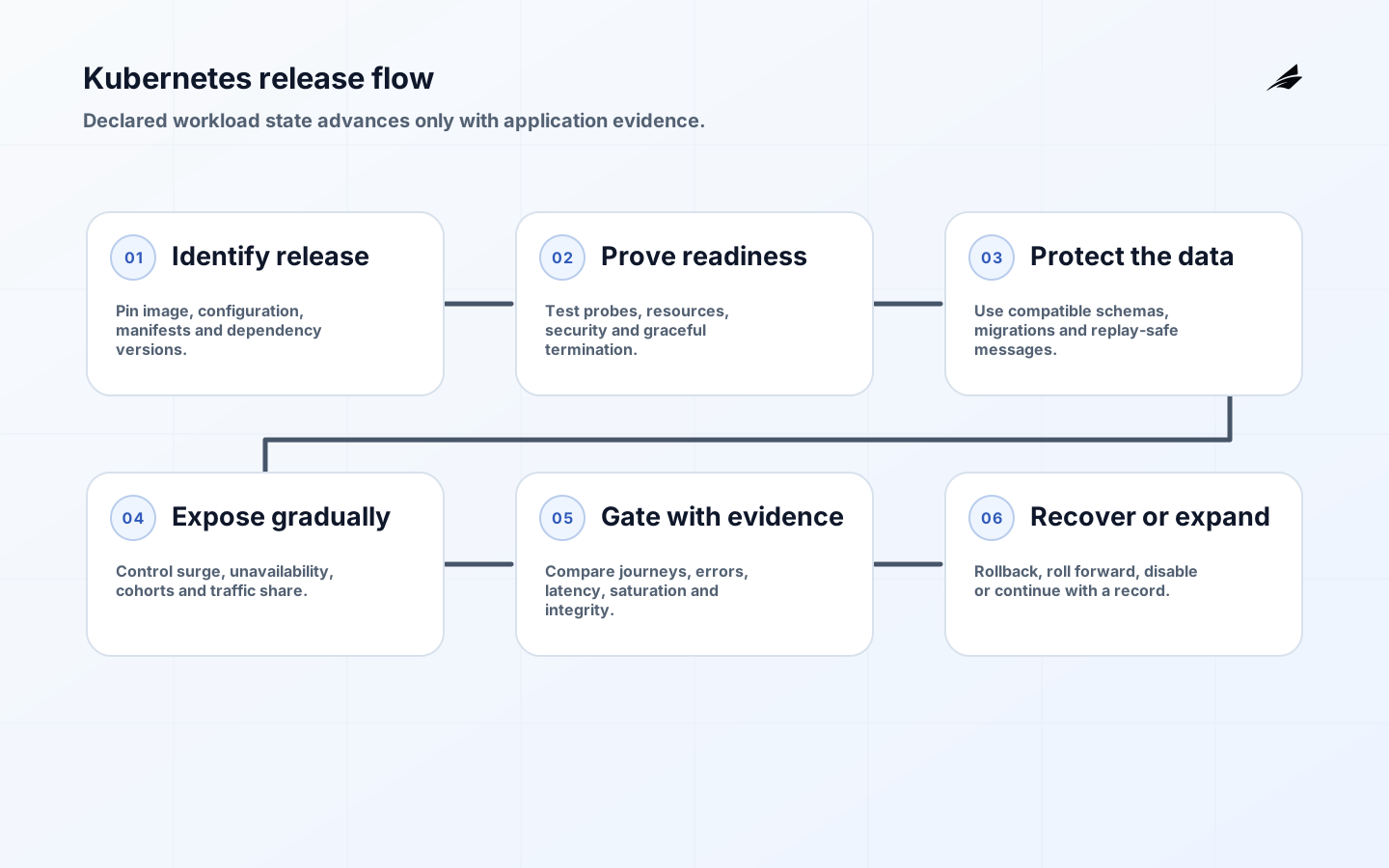
Kubernetes deployments turn an application change into a declared rollout managed by controllers. That machinery does not know whether the new version serves correct responses, has enough database capacity or can coexist with the old schema. Safe Kubernetes deployments therefore combine workload configuration with application readiness, artifact identity, release evidence, traffic exposure and recovery.
The practical unit of release is larger than a Deployment object. It includes the container image, configuration, secrets references, service account, network policy, data migration, Service behavior, autoscaling and observability. The official Deployment documentation explains controller behavior; the delivery team must supply the business and service criteria that decide whether a rollout should continue.
Use Edilec's Kubernetes production checklist for platform readiness, blue-green deployment mistakes and canary release security review for alternative exposure patterns, and Docker image production guide for artifact discipline.
Key takeaways
- Release immutable image digests and version configuration with the workload.
- Make startup, readiness and liveness probes answer different operational questions.
- Set requests and limits from measured behavior, including rollout overlap.
- Use release gates based on user outcomes and service health, not pod state alone.
- Design database compatibility and rollback before deploying the new version.
Define the release contract
Before writing YAML, define the service objective, critical journeys, acceptable error and latency change, rollout duration, stop conditions and recovery objective. Name the release owner and incident commander. Specify how many old and new replicas may coexist, whether requests are stateful, how connections drain and which dependencies could be amplified during startup. These choices determine strategy values more reliably than copied defaults.
Pin images by digest or enforce immutable tags, retain build provenance and record the exact manifest set promoted. Keep environment-specific values separate from application identity while reviewing both together. Avoid mutable configuration that changes running behavior without a release record. A rollback must identify not only an earlier image but compatible configuration, secrets, database state and dependent service contracts.
| Release concern | Kubernetes mechanism | Application evidence | Failure if omitted |
|---|---|---|---|
| Version identity | Image digest and labels | Build and dependency provenance | Pods with the same tag run different code |
| Traffic eligibility | Readiness probe | Critical dependencies and warm-up complete | Requests reach an unusable pod |
| Process recovery | Liveness probe | Confirmed unrecoverable local failure | Restart loops amplify overload |
| Capacity | Requests, limits and autoscaling | Measured CPU, memory and concurrency | Rollout cannot schedule or gets throttled |
| Availability | RollingUpdate values and replicas | Service-level disruption budget | Too much capacity disappears at once |
| Recovery | Revision history and deployment tooling | Data and contract compatibility | Image rollback worsens the incident |
Make probes express service state
A startup probe answers whether initialization has completed; readiness answers whether the pod should receive traffic now; liveness answers whether restarting the container is an appropriate recovery. Kubernetes' probe guidance warns that incorrect liveness behavior can cause cascading failures. Do not point every probe at one shallow endpoint or make liveness fail because a shared database is briefly slow.
Keep probe handlers cheap, deterministic and observable. Readiness may consider required local state and critical dependencies, but avoid synchronized checks that overload those dependencies. Use startup probes for slow initialization rather than oversized liveness delays. Test failure thresholds against real pause times, cold starts and overload. Record probe transitions beside request and dependency telemetry so an operator can tell whether traffic removal helped or reduced capacity further.
Budget capacity for the rollout
CPU and memory requests influence scheduling; limits constrain resource use according to resource type and runtime behavior. Use the official resource-management documentation and measurements from representative load. A request based on idle consumption can pack pods too tightly, while an unrealistic limit can create throttling or out-of-memory termination during normal peaks.
Account for overlap created by maxSurge, warm caches, duplicate consumers and migration jobs. Verify cluster headroom before rollout, including topology constraints and unavailable nodes. Horizontal autoscaling can react too late to a fast release or misread startup demand, so establish initial replica capacity. Confirm quotas, priority and disruption settings do not deadlock scheduling. A rollout that cannot create the next ready pod cannot safely remove an old one.
Choose a rollout strategy from risk
Rolling updates suit compatible changes where old and new versions can serve together. Tune maxUnavailable and maxSurge from capacity and disruption tolerance. Blue-green deployment offers a distinct environment and fast traffic switch but duplicates infrastructure and does not solve data compatibility. Canary exposure provides early production evidence from a bounded cohort but requires trustworthy traffic selection, comparison and automated stop criteria.

A Kubernetes Deployment natively manages ReplicaSet progression, not sophisticated user cohort analysis. Service mesh, ingress, feature flags or a progressive-delivery controller may manage exposure, but each adds failure modes. Keep one source of release intent and make traffic state visible. Never call a canary safe because only ten percent of traffic is exposed if that ten percent includes every administrator or a complete high-value region.
| Gate | Signal | Pass condition | Stop response |
|---|---|---|---|
| Scheduling | Pending pods and placement | Required replicas fit across failure domains | Pause and restore capacity |
| Startup | Startup duration and failures | Within tested distribution | Inspect image, config and dependencies |
| Serving | Readiness and endpoint count | Enough ready capacity before old pods drain | Hold progression |
| User outcome | Critical journey success | No material regression against baseline | Remove new traffic |
| Service health | Errors, latency, saturation | Within release budget | Rollback or mitigate |
| Data integrity | Migration and reconciliation checks | No invalid writes or unexplained drift | Stop writers and execute recovery plan |
Treat data changes as a separate release problem
Design expand-and-contract migrations when old and new code overlap: add backward-compatible structures, deploy code that can use them, backfill with checkpoints, switch reads, then remove obsolete structures in a later release. Avoid startup migrations in every replica. Use a controlled job with ownership, locking, timeout, progress and restart behavior. Backups matter only if restoration is tested and recovery time meets the service need.
Rollback is not always the inverse of deployment. If new code writes data the old version cannot read, rolling back the image may compound corruption. Define roll-forward, compatibility mode, feature disablement and data restoration options in advance. Validate message-schema changes and event consumers similarly; queued events outlive pods and can reach a downgraded application after rollback.
Keep release privilege narrow
Use distinct service accounts, namespace boundaries and least-privilege RBAC. Run as non-root where feasible, drop unneeded capabilities, use read-only filesystems and apply appropriate seccomp and policy controls. Kubernetes provides an official security checklist and security context guidance; apply them through reviewed platform defaults plus workload-specific exceptions.
Protect the delivery path too. Restrict who can change workloads, verify artifacts, scan dependencies and preserve API audit records. Do not pass secrets in image layers, command arguments or broad environment dumps. A release should not acquire cluster-wide permission to simplify one installation. Time-bound exceptional access and remove it after use. Policy failures should block promotion with an understandable reason and an owned exception process.
Example: an API rollout under peak traffic
An eight-replica ordering API releases a version with a warmed pricing cache. Load tests show 70 seconds to warm and double normal CPU during that period. The team configures a startup probe around the warm-up, readiness only after the cache and local routes are valid, and liveness around process progress. Requests and temporary surge capacity reflect the measured peak. One new replica is introduced first through bounded traffic.
The canary shows normal pod health but checkout latency rises because a downstream client changed connection reuse. The user-journey gate stops exposure and traffic returns to the old ReplicaSet. Because the database change was additive and disabled behind a flag, no destructive rollback is needed. This is the value of layered gates: Kubernetes state was necessary evidence, but not sufficient release proof.
Kubernetes deployment checklist
- Record image digest, configuration version and manifest identity.
- Validate security policy, permissions and secret references before promotion.
- Test startup, readiness, liveness and graceful termination under failure.
- Measure requests, limits, replica count and rollout overlap under load.
- Prove old and new versions can share traffic and data safely.
- Set user, service and data gates with automated pause or stop actions.
- Exercise rollback, roll-forward and feature-disable paths.
- Retain release events, telemetry, decision records and reconciliation results.
Test termination and background work
A safe rollout also depends on how old pods leave. On termination, stop accepting new work, update readiness, drain connections and complete or checkpoint in-flight operations within the grace period. Make signal handling explicit and test it under slow requests. If a load balancer or client keeps stale endpoints, align its drain behavior with pod termination. Forced kills should leave operations idempotent or recoverable.
Treat workers and scheduled jobs differently from request-serving APIs. A consumer should stop fetching messages before shutdown, finish or release current work and preserve acknowledgement semantics. A CronJob must tolerate overlap, missed schedules and retries according to business rules. During deployment, old and new consumers may process the same queue, so message and schema compatibility matters. Include these workloads in release gates instead of watching only the public Service.
Kubernetes deployments FAQ
Does a PodDisruptionBudget control rolling updates?
Not directly. The disruptions documentation explains that workload rollout behavior is configured on the workload resource, while PDBs primarily constrain voluntary evictions.
Is kubectl rollout undo a complete rollback plan?
No. It can restore an earlier Deployment revision, but it does not reverse incompatible data, external configuration, messages or third-party changes. Plan recovery across the full release.
Should liveness check the database?
Usually not as a direct restart trigger. A shared database outage could restart every pod and worsen recovery. Readiness, graceful degradation and dependency telemetry are generally better for transient shared failures.
Conclusion
Safe Kubernetes deployments connect controller behavior to application truth. Release immutable artifacts, express meaningful health, reserve overlap capacity, preserve data compatibility and gate exposure with user and service evidence. Kubernetes can coordinate the rollout; a well-designed delivery system decides when that rollout deserves to continue and how it will recover.