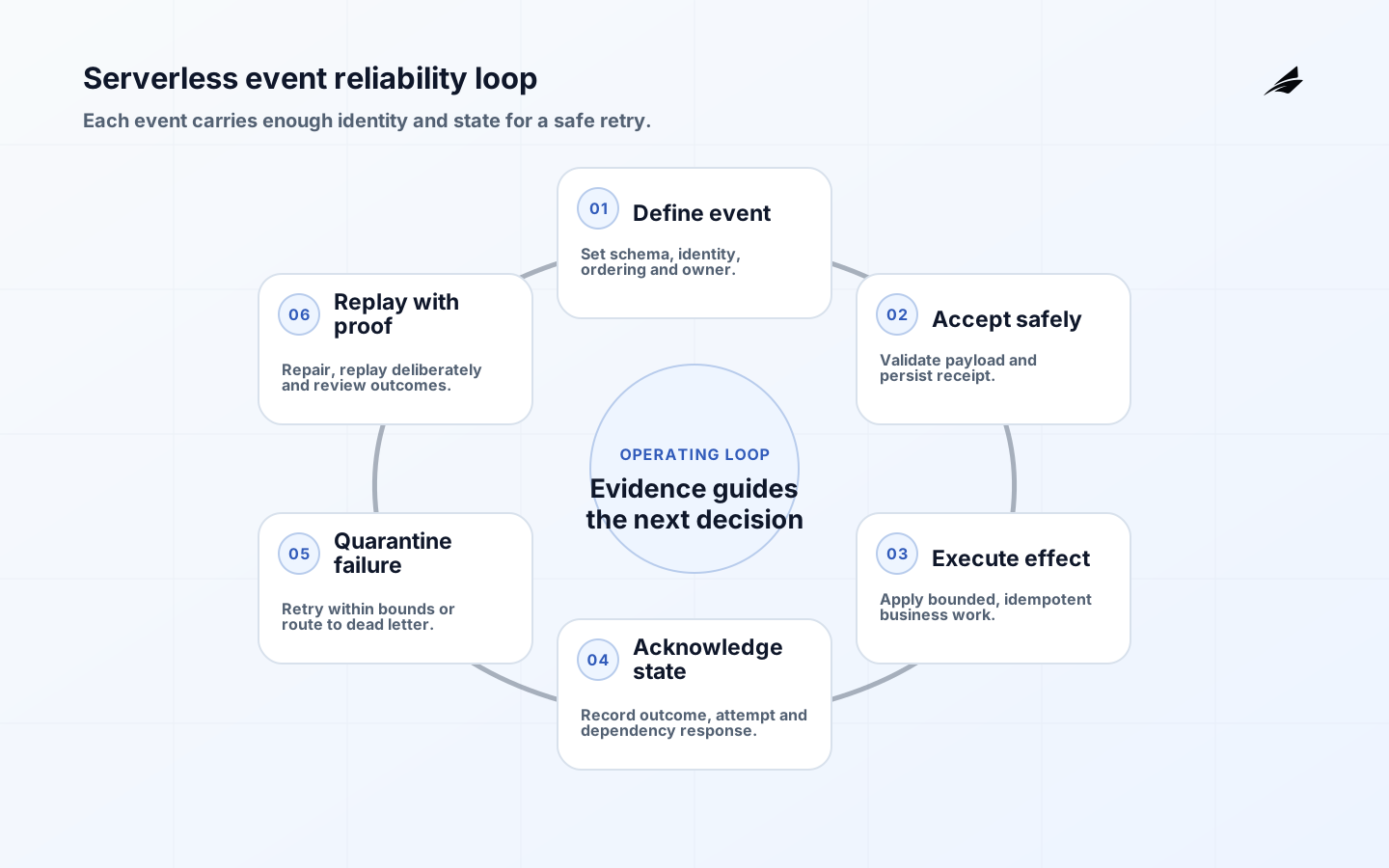
Serverless architecture should be treated as an event contract, not as a tool purchase or a YAML exercise. Before the first build, an engineering team needs to decide what it is trying to protect: a delivered event produces one understood business result even when execution is retried. That decision changes the design. The important record is not a screenshot of a successful run; it is event identifier plus the context that explains its effect. Automatic retries multiply a payment, email, or inventory adjustment after a timeout or partial failure. For serverless architecture, the practical goal is a repeatable path that makes the next action clear to the person on call, the service owner, and the customer-facing team.
Key takeaways
- Start serverless architecture with one accountable owner and one customer-facing outcome.
- Use event identifier as durable evidence rather than relying on memory or a mutable label.
- Design schema validation, idempotency storage, bounded concurrency, dead-letter handling, and a replay procedure before scaling the workflow.
- Pair technical evidence with event age, retry count, dead-letter depth, invocation errors, throttles, and completed business outcomes.
- For serverless architecture, make the recovery action and its authority explicit before normal operation begins.
Define an event contract before implementation
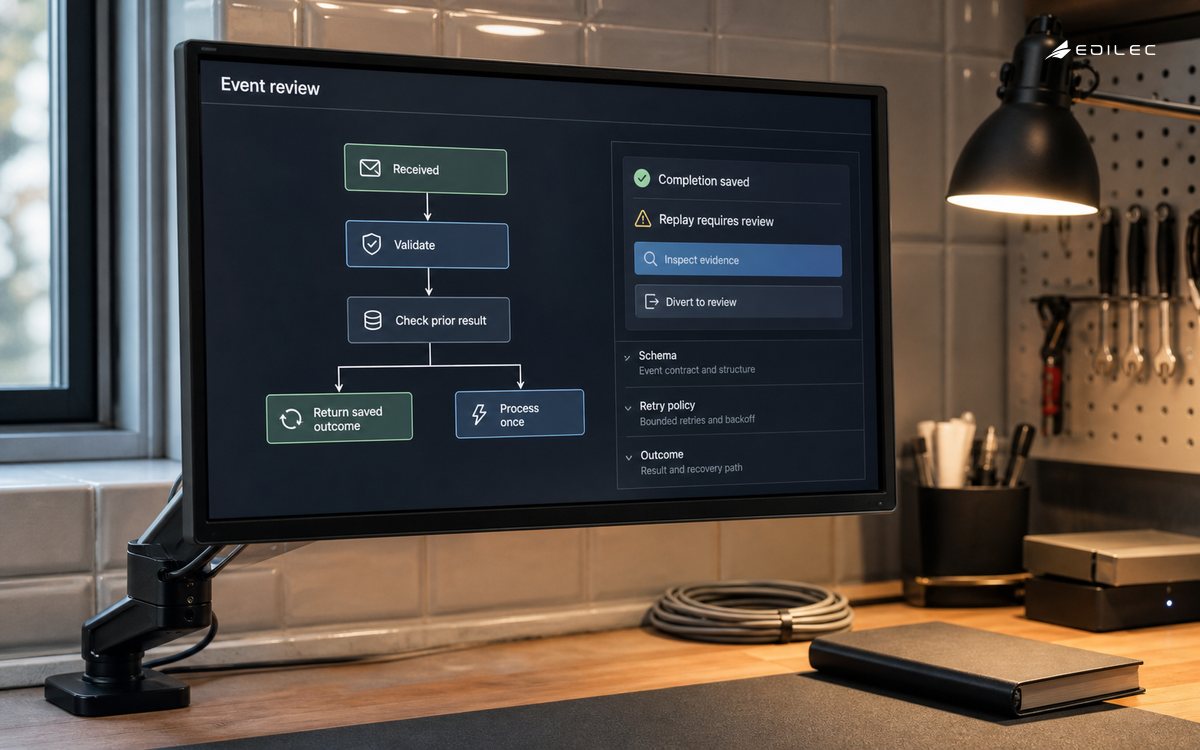
The first design conversation for Serverless architecture should produce a small, reviewable contract. For serverless architecture, state the system boundary, the trigger or change that crosses it, the owner who may decide, and the evidence required to proceed. For serverless architecture, then identify the unhappy path: dependencies that time out, invalid state, untrusted input, capacity pressure, and a person who is unavailable. For serverless architecture, this is where teams turn a vague reliability ambition into operating choices. Schema validation, idempotency storage, bounded concurrency, dead-letter handling, and a replay procedure are valuable because they reduce the number of assumptions a responder must reconstruct during pressure. Choose the source of truth and idempotency key for one event before adding more consumers. An order-confirmed event can carry a stable event ID; the email worker stores the ID before sending, so a retry observes the previous completion rather than sending a duplicate receipt.
| Decision area | Evidence to retain | Why it matters |
|---|---|---|
| Trigger | Producer identity, schema, and delivery semantics | Clarifies what the consumer may trust |
| Concurrency | Reserved or maximum execution setting | Bounds downstream pressure and cost |
| Side effect | Idempotency key and durable completion record | Makes retries safe to reason about |
| Failure route | Retry rule, dead-letter target, replay owner | Keeps failed events visible and repairable |
Make serverless failure risk visible
Serverless architecture work best when the safest route is also the easiest routine. For serverless architecture, put the required checks and ownership near the action instead of relying on a separate document. A team should be able to see the current event identifier, the scope of change, and the next required decision from the same operational record. This does not mean every modification needs the same ceremony. For serverless architecture, it means the controls should match consequence: a bounded, reversible change needs fast automated evidence, while an irreversible or cross-system change needs compatibility checks, explicit authority, and a repair plan. For serverless architecture, the purpose is not to slow delivery; it is to remove preventable ambiguity.
Use serverless evidence, not proxy success
A successful invocation is only one piece of serverless evidence. Review event age, retry and dead-letter behavior, throttling, completion, and downstream business outcome together over an agreed comparison window. Correlate the evidence with an event identifier where practical and keep a normal-behavior baseline. For serverless architecture, the signal needs a named owner who can decide which response protects the service promise; a dashboard maintainer alone is not enough.
| Situation | Evidence and control | Decision rule |
|---|---|---|
| Transient dependency error | Retry with bounded backoff | Escalate when age or attempts exceed the policy |
| Malformed event | Validate and divert with reason | Fix producer or map the version before replay |
| Duplicate delivery | Check the durable event key | Return prior result without repeating the effect |
| Poison message | Quarantine and investigate | Replay only after a corrective change or data repair |
Start with one event path
Avoid beginning with a broad platform mandate. For serverless architecture, pick a service or workflow that has an accountable team, a known customer outcome, and enough existing telemetry or records to compare before and after. Run the new serverless architecture path through ordinary work, then through a controlled adverse case. Record what required manual judgment and why. For serverless architecture, that result is more useful than a generic scorecard because it exposes missing permissions, unclear handoffs, fragile dependencies, and inaccessible evidence. For serverless architecture, the relevant production companion, serverless production guide, gives additional operating detail once the first path is in use.
Evaluate serverless architecture trade-offs
Serverless pricing and reliability both depend on the shape of work. A long-running synchronous task may need queue decoupling, a state machine, or a different compute model rather than a larger timeout. Set concurrency with downstream limits in mind: an API database that accepts fifty writes per second does not become safer because a function can start thousands of invocations. Version event schemas deliberately, retaining enough compatibility for delayed or replayed messages. Dead-letter queues deserve operational ownership, access controls, and alert thresholds; they are not a place to hide failure. The restore path must include how a corrected consumer will distinguish old events from new ones and how affected customers will be reconciled.
Design serverless recovery
Recovery is not always the inverse of execution. For serverless architecture, a previous revision may be available while data, external side effects, or declared state have already moved forward. Separate immediate containment from restoration and reconciliation. For serverless architecture, define what can be disabled or paused, what evidence must be preserved, and what customer condition proves recovery. For serverless architecture, for changes that touch durable records, a compatible transition and a reconciliation query are often safer than a hurried reversal. The deployment rollback guide explains this distinction for releases; the same discipline applies whenever serverless architecture changes a live system.
Serverless event review checklist
- Name the service owner, operational owner, and decision authority for serverless architecture.
- Confirm that event identifier is retained with enough context to reconstruct an event.
- Exercise one realistic failure without relying on the original implementer.
- For serverless architecture, check that permissions are scoped to the action and target actually required.
- Compare one customer outcome with technical telemetry before widening use.
- Write the containment action separately from the repair or reconciliation action.
- For serverless architecture, set an expiry and an owner for every exception to the normal route.
- For serverless architecture, use the next review to remove a repeated manual step or unclear handoff.
Frequently asked questions
Question: What should an event contract define before serverless implementation? Answer: Define event identity, schema, producer, consumer, ordering, delivery semantics, retry and dead-letter behavior, idempotency key, authorization, and retention. These details determine whether a function can safely create or retry effects.
Question: How should a serverless workflow handle retries? Answer: Make handlers idempotent, persist processing state where needed, classify transient and permanent failures, and route exhausted messages to an inspectable dead-letter path. Never assume a retry means the prior attempt had no effect.
Question: Which serverless signals matter beyond invocation count? Answer: Review end-to-end completion, age of oldest event, duplicate effects, error and retry rates, cold-start or latency impact, downstream saturation, cost, and recovery time. Invocation success alone can hide a broken business workflow.
What is the best first investment in serverless architecture?
Start with the evidence that makes a single important path understandable after a handoff: its event identifier, responsible owner, change or trigger, and customer outcome. For serverless architecture, that foundation makes later automation and standardization safer because teams can investigate a failure without relying on a particular person.
Does serverless architecture remove human judgment?
Platform retries and scaling remove routine infrastructure work, but they cannot decide whether a late event should be replayed or whether a duplicate side effect is acceptable. Humans own those business semantics.
How should a team measure success for serverless architecture?
Measure completed outcomes, retry age, dead-letter backlog, duplicate suppression, throttling, and repair time. Invocation count alone can rise while customers receive no completed result.
Practice an event-driven serverless flow with a real scenario
A payment-confirmed event that times out after the provider accepts the request illustrates why retries need durable idempotency. The worker records the event key and provider response before acknowledging completion. A later retry can return the stored result and queue a reconciliation task instead of charging again.
Conclusion
Serverless architecture becomes dependable when its decisions are visible before the first build. Define an event contract, retain evidence around the event identifier, match controls to consequence, and rehearse the action that contains harm. For serverless architecture, that approach creates faster engineering work because people do not have to rediscover the system while it is failing. For closely related reading, see Serverless Architecture in Production: Events, Limits and Recovery, CI/CD Pipelines in Production: Evidence, Exposure and Recovery, Incident Response in Production: Containment, Communication and Learning, Backup and Restore in Production: Recovery Objectives, Proof and Repair.
Review one event path end to end
Choose one event that matters to a customer and draw its complete path: producer, broker or trigger, function, state store, downstream effect, acknowledgement, retry and dead-letter route. AWS Lambda design guidance recommends stateless functions, decoupling, orchestration for complex workflows and idempotency. Microsoft guidance on reliable event processing makes the at-least-once implication explicit: a consumer must be safe when the same event is delivered more than once.
Record event identifier, schema version, received time, attempt count, state transition and downstream response. Then test the hard cases: a timeout after the external system accepted the request, a poison event that never succeeds, a throttled function, and a replay after repair. Define whether the operator retries, quarantines, compensates or asks for a business decision. For nearby operational detail, see serverless in production, incident response in production, and backup and restore.
Further Edilec context: Serverless production guide, Incident response in production, Backup and restore in production. The production path applies those references specifically to serverless architecture before the first build: events, state and recovery.
Source trail: AWS Lambda application design covers statelessness, orchestration and idempotency; AWS event-driven architecture explains push and pull sources; Azure Functions architecture guidance maps reliability choices; and Azure reliable event processing explains at-least-once delivery. Use the sources to test the full event path.