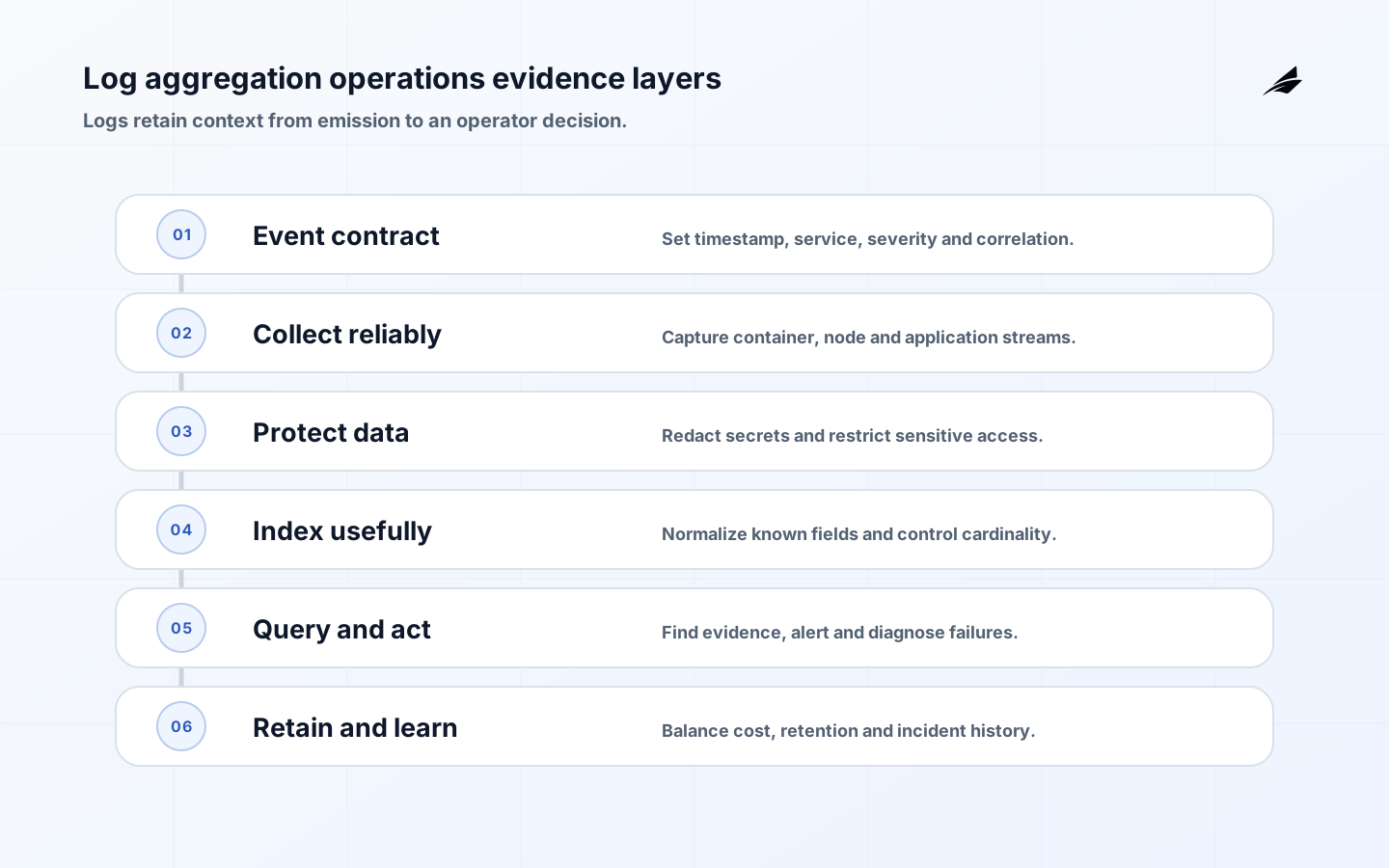
Log aggregation is useful when it helps an operator answer what happened, to whom, where, and what should happen next. It is not shipping every line to a central index. Unstructured volume, inconsistent time, missing request context, and accidental secret capture create an expensive archive that still fails during an incident. Fund a log program as an operational product with a data contract, access model, retention policy, and user outcomes.
Establish the log aggregation operating boundary
Start with decisions logs must support. Responders connect an alert to deployment and a customer-safe request identifier; security reviewers find access-denied events; support explains without seeing payloads. Define event classes, required and permitted fields, source systems, and owners. Include infrastructure, application, audit, and integration events, but distinguish retention and access. One storage setting rarely suits high-volume debug output and privileged audit evidence.

| Decision area | Working rule | Evidence to keep |
|---|---|---|
| Time and service | Orders events and establishes origin. | Synchronized clocks and canonical names. |
| Revision | Connects behaviour to change. | Release metadata injection. |
| Correlation | Follows safe operation across services. | Avoid raw personal identifier. |
| Outcome | Explains success or failure. | Schema review and redaction. |
Design log aggregation for safe change
Create a schema that survives boundaries: timestamp, severity, service and environment identity, deployment revision, correlation reference, event name, outcome, and safe diagnostic attributes. Prefer structured events over post-hoc prose parsing. Redact or avoid secrets and unnecessary personal data at source. Make delivery failure visible so logging outage does not become an observability blind spot during the incident that needs records.
Control the risks around log aggregation
Aggregated logs can reveal customer activity and infrastructure detail. Use roles, segregate sensitive indexes, log privileged search, and provide support-safe views. Protect audit integrity and time synchronization. Define an export path that respects commitments. Operators need speed, but broad permanent access and unmanaged downloads are not its price; a designed emergency route provides access and accountability.
| Scenario | Expected response | Verification |
|---|---|---|
| Delivery lag | Alert and preserve buffering within limits. | Operators know result freshness. |
| Sensitive field | Block or redact and remediate. | No secret reaches broad storage. |
| Schema change | Support old and new consumers. | Queries remain meaningful. |
| Incident search | Find trace, revision, and error context. | Responder explains safely. |
Test log aggregation under pressure
Practice retrieval. Trace a representative request across services, find revision, distinguish customer failure from dependency error, and produce a support-safe summary. Test collector outage, malformed event, schema change, clock skew, and redaction failure in non-production. Verify alerts for delivery lag and storage saturation. The question is whether people can find trustworthy permitted records quickly enough to decide.
Operate and improve log aggregation
Track ingestion by service, dropped events, query latency, search patterns, access exceptions, retention cost, and incident time locating context. Remove low-value fields and noise with the owners who rely on them. When review reveals missing correlation or unsafe exposure, update shared contracts and libraries. Observability improves through small corrections, not endlessly increasing storage.
- Write a log contract.
- Use structured context.
- Redact at source and restrict access.
- Measure ingestion health.
- Run retrieval exercises.
Implementation field notes for log aggregation
Architecture review for log aggregation starts with the structured event, collector, audit trail, storage tier, query role, redaction rule, and retention policy. Give each element an owner, an authoritative source, and expected failure behavior. Follow a normal request across automation, people, and vendor boundaries, then test late, denied, stale, and partial outcomes. For log evidence contract, that turns a feature list into an operating design. It makes the route from ordinary work to accountable recovery visible and reveals assumptions that belong in a runbook, configuration review, or smaller scope rather than in private memory.
Acceptance evidence must be practical. Define what proves the intended control works in representative conditions, who reads the proof, and what result stops expansion. Evidence can be a versioned configuration comparison, scoped identity decision, customer-safe synthetic transaction, audit event, or reconciliation record. Keep it with the release or operating decision. When an operator must gather proof from dashboards, chat threads, and private notes, the control becomes slow exactly when speed and clarity matter. Log acceptance includes finding an event by safe correlation, connecting it to a revision, and producing a permitted support explanation. Test collector delay and redaction; ingestion alone is not useful evidence.
Decision rights are part of log aggregation. Separate authority to observe, change, approve, and override. The person running routine work needs a fast supported path; the person accepting a material exception needs context and a durable record. Define the escalation route before the exception, including the point at which work pauses rather than silently continuing. This avoids broad permanent privilege and makes handoffs inspectable by engineering, security, product, and support without forcing each group to master every implementation detail.
Use a failure exercise that crosses the boundary instead of a healthy-path demonstration. In the operating model, a support engineer cannot explain a failure from an error code without correlation and revision. The response should name containment, stakeholder communication threshold, evidence preservation, and the reconciliation action that proves closure. Rehearse it in non-production where possible, then run a tabletop with the people who would decide and communicate. These exercises expose unavailable permissions, incomplete audit context, undocumented dependencies, and unclear ownership before customers depend on the path.
Measure behavior rather than activity volume. Combine an outcome relevant to log aggregation with a review of operator confusion, support contacts, recurring overrides, and workarounds. Version the calculation and alert separately when evidence is incomplete; a quiet chart is not proof of health if collection failed or people stopped recording exceptions. This lets the team distinguish genuine improvement from a reporting change and gives leadership a defensible reason to prioritize a repair, investment, or retirement.
Cost and capacity belong in the operating review. Estimate direct infrastructure spend alongside release delay, support demand, training, investigation time, and recurring exception cost. Start with one representative workflow and a success and stop criterion rather than a broad commitment based on feature lists. Expand only when teams can explain the value, operate the path without private expertise, and show that it removes a meaningful risk or handoff instead of moving it to another queue. For log aggregation, review the economic trade-off with the owner who experiences it.
Publish what changed, what stays deliberately out of scope, the evidence collected, and the date owners will retest the assumption. Revisit after architecture, ownership, customer-commitment, or incident changes. This keeps log aggregation connected to live operations and makes continual improvement normal delivery work rather than a retrospective promise that disappears after the immediate problem has passed.
Field application: Log acceptance includes finding an event by safe correlation, connecting it to a revision, and producing a permitted support explanation. Test collector delay and redaction; ingestion alone is not useful evidence. In the next operating review, compare that evidence with the stated risk boundary and decide whether the control can expand, needs correction, or remains limited. Record the decision with its accountable owner so later changes do not recreate the same uncertainty.
Incident example: take a support report containing a time, account-safe reference, and symptom. A responder should locate the relevant request, see the deployed revision and dependency outcome, and provide a permitted explanation without copying sensitive payloads. Repeat after deliberately delaying the collector and after introducing a malformed event. Record whether the index made freshness visible and whether the redaction path protected access. These steps test the human retrieval workflow that determines whether log aggregation reduces incident time or merely centralizes storage.
Key takeaways for log aggregation
- Define the customer, service, or risk boundary before implementing log aggregation.
- Make the normal path observable and exceptions attributable.
- Use rehearsals to prove recovery, not dashboards to claim readiness.
- Review the model when architecture, ownership, or commitments change.
Frequently asked questions about log aggregation
Question: What belongs in a useful log record? Answer: Capture the event and observed times, service or resource identity, severity, trace context, safe attributes, and the outcome needed for a decision.
Question: How long should logs be kept? Answer: Set retention from investigation, security, legal, and privacy needs, then tier and delete deliberately instead of retaining every record indefinitely.
Should logs replace metrics and traces?
No. Metrics show trends, traces show request flow, and logs provide detailed events. Link them so operators move from symptom to evidence.
How long should logs stay?
Classify by operational, security, legal, and customer requirement, then apply documented retention and deletion rather than keeping everything.
Can logs contain customer identifiers?
Only when necessary and permitted. Prefer scoped opaque references that support investigation without making logs a customer-data store.
Conclusion: make log aggregation an operating capability
Log aggregation earns cost by turning distributed events into operational evidence. Define decisions, standardize safe context, observe delivery and access, and rehearse the searches incident and support teams perform.
Make log aggregation answerable
A log aggregation system is successful when an operator can answer a question across service boundaries without guessing which host or format contains the evidence. Kubernetes Logging Architecture shows why collection boundaries matter: containers, nodes and cluster components do not all write through the same path. OpenTelemetry provides a common telemetry model, but a backend, retention policy and access design still have to be chosen.
Define a minimum event contract: timestamp, service, environment, severity, request or trace identity, version, outcome and a safe message. Normalize only what helps a known query, preserve useful original context, and redact secrets and personal data before storage or export. Measure ingestion delay, dropped events, query latency, retention cost, cardinality and the time needed to find the first actionable clue. Test a missing collector, malformed event, backend outage and high-volume incident. Pair these notes with observability engineering, distributed tracing, and incident response planning.
Further Edilec context: Observability engineering notes, Distributed tracing guide, Incident response planning. The operating decision applies those references specifically to log aggregation: an operations playbook for cloud systems.
Source trail: Kubernetes Logging Architecture makes collection boundaries explicit; OpenTelemetry defines telemetry generation and export; the OpenTelemetry Collector provides a vendor-neutral processing path; and Google SRE monitoring connects signals to action. A logging platform earns its place by reducing uncertainty during real diagnosis.