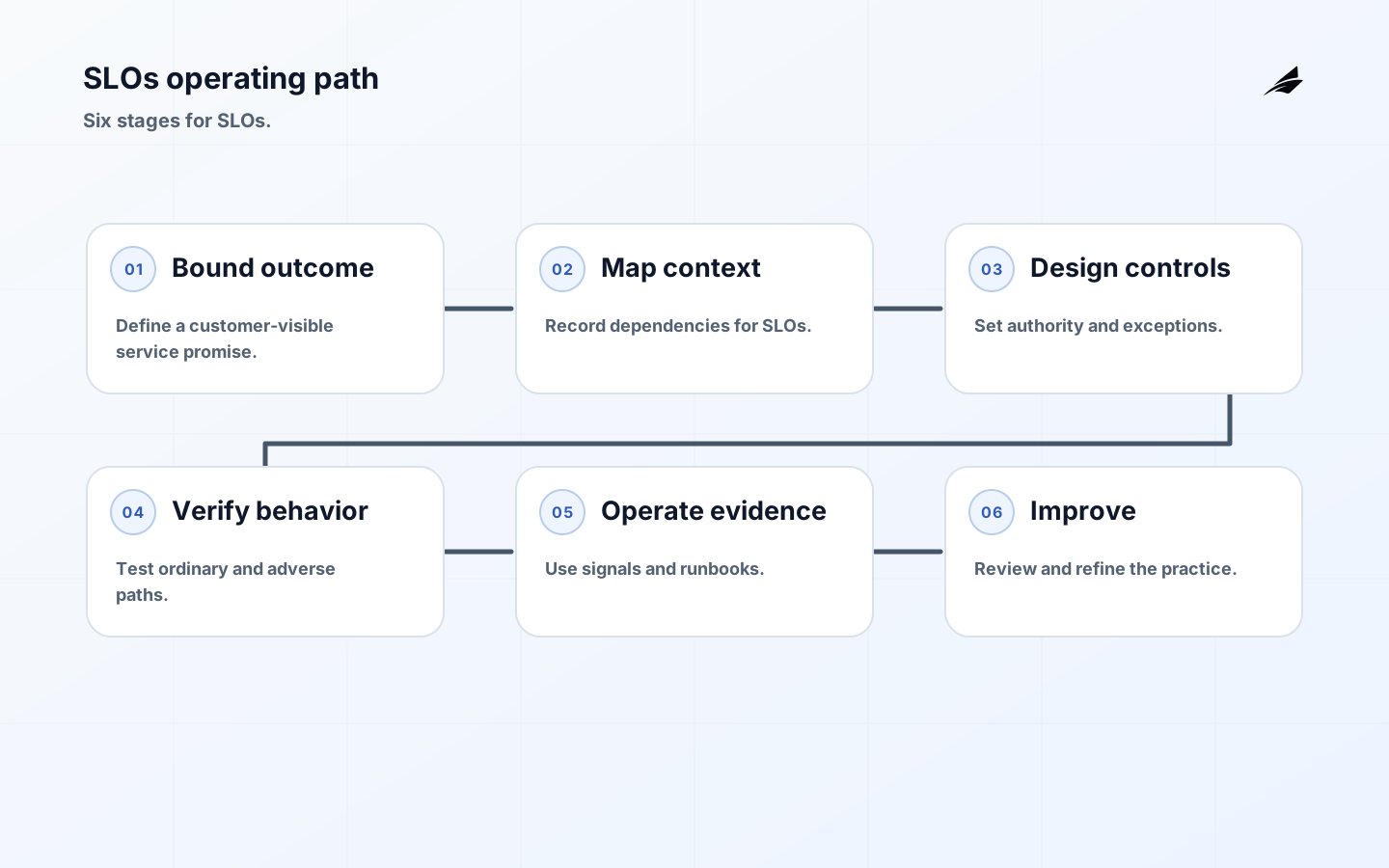
A service level objective turns a reliability expectation into a measurable operating agreement. For engineering teams, an SLO should answer which user experience matters, how it is measured, what period applies, who owns the service, and what happens when the target is missed. It is not a decorative percentage and it is not a substitute for understanding the system. A useful SLO helps teams make trade-offs between feature delivery, reliability work, and operational risk. It gives product and engineering a shared language for deciding when to slow change, invest in resilience, or accept a known limitation.
Start with the user-visible promise
Choose a service behavior that users or dependent systems actually experience: successful checkout, timely API response, completed job, available dashboard, or correct data delivery. State the boundary precisely. An objective for an internal queue may differ from one for an interactive request, and a batch process may need freshness or completion criteria rather than uptime. Write what is included, what is excluded, which dependencies are part of the promise, and who can challenge the definition. If no one can describe the consequence of a breach, the objective is probably measuring activity rather than service value.

Design an SLI that reflects the experience
The service level indicator is the measurement used to evaluate the objective. For availability, define which requests count and which outcomes count as good. For latency, choose the operation, population, and threshold that matter. For freshness, measure the age of data that consumers receive. Avoid relying on an infrastructure signal when a customer-facing signal is available. Check the measurement for missing events, retries, caches, sampling, region differences, and planned maintenance. A clean formula with incomplete telemetry can create false confidence. The team should know what evidence proves a request was good, bad, or not observed.
| Service behavior | Useful indicator | Question to settle |
|---|---|---|
| Interactive API | Good responses within a defined latency. | Which requests represent user value? |
| Async workflow | Jobs completed within an agreed window. | When does the clock start? |
| Data product | Fresh and correct data delivered. | How is correctness verified? |
| Control plane | Successful accepted operations. | Which failures are actionable? |
Set a target teams can use
A target should be ambitious enough to protect the experience and realistic enough to guide engineering choices. Use historical behavior, customer commitments, dependency limits, and the cost of improvement as inputs. Avoid choosing a number because it sounds familiar or precise. Decide the evaluation window and how to handle missing data, partial regions, maintenance, and known exclusions. The target should make a difference to a decision. If every release proceeds the same way whether the objective is healthy or exhausted, the number has not become part of the operating model.
Use the error budget as a decision rule
The error budget is the amount of unreliability allowed by the objective over its evaluation period. Its value is practical: it gives the team a shared basis for deciding whether to spend effort on new capability or reliability work. Define the actions for a healthy, nearly exhausted, and exhausted budget. Those actions may include additional testing, a slower rollout, capacity work, dependency escalation, or a temporary pause on risky changes. Do not turn the budget into punishment for an individual team. Use it to surface system conditions and make trade-offs explicit.
Assign ownership across engineering and product
The service owner maintains the indicator, target, dashboard, and response path, but the decision cannot live only with operations. Product should explain the customer consequence and prioritize reliability investment. Engineering should understand the failure modes and the work required to improve them. Support and incident response should know how to communicate a breach. For shared services, define how consumption, dependencies, and inherited budget are handled. Record who can change the objective and what evidence is needed. A target that can be edited casually is not an agreement; a target that nobody can revise is not an operating tool.
Handle breaches as learning events
When an objective is missed, first verify the measurement and establish customer impact. Then connect the breach to the incident, contributing conditions, containment, and follow-up work. The question is not only why the service failed; it is why the system allowed the failure to reach users and whether the objective still represents the right promise. Look for capacity limits, dependency behavior, deployment risk, missing alerts, unsafe retries, and gaps in ownership. Keep remediation specific and review whether it changed the indicator in the intended way.
| Budget state | Team response | Evidence |
|---|---|---|
| Healthy | Continue planned delivery with normal checks. | Current indicator and review date. |
| At risk | Increase scrutiny of risky changes. | Change assessment and owner. |
| Exhausted | Prioritize recovery and reliability work. | Decision record and release pause. |
| Invalid data | Repair measurement before making a claim. | Telemetry gap and correction. |
Test the measurement and its response
Inject a known failure or replay a representative event to verify that the indicator changes as expected. Check the path from source telemetry to calculation, dashboard, alert, budget decision, and incident record. Test missing data and delayed delivery so silence cannot look like health. Ask a team member who did not design the query to explain the result and choose the next action. Then test a recovery scenario: restore service, confirm the measurement returns correctly, and determine when the budget becomes usable again. This makes the objective a practiced control rather than a chart that is trusted by assumption.
Review and evolve objectives carefully
Review an SLO when the service, user promise, dependency pattern, architecture, or business commitment changes. Compare the original definition with actual incidents and support questions. A target that is always met may be too weak, or the indicator may miss the important experience. A target that is always missed may be measuring an impossible contract, a neglected service, or a faulty boundary. Change one meaningful part at a time where possible, record the reason, and preserve the previous calculation so trends remain interpretable. The goal is a stable decision framework that improves with the service, not a number that moves to avoid uncomfortable evidence.
Review the objective with the teams it affects
Bring product, service owners, support, and incident responders to the review of an objective. Product can explain which failure matters to customers; engineers can explain the measurement and its blind spots; support can show which incidents are difficult to communicate. Compare the target with the service's dependency and release reality. If the budget is repeatedly exhausted by one dependency, the next decision may belong in capacity, contract, architecture, or vendor management rather than in another dashboard adjustment.
Keep a short record of the definition, calculation, target, exclusions, owner, and next review. When the service changes, this record lets a new team member understand why the objective exists and what evidence supports it. It also prevents a target from becoming a silent source of conflict between delivery and operations. A shared explanation makes it easier to choose reliability work before the next breach forces the conversation.
- Define a user-visible promise and service boundary.
- Validate the indicator against real good and bad outcomes.
- Set a target that changes delivery or reliability decisions.
- Use the error budget without turning it into team punishment.
- Test missing data, breach response, recovery, and objective changes.
Key takeaways for engineering teams
- An SLO describes a service promise, not an internal component's health alone.
- The SLI must make good and bad user outcomes observable.
- An error budget matters when it changes a release, investment, or incident decision.
- Product, engineering, operations, and support share the consequence of a breach.
- Review definitions when architecture, dependencies, or customer expectations change.
Frequently asked questions
What is the difference between an SLI and an SLO?
The SLI is the measurement of service behavior, such as good requests or timely jobs. The SLO is the target for that measurement over a defined period, together with the boundary and decision rules that make it useful.
How should teams use an error budget?
Define actions before the budget is exhausted. When reliability risk rises, teams can increase review, test more deeply, defer risky change, or prioritize recovery. The exact response should match the service consequence and the organization's delivery model.
Should every service have an SLO?
Start with services whose failure affects users, important dependencies, or operational continuity. Add more objectives when the team can maintain the measurement and use the result in a real decision. A large collection of ignored targets creates noise.
Further reading and adjacent practice
For reliability and platform context, consult the Kubernetes documentation, Google SRE Book, AWS Well-Architected Framework, and OpenTelemetry documentation. Log evidence that supports an objective is discussed in the related guide on how operations leaders should think about log aggregation.
For adjacent decisions, continue with Edilec's How Operations Leaders Should Think About Log Aggregation and GitOps for Cloud and DevOps: Reconciliation, Security and Operations.
Conclusion: make reliability targets actionable
A good SLO connects a user promise to an honest measurement and a decision the team is prepared to make. Define the boundary with care, test the signal, use the budget to focus attention, and revise the objective when the service changes. The result is not a promise of perfect reliability. It is a clearer agreement about what matters, what evidence says, and what the team will do next.