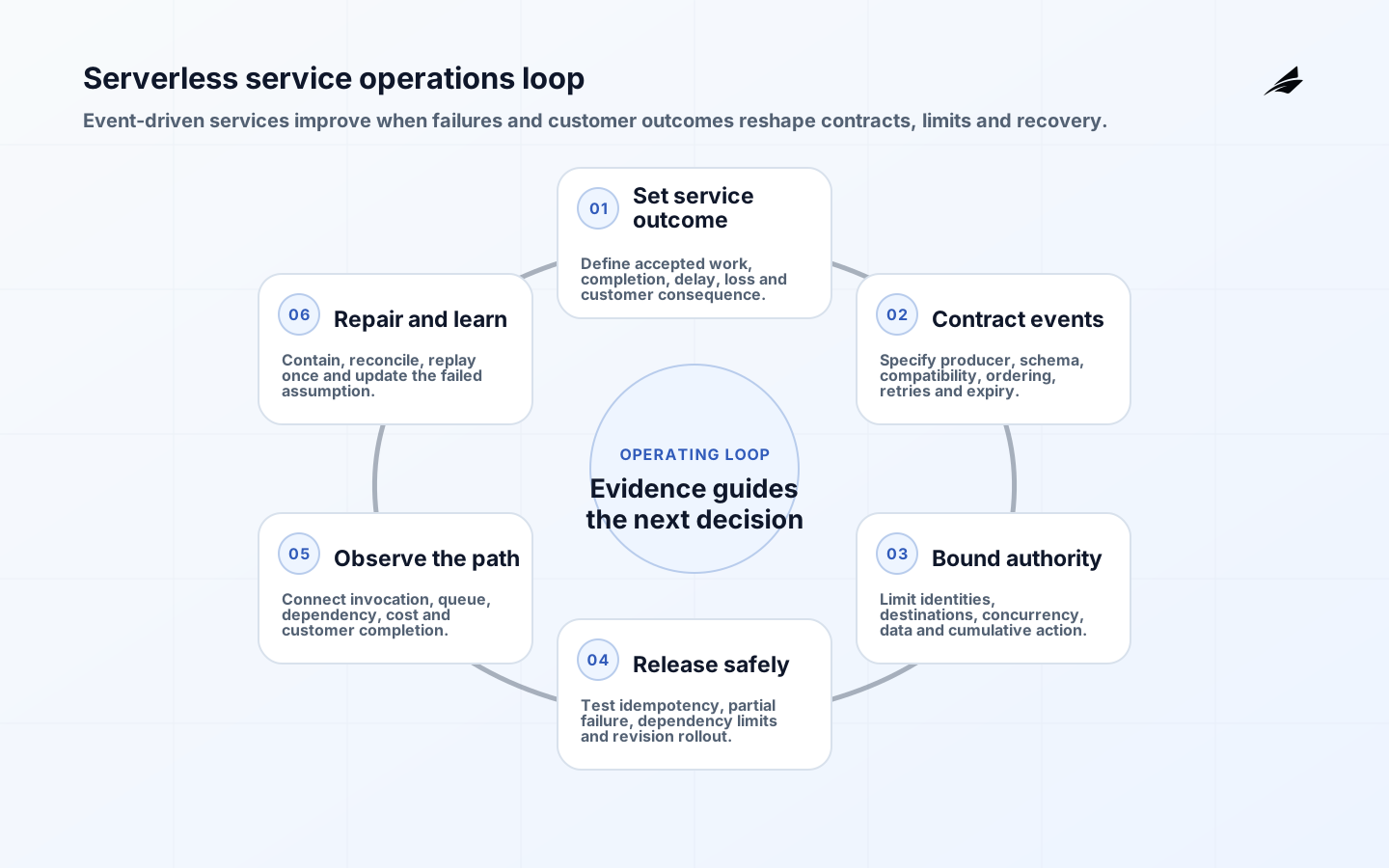
Serverless architecture for IT managers becomes important when a team can no longer rely on shared memory to make a production decision. Serverless shifts capacity and server management to a provider; it does not remove responsibility for the business service. IT managers still need a named owner for each event path, a usable security boundary, an understanding of dependency limits, and a way to repair work when an invocation fails after causing a side effect. The useful question is where the managed platform creates leverage and where it adds coupling. This guide treats the work as an operating system for change: name the service obligation, make the boundary inspectable, choose controls that match risk, and retain evidence that lets a different responder act safely. The companion serverless architecture guidance is useful context when the topic touches a related production concern.
AWS documents application design, Lambda operational practices and a broader Serverless Lens. The vendor-neutral CloudEvents specification standardizes common event metadata, not delivery or business correctness. Together they reinforce the need for idempotency, bounded concurrency, observable event paths and explicit recovery.
Continue with the serverless mistakes guide, production serverless guide and serverless backpressure guide when evaluating retries, overload and event repair.
Key takeaways
- Make serverless architecture for IT managers answer a concrete service decision, not a tool-adoption question.
- Document the boundary, owner, and recovery action before broad production use.
- Use evidence from customer outcomes and technical signals together.
- Start with a bounded implementation, then standardize what survives a real exercise.
Set the purpose and boundary for serverless architecture for IT managers
The first design task is deciding what belongs inside the system and what remains an explicit dependency. Model the system around events and outcomes. For every trigger, document producer, consumer, schema, retry policy, timeout, failure destination, data classification, and customer consequence. A function that processes a payment event is not isolated simply because it is short-lived; its identity permissions, queues, databases, and partner calls create the operating boundary. That description should be short enough to use during a release or incident and specific enough to expose missing owners. It also prevents an attractive platform feature from being mistaken for an end-to-end guarantee. A reliable operating boundary tells a team what it can change, what it must observe, and when it needs another owner involved.
For an event-driven service, state the business outcome each accepted event must reach and what happens when a retry is exhausted. The failure statement should identify the failure queue, repair owner, replay guardrail, and the signal that distinguishes delayed work from lost work.
| Boundary | Decision to document | Why it matters |
|---|---|---|
| Event | Producer, schema, and compatibility rule | Prevents silent producer-consumer breakage |
| Invocation | Timeout, retry, and idempotency behavior | Prevents duplicate or stranded work |
| Permission | Exact data and services the function may use | Limits blast radius of code or credential misuse |
Build an operating model for serverless architecture for IT managers
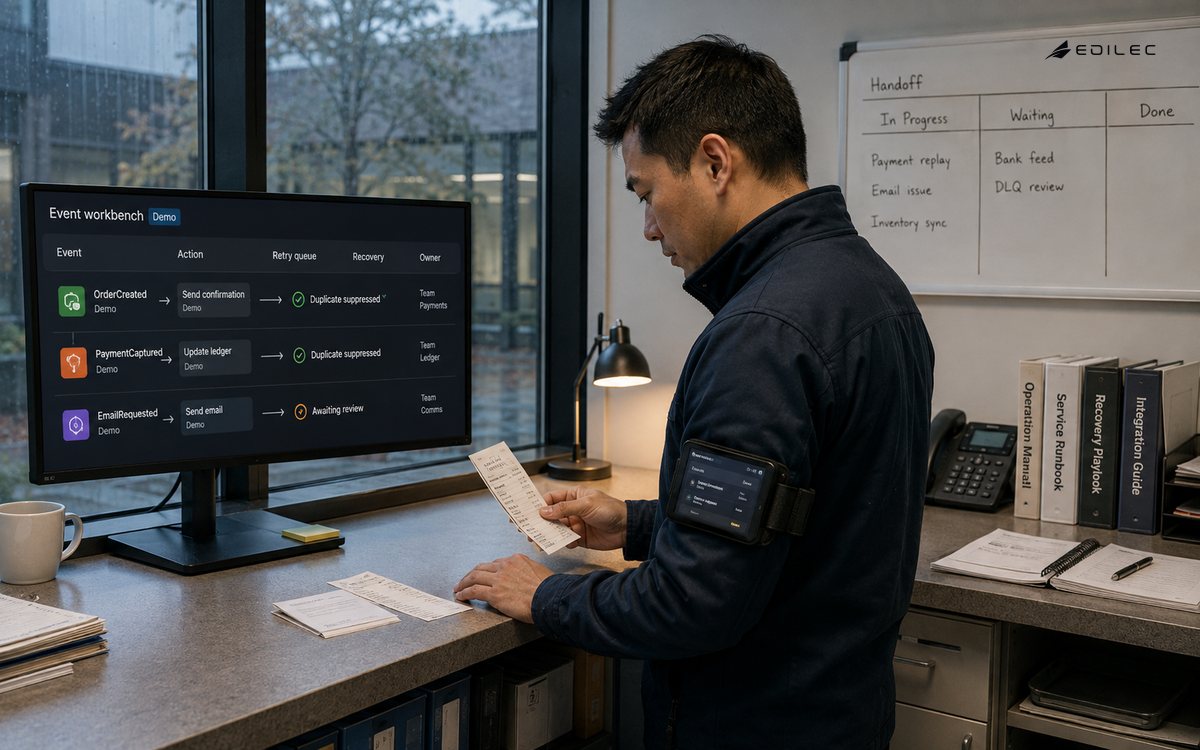
A workable model gives routine operators authority to make the ordinary safe action and makes escalation predictable when evidence is incomplete. Use least-privilege execution roles, separate environments, idempotent handlers, explicit dead-letter or failure handling where supported, and concurrency limits that protect downstream systems. Put configuration and secrets in controlled services rather than code packages. Decide how event versions evolve before teams publish incompatible payloads, especially where replay can reintroduce older messages. The model should identify the accountable service owner, the platform or security partners who set shared guardrails, and the person who validates customer recovery. It should also preserve a narrow exception path. Teams will bypass controls that block urgent recovery; a reviewed, recorded exception is safer than an invisible workaround.
Use proportionate controls and retained evidence
Controls should reduce a specific uncertainty rather than add ceremony. Use least-privilege execution roles, separate environments, idempotent handlers, explicit dead-letter or failure handling where supported, and concurrency limits that protect downstream systems. Put configuration and secrets in controlled services rather than code packages. Decide how event versions evolve before teams publish incompatible payloads, especially where replay can reintroduce older messages. Keep a durable record of the relevant revision, the target or affected cohort, the decision maker where needed, the observed condition, and the recovery action. This lets an on-call engineer distinguish a known change from an unknown symptom. It also makes a later review about the system and its evidence rather than recollection. For related release containment, see observability engineering notes.
| Operational symptom | Containment action | Follow-up |
|---|---|---|
| Throttling | Protect downstream work and assess concurrency | Adjust capacity and workload pacing |
| Retry growth | Pause producer or route failures safely | Inspect idempotency and dependency behavior |
| Dead-letter increase | Preserve messages and notify owner | Repair, replay, or retire invalid work |
Measure the service outcome and operating health
A dashboard should help someone decide what to do next. Monitor invocation errors, duration, throttling, retries, queue age, dead-letter volume, downstream error rates, and successful completion of the customer task. Cost should be examined beside demand and duration, not as a detached bill line: a cost jump may reveal an accidental retry loop or a new workload with legitimate value. Define a baseline before changing the system, label new revisions or cohorts where useful, and avoid treating a single aggregate as the whole story. Pair a leading signal that helps contain harm quickly with a customer or business signal that confirms whether the service obligation was restored. Review the signals after a real event and remove measurements that cannot support an action.
Adopt serverless architecture for IT managers in deliberate increments
Broad mandates often hide unresolved edge cases. Select an event-driven use case with a clear owner and bounded repair path, such as document conversion or notification preparation. Establish the event contract, dashboards, alert thresholds, access review, and replay procedure before connecting a critical business process. Then use the result to define a reusable service template, including the exceptions that still need a different runtime model. Publish the reference path, its owner, and the conditions under which a team may use an exception. Then revisit the reference after an incident, recovery exercise, or significant architectural change. The point of standardization is not uniformity for its own sake; it is to make the next decision faster, safer, and easier to explain.
Worked operating scenario
Consider a concrete situation rather than an idealized diagram. A document service triggers a function after upload. A new version times out after storing a partial record but before publishing its completion event, and retries create duplicate records. The fix is not merely a longer timeout. The team makes the write idempotent with a request identifier, records a completion state, sends repeated failures to a reviewed queue, and gives operations a safe replay tool. Managed execution did not remove distributed-systems work; it made its boundaries easier to see. This kind of scenario is valuable because it tests the handoffs between engineering, operations, product, and security. Ask who observes the first signal, who has authority to contain the effect, which records or customers need repair, and what evidence proves normal service has returned. When those answers are clear before pressure arrives, the system can change with considerably less guesswork.
Run a readiness review for serverless architecture for IT managers
A readiness review turns serverless architecture for IT managers from a proposed design into a demonstrated operating capability. Review a complete event path under timeout and retry conditions. Verify the execution role, message schema, failure destination, idempotency behavior, and the procedure for safely replaying work. The test should distinguish an accepted but delayed item from an item that needs manual repair, which is the distinction customers and support teams ultimately feel. Capture the result as a small decision record: the scenario, participants, observed evidence, elapsed time, unresolved assumptions, and the owner for each correction. Repeat after a material architecture or ownership change. This is deliberately practical work. It shows whether instructions, permissions, telemetry, and decision rights still line up when a team must protect a real service rather than explain an ideal workflow.
Frequently asked questions about serverless architecture for IT managers
Is serverless automatically cheaper than long-running services?
No. It can reduce idle-capacity cost and operational burden for variable demand, but high invocation volume, long duration, data transfer, and downstream services can change the economics. Compare a complete workload cost with reliability and delivery needs.
When is serverless a poor fit?
It can be a poor fit when a workload needs persistent connections, specialized runtime control, predictable long-running execution, or low-latency behavior that a provider's limits cannot support. Evaluate the actual service contract rather than a label.
What evidence should leaders ask for?
Ask for evidence that the stated boundary, controls, and recovery path work in the environment that matters. For serverless architecture for IT managers, that normally includes a named owner, a current revision or configuration record, service and customer signals, and the result of a relevant test or exercise. Prefer a small set of evidence tied to a decision over a large inventory that nobody uses under pressure.
For serverless services, include the event contract in change review. A code change that preserves function tests can still alter timeout behavior, payload compatibility, or downstream pressure. Reviewing those boundaries together keeps a fast deployment path from becoming an unbounded retry path.
Conclusion
Serverless architecture for IT managers is most useful when it makes production work more understandable and recoverable. Start with one service promise and one bounded path, assign ownership, collect only the evidence that supports a decision, and practice the recovery action. The resulting discipline gives teams room to move faster without losing track of what customers experience.