Docker images are production artifacts, not merely a convenient packaging format. An image carries application code, runtime libraries, metadata, and the instructions that a platform will use to start a process. Architecture choices made during its build affect startup time, patching, debugging, provenance, and the ability to identify what is running. A sound image practice therefore treats the registry, build system, deployment manifest, and runtime policy as one chain. The key question is not whether an image can start locally, but whether the organization can explain and safely promote the exact digest serving customers.
Key takeaways
- Treat Docker images as an operating decision with a named owner and explicit evidence.
- Separate the normal delivery path from the exception or recovery path before production pressure arrives for the Docker image supply chain.
- Use customer, service, and operational signals together so a technically green result does not hide a failed outcome for the Docker image supply chain.
- Improve the supported pattern from incidents, exercises, and recurring exceptions rather than relying on informal memory for the Docker image supply chain.
Build for repeatability and a small runtime surface
Separate build dependencies from runtime dependencies where the language and toolchain allow it. A multi-stage build can compile or bundle in one stage and copy only the required output into a smaller runtime image. This reduces accidental tools and files, but it is not a security guarantee by itself. Pin base image choices to a policy the team can maintain, understand what package manager artifacts remain, and make ownership of the base image explicit. An unowned base image is a deferred production dependency.
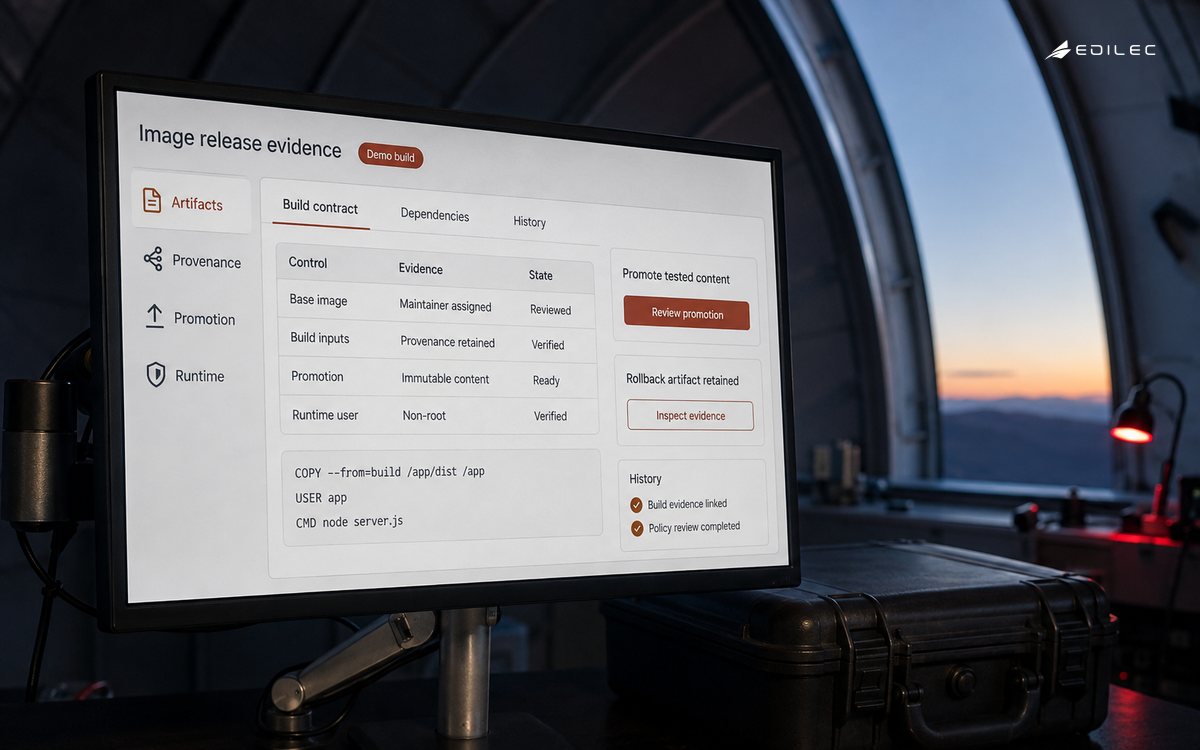
Use immutable digests for production promotion rather than relying on a mutable tag such as latest. Tags are useful human labels, but a deployment should resolve to the content that was tested and approved. Record the source revision, build system identity, dependency or SBOM evidence where available, image digest, and test result. Docker build attestations can carry provenance and SBOM information, but their value depends on verification policy and a clear response when an attestation is absent or does not match expectations.
| Image decision | Preferred evidence | Operational benefit |
|---|---|---|
| Base image selection | Maintainer, digest, patch policy, and intended runtime | Clear responsibility for inherited software. |
| Build output | Reproducible build metadata and artifact digest | Ability to identify the exact deployed content. |
| Registry promotion | Immutable digest plus approval or policy result | Avoids a tag silently changing under deployment. |
| Runtime user and ports | Documented process, permissions, and health behavior | Makes container failures easier to diagnose. |
Connect registry promotion to deployment policy
A registry should distinguish build output from artifacts eligible for a protected environment. Promotion can be a metadata action, a signed reference, or a policy-controlled repository path, depending on the platform. What matters is that the deployment mechanism consumes the approved digest and retains a record. Scanning is useful when it produces prioritized, actionable findings tied to the image and its exposure; an enormous unowned vulnerability list is not a control. Define severity thresholds, exception authority, and a patch route before an urgent release arrives.
At runtime, Kubernetes and other platforms add their own image behavior. Pull policy, registry credentials, node caching, architecture compatibility, and admission controls affect what actually starts. Do not assume that a tag change will update a running workload or that a locally cached image proves it was authorized. Test the deployment manifest with the same image reference and access mode used in the target environment. Runtime policy should prevent known bad patterns while leaving a documented route for legitimate exceptions.
Design the Docker images decision path
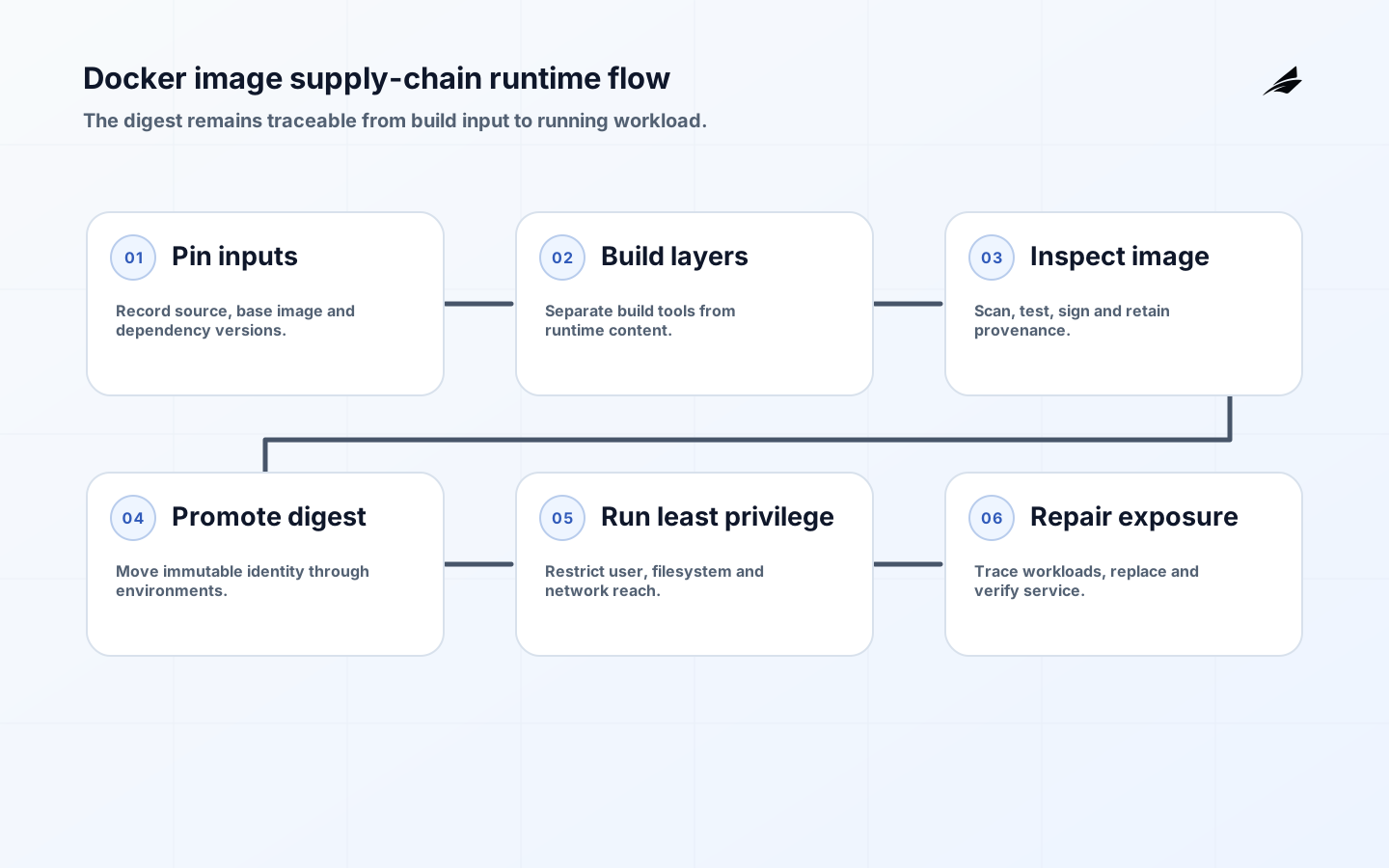
The image path begins with a maintained base and reproducible build, records provenance and test evidence, promotes an immutable digest, verifies it at deployment, observes the running workload, and feeds patch or incident evidence back into the next build. The diagram keeps the registry from becoming a blind storage bucket.
| Runtime symptom | Image-related check | Likely next action |
|---|---|---|
| Pod uses unexpected code | Compare deployed digest with release record | Correct manifest or promotion reference; investigate access. |
| ImagePullBackOff | Check registry authorization, name, and network path | Fix credential or reference without changing unrelated app code. |
| Vulnerability finding | Check affected package, exploitability, and exposure | Patch base or dependency; document a bounded exception if needed. |
| Slow rollout | Inspect image size, pull behavior, and node capacity | Reduce runtime surface or adjust delivery capacity deliberately. |
Make image security operational rather than aspirational
Set a minimum image contract that engineers can meet: approved base-image sources, non-root execution where compatible, no embedded production secrets, a health behavior, a content digest for production, and retained build evidence. Apply stronger controls to workloads with sensitive data or broad network reach. A single universal policy can be either too weak for critical systems or too burdensome for internal tools. Classify consequence and explain the reason for each requirement so teams can design with it instead of discovering it at deployment time.
Plan for patch response before a critical advisory. Know how to find deployments using a digest, how to rebuild against a fixed base, how to test the new artifact, and how to promote it through environments. Maintain a small inventory of image owners and runtime locations. This is much more useful than a weekly report that identifies a package but cannot identify the affected service or its exposure. Image hygiene is a continuous delivery responsibility, not a quarterly registry cleanup.
Use production evidence to improve image design
Review container start failures, pull latency, base-image patch lag, scanner exception age, and incidents where the deployed digest could not be identified quickly. Each category points to a different improvement: build cache design, registry topology, metadata retention, policy usability, or deployment records. Avoid interpreting a low number of vulnerabilities as proof of a healthy process; coverage and response capability matter more than a snapshot count. The process should make the next image easier to trust.
Retire unused repositories and old tags according to a retention policy that respects rollback and investigation needs. A registry without lifecycle rules accumulates costs and ambiguous artifacts; a registry that deletes every prior image removes recovery options. Tie retention to released digests, supported versions, and legal or audit obligations. The decision should be visible to service owners so a cleanup operation does not unexpectedly remove the only artifact needed for a proven rollback.
Worked image decision
A team builds an API image from a language runtime base, publishes a tag, and later discovers that a deployment using the same tag started a different image than the one tested. The immediate cause is a mutable tag, but the deeper issue is that the promotion process never named immutable content. A better route records the build digest, provenance, test result, and release approval, then updates the deployment manifest to that digest. When a security advisory affects the base image, the registry inventory can show which released digests contain it and which workloads reference those digests. The team rebuilds, verifies the new artifact, and promotes it through the normal environment path.
This scenario also keeps scanning in proportion. A finding is useful when it can be linked to a deployed image, an owning service, and a patch decision. It is less useful when it creates an undifferentiated backlog across images that nobody runs. The architecture should make the relevant question easy: what content is live, how was it built, and what is the smallest safe route to replace it?
This image discipline has a direct delivery benefit as well. When a production issue occurs, an operator can obtain the digest from the workload, find the build record, compare the source revision and base image to the prior release, and choose a known artifact to restore. That trace takes minutes when the chain is designed, and hours when image names are informal. Build-time choices should support the same clarity: explicit entrypoint, documented exposed interface, predictable configuration locations, and a health behavior that reflects the application rather than a process merely existing. These details reduce the amount of unexplained runtime state that a platform team has to infer under pressure.
Frequently asked questions about Docker images
Question: Why pin an image by digest? Answer: A digest identifies the exact artifact that was built and tested, so deployment can be reproduced even when a human-readable tag later moves.
Question: What belongs in a production image review? Answer: Review the build context, dependencies, provenance, runtime user, capabilities, vulnerability results, and the policy that controls promotion and execution.
Why use an image digest if a tag is easier to read?
A digest identifies immutable content, while a tag can be moved. Keep readable tags for navigation, but record and deploy the digest when the exact artifact matters.
Does a smaller image automatically mean a safer image?
Smaller images usually reduce runtime surface and pull time, but safety also depends on provenance, patching, runtime permissions, exposed interfaces, and the deployment controls around the image.
Conclusion
Docker images become dependable production artifacts when build, registry, policy, and runtime behavior are designed together. Promote immutable content, retain evidence, and make patching and rollback practical for the teams that operate the workload.
Trace one image from build to runtime
A useful Docker image review follows one digest from source commit and dependency resolution through Dockerfile stages, registry publication, deployment admission and runtime permissions. Docker build best practices recommends multi-stage builds, appropriate base images, regular rebuilds, pinned versions and CI testing. NIST SP 800-190 broadens the view to registries, orchestrators and running containers, so a clean build is not the same as a safe service.
Keep tags convenient for people but use immutable digests for promotion and rollback. Record builder identity, source revision, base-image digest, package manifest, scanner findings, signature or attestation, target environment and service owner. When a vulnerability or bad configuration is found, the response should identify every running copy, decide whether to block, replace or isolate it, and verify the business path afterward. Related practice is covered in the plain-language Docker images guide, container security, and Docker images operating guidance.
Further Edilec context: Plain-language Docker images guide, Container security guide, Docker images operating guide. The operating decision applies those references specifically to docker images: architecture, supply-chain evidence and runtime discipline.
Source trail: Docker build best practices covers multi-stage builds, base images, pinning and rebuilds; Docker Engine security explains runtime boundaries; NIST SP 800-190 maps container risks; and SLSA supplies provenance vocabulary. Together they connect image construction to promotion and recovery.