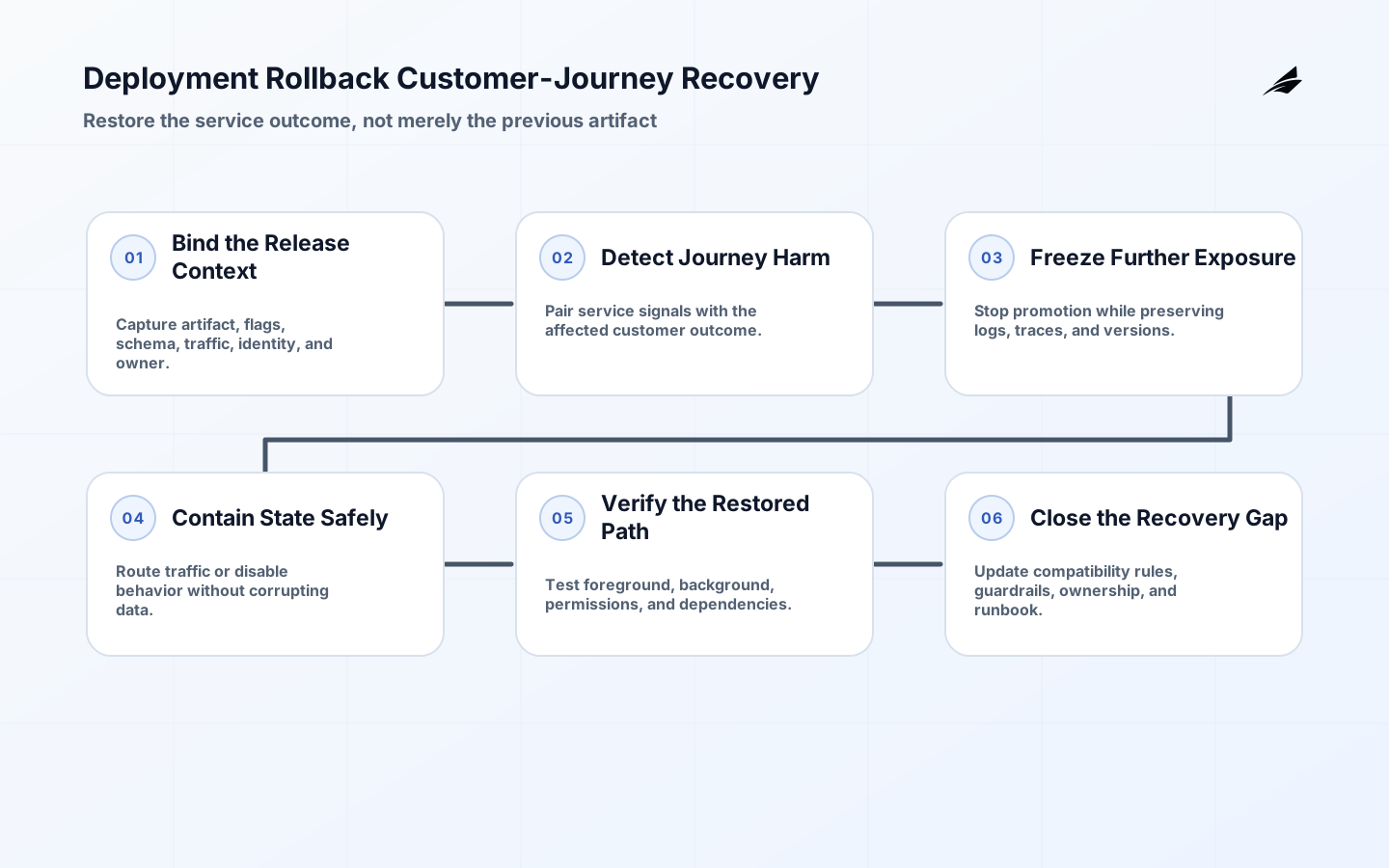
A deployment rollback is a recovery capability for a live service. It is not simply a button that selects an older artifact. The older version may not understand new data, a background worker may continue processing, or a dependent service may already have changed. CTOs should make rollback a system property that spans release design, data compatibility, observability, authority, and customer communication. The practical question is not whether a previous version can start. It is whether the critical customer journey can return to a known working state without creating a second incident.
Define what recovery must restore
Begin with the user-visible failure and the business action that must resume. A checkout may require catalog reads, payment authorization, order creation, inventory reservation, and confirmation. An internal workflow may depend on a queue, an identity provider, and a downstream export. Name the journey, its acceptable interruption, and the evidence that shows it is working again. This boundary gives the incident commander a better question than whether the deployment is healthy. It also helps engineering decide which components can roll back independently and which must be contained together.
Capture release context before launch
Every release should leave enough context for a fast decision: artifact identity, configuration version, schema change, feature state, dependency versions, rollout scope, and owner. Keep the previous known-good state available through the same controlled path used for delivery. Record which migrations are additive, which are destructive, and which require a forward fix. During an incident, people should not reconstruct this information from scattered chat messages. A concise release record reduces hesitation and makes it possible to compare the observed failure with the change that preceded it.

Make data changes compatible
Database migration safety determines whether a rollback is real or imaginary. Prefer an expand-and-contract approach: add a compatible field or table, deploy code that can work with both shapes, migrate or backfill gradually, and remove the old path only after the new release is proven. Treat event schemas and message payloads with the same care. A binary downgrade can fail even when the web process starts because it cannot parse records written by the newer code. If a destructive change has already occurred, the recovery plan may be a forward repair, a replay, or a restore with a defined data-loss boundary rather than a version switch.
| Decision | Working rule | Evidence |
|---|---|---|
| Purpose | Name the restored customer journey. | Owner and scope. |
| Dependencies | Expose code, data, queues, and state. | Versioned change record. |
| Authority | Give one person power to freeze promotion. | Decision log. |
| Recovery | Verify the journey after containment. | Runbook and exercise. |
Set rollback and pause triggers
Agree the trigger before a release is under pressure. Useful signals include a sharp rise in failed requests, a broken critical transaction, queue growth, elevated dependency errors, data-integrity warnings, or a clear regression for the exposed cohort. The threshold should include duration and scope so a brief noisy sample does not cause a needless reversal. Make promotion freeze an available action when the cause is uncertain. Name who can initiate containment, who decides whether to continue, and who communicates the customer impact. Clear authority is a technical control because delay can turn a narrow regression into a broad one.
- Keep the last known-good artifact and configuration addressable.
- Record schema, event, feature-flag, and dependency compatibility.
- Define the customer journey that must be checked after recovery.
- Give incident responders a freeze, contain, and communicate path.
- Practice a failure where the previous version cannot safely resume.
Execute the rollback in controlled steps
First stop promotion and preserve the evidence that explains the failure. Decide whether to route traffic away, disable a feature, pause workers, or restore the prior application version. Contain writes when continuing them would make reconciliation harder, and record the time and scope of any pause. Roll back the smallest safe unit, then observe dependent services before changing another component. Do not hide a failing migration behind a healthy process count. The incident lead should keep a simple timeline of actions, signals, and decisions so the team can detect whether the situation is improving rather than merely changing shape.
Set the recovery observation window
Recovery needs an observation window that reflects the system's delayed work. A synchronous API may settle quickly, while billing, indexing, notifications, or batch processing can reveal the failure later. Define the signals that must remain stable, the queues that must drain, and the records that need reconciliation before the incident can close. Keep the release frozen until that window has passed or an accountable leader accepts the remaining uncertainty. This prevents a team from declaring success after the first healthy request while a backlog or corrupted workflow is still moving through the system.
Coordinate the human response
The rollback plan should identify who speaks to support, customers, security, and delivery teams. Give each group a factual status, the affected journey, the current containment, and the next update point. Avoid promising that all data is safe until reconciliation has been checked. Support can often identify a pattern before a dashboard does, while product can help decide whether a feature should remain disabled. Clear communication keeps the technical team focused and prevents separate groups from making incompatible recovery changes.
Exercise the uncomfortable cases
A useful exercise includes more than selecting a previous artifact. Ask the team to handle a release with a partially completed migration, a busy queue, stale credentials, and a dependency that remains unhealthy. Let the operators use the same permissions, dashboards, and contacts available during a real event. Measure whether they can identify the affected journey, freeze promotion, choose containment, communicate clearly, and verify state. The exercise should end with one practical improvement, such as a compatibility check, a missing signal, a clearer owner, or a runbook step that can be automated. Repeating a small scenario keeps recovery knowledge current as services and people change.
Verify the journey and the state
A successful process restart proves very little. Run a safe representative transaction through the restored path and inspect the records, messages, and side effects it creates. Confirm that retries are not duplicating work, that queues are draining, and that caches or read replicas are not serving incompatible data. Compare customer-facing latency and errors with the pre-release baseline. If the application is available but orders, exports, or notifications remain stuck, recovery is incomplete. Keep the verification steps close to the runbook and make them executable by the people who will be present at an inconvenient hour.
Include reconciliation in the definition of done. Identify requests that were accepted during the incident, records that were written twice, and work that needs replay or manual correction. Give support a bounded explanation for any customer-visible delay and keep the incident owner responsible until those cases have a disposition.
Keep rollback ownership visible in the release system itself. The person approving a promotion should be able to find the prior artifact, migration notes, trigger definitions, and verification steps without requesting special access. That small investment shortens the path from detection to a safe decision and reduces dependence on the engineer who originally built the release.
Improve rollback readiness after every event
After service is stable, reconcile affected state and identify customers who need correction or notice. Then examine the decision boundary: was the trigger late, was the artifact unavailable, did a migration remove compatibility, or did the team lack authority to pause? Convert the answer into a concrete change with an owner and a verification date. Rehearse the changed path in a representative environment. The secrets management guide is relevant when rollback depends on credentials, certificates, or workload identity that also changed during the release.
Decide rollback readiness before deployment
A rollback is dependable when the trigger, state compatibility, execution authority, and verification steps are decided before a release fails. Review these points while the team still has time to change the delivery design.
| Rollback decision | Evidence to inspect | Required response |
|---|---|---|
| Trigger | Error, latency, saturation, business outcome, security signal, and observation window. | Name the threshold and the person authorized to stop promotion. |
| State compatibility | Schema change, queued work, cache state, external side effects, and data written by the new version. | Confirm whether code reversal alone restores a valid business state. |
| Execution path | Artifact, configuration, feature controls, deployment command, access, and communication route. | Rehearse the bounded rollback path using production-like permissions. |
| Verification | Version, service health, critical journey, reconciled records, and unresolved customer impact. | Close the rollback only after service and business state are both checked. |
Key takeaways
- Define the customer journey that recovery must restore.
- Keep release, configuration, schema, and dependency context together.
- Design migrations so the prior safe state remains usable where possible.
- Freeze promotion early when signals are uncertain or worsening.
- Verify state and side effects, not just process health.
Frequently asked questions
Can every release be rolled back?
No. Destructive data changes, irreversible external actions, and incompatible events can make a forward repair safer. Classify those cases before release and document the alternate recovery path.
Who should call for a rollback?
The person operating the incident should be able to freeze promotion and start containment. A named technical or business authority can decide the wider reversal when customer impact or data risk is significant.
When is recovery complete?
It is complete when the critical journey works, dependent state is reconciled or bounded, signals have returned to an acceptable range, and support knows what customers experienced.
For implementation context, consult Kubernetes documentation and Google SRE Book; these references help teams verify platform behavior and operating controls against maintained primary guidance. For adjacent decisions, continue with Edilec's How Engineering Teams Should Think About Secrets Management and How Engineering Teams Should Think About SLOs.
Conclusion
CTOs make deployment rollbacks dependable by treating them as part of release architecture. Preserve compatibility, capture context, set authority before launch, and rehearse the path through data and customer verification. The strongest recovery plan is not the one with the fastest version switch; it is the one that lets a team contain harm, restore a meaningful service, and learn exactly what must change before the next release.