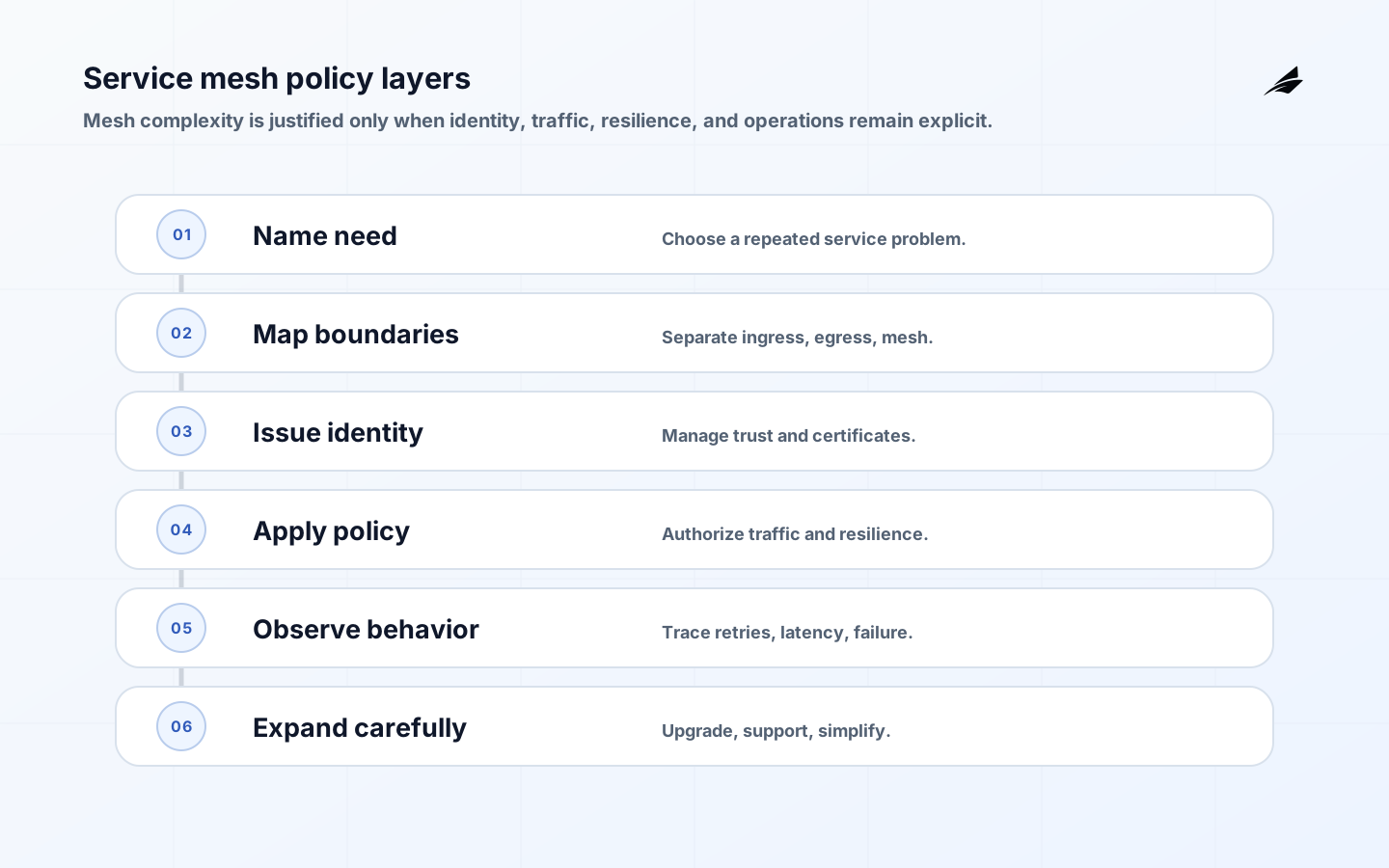
Service meshes add a managed layer for service-to-service communication, commonly providing traffic control, workload identity, mutual TLS, and telemetry. They can reduce inconsistent application-level implementations across a large service estate, but they also introduce control-plane, data-plane, certificate, policy, and upgrade responsibilities. The right question is not whether a mesh is modern; it is whether repeated communication problems exceed what simpler application libraries, gateway controls, and network policy can manage. The Istio architecture overview is a helpful reference for the moving parts. Read it alongside your own incident and delivery evidence before adding another critical platform dependency.
Establish the mesh boundary
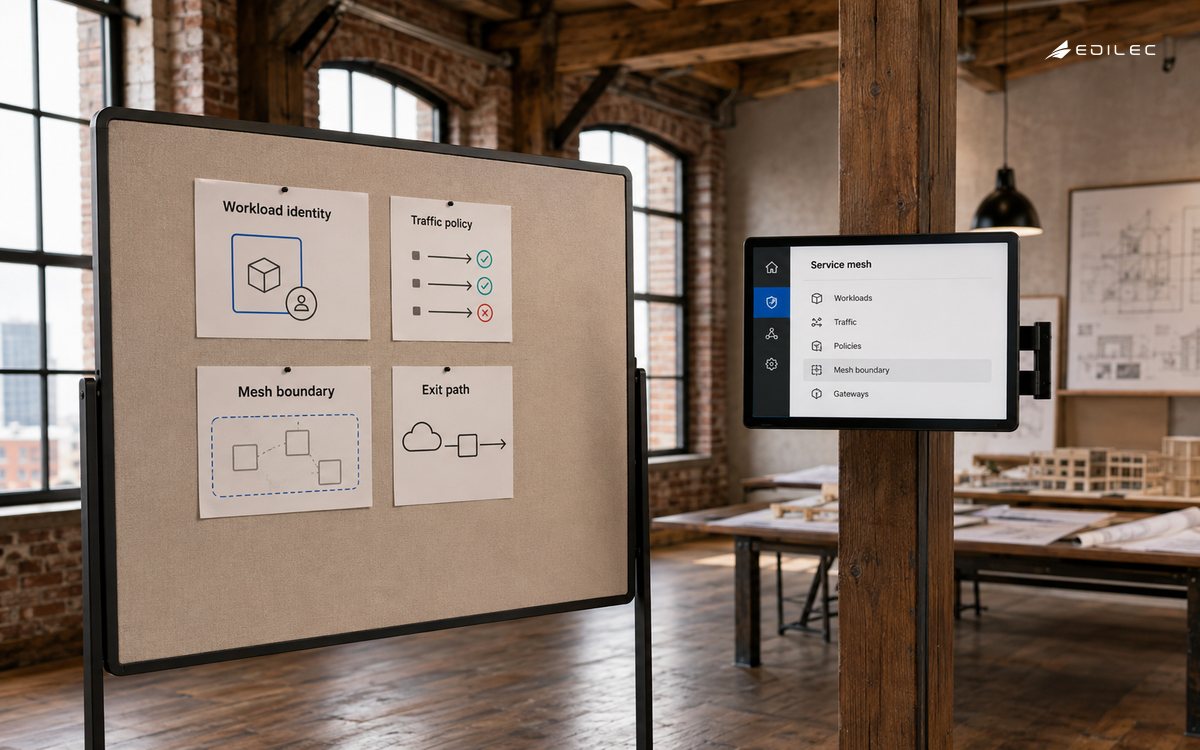
Start with a concrete service communication problem. You may need consistent workload identity across many services, safe traffic shifting for a mature microservice fleet, service-level telemetry that is expensive to add repeatedly, or policy enforcement that cannot be reliably maintained in every codebase. Define which workloads enter first, which traffic stays outside, how ingress and egress are handled, and how the mesh relates to existing gateways and network controls. Avoid a big-bang enrollment of every namespace. Early adopters should have compatible service behavior, committed owners, and a valuable reason to test the platform capability.
| Need | Mesh capability | Alternative to assess |
|---|---|---|
| Workload authentication | mTLS and identity policy | Application credentials or workload identity |
| Traffic shaping | Routes, retries, timeouts | Gateway or client library |
| Telemetry consistency | Proxy-collected signals | Application instrumentation |
| Authorization | Service-to-service policy | Network policy plus application authorization |
Make identity and policy understandable
Transport authentication through mutual TLS depends on correct identity issuance, trust roots, and authorization policy. Map service identities to ownership and permitted calls, then test both allowed and denied paths. A mesh can make encryption easier to apply, but it cannot decide whether the payroll service should call a customer-data API. The Istio security concepts distinguish authentication, authorization, and certificate management; retain those distinctions in operations. Plan certificate rotation, policy rollout, emergency bypass, and audit evidence before requiring every workload to participate.
- Use stable workload identities rather than environment-wide shared credentials.
- Apply authorization incrementally after observing normal traffic patterns.
- Keep policy authorship and review close to the service owners who understand the data flow.
- Test certificate rotation and a denied dependency call in a safe environment.
Use traffic policy to expose trade-offs
Retries, timeouts, circuit breaking, and load balancing can improve resilience, but defaults can also amplify an outage. A retry without a bounded budget may multiply load on a struggling dependency; a timeout chosen without an end-to-end latency budget may fail useful work; outlier ejection can conceal a regional fault. Apply policy to one service relationship at a time, instrument the effect, and keep application semantics in view. A mesh is a delivery mechanism for resilience policy, not a replacement for idempotency, back-pressure, or sensible service contracts.
| Policy | Potential benefit | Question before enabling |
|---|---|---|
| Timeout | Bounds waiting and resource use | What is the caller's full latency budget? |
| Retry | Handles transient failure | Is the operation safe to repeat? |
| Circuit breaking | Protects a dependency | How does the caller degrade gracefully? |
| Traffic split | Supports progressive delivery | Can versions coexist with this contract? |
Operate the mesh as critical infrastructure
The mesh control plane and proxies become part of the request path, so operate them with production discipline. Define availability objectives, upgrade sequencing, capacity requirements, certificate health, policy rollout verification, and an escalation route. Watch proxy resource overhead, control-plane convergence, failed policy pushes, connection errors, and telemetry cost. Kubernetes Network Policies remain relevant even with a mesh because layers have different scopes and failure modes. A clear responsibility map prevents teams from assuming that platform encryption solves application authorization or that application teams can repair a cluster-wide policy outage alone.
Adopt in stages and retain an exit view
Pilot the mesh with a bounded service path and measurable outcomes, such as replacing inconsistent mTLS setup or enabling a known traffic-shifting requirement. Document performance overhead, development workflow changes, onboarding steps, and incidents alongside the security or delivery benefit. Only widen the footprint after the platform team can support upgrades and the participating teams can diagnose failures. Keep configuration portable enough that you understand the cost of changing mesh implementation or simplifying a workload out of the mesh. That discipline protects the mesh from becoming unexamined infrastructure gravity.
Apply the service-mesh operating practice
- Define the operating boundary for service mesh adoption in terms of workload boundary, service identity, traffic policy, proxy lifecycle, and control-plane ownership; this turns a broad technical theme into work that an accountable team can review and improve.
- Name the user outcome and safety signals before changing anything. For this practice, compare service success, proxy health, policy denials, latency overhead, and upgrade readiness with an explicit baseline rather than relying on a tool status alone.
- Record assumptions that affect the decision, including demand, dependencies, time windows, and ownership (for service-mesh operations apply service-mesh). An assumption that stays implicit cannot be tested when conditions change.
- Choose a reversible first action and document the recovery path. This limits the cost of learning and gives the responder a known control when the observed result differs from expectation (for service-mesh operations apply service-mesh).
- Keep the evidence close to the service: versioned configuration, a short decision record, relevant dashboards, and the runbook used by the person who receives the alert (for service-mesh operations apply service-mesh).
- Review the change at a cadence that matches its risk. Look for retry amplification, opaque policy failures, or a mesh that teams cannot operate; treat recurring exceptions as design feedback rather than as a reason to normalize manual work.
- Separate what the service team owns from what a shared platform or partner owns (for service-mesh operations apply service-mesh). The boundary should state who acts, who supplies evidence, and who approves an exception (for service-mesh operations apply service-mesh).
- Test the uncomfortable path deliberately. A quiet success case is not enough; exercise degraded dependencies, delayed work, recovery, and the handoff between ordinary operation and incident response (for service-mesh operations apply service-mesh).
- Use a small representative pilot before broad rollout. Capture what users actually did, which controls confused them, and whether the intended guardrail was visible at the moment of decision (for service-mesh operations apply service-mesh).
- Make exceptions visible, time-bound, and reviewable. An exception is useful when it reveals a real constraint; it becomes debt when it quietly replaces the supported path (for service-mesh operations apply service-mesh).
- Avoid measuring activity as proof of value. Count completed, safe outcomes and the effort required to achieve them, then use both quantitative evidence and operator feedback to choose the next improvement (for service-mesh operations apply service-mesh).
- Preserve context after an incident or failed change: identifiers, configuration state, timing, observed behavior, and the recovery action (for service-mesh operations apply service-mesh). This is more useful than a generic summary when the pattern returns (for service-mesh operations apply service-mesh).
- Review interfaces and contracts at the same time as the primary control (for service-mesh operations apply service-mesh). Many failures appear at boundaries: a client behavior, a delayed message, an identity assumption, or a shared dependency (for service-mesh operations apply service-mesh).
- Give the normal path a clear owner and a usable escalation route (for service-mesh operations apply service-mesh). Teams adopt controls that help them act quickly under pressure and abandon ones that require private knowledge to recover (for service-mesh operations apply service-mesh).
- Retire outdated rules when architecture, product demand, or customer commitments change. Keeping old controls without their original context can create risk as surely as leaving a system unconfigured (for service-mesh operations apply service-mesh).
- Turn the result into the next default for service mesh adoption: keep what protected the outcome, simplify what caused friction, and schedule the next review while the evidence is still fresh.
Stage mesh adoption by policy
The safest service-mesh rollout starts with one policy or traffic problem that has a measurable cost. Choose a small workload set, define success and bypass conditions, and keep the existing route available.
Review security and resilience as separate dimensions. Istio's security overview explains certificate and authorization concerns, while Kubernetes Network Policies provide a distinct network-layer control. Test a permitted call, a denied call, an expired certificate, a policy rollout, a dependency timeout, and a proxy or control-plane outage. Observe application retries with mesh retries; otherwise a policy can appear successful while multiplying load or hiding the real failure. Keep trace context consistent so a request can be followed across the added hop.
Use Edilec's service mesh buyer guide, service mesh practical guide, and secrets management guide when comparing adoption boundaries. The mesh should earn each expansion through evidence: lower configuration drift, clearer authorization, safer traffic change, or a better investigation. If the benefit cannot be separated from the cost of proxies, certificates, upgrades, and new failure modes, simplify the design or keep the boundary narrow.
- Choose a measurable communication problem before enrolling workloads.
- Separate transport identity, authorization, and network policy.
- Test retries, timeouts, certificates, and control-plane failure together.
- Expand only when owners can support the new boundary.
Key takeaways
- Adopt a service mesh for demonstrated multi-service needs, not fashion.
- Define the workload boundary, traffic boundary, and ownership before enrollment.
- Separate transport authentication from authorization and application semantics.
- Test resilience policies because retries and timeouts can amplify failure.
- Operate the control plane, proxies, and certificates as critical infrastructure.
Frequently asked questions about service meshes
Question: Does a service mesh replace an API gateway? Answer: Usually not. Gateways and meshes often govern different boundaries; choose both only when their responsibilities and operational costs are clear. Question: How should a team adopt a service mesh safely? Answer: Start with one policy or identity boundary, rehearse failure, measure proxy and control-plane cost, and keep an exit path before expanding.
Does a mesh replace API gateways? Usually no; gateways and meshes often govern different boundaries. Does mTLS solve authorization? No. It authenticates transport peers; authorization still decides permitted actions. Will a mesh improve every latency problem? No. Proxies add overhead and cannot repair an inefficient dependency. Can we introduce it gradually? Yes, and gradual adoption is usually safer because it reveals operational and compatibility costs early.
Conclusion
A service mesh can make service communication more consistent and auditable when its operational burden is justified. Begin with a real boundary and a narrow outcome, test policies against failure behavior, and run the mesh as a product with owners. Complexity should pay rent.
Run the failure drill before expansion
Before a mesh moves beyond its pilot, run a drill across application, proxy, and control-plane layers. Start with a slow dependency and observe application retries, mesh retries, timeout budgets, circuit behavior, trace continuity, and customer latency. Then rotate a certificate, push a narrow authorization change, and make the control plane unavailable while existing data-plane behavior continues. The goal is to prove that owners know the expected behavior and the safe return path.
Capture a workload-specific runbook with service identity, policy objects, dashboards, bypass conditions, escalation routes, and rollback steps.
Compare the promised benefit with proxy resources, certificate lifecycle, policy testing, upgrade effort, telemetry volume, and developer workflow changes. Keep the mesh where it removes repeated work or protects a boundary simpler controls cannot maintain. The W3C Trace Context specification preserves request identity, but trace continuity alone does not justify adoption. Expand each scope as a release with compatibility checks, a support owner, and rollback. Gradual does not mean unmeasured.
Make mesh complexity accountable
The mesh needs a service-level contract: state its guarantees, excluded behaviors, owner, and evidence for deciding whether it helps. Keep the contract narrow enough to test during rollout and incidents.
After each major mesh change, review a representative request for identity, authorization, timeout, retry, trace context, and policy behavior. Record the result with the workload owner.
Price the exit path by recording which code, certificates, routes, dashboards, and runbooks depend on the mesh. A reversible boundary is easier to operate and replace.
A service mesh decision is complete only when the team can explain the smallest boundary that delivers the benefit and the condition that would make the boundary smaller again. Keep that decision visible in the service catalog and review it after upgrades, incidents, and major traffic changes. The discipline protects application owners from accidental enrollment and gives the platform team evidence for where mesh capability is genuinely earning its operational cost.