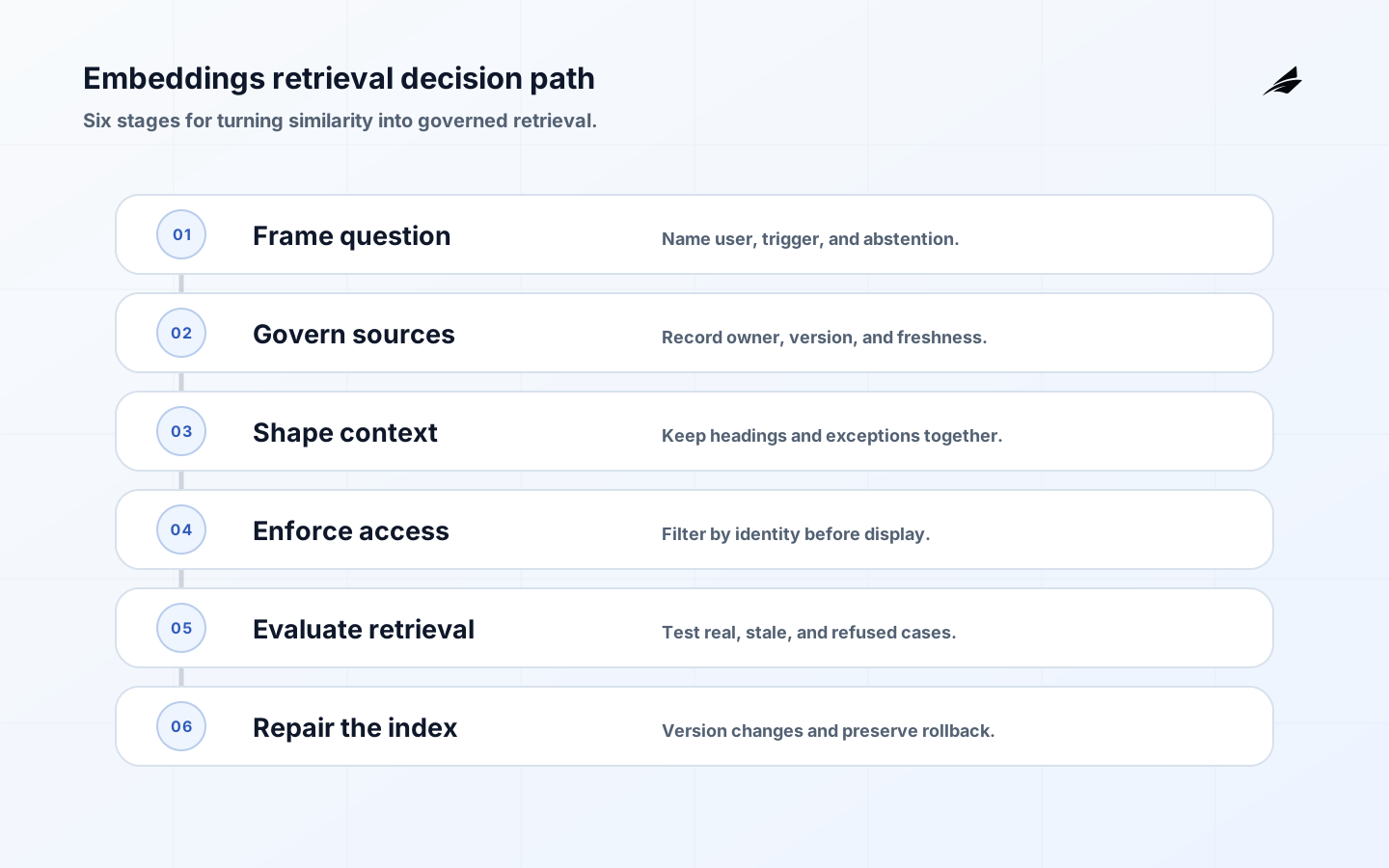
Embeddings are a representation technique, not a complete retrieval strategy. They can help a service find material with related meaning, but a useful result still depends on source authority, chunk boundaries, access policy, query intent, ranking, and evaluation. Before building an index, state the decision the system must support and the evidence a reviewer would accept. The OpenAI embeddings guide explains the basic mechanism; the NIST AI Risk Management Framework adds the lifecycle questions that keep an index accountable. A small, inspectable retrieval path is usually a better starting point than a broad corpus with unclear ownership.
Define the embeddings decision
Write a plain-language statement: a named user may retrieve current, permitted evidence to answer a recurring work question, and the system must abstain or escalate when evidence is missing or conflicting. Add the trigger, corpus, freshness requirement, expected response, and prohibited action. “Make search smarter” is not a testable boundary; “help an analyst locate the policy clause that governs an exception and show its effective date” is. The RAG systems guide and vector search guide are useful adjacent reading when the first decision touches generation or index selection.
| Design question | Why it matters | Evidence to retain |
|---|---|---|
| What decision is supported? | Sets the relevance and abstention standard. | User, trigger, expected action, and owner. |
| Which sources are authoritative? | Prevents stale or unapproved material from ranking well. | Source owner, version, status, and effective date. |
| What access applies? | Avoids retrieval becoming a data-leak path. | User scope, document permission, and filter result. |
| How is quality checked? | Makes changes comparable over time. | Representative queries, expected evidence, and review outcome. |
Design the control boundary
Treat the source record, its chunks, embeddings, metadata, and retrieval logs as governed assets. Preserve source identity and location so a result can be opened and challenged. Define how updates invalidate or replace derived vectors, how deletion requests propagate, and how a user’s permissions are enforced at query time. Do not rely on a hidden filter that has never been tested with mixed-tenant or changed-permission cases. If the service generates an answer after retrieval, show citations or source references and make unsupported claims an explicit failure state.
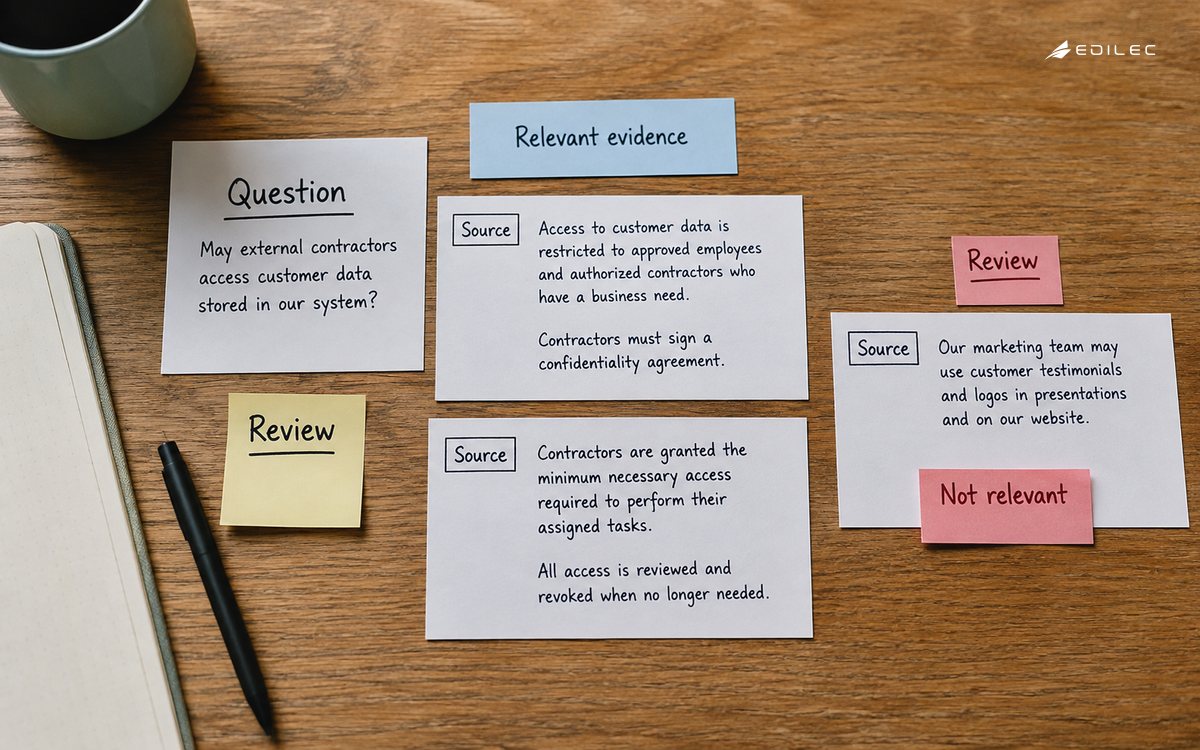
Embedding similarity does not prove truth, permission, or currency. Similar language can connect two policies with different jurisdictions or effective dates. Metadata filters, lexical checks, reranking, and a source hierarchy can reduce these errors, but each introduces behavior that needs evaluation. The NIST Generative AI Profile and OWASP LLM guidance together encourage teams to consider data provenance, testing, prompt or content injection, and incident response. That is especially important when retrieved evidence influences a financial, legal, safety, or customer action.
Measure the real retrieval workflow
Create an evaluation set from actual questions, not only clean examples. Include paraphrases, short queries, ambiguous terms, outdated references, missing evidence, access-boundary cases, and questions that should be refused. Score whether the right source appears in the result set, whether the best passage is prominent, whether the answer uses it correctly, and whether the user can complete the work. Track false confidence and abstention separately. A high recall number can still produce a poor experience if the first result is stale, inaccessible, or too broad to act on.
| Failure mode | What it looks like | Design response |
|---|---|---|
| Chunk loses context | A passage is relevant but omits scope or exception. | Preserve headings, neighboring context, and document identifiers. |
| Stale source wins | An old procedure outranks a current one. | Use effective-date metadata and source authority rules. |
| Permission mismatch | A result is semantically right but not permitted. | Apply identity-aware filtering before generation or display. |
| Semantic collision | Similar terms point to different domains. | Use metadata, query classification, and user-visible disambiguation. |
Operate change and incidents
Version the embedding model or configuration, chunking rules, source snapshot, and index build. When relevance shifts, compare the new index with the previous one on the same evaluation set before promotion. Keep the old route available long enough to diagnose unexpected changes, and record which index served each answer. During an incident, an operator should be able to identify the source, transformation, query, filters, ranking route, and answer generated at the time. Repair may involve correcting source metadata rather than changing the model. Make that distinction visible.
Connect the adjacent decisions
Embeddings sit inside a larger retrieval system. Data ingestion determines what enters the corpus; access control determines who may see it; observability determines what can be reconstructed; generation determines how retrieved material is used. The model evaluation guide helps when the retrieval result feeds a generated answer. The document intelligence guide helps when source files need structured extraction first. Keep these choices separate enough to test and connected enough to explain the final result.
Chunking is a content decision as much as a technical one. Preserve the heading, effective date, audience, and exception language that give a passage meaning. A smaller chunk may improve matching while making an answer unsafe if the condition that limits the rule is left behind. Test chunking with real documents and ask a domain reviewer whether the returned passage could stand on its own. When it cannot, include neighboring context or use a document-level route.
Freshness should be a visible property of the retrieval contract. Set what “current” means for the use case, how quickly an update must reach the index, and what happens during rebuild or delay. If the source is changing while an index is being built, record the snapshot boundary. A user should not have to guess whether a result reflects yesterday’s policy, a draft, or the current approved version. Freshness failure should route to clarification or manual lookup.
Test access changes as part of normal operation. Remove a user’s permission, move a document to a new owner, expire an entitlement, and delete a source record. Confirm that derived vectors, caches, citations, and answer traces follow the intended policy. Do not treat permission filtering as a one-time security review; index rebuilds, new metadata fields, and alternate query routes can reopen a closed path. Make the negative cases part of the evaluation set.
The best retrieval review includes a human explanation of failure. Ask a reviewer to identify why the result was accepted, why an alternative was rejected, and what evidence would have changed the decision. That explanation can reveal a missing source hierarchy, an ambiguous query class, or a metadata field that is not trustworthy. Use the finding to improve the source and workflow before tuning similarity thresholds. A tuned score cannot repair an unclear authority model.
A retrieval service also needs a clear degraded mode. If the index is stale, source permissions cannot be checked, or the query is too ambiguous, show that condition and route to a trusted manual path. Do not quietly broaden the corpus or fall back to an unfiltered answer to preserve a smooth interface. Record the reason for abstention so product owners can distinguish a healthy safety boundary from a preventable availability problem.
Plan index rebuilds as changes to a live dependency. Define how long the old index remains available, how writes and deletes are synchronized, and how a partial build is detected. Reconcile the source count, permission state, and representative retrieval results before switching traffic. Keep a small rollback window and a named owner for the cutover. These controls matter more than shaving a little time from a build that nobody can verify.
Document the limits of similarity for the people who consume results. A semantic match can be useful for discovery while still requiring exact checks for dates, amounts, identifiers, and jurisdiction. Where the decision is sensitive, combine retrieval with deterministic validation and ask the user to confirm the source. Make that extra step part of the product flow rather than leaving it as an informal warning in documentation.
Choose a representation by failure cost
The right embedding representation depends on what a wrong match would hide. Product names, abbreviations, legal terms, identifiers, dates, and quantities often need lexical or deterministic checks alongside semantic similarity. A support query may benefit from a dense match across paraphrases, while a policy question may require an exact jurisdiction or effective-date filter before any passage is considered. Keep those behaviors visible in the retrieval contract: define when the vector score is informative, when a lexical constraint is mandatory, and when the service must show uncertainty instead of selecting the nearest text.
Evaluate representation choices with slices that expose different failure costs. Separate short queries from long questions, common language from domain vocabulary, and current documents from superseded versions. Include near-duplicate policies, negated instructions, multilingual terms, tables, headings, and documents whose meaning depends on a nearby exception. Compare embedding models, chunk sizes, metadata filters, rerankers, and hybrid combinations on the same cases, then record the latency and index-cost effect of each change. A model that improves recall but returns more unauthorized or outdated passages may be a regression for the workflow. Keep a small, inspectable set of hard negatives so a reviewer can see which similar-looking documents the system must learn to distinguish.
Practical takeaways
- Define a decision, user, corpus, freshness need, and abstention rule before choosing a model.
- Preserve source identity, version, location, and transformation history in derived records.
- Enforce permissions at retrieval time and test changed-access scenarios.
- Evaluate real questions, stale sources, ambiguity, missing evidence, and refusal cases.
- Version index inputs and keep a comparable baseline for every relevance change.
- Make it possible to reconstruct why a result appeared and how it affected work.
Frequently asked questions about embeddings
Question: What should teams define before using embeddings retrieval? Answer: Define the retrieval question, permitted corpus, freshness rule, and action that follows a match. Similarity must remain subordinate to authority and entitlement.
Do embeddings understand truth? No. They represent relationships useful for similarity; authority and correctness come from governed sources and checks. Is more data always better? No. An unowned or stale corpus can lower trust. Should every result be generated into prose? No. Showing a source list or asking for clarification may be safer. Do we need one embedding model forever? No, but changes should be evaluated against a stable set and tied to a rollback plan. Can metadata replace semantic retrieval? It can solve some scope and freshness questions, while embeddings handle other language variation; a good system uses both deliberately.
Conclusion
The first embeddings decision is not which vector service to buy. It is whether the organization can define an accountable retrieval question, trusted evidence, access boundary, quality test, and repair path. Build that contract first, then choose the smallest representation and index design that can prove its value. Retrieval earns trust when people can inspect both the result and the reason it was allowed to appear.