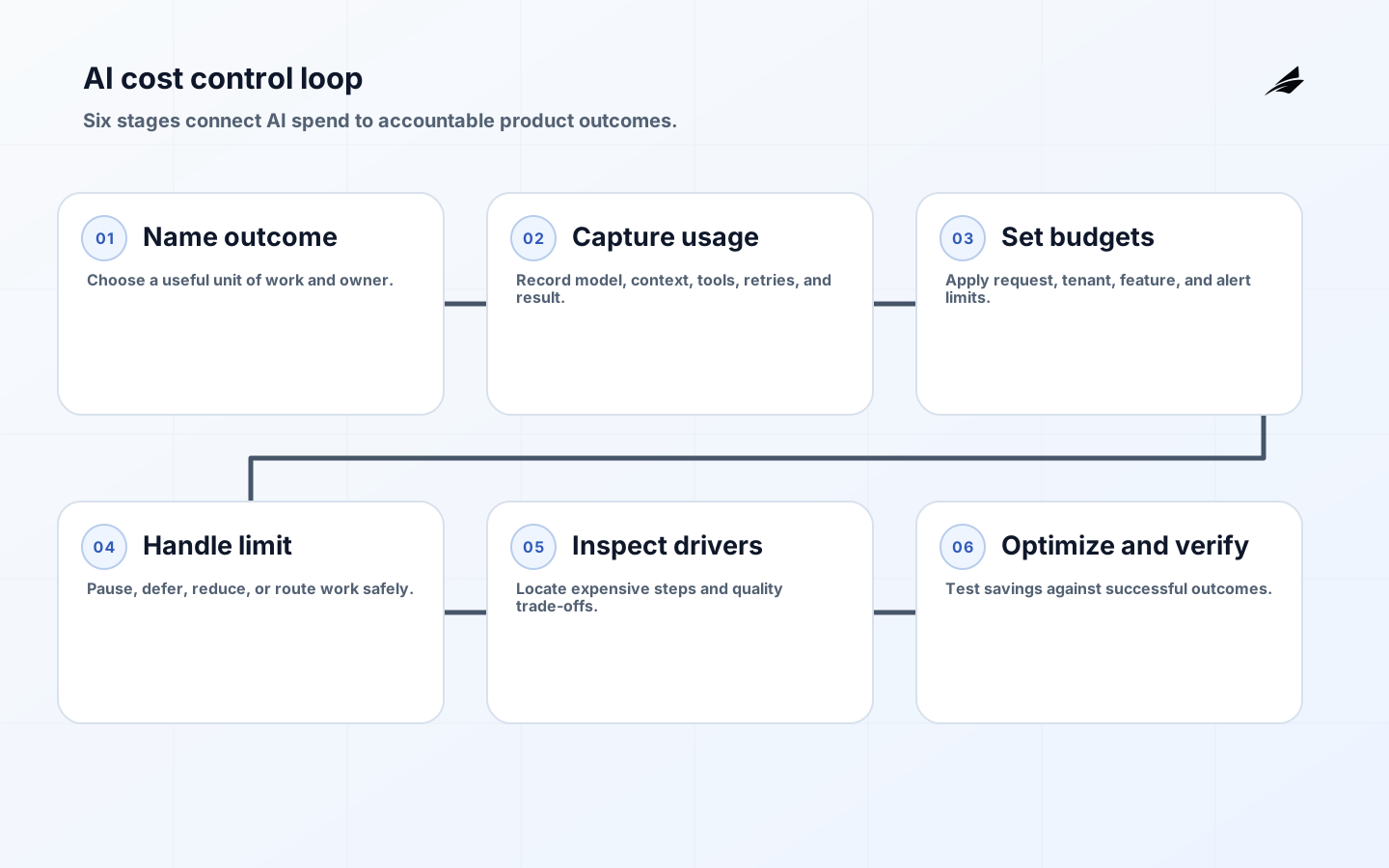
AI cost controls are not a monthly finance report after usage has already grown. They are product and engineering decisions that connect a request, a model call, retrieved context, tool work, and human review to a useful outcome. A team cannot manage what it cannot attribute: a rising bill may come from long prompts, uncontrolled retries, unused features, an expensive model selected for routine work, or an upstream bug. This guide helps growing teams make AI spend observable without turning every product decision into a manual approval. The goal is a cost envelope that protects experimentation while revealing whether a workflow is delivering enough value.
Define the AI cost boundary
Begin with a unit that the business can understand: cost per resolved support case, completed document review, qualified lead, or analyst-ready report. Include all relevant components, not only model tokens: embeddings, retrieval, storage, tool calls, retries, observability, and reviewer effort. Assign an owner for the workflow and a budget horizon appropriate to its maturity. The FinOps Framework is useful for framing accountability and timely decision-making. A clear cost boundary stops teams from comparing raw token totals across products with very different outcomes.

| Cost component | Question to ask | Useful tag |
|---|---|---|
| Model inference | Which feature and request class caused it? | Product, workflow, and model. |
| Context and retrieval | How much evidence was assembled? | Corpus, query type, and tenant. |
| Tool execution | Did a call create external work? | Tool name and disposition. |
| Human review | Did automation reduce or shift effort? | Queue, case type, and outcome. |
Instrument the drivers of AI spend
Record usage events close to the workflow, with privacy-appropriate identifiers for tenant, feature, request class, model, configuration version, input and output size, cache outcome, tool calls, retries, and final disposition. Aggregate rather than expose sensitive prompt text in broad dashboards. Separate successful completion from cancelled, failed, or abandoned work. This lets an operator see whether a cost change follows more useful requests, a loop in orchestration, a context-growth regression, or a vendor pricing change. Do not wait for an invoice to discover that an internal test path became a production-scale workload.
- Tag every call with the product feature and version that initiated it.
- Track cache hit rate, retry count, context size, and tool-call fan-out.
- Set data-retention rules for traces that balance investigation and privacy.
- Reconcile application usage events with provider billing on a regular cadence.
Set limits that match the failure mode
Use several limits instead of a single monthly ceiling. Per-request budgets can stop an accidental loop; per-user or tenant limits can contain abuse; feature budgets can protect an experiment; and organization-level alerts can reveal a broad regression. Decide what happens at each threshold: shorten nonessential context, use a lower-cost approved route, queue non-urgent work, request confirmation, or stop safely. Limits must be observable and understandable to users, otherwise they appear as mysterious product failures. Keep hard stops for conditions where continued execution has no defensible value.
| Control | Use it for | Response at limit |
|---|---|---|
| Request budget | Runaway chain or unusually large context. | Stop and return a recoverable status. |
| Tenant budget | Unexpected customer or partner usage. | Throttle, notify, or require plan review. |
| Feature budget | Pilot or low-value capability. | Defer work and examine outcomes. |
| Alert threshold | Cost trend requiring investigation. | Page owner with usage evidence. |
Optimize the expensive step, not the headline
Optimization starts with a trace, not a preference for a smaller model. Remove duplicate calls, cache stable transformations, trim irrelevant context, batch work that can wait, and route simple classifications to an evaluated lower-cost option. The scaling laws research illustrates why capability and resource use have trade-offs, but production choices should be tested against the actual job. For every change, compare quality, latency, correction load, and cost per completed outcome. A cost reduction that weakens citation quality or increases human review may be false economy.
- Measure context utility before shortening it; preserve required evidence and policy information.
- Use caching only where the data, access scope, and freshness requirements allow it.
- Test alternative models and routes on a representative evaluation set.
- Investigate repeated retries as product defects before treating them as normal consumption.
Make cost controls part of delivery governance
Cost governance should join product, engineering, finance, and security around the same evidence. A product owner decides whether an outcome justifies spend; an engineering owner maintains efficient execution; finance checks attribution and forecast; security reviews whether a cost anomaly is also abuse. The NIST Generative AI Profile helps keep risk, measurement, and management connected. Review material cost changes with configuration changes, feature adoption, and quality incidents rather than as an isolated billing exercise.
Release cost changes reversibly
Introduce budgets and optimization changes in a limited cohort first. Confirm that alerts trigger, user-facing fallback is understandable, and an operator can find the causal trace. Keep the prior route available until the new configuration meets quality and service objectives. During a pilot, watch cost per successful outcome, tail latency, rate of abandoned tasks, and human correction. A quarterly budget review is useful, but high-variance workflows need more frequent operational review.
Forecast with product adoption and failure in view
A useful forecast starts from expected workflow volume and a range of request shapes, not a single average prompt. Model routine cases, long-context cases, retries, peak concurrency, and the portion of work that should go to human review. Compare the forecast with actual tagged usage each week during a new launch. When the variance grows, locate the driver before changing the budget: adoption may be higher than expected, a new customer may have different data, an interface may be causing duplicate submissions, or an orchestration change may be calling tools repeatedly. Forecasts should include the cost of safe operation, such as logging, evaluation, and exception handling, because ignoring them makes a feature appear cheaper only by hiding work elsewhere.
Design commercial and internal usage policies around the same evidence. If a workflow has a fair-use limit or a paid usage tier, expose the unit in terms users can understand and make the enforcement path predictable. For internal teams, publish a dashboard that shows cost and outcome by feature owner, not as a ranking meant to shame experimentation. The conversation should be: which usage produces durable value, which is exploratory, and which is avoidable waste? Set an escalation process for unusual demand so a legitimate high-value case can be reviewed without bypassing controls. This keeps cost control from becoming an arbitrary brake and instead makes it a way to decide where more capacity is justified.
AI cost controls implementation checklist
- Choose a cost-per-successful-outcome unit for every AI feature before broad adoption begins.
- Tag model calls with product, workflow, tenant, request class, model, configuration, and result disposition.
- Capture context size, cache state, tool calls, retries, latency, and user-visible completion in usage events.
- Reconcile application measurements with provider billing regularly and investigate material differences promptly.
- Set request budgets to contain loops, large contexts, and unexpected tool fan-out before they escalate.
- Use tenant or user limits to manage abuse and unusual demand without hiding normal product behavior.
- Create feature budgets for pilots and define the safe user experience when a threshold is reached.
- Alert named owners on cost trends, not only on fixed monthly totals after the budget is consumed.
- Compare cost changes with quality, completion, correction, and support demand before optimizing further.
- Eliminate duplicate work and retries before selecting a lower-cost model for a complex task.
- Test caching against access scope, freshness expectations, and potential disclosure of prior-user results.
- Forecast routine, long-context, failed, peak, and reviewed cases rather than a single average request.
- Give finance, product, engineering, and security owners the same attribution and exception evidence.
- Release budget and routing changes to a cohort with rollback conditions and understandable fallback behavior.
- Review high-value usage separately from waste so controls do not block work that merits more capacity.
Review cost anomalies through a short incident-style workflow. First confirm that attribution and billing data agree. Then identify the feature version, request pattern, context size, tool sequence, retry behavior, and final outcome associated with the increase. Decide whether the event is valuable demand, an engineering defect, a security concern, or a forecasting miss. Document the chosen response and verify its effect in the next reporting period. This keeps teams from reacting to a total number with blunt limits that damage useful work. It also makes high-value usage visible when it genuinely deserves a larger budget or a more efficient design.
Key takeaways
- Measure AI cost per useful workflow outcome, not just tokens or calls.
- Instrument model, context, tools, retries, and final disposition together.
- Use request, tenant, feature, and alert thresholds for different failure modes.
- Validate savings against quality and reviewer workload before declaring success.
AI cost controls FAQ
What should be our first AI cost metric? Start with cost per successful completion for one bounded workflow, then add quality and escalation measures. It is more actionable than a total spend number because it points to product behavior.
Should we always use the cheapest approved model? No. Match a tested route to the task. A low-cost option may be right for extraction and classification while a complex reasoning task needs a different evaluated configuration.
How do we handle a budget limit during a customer task? Define the fallback ahead of time: safe pause, reduced nonessential work, queued completion, or a human route. Never hide the limit by allowing an uncontrolled retry loop.
Conclusion
Good AI cost controls make spending legible to the people responsible for outcomes. Attribute usage to a workflow, set limits with safe responses, inspect the real drivers, and test optimization against quality. With that discipline, a growing team can spend deliberately on useful capability instead of discovering its operating model in an invoice.