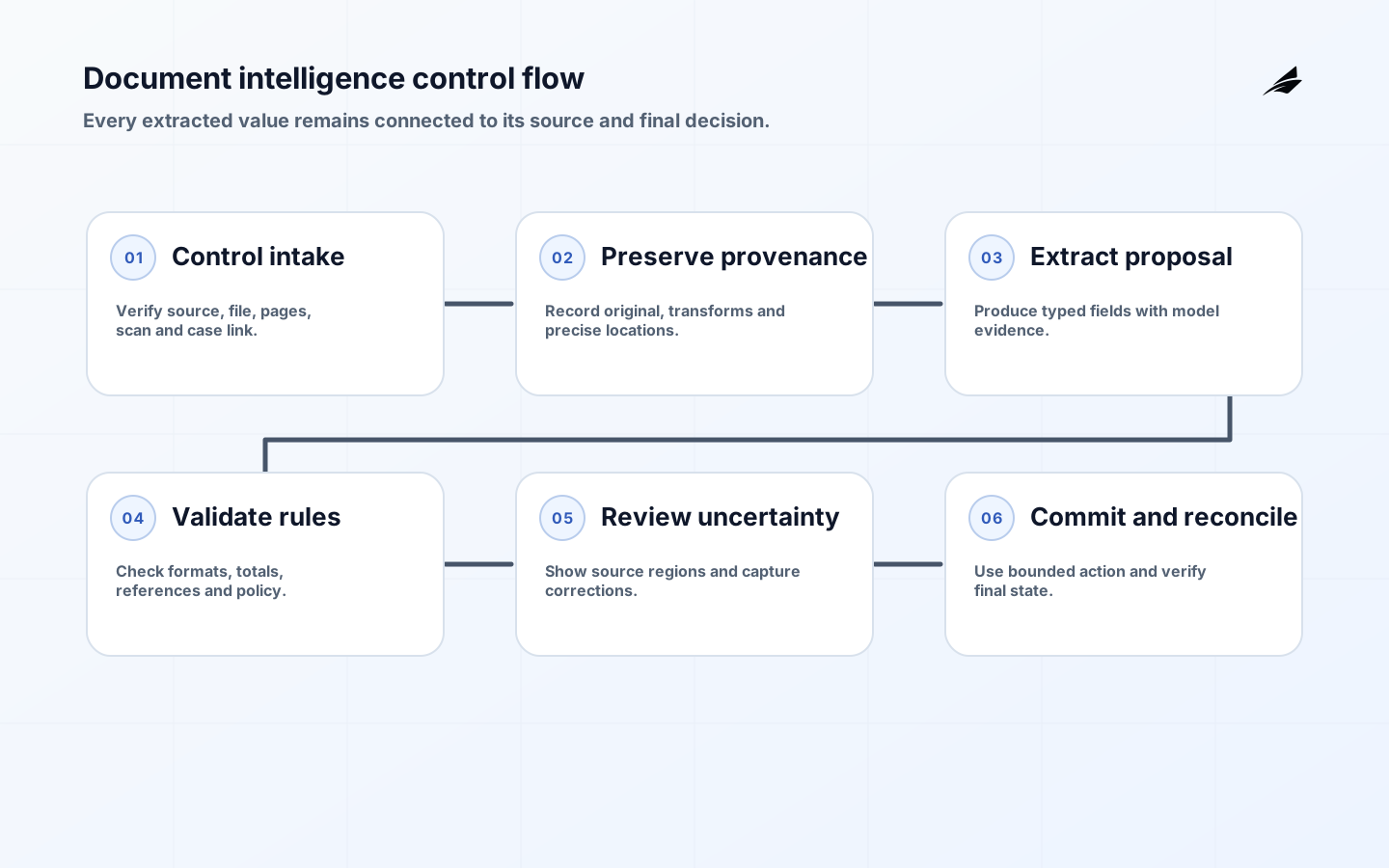
Document intelligence for AI automation turns files into proposed facts, classifications and workflow actions. The model is only one component. A dependable service must identify the source, preserve the original, detect file and page boundaries, extract structured values with provenance, validate business rules, route uncertainty to a capable reviewer and reconcile the accepted result with the system of record. Without that chain, a confident field can silently become an incorrect operational decision.
Use this guide with Edilec's model evaluation guide, tool-calling guide and retrieval pipeline guide. They help separate probabilistic interpretation from deterministic authorization and execution.
Define the document decision
Begin with which invoice, contract, or form field can safely drive a workflow. Describe the user, the case boundary, the evidence or state needed to proceed, the acceptable result, and the condition under which the system must stop. A vague request invites improvised behavior and makes later failures impossible to classify. The weak alternative is treating a summary of a file as verified business data. Instead, write a decision brief that can be reviewed by the person who owns the business outcome and the engineer who owns the service. It should distinguish suggestions from effects, specify who receives exceptions, and state the cost of a false positive, false negative, delay, or unnecessary handoff.
| Decision question | Weak pattern | Operational pattern |
|---|---|---|
| Scope | treating a summary of a file as verified business data | Name the user, case, permitted input, and abstention point. |
| Evidence | Assume fluent output is enough. | Require source, state, or policy evidence appropriate to the effect. |
| Authority | Let model instructions imply permission. | Enforce identity, role, tenant, and current-state checks in software. |
| Change | Treat a revised model or input as harmless. | Evaluate material changes against representative cases before expansion. |
Design the provenance record
The document intelligence service needs a durable boundary between language interpretation and authoritative operations. Maintain original file identity, page reference, extraction method, confidence, and validation result. Keep canonical facts in the appropriate system of record, and make every derived claim traceable to a source or rule. A model can help select, summarize, or structure information, but it should not quietly redefine the data’s owner or lifetime. This distinction protects both users and operators: a reviewer can see where a proposal came from, and an incident responder can identify what changed without reconstructing an entire conversation.
- Name a business owner and a technical owner for the document intelligence workflow.
- Record approved inputs, access conditions, and the facts that must be fetched live.
- Make uncertainty and unavailable information visible to the user.
- Provide a defined handoff for exceptions rather than an endless retry loop.
- Retain a change record for model, prompt, data, tool, policy, and interface revisions.
Apply controls at the boundary
Controls work when they are enforced where a request can read data or cause an effect. Do not rely on a prompt to decide authorization, validate a critical field, or block a prohibited action. Treat user text, documents, retrieved content, and connected responses as untrusted input that may try to influence the model. The OWASP Top 10 for LLM applications explains why prompt injection and excessive agency need conventional safeguards. Use minimum permissions, structured inputs, deterministic validation, safe defaults, rate limits where appropriate, and an audit trail that relates the user request to the final result.
Measure the workflow
Evaluate the assembled workflow rather than an isolated model answer. Build a reviewed set from representative work, including ordinary cases, ambiguity, missing facts, conflicting instructions, permission limits, and inputs that must be rejected. Inspect failures at the stage where they occur: a missing record is not repaired by changing prose, and a valid draft does not excuse an invalid action. Track field precision, citation accuracy, review age, confidence calibration, and downstream corrections. The NIST AI Risk Management Framework provides a helpful lifecycle frame: governance, context mapping, measurement, and risk management must remain connected as the system changes.
| Signal | What it reveals | Next action |
|---|---|---|
| Evidence gap | The output lacks the material needed to support a claim. | Inspect source selection, freshness, permissions, and context assembly. |
| Correction pattern | People repeatedly repair the same part of a result. | Diagnose the task contract, source quality, or unclear policy. |
| Control failure | A request reaches or fails at the wrong boundary. | Review authentication, authorization, validation, and escalation. |
| Outcome drift | A change alters completion, rework, or harm. | Compare versions on standing cases and a staged production sample. |
Release and operate
Release document intelligence in a bounded workflow first, preferably where effects are read-only, reversible, or reviewed. Preserve a disable path and make operational traces accessible to the people who investigate failures. A useful trace ties together the case, the permitted context, the relevant version, any tool or policy decision, the user-visible response, and the final workflow state. The NIST Generative AI Profile emphasizes that generative AI risks are managed across a lifecycle; a release is therefore the start of observation and correction, not the end of design.
Ownership and change
Someone must be able to answer who owns the decision, who owns the technical service, who may pause it, and who handles a disputed result. Put those answers in a runbook with review cadence, incident contacts, approved change types, and records of material decisions. This is particularly important when document intelligence is connected to evolving sources or third-party services. A small change in a source, model, access rule, or dependency can alter behavior without a visible interface change. Treat it as a release candidate until the reviewed cases and controls say otherwise.
Run a document intelligence operating review
Review extracted values with their source page and surrounding context. Test difficult scans, tables, attachments, and conflicting values. Preserve correction reasons so teams can separate parsing, classification, validation, and business-rule failures.
Document intelligence practical checklist
- Choose one bounded decision before scaling document intelligence.
- Define evidence, permissions, validation, escalation, and recovery conditions.
- Test ordinary, ambiguous, unsafe, and unavailable-information cases.
- Instrument the path from input to business outcome with privacy-aware traces.
- Stage changes and retain a rapid rollback or disable option.
- Convert confirmed corrections and incidents into a test, control, or explicit operating decision.
Frequently asked questions
Does document intelligence replace normal application controls? No. It can improve interpretation, retrieval, drafting, or orchestration, but authorization and state changes remain responsibilities of deterministic services and accountable people. Is a confidence score enough to automate a decision? No. Confidence must be interpreted alongside evidence quality, consequence, permissions, source freshness, and the ability to recover. Where should a team start? Pick a high-frequency, bounded task with a clear owner and a reviewable definition of success. The OpenAI Agents guide is useful for agent patterns, while the surrounding workflow still needs its own product, security, and operations design.
Prepare for the next change
Before expanding document types, create a test pack that includes poor scans, handwritten annotations, multi-page tables, revision marks, and attachments that disagree with the main file. Validate both field extraction and the decision that uses the field. A system that reads an invoice total correctly but applies the wrong approval policy has not solved the operational problem. Treat source location and human correction as first-class outputs of the service.
Design a document-to-decision control flow
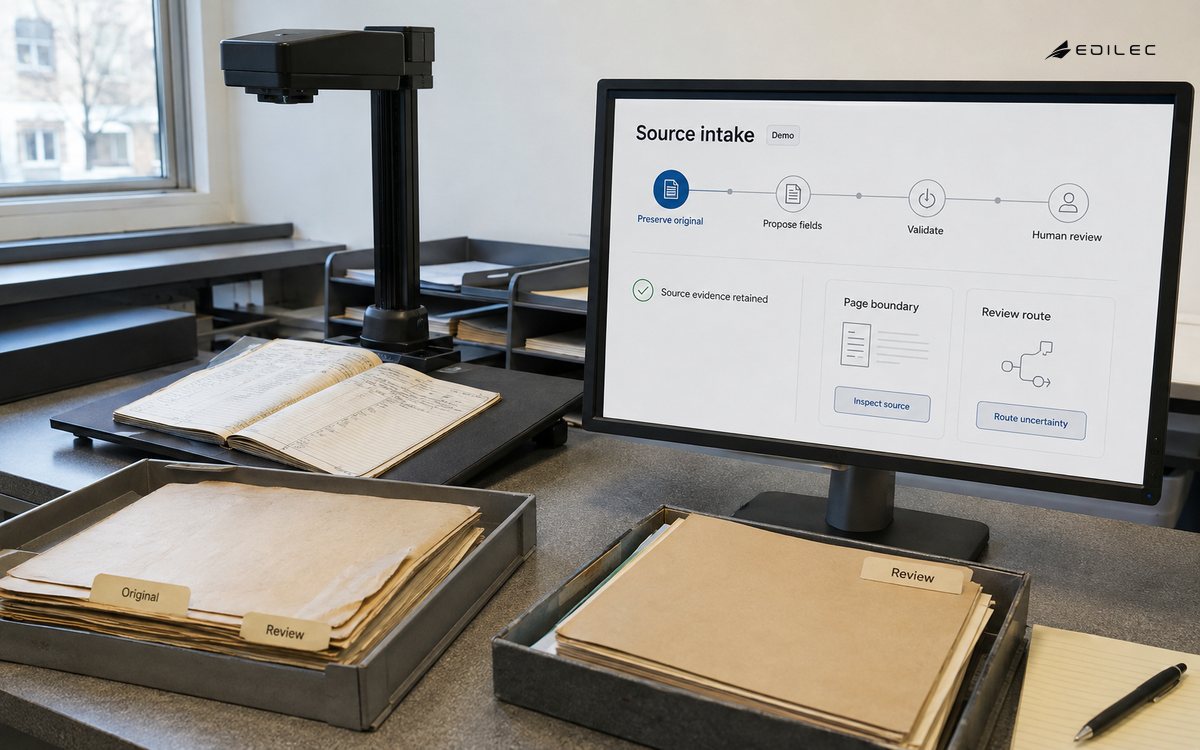
Define the unit of work before selecting extraction technology. It may be one invoice, a packet with required attachments, a contract version or a claim containing multiple evidence types. Assign a durable intake ID and preserve file hashes, source channel, received time, submitter, malware-scan result, page count and retention class. Record every transformation such as conversion, deskewing, OCR or page splitting so a reviewer can trace an extracted field back to a precise region of the original.
| Control stage | Decision | Evidence |
|---|---|---|
| Intake | Is the file allowed, complete and associated with the right case? | Source, hash, type, pages, scan and case ID |
| Extraction | What values and structure are proposed? | Model, parser, field value, location and confidence |
| Validation | Are formats, totals, relationships and policy conditions valid? | Rule results and authoritative reference checks |
| Review | Which uncertainties require human judgment? | Original region, proposal, reason and correction |
| Execution | What downstream action is permitted? | Approved values, actor, policy and idempotency key |
| Reconciliation | Did the intended system record the accepted outcome? | Result ID, exception state and correction history |
The NIST AI Risk Management Framework and its Generative AI Profile provide a structure for governing, mapping, measuring and managing AI risks. The OWASP guidance for LLM and generative AI matters because documents can contain instructions, links, embedded objects or sensitive content. WCAG 2.2 helps ensure the review interface exposes errors, status and source regions in a form people using keyboards or assistive technology can operate.
Evaluate fields and workflow outcomes separately. Per-field precision and recall can hide a failed total, wrong party or missing page. Build document sets across templates, languages, scans, handwriting, rotations, low contrast, duplicates, amended versions and adversarial content. Measure straight-through acceptance only after measuring false acceptance and reviewer correction. In production, monitor shifts in supplier, template and capture channel; route unfamiliar clusters for review rather than allowing a global confidence threshold to approve them silently.
Key takeaways
- Document Intelligence should serve a specific operational decision, not a vague promise of automation.
- Evidence, permissions, validation, and recovery are product requirements.
- Measure the complete workflow and locate failures at their actual stage.
- Visible ownership and gradual releases make improvements safer and more useful.
Conclusion
Document Intelligence earns its place in an AI automation program when it makes useful work easier without obscuring accountability. Bound the decision, govern the inputs and effects, inspect real outcomes, and keep the system easy to pause or correct. That is how an interesting capability becomes a dependable service.