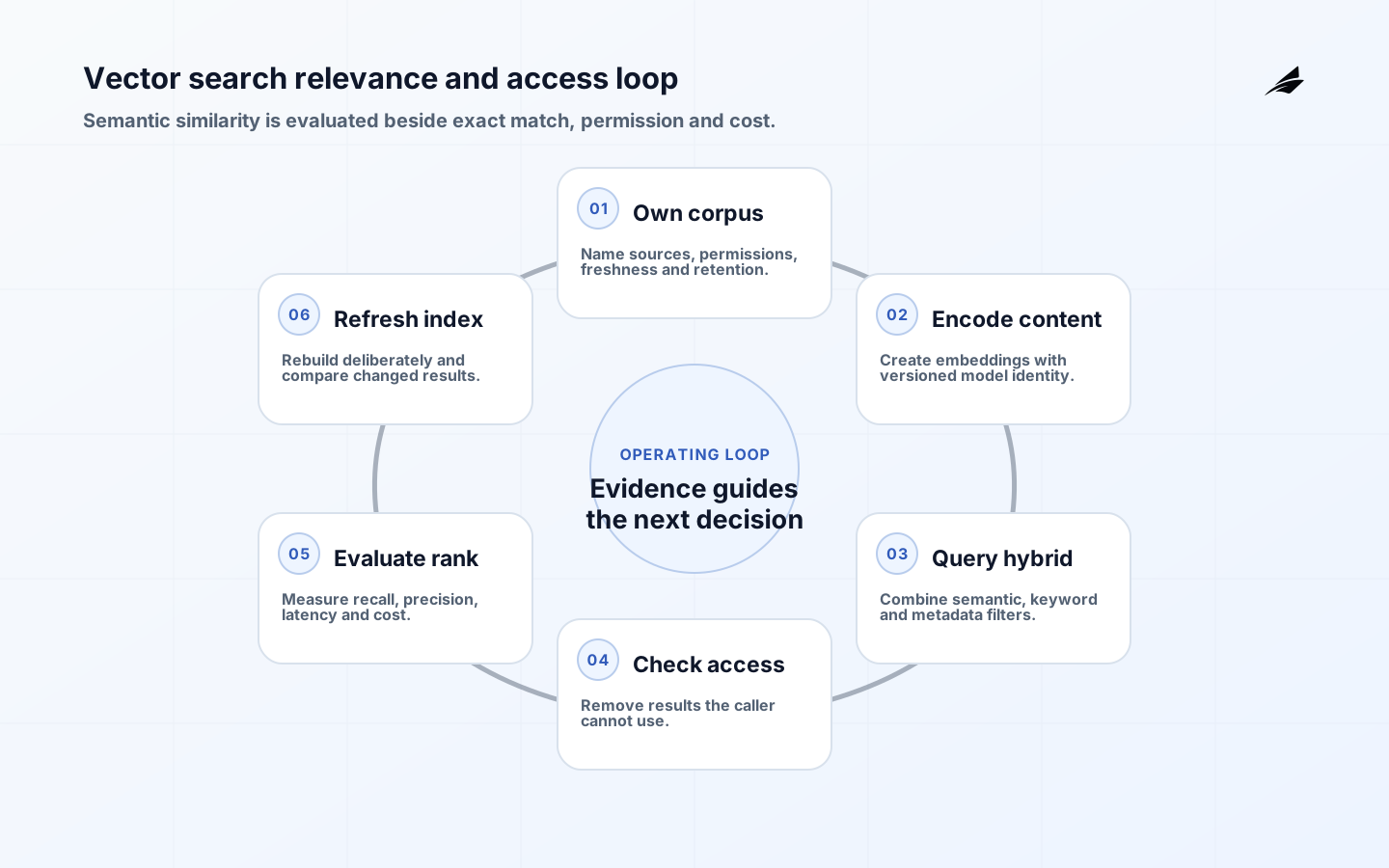
Vector search moves into production when it is attached to a decision that somebody can own, test, and recover. The useful starting point is not a model demonstration but the question: can this workflow reliably retrieve conceptually related records while preserving the access, version, and meaning constraints of the underlying work? Define who is served, which record is authoritative, what must be shown to a reviewer, and what happens when evidence is incomplete. The NIST Generative AI Profile frames risk work across governance, mapping, measurement, and management; that lifecycle is more helpful than treating launch as the finish line. Related foundations such as the semantic search guide, embeddings guide, and retrieval pipelines guide help clarify the components, but the local operating boundary decides whether the service deserves trust.
Set the vector search decision boundary
Write the task as an observable outcome. For this use case, the system should retrieve conceptually related records while preserving the access, version, and meaning constraints of the underlying work. Its inputs are embedded records, metadata filters, query context, relevance judgments, and a source register. Its boundary is ranked candidates with inspectable provenance, never a similarity score presented as truth. This language exposes missing ownership early: a system cannot be evaluated if the team cannot say what a successful result lets a person do, which cases are excluded, or who has authority to resolve a dispute. Keep a decision record with the workflow owner, source owners, affected users, assumptions, and a review date. It gives future maintainers a reasoned starting point when a policy or dependency changes.
| Decision element | Question to settle | Evidence to retain |
|---|---|---|
| User outcome | What work becomes possible after vector search responds? | Task statement, accountable owner, and acceptance criteria. |
| Authority | Which person or system can approve the retrieve conceptually related records while preserving the access, version, and meaning constraints of the underlying work outcome? | Policy hierarchy, role definition, and escalation route. |
| Evidence boundary | What records may influence the result? | Source register, access classification, version, and effective date. |
| Failure behavior | When must the workflow stop or abstain? | User message, handoff queue, and manual completion method. |
| Change control | Which edits need retesting before release? | Configuration version, evaluation set, approval, and rollback plan. |
Design evidence, state, and interfaces together for vector search
Production design is an evidence chain, not a prompt plus an endpoint. Preserve the request identity, source version, transformation, model configuration, tool result, and final state that mattered to a case. Pair similarity retrieval with metadata filters, hybrid retrieval where needed, and evaluation cases for negation, exceptions, and stale content. The NCSC secure AI development guidance is a useful reminder to treat AI-specific concerns as part of secure development rather than as a review held after a feature is complete. Build deterministic checks for permissions, schemas, destinations, and transaction limits; reserve model judgment for interpretation where it is genuinely useful.
- Name a service owner who can pause vector search when evidence or controls fail.
- Keep the authoritative record available to the user rather than only a generated summary.
- Store the configuration and source versions that materially shaped a result.
- Make uncertain, denied, and incomplete states visible rather than silently replacing them.
- Give reviewers sufficient context to correct a case without reconstructing hidden system state.
- Limit machine authority to actions that match the workflow owner’s explicit approval.
- Document how a user finishes the task manually when a dependency is unavailable.
- Review access and retention rules whenever the corpus, tool set, or user group expands.
- Separate a measured workflow improvement from a cosmetic increase in generated output.
- Test recovery paths as deliberately as the ordinary successful path.
Place controls at the point of consequence for vector search
For vector search, controls make similarity subordinate to source metadata, preventing an attractive near-match from overriding access or currency. Controls must survive fluent output. The OWASP Top 10 for LLM applications highlights risks such as prompt injection, insecure output handling, and excessive agency; each matters here because untrusted input can influence a system without becoming authorized instruction. Treat external documents, messages, and tool responses as data. Validate structured arguments before a tool is called, allow-list destinations, and log the enforcement decision. A reviewer should be able to distinguish a bad recommendation, a blocked request, and a downstream service failure, because each requires a different repair.
| Control layer | Purpose | Practical test |
|---|---|---|
| Identity and entitlement | Prevent a requester from seeing or using unauthorized material. | Change a role and confirm forbidden data never reaches the candidate set or tool. |
| Input handling | Stop untrusted content from changing system authority. | Inject conflicting instructions into a source and verify it is treated only as content. |
| Action validation | Constrain side effects to approved schema, scope, and destination. | Submit malformed, oversized, or cross-account arguments and require deterministic rejection. |
| Observability | Make significant state changes and failures reviewable. | Trace one completed case and one stopped case from request to outcome. |
| Recovery | Return work to a safe state when a check or dependency fails. | Disable a dependency during rehearsal and confirm ownership, queues, and user guidance work. |
Measure vector search as work quality
A single accuracy figure hides the failures that matter in operation. Evaluate with representative normal cases, ambiguous inputs, policy changes, adversarial content, denied access, and cases that should receive no answer. Track recall at the reviewed cutoff, ranking quality, filter correctness, latency, index freshness, and no-result behavior. Keep the evaluation set separate from everyday tuning decisions, record who judged each case, and review disagreements with the process owner. The original RAG research established the value of grounding knowledge tasks in retrieved memory; a production team still has to measure whether its own sources, permissions, and workflow rules are being respected. Compare releases against a stable baseline and investigate qualitative failures before widening scope.
Stage vector retrieval behind a clear gate
Pilot vector search against a reviewed query set from one corpus, then study false positives before adding more records or product surfaces. Start beside the current process for one decision class. Let users compare the result with their existing method, sample disagreements, and record whether the remedy belongs in the source, interface, policy, model route, or reviewer instructions. Define rollback before enabling the new route: who can disable it, how affected users continue, and how the team identifies cases completed during an incident. Early scope is not an exemption from controls; it is a way to learn with a smaller consequence radius. A measured decision to hold or stop expansion is valuable evidence when the workflow has not earned broader authority.
Operate the service as a changing system for vector search
After launch, review source changes, unusual denials, high-friction queues, repeated no-result patterns, downstream failures, and shifts after each release. Assign an owner to approve updates to instructions, parsers, indexes, model routes, and tool contracts. Preserve a short change record linking the altered component to evaluation evidence and rollback conditions. This helps operators distinguish a source problem from a relevance problem, a cost problem, or a policy change. It also keeps vector search connected to the real work it was built to improve rather than becoming a feature that nobody feels accountable for running.
Key takeaways
- Anchor vector search in one owned decision before broadening the capability.
- Make authority, evidence, and uncertainty visible at the moment a user acts.
- Use deterministic enforcement for permissions, schemas, destinations, and irreversible transactions.
- Measure failure modes separately instead of hiding them inside a single success score.
- Release with a named rollback path and use reviewed outcomes to decide the next boundary.
Vector search FAQ
Question: What must vector search decide before implementation? Answer: Define the user, corpus, authority, permission boundary, ranking objective, freshness expectation, and behavior when no trustworthy result exists.
Question: How should vector relevance be evaluated? Answer: Use judged queries that include stale, absent, ambiguous, and permission-sensitive cases, then measure retrieval quality, filter correctness, and the downstream task result.
Is vector similarity enough to decide relevance? No. Similarity is a candidate-generation signal. Apply filters and evaluate against judged outcomes, especially for negation, dates, exclusions, and terminology that appears similar but carries a different rule.
When should hybrid search be considered? Use it when exact identifiers, product codes, regulatory citations, or rare terms matter alongside semantic meaning. Test hybrid ranking against the real query distribution rather than assuming it helps.
Why track no-result behavior? A controlled no-result can prevent a plausible but irrelevant answer. Monitor it with false-positive retrieval so the team can tune the right trade-off for the decision.
Conclusion
Vector search becomes dependable through a disciplined operating model: a bounded decision, governed evidence, enforceable controls, realistic evaluation, and reversible release. Keep the primary question close to the work: can this service retrieve conceptually related records while preserving the access, version, and meaning constraints of the underlying work without obscuring authority or creating an unsafe shortcut? When the answer is supported by source ownership, observable behavior, and recovery practice, the team has a foundation for expansion. When it is not, narrowing the boundary is an engineering decision, not a failure of ambition.
Review retrieval evidence before scaling
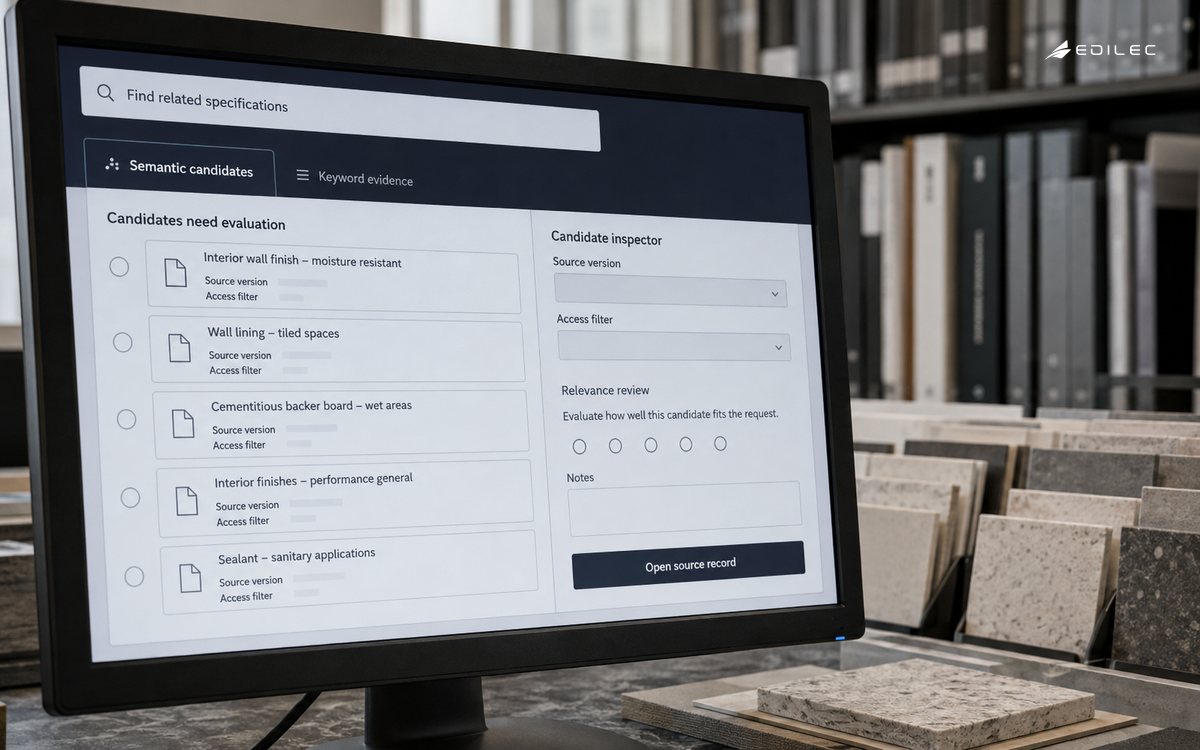
A vector search review should compare semantic retrieval with exact and filtered retrieval on the questions that matter. Azure vector search guidance distinguishes similarity, hybrid and multimodal search; hybrid search guidance explains why keyword and vector results may be merged rather than treated as competing systems. Preserve query, embedding model, index version, filters, returned identifiers and rank so a reviewer can reproduce a surprising result.
Evaluate recall, precision, rank quality, latency, cost and permission correctness separately. Include synonyms, exact identifiers, multilingual queries, short queries, conflicting documents, deleted content and newly added content. A high similarity score cannot authorize a result that the caller may not access. Re-indexing is also a release: compare old and new neighborhoods, sample changed results, and retain a rollback or rebuild plan. For adjacent design, see semantic search, embeddings, and retrieval pipelines.
Further Edilec context: Semantic search guide, Embeddings guide, Retrieval pipelines guide. The operating decision applies those references specifically to vector search before the first build: relevance, access and evaluation.