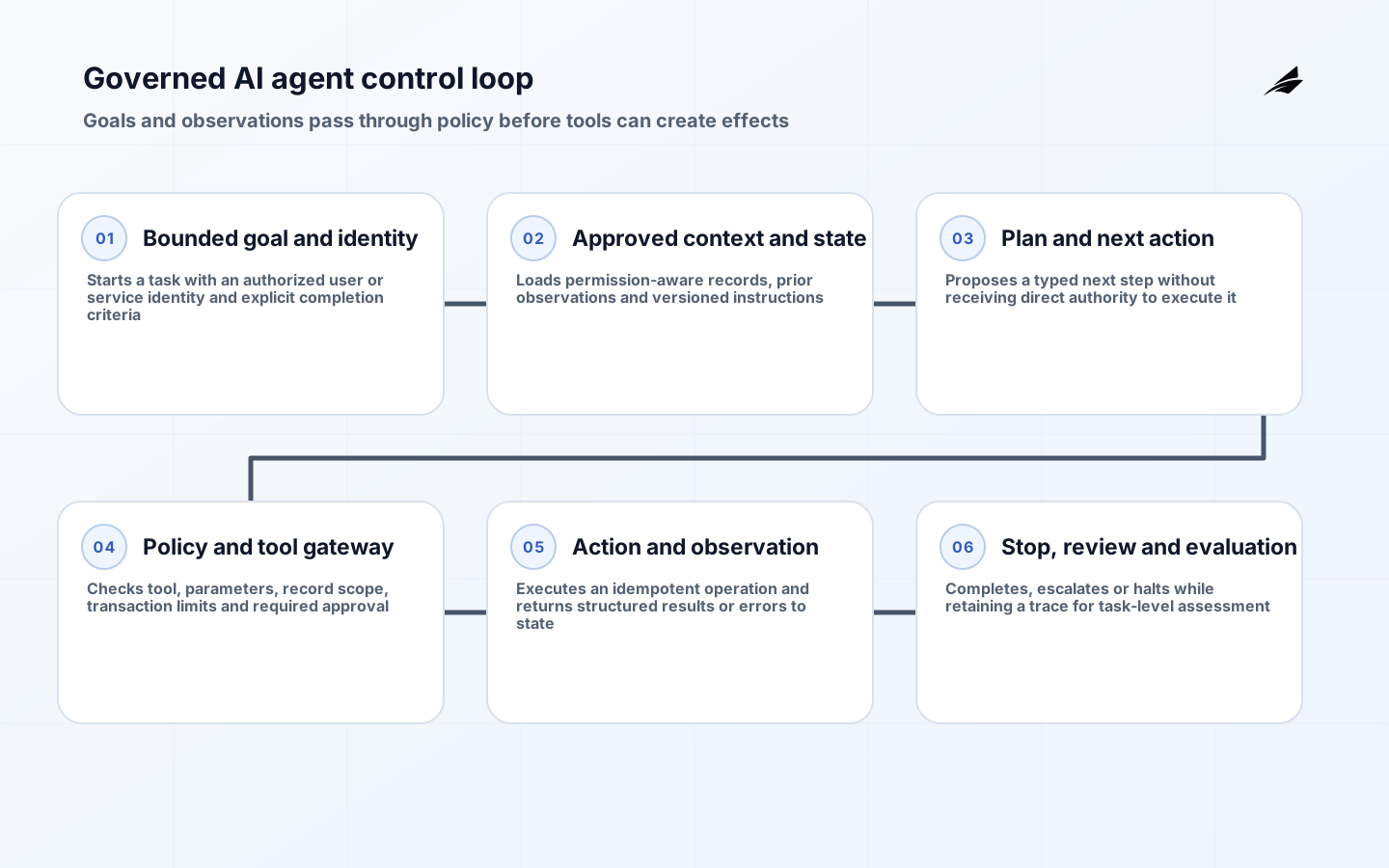
AI agents represent the critical decision-making layer within modern business operations, operating as autonomous systems that process information and execute actions without direct human intervention. Unlike traditional rule-based automation, these agents dynamically adapt to changing conditions while maintaining alignment with organizational objectives. This article explores how AI agents function as the unseen architecture of business decisions, focusing on practical implementation strategies that prioritize security and governance from the ground up. The distinction between AI agents and conventional automation tools lies in their ability to make real-time decisions based on contextual understanding rather than pre-defined triggers.
What Are AI Agents?
AI agents are specialized software entities designed to perceive their environment, process information, and take actions to achieve specific goals. They operate within a defined scope of tasks, such as processing customer inquiries, analyzing financial data, or automating routine administrative functions. Unlike simple chatbots, AI agents maintain persistent state and can interact with multiple systems to complete complex workflows. For example, an AI agent might monitor sales data in real-time, identify potential anomalies, and trigger alerts to the relevant team without requiring manual review. This capability makes them particularly valuable for time-sensitive business processes where rapid response is critical.
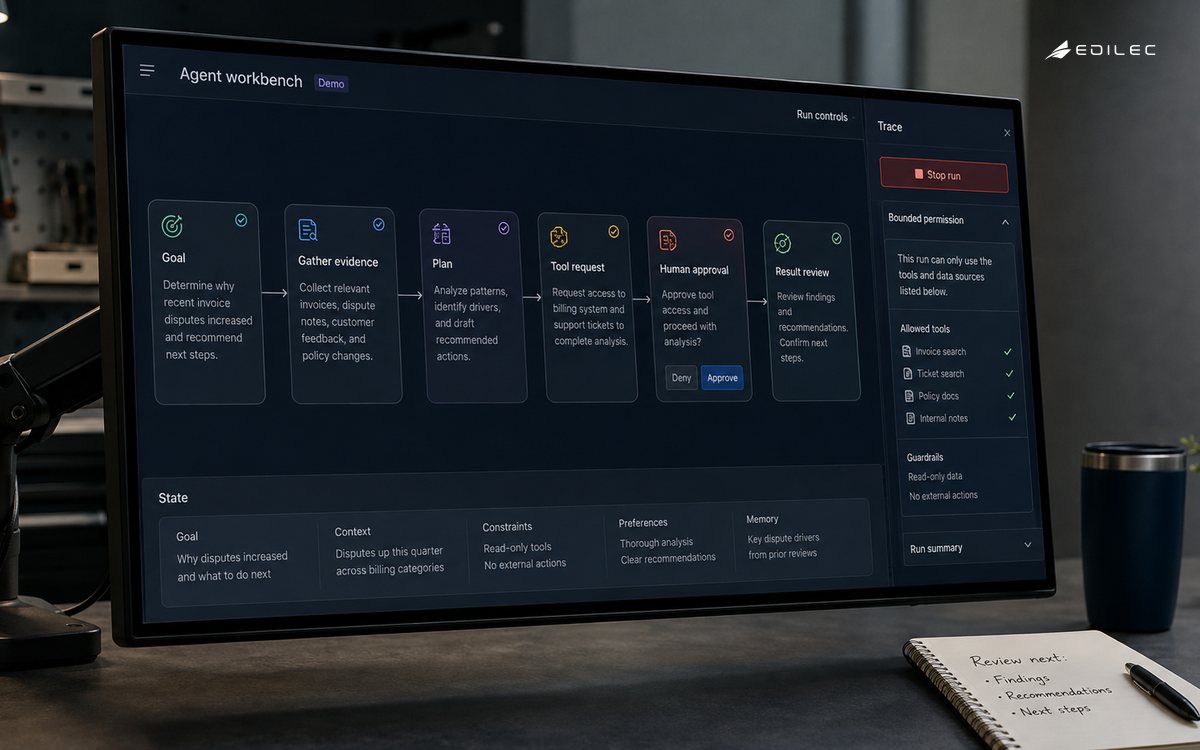
- Perceive environmental changes through data inputs
- Process information using contextual understanding
- Execute actions to achieve predefined objectives
- Maintain persistent state across interactions
- Adapt behavior based on outcomes and feedback
Why AI Agents Matter for Business Decisions
The strategic importance of AI agents stems from their ability to bridge the gap between data and actionable insights. In today's fast-paced business environment, organizations need systems that can process vast amounts of information and make decisions at a speed that human teams cannot match. AI agents excel in scenarios where decisions must be made rapidly and with high precision, such as financial risk assessment, supply chain optimization, or customer service escalation. By automating these processes, businesses can reduce handling time for some bounded tasks when tools, data, review rules, and evaluation evidence support that conclusion.
Security Considerations for AI Agents
Implementing AI agents introduces unique security challenges that require specialized attention. Unlike traditional applications, agents operate with elevated privileges and interact with multiple systems, creating potential attack surfaces. The NIST AI Risk Management Framework emphasizes that agents must undergo rigorous security validation before deployment, including threat modeling, access control verification, and continuous monitoring. OWASP's Securing Agentic Applications Guide highlights the importance of minimizing the attack surface by limiting agent permissions to only what is strictly necessary for their specific tasks. This approach ensures that even if an agent is compromised, the damage is contained within a narrow scope.
| Security Challenge | Mitigation Strategy | Implementation Example |
|---|---|---|
| Unauthorized data access | Least-privilege identity and record-level authorization | Test every tool with allowed and denied identities |
| Untrusted instructions | Separate instructions from retrieved or user-controlled content | Evaluate prompt injection and indirect instruction attacks |
| Excessive tool authority | Typed tools, constrained parameters, approvals and transaction limits | Attempt prohibited and out-of-scope actions |
| Unbounded execution | Step, time, cost and retry limits with a stop state | Simulate loops, dependency failures and ambiguous results |
Governance Frameworks for AI Agents
Effective governance of AI agents requires clear policies and procedures that define how agents are developed, deployed, and monitored. The NIST AI Risk Management Framework provides a structured approach to governance, including risk assessment, policy development, and continuous oversight. Organizations must establish mechanisms to track agent performance, ensure compliance with regulatory requirements, and address ethical concerns. For instance, financial institutions implementing AI agents for fraud detection must verify that the system does not disproportionately target certain demographic groups, which requires ongoing bias testing and human oversight.
| Governance Requirement | Implementation Approach | Real-World Application |
|---|---|---|
| Compliance with data privacy laws | Data anonymization and consent management | Healthcare provider using agent to analyze patient records without identifying individuals |
| Regulatory reporting | Automated compliance checks with external systems | Bank automatically generating regulatory reports based on agent analysis |
| Ethical decision-making | Human-in-the-loop verification for critical decisions | HR agent reviewing job applications before final hiring decisions |
Practical Implementation of AI Agents
The practical implementation of AI agents begins with clearly defining the scope and objectives of the agent. Organizations must determine what specific tasks the agent will handle, the data sources it will access, and the decision thresholds it must meet. For example, an agent designed to manage customer service escalations should be trained to recognize when a customer's issue exceeds standard resolution capabilities and trigger the appropriate escalation path. This requires careful planning to avoid over-engineering, which can lead to complex systems that are difficult to maintain and scale.
Real-World Case Study: Financial Services
Consider a bounded transaction-review agent that receives authorized event fields, applies deterministic screening rules, retrieves permitted case context, and proposes a disposition for a human analyst. The agent cannot block an account, contact a customer, or change a record without an explicit tool policy and approval. Evaluation covers missed and incorrect escalations, tool-denial behavior, unsupported explanations, latency, and trace completeness. This hypothetical pattern illustrates the architecture; teams must set thresholds from their own risks, data, obligations, and baseline.
Key Considerations for Success
Successful implementation of AI agents requires addressing several critical considerations. First, organizations must ensure that the agent's decision-making process is transparent and explainable, particularly for high-stakes decisions. Second, there must be clear protocols for handling errors and failures, including mechanisms for human intervention and system recovery. Third, the agent must be designed to operate within the existing organizational structure, avoiding silos that could hinder collaboration. Finally, continuous monitoring and iterative improvement are essential to maintain performance as the agent interacts with increasingly complex environments.
AI agents are not a panacea for business challenges. They excel in specific, well-defined tasks but struggle with novel situations that require creative problem-solving or deep contextual understanding. For instance, an agent trained to handle customer complaints may fail to address a completely new type of complaint that has never been encountered before. Organizations must recognize these limitations and implement fallback mechanisms that ensure human oversight for ambiguous or unprecedented scenarios.
Future Directions for AI Agents
As AI agent technology matures, we can expect to see increased integration with other business systems, more sophisticated decision-making capabilities, and enhanced security protocols. However, the most significant advancements will likely focus on improving the agent's ability to understand and respond to complex, multi-faceted business challenges. Organizations that proactively address security and governance will be better positioned to leverage AI agents without compromising their operational integrity.
Implementation Verification Protocol
Implementing AI agents requires rigorous verification to ensure alignment with business objectives and operational constraints. This protocol mandates real-time validation of agent outputs against predefined business rules, using a multi-stage checkpoint mechanism. Each agent's decision path must be traceable through a lightweight, immutable log that captures input, transformation steps, and output decisions. This log serves as the foundation for post-implementation audits and drift detection. The verification process must be automated and integrated into the CI/CD pipeline to prevent manual oversight gaps. Critical thresholds for validation include accuracy metrics, latency compliance, and adherence to ethical constraints, with automated alerts triggering when thresholds are breached.
- Real-time validation against business rules via API-based rule engines
- Immutable log of decision paths for auditability
- Automated CI/CD integration for continuous validation
- Threshold-based alerting for accuracy, latency, and ethical constraints
Key takeaways
- AI agents function as autonomous decision-making systems that operate within specific business contexts
- Security and governance must be integrated into the design phase of AI agent implementation
- Real-world examples demonstrate significant improvements in decision speed and accuracy
- Continuous monitoring and human oversight are critical for maintaining trust and reliability
Frequently asked questions
- What are the most common security risks associated with AI agents?
- How can organizations ensure AI agents comply with data privacy regulations?
- What role does human oversight play in AI agent decision-making?
- How do AI agents handle errors and system failures?
What are the most common security risks associated with AI agents?
The most common security risks include unauthorized data access, insecure communication channels, and agent hijacking. AI agents often have elevated privileges that allow them to interact with multiple systems, creating potential attack vectors. For example, an agent with access to customer databases could be exploited to extract sensitive information if not properly secured. The OWASP Securing Agentic Applications Guide recommends implementing role-based access controls and continuous monitoring to mitigate these risks.
How can organizations ensure AI agents comply with data privacy regulations?
Organizations can ensure compliance by implementing data anonymization techniques, obtaining explicit consent for data processing, and conducting regular audits of agent activities. The NIST AI Risk Management Framework provides guidance on conducting privacy impact assessments for AI systems, which helps identify and mitigate potential privacy violations before deployment.
What role does human oversight play in AI agent decision-making?
Human oversight is critical for high-stakes decisions where the consequences of errors could be severe. For example, in financial services, an AI agent might flag a potential fraud transaction, but a human analyst must verify the legitimacy before taking action. This hybrid approach ensures that the agent's decisions are accurate and aligned with organizational values and regulatory requirements.
How do AI agents handle errors and system failures?
AI agents are designed with error-handling mechanisms that include fallback protocols, retry logic, and human intervention pathways. When an agent encounters an error, it can either retry the operation, escalate the issue to a human operator, or switch to a predefined backup process. This ensures that critical business functions continue without interruption, even in the face of system failures.
Conclusion
AI agents are transforming how businesses make decisions, but their implementation requires careful attention to security, governance, and practical considerations. By integrating these elements from the outset, organizations can harness the power of AI agents to enhance decision-making while maintaining operational integrity. The future of AI agents lies in their ability to work seamlessly within existing business frameworks, providing value without compromising security or ethical standards.