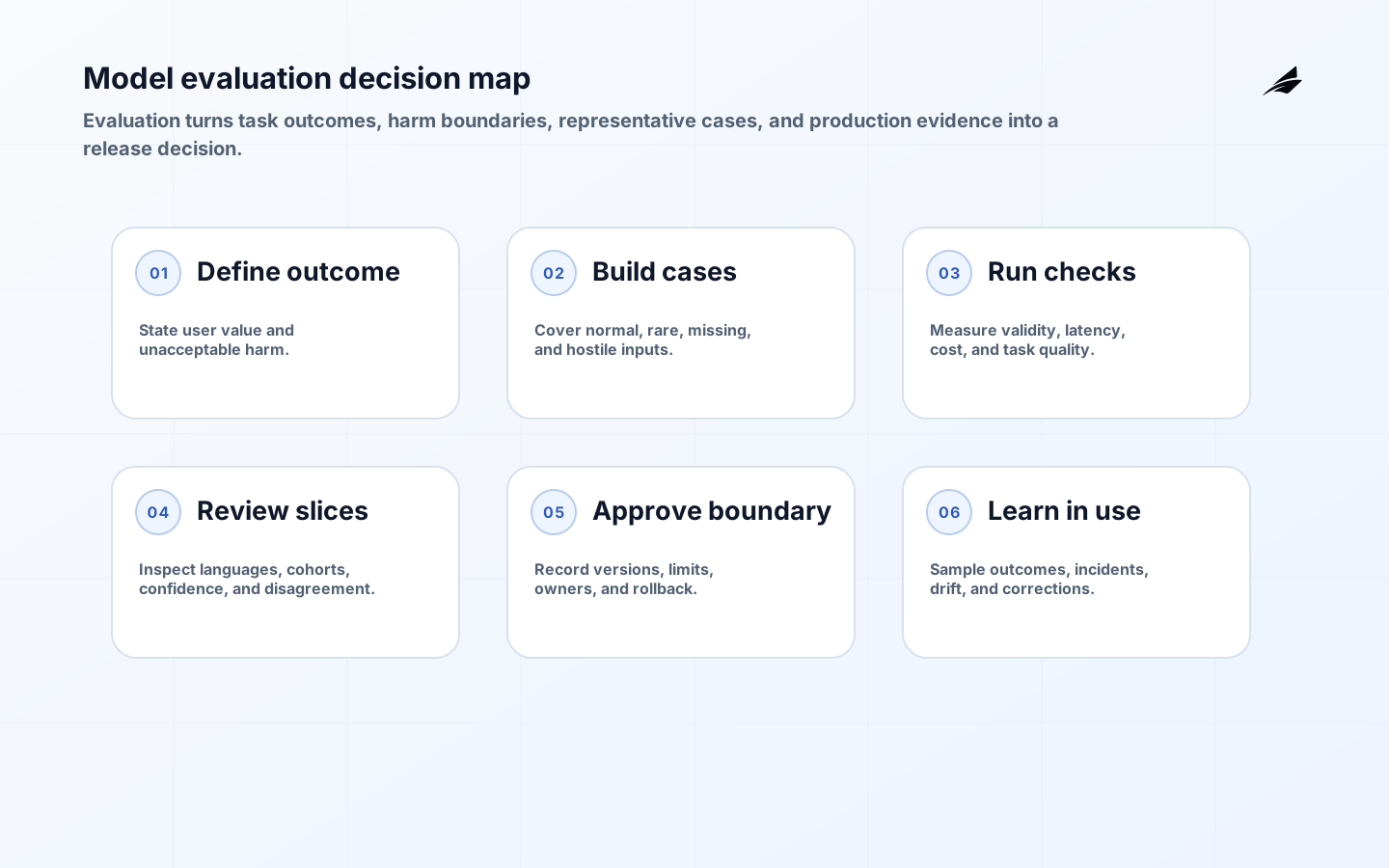
Model evaluation is a decision system, not a final score added after a model has been built. Before the first build, decide what outcome matters, which failures are unacceptable, who judges ambiguous cases, what evidence is authoritative, and what would make the team pause or stop. The NIST Generative AI Profile places pre-deployment testing alongside governance, provenance, and incident disclosure. That framing prevents a benchmark from becoming a false promise about a real workflow.
Evaluation should follow the job, not the novelty of the model. A support-draft system, a code assistant, and a document classifier need different success criteria. The Google Cloud AI and ML architecture guidance connects model work to operational excellence, security, reliability, cost, and monitoring. OpenAI’s evaluation guidance and the NIST AI RMF Playbook illustrate why capability, integration, user controls, and product context all belong in the evaluation boundary. Edilec’s vector search guide, human-in-the-loop guide, and RAG decisions guide extend that boundary.
Define the outcome and the harm
Write the target outcome in user and business terms: a correct triage, a safe draft, a completed code task, or a decision that remains reviewable. Separate the outcome from a proxy such as token overlap, click-through, or average score. Define unacceptable harm, including privacy exposure, biased access, unsafe instructions, incorrect escalation, silent omission, and cost or latency that breaks the service. Specify the baseline process and the populations or languages for which performance must be understood.
| Evaluation decision | Question | Evidence |
|---|---|---|
| Target outcome | What should be better for the user or operator? | Task definition, baseline, and owner. |
| Failure boundary | Which errors require rejection, escalation, or shutdown? | Severity rule and example cases. |
| Coverage | Which data, languages, roles, and contexts are represented? | Dataset provenance and segment counts. |
| Release gate | What evidence is sufficient for this consequence? | Thresholds, reviewer sign-off, and rollback condition. |
Build cases that represent reality
Use a layered evaluation set. Include ordinary cases, rare but material cases, ambiguous inputs, missing data, conflicting records, adversarial prompts, stale knowledge, malformed files, and cases that should produce no answer. Keep a private holdout for final review and version each set. Label the source, consent or usage basis, date, language, difficulty, expected action, and harm category. When labels are subjective, record disagreement rather than forcing a false single truth. Evaluation data should not quietly become training data without a documented boundary.
Combine automated and human checks
Automated checks are valuable for repeatability, regression detection, schema validity, latency, cost, and simple correctness. They cannot fully judge whether an answer is useful, respectful, grounded, or safe in a consequential context. Use calibrated domain reviewers for a sample of normal and difficult cases. Give them a rubric, the authoritative reference, and a way to mark “cannot determine.” For generated content, inspect factual support, omissions, contradictions, and unsafe confidence rather than fluency alone. For tools, test whether the action payload, permission, destination, and side effect match the intended task.

| Signal | What it can show | What it cannot prove |
|---|---|---|
| Task accuracy | Whether expected answers or labels match on the tested set. | Safe behavior outside the set. |
| Grounding or citation | Whether output is linked to an accepted source. | That the source is current or complete. |
| Latency and cost | Whether the service fits its operating envelope. | User value or decision quality. |
| Reviewer agreement | Whether humans apply the rubric consistently. | That the rubric covers every harm. |
| Production incidents | Which failure modes occur in actual work. | The absence of unobserved failures. |
Review slices instead of averages
An average can hide a dangerous segment. Break results down by language, customer type, document class, input length, confidence band, model route, and reviewer outcome. Compare false positives and false negatives according to consequence; a missed escalation may matter more than an extra review. Track abstention quality because a useful system knows when evidence is insufficient. When a change improves the overall number but degrades a material slice, make that trade-off explicit rather than burying it in a dashboard.
Turn results into a release decision
A release record should state model and prompt versions, data and retrieval versions, evaluation set version, thresholds, known limitations, approved use, excluded use, reviewers, and rollback trigger. Use shadow traffic, draft-only operation, or a small permissioned cohort when the risk allows. Keep a comparison against the previous model or manual baseline. A release is not approved because one score crossed a line; it is approved because the evidence matches the consequence and the team can recover when the assumption fails.
Learn from production failures
Production evaluation is continuous but should remain disciplined. Collect a sample of successful and failed tasks, user corrections, abstentions, escalations, latency, cost, policy denials, and incident reports. Remove sensitive data or protect it according to the workflow. Triage failures into source quality, labeling, prompt, model, retrieval, interface, tool, policy, or process causes. Add representative examples to the next evaluation set only after checking whether they can be used. A metric trend is a prompt for investigation, not a reason to retune blindly.
Before release, ask a reviewer to inspect one normal case, one boundary case, and one failure case from the evidence package. They should be able to explain the expected outcome, observed output, uncertainty, applicable control, and fallback. If the answer depends on an undocumented assumption, the evaluation is incomplete even when the numeric results look strong. This small review catches missing context that automated pipelines often overlook.
Keep an evaluation decision record
The evaluation record should capture the intended use, excluded use, data provenance, label policy, test-set version, model and prompt versions, retrieval or tool configuration, metrics, segment results, reviewer disagreement, known limitations, and release authority. Write down why a threshold is appropriate for the consequence instead of importing a number from another system. Include the evidence that would invalidate the decision, such as a new language, a changed source, a provider update, a recurring user correction, or an incident. This turns evaluation into an accountable engineering artifact.
Suppose a classifier routes inbound compliance questions. Overall accuracy may be high because routine requests dominate, while rare requests involving a protected category are often misrouted. A useful evaluation separates those cases, measures the cost of false routing, tests missing and conflicting fields, and includes a safe escalation label. The release decision might allow low-risk routine routing but require human review for the rare segment. That is a stronger outcome than chasing one global number because it connects the model boundary to the actual consequence.
Set a review cadence for both scheduled and event-driven evaluation. Re-run a small regression suite on every material change, a broader representative set before release, and a production sample after deployment. Trigger deeper review when drift, user corrections, incidents, a source change, or a new integration appears. Keep the sample understandable enough for domain reviewers to inspect and challenge. When results conflict, preserve the disagreement and ask which decision the system is actually optimising; the answer often exposes a missing outcome or an overconfident proxy.
Use evaluation to decide the system boundary
Evaluation results should change the shape of the product, not only the model configuration. If the system performs well on summarisation but poorly on attribution, permit summarisation while requiring source review. If one language or customer segment has unstable performance, narrow the eligible population or add a human route. If tool use is unreliable, keep the model in draft mode instead of granting it action authority. This is not a failure of evaluation; it is evaluation doing its job by making the safe boundary explicit.
Document the cost of each evaluation outcome. A false positive may consume a reviewer’s time, while a false negative may delay a critical response; the same metric can mean different things across workflows. Include time, money, privacy, trust, and operational burden in the release discussion. Revisit those assumptions when the process, customer population, provider, or policy changes. A model can improve technically while becoming a worse fit for the service if its new behaviour creates more review or reconciliation work than the team can safely absorb.
Evaluation ownership should be shared but explicit. A domain owner defines acceptable work and harm, an engineering owner maintains reproducible tests, a product owner accepts the workflow trade-off, and a risk or security owner challenges the boundary. Keep the final release decision with the person accountable for the outcome, not only the person who assembled the benchmark. This separation makes it easier to pause when evidence is mixed and to explain later why a model was limited, released, or replaced.
Evaluation should also test the surrounding product. A model may pass a static set while the application truncates evidence, loses a locale, displays an unsafe link, or sends a tool payload with the wrong identifier. Include interface, retrieval, policy, and integration checks in the release evidence. Test the model under the same latency, token, context, and permission limits it will face in production. Record which assumptions were simulated and which were exercised end to end. This avoids the false confidence that comes from evaluating an isolated model when users experience an entire system.
Key takeaways
- Define the user outcome and unacceptable harm before selecting a metric.
- Version representative, difficult, absent, and adversarial cases with provenance.
- Combine automated checks with calibrated domain review and explicit abstention.
- Inspect slices, trade-offs, and downstream work rather than relying on averages.
- Make each release reversible and carry production failures into the next evaluation set.
Frequently asked questions
Question: Is a benchmark score enough to approve a model? Answer: No; evaluate the assembled workflow, difficult cases, safety, cost, and user outcome. Question: What should fail a release? Answer: An unacceptable harm, an unexplained regression, missing evidence, or a recovery path that has not been tested.
What is a useful model-evaluation case?
Answer: It is a representative input paired with the expected outcome, acceptable alternatives, failure severity, evidence requirements, and the reviewer rationale needed to judge the workflow.
Can one score decide whether a model ships?
Answer: No. Combine task quality, safety, grounding, latency, cost, reviewer burden, and severe-failure analysis with explicit release thresholds.
How should production failures change evaluation?
Answer: Convert a reviewed incident or customer correction into a protected regression case, then decide whether the fix belongs in data, prompt, model, policy, interface, or operations.
What is the best model evaluation metric? There is no universal metric; choose measures that reflect the task and consequence. Is a large test set enough? No. Coverage, provenance, label quality, and difficult cases matter more than volume alone. Should humans review every result? Not always; use pre-action review, exception handling, or sampling according to risk. When is evaluation finished? Never entirely; pre-release evidence supports a decision, while production evidence tests whether the decision still fits reality.
Conclusion
Model evaluation gives a team the evidence to decide whether to build, release, limit, improve, or stop. Start with the work and its harm boundary, construct representative cases, use human judgment where it matters, and keep production learning connected to the same contract. The result is not a perfect score; it is a defensible release decision with a clear recovery path.