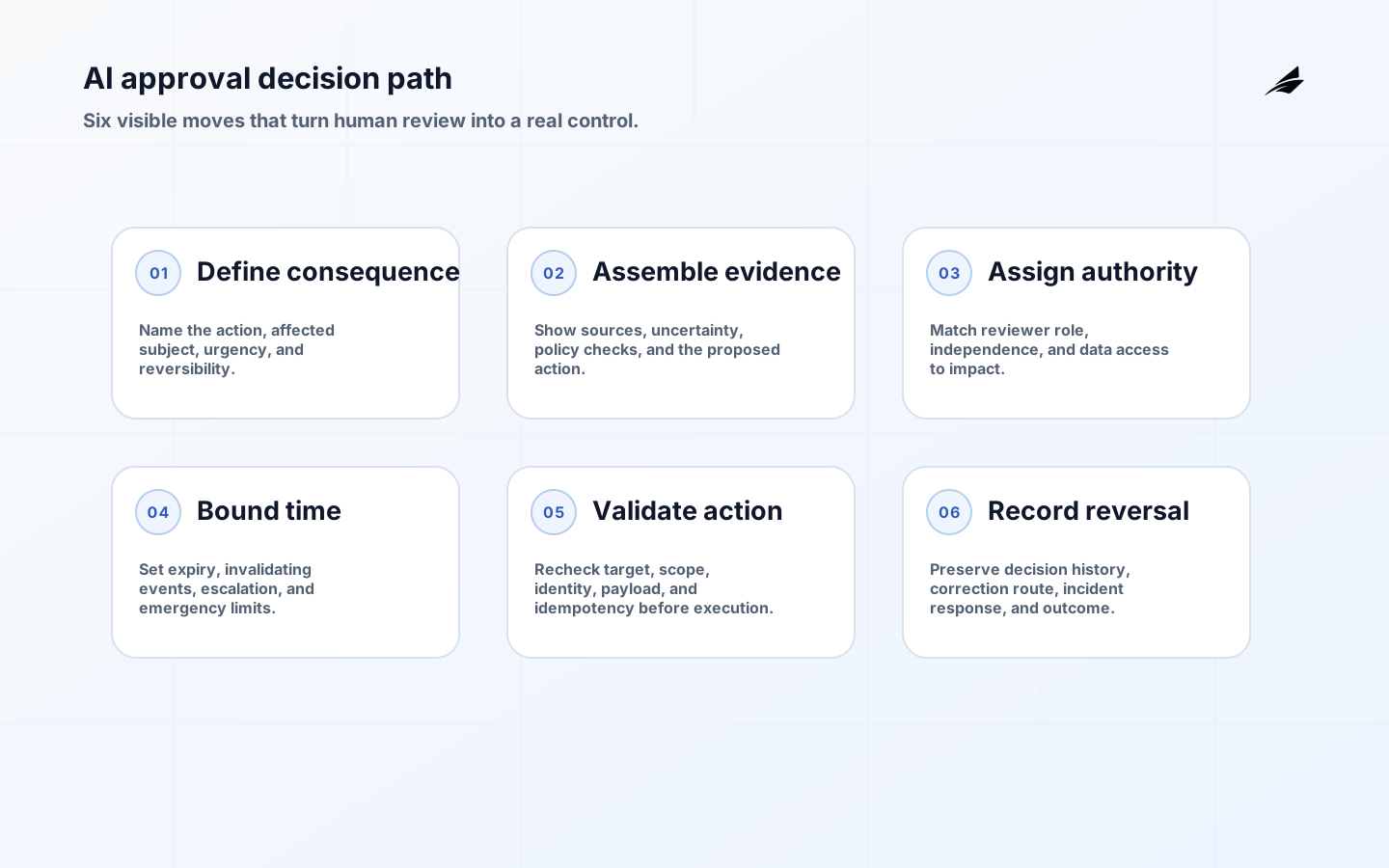
An approval step is not automatically meaningful human oversight. A reviewer who sees an opaque score, has seconds to respond, and cannot inspect the evidence is performing ceremony rather than control. AI workflow approvals should specify what decision is being made, what evidence supports it, who has authority, how long the approval remains valid, and how the outcome can be reversed. The Cloudflare Agents documentation shows why stateful agent workflows need explicit coordination around durable work. The approval boundary is one part of that coordination, and AI workflow approvals in production provides a useful follow-on for operating an approved design.
Name the decision and consequence
Begin with the action the workflow may take, not the model it will use. Drafting a response, routing a request, changing a record, approving a payment, granting access, and closing an investigation have different consequence levels. Document the affected subject, the reversibility of the action, the time sensitivity, and the cost of delay. A low-risk formatting task may need no approval, while a financial or security action may require a named person with domain authority. If the team cannot explain what the approver is deciding, it cannot define a suitable evidence packet or measure whether the review adds value.

| Decision class | Typical AI role | Approval design |
|---|---|---|
| Assistive | Draft, summarize, or classify for a person | User review with easy edit and no automatic side effect. |
| Operational | Route, schedule, or update a low-risk record | Role-based approval with evidence and an audit trail. |
| Sensitive | Handle personal, financial, employment, or security data | Named authority, limited context, and explicit policy checks. |
| High consequence | Change access, move funds, or make a material decision | Separate authorization, strong evidence, and reversible execution. |
| Emergency | Act during an incident or outage | Pre-authorized scope, expiry, logging, and post-event review. |
Design the evidence packet
An approver needs enough context to make a decision, not a transcript dump. Define the input, relevant source records, model output, uncertainty or missing information, policy checks, proposed action, and expected consequence. Show citations or record identifiers that the reviewer can open within their permission scope. Keep generated text distinct from authoritative facts and flag any fields the model inferred. The packet should also explain what happens if the reviewer rejects, edits, or asks for more information. Evidence is part of the user interface and the control design; if it is too sparse the reviewer guesses, and if it is too large the important signal disappears.
- State the exact action awaiting approval and the system that will execute it.
- Show the source records and policy version that support the proposal.
- Separate model suggestions, human edits, and authoritative values.
- Expose missing evidence, uncertainty, and conflicts rather than hiding them in a score.
- Record approve, reject, edit, defer, and escalate as distinct outcomes.
Match authority to consequence
Approval is meaningful only when the reviewer has the right authority and enough independence from the automation. A requester should not automatically approve their own exception. Map roles to actions, restrict access to the minimum necessary context, and make delegation and expiration explicit. For sensitive workflows, verify that the approval applies to the current record and not merely to a similar case. The NIST Generative AI Profile and NCSC secure AI guidance both illustrate why identity, data boundaries, and operational integration must be designed together. The model's confidence is not a substitute for a person's authority.
Make time and expiry explicit
Approvals can become unsafe when a decision outlives the facts that justified it. Set a review deadline, an approval expiration, and the event that invalidates the decision, such as a changed record, policy update, role change, or new evidence. A deferred item should not silently execute later. If a workflow needs an emergency path, predefine the maximum scope and duration, require additional logging, and schedule a retrospective. Time limits also reduce stale queues: an approval that has not received a response should move to a known state rather than becoming an invisible bottleneck. The NIST AI RMF Playbook is a useful reference point for keeping human control visible in assisted workflows.
| State | System behavior | Reviewer expectation |
|---|---|---|
| Pending | No side effect has occurred | Inspect evidence and choose an outcome. |
| Needs information | Pause and request a named missing input | Do not approve from an incomplete packet. |
| Approved | Execute only the specified action | Record authority, timestamp, and evidence version. |
| Rejected | Do not retry automatically | Capture the reason and route for reconsideration. |
| Expired | Invalidate the proposal or re-evaluate it | Require fresh evidence for a new decision. |
| Reversed | Undo or compensate for the action | Preserve the original approval and reversal record. |
Measure review quality
Measure the approval system as a workflow, not as a queue. Track agreement between model proposal and final outcome, reviewer edit and rejection reasons, time to decision, escalation rate, expired items, repeat submissions, and downstream corrections. Inspect whether reviewers catch the failures the process was designed to catch. A very high approval rate may mean the proposals are good, or it may mean the interface makes disagreement costly. Sample decisions for domain quality and compare outcomes by role, segment, and consequence level. A review metric is useful only when paired with the harm it is meant to reduce and the service level it is meant to protect.
Protect the execution boundary
Keep the approval record separate from the model's suggested action until the authorized system validates and executes it. Check that the target object, scope, amount, recipient, and version still match the approved packet. Use idempotency for retries and prevent a stale approval from being replayed against a new record. Log the principal, decision, evidence version, action payload, execution result, and reversal path. If the model output contains a tool request, treat it as a proposal that must pass the same policy checks. The NIST AI RMF Playbook reinforces the value of separating components and governing the data and operations that connect them.
Handle failures and appeals
Design for the case where the reviewer is wrong, the model is wrong, the source record is wrong, or the action succeeds technically but causes an unwanted outcome. Give operators a way to pause a class of actions, quarantine affected records, and identify which approvals used the same faulty evidence. Provide an appeal or correction route for people affected by the decision. Preserve the original packet so a later reviewer can understand what was known at the time, then attach the correction rather than rewriting history. Incident review should ask whether the issue was data quality, authority mapping, evidence design, model behavior, or execution control. The answer should change the system, not only the individual case.
Design exceptions and the review experience
Most approval systems fail at the edges. Define what happens when the requester is unavailable, the evidence source is down, two reviewers disagree, or the action must be completed before the normal deadline. An exception path should have its own authority, scope, expiry, and post-event review. Never let a timeout silently become approval. If the work is urgent, reduce the allowed action or require a second check after execution. This keeps urgency from becoming a permanent bypass that the normal workflow gradually depends on.
The reviewer interface should support attention rather than simulate certainty. Put the proposed action, material evidence, conflicting signals, and consequence near one another. Let the reviewer inspect a source, edit a field, request more information, or escalate without losing the case. Avoid presenting a single confidence color as the main explanation. Test the interface with the people who will make the decision under realistic time pressure; a control that is technically available but practically unusable will be bypassed or rubber-stamped.
Audit records should be useful to more than a compliance reviewer. A support lead may need to explain why a request was rejected, a security analyst may need to trace a privilege change, and an engineer may need to reproduce a failed execution. Store the decision, actor, evidence version, policy result, action payload, and downstream result with appropriate access controls. Keep human edits distinct from generated suggestions. This preserves the difference between what the model proposed, what the person authorized, and what the system actually did.
Review approval outcomes for consistency across teams and subjects. A high rejection rate in one queue may reflect a real difference in risk, or it may reveal an unclear rubric or a poorly designed evidence packet. Sample approved and rejected cases, compare reasons, and look for systematic use of the exception path. Where the decision affects people, include a route for correction and a way to investigate whether the workflow creates unequal error or delay. The approval process should make accountability visible without forcing reviewers to expose more personal data than the task requires.
A practical launch sequence starts with recommendation-only behavior. The model prepares a packet, but a person performs the action manually while the team measures evidence quality, review time, corrections, and missed risks. Next, automate low-consequence actions with a bounded reversal path. Only then consider higher-consequence decisions, adding stronger identity and approval requirements. This sequence gives the team real cases for tuning the interface and policy before automation has the authority to create broad side effects.
Approval queues also need capacity design. Estimate how many cases arrive, how long a qualified reviewer needs, and what happens during a surge or absence. A queue that grows faster than the review team will create pressure to widen permissions or approve without reading. Use prioritization based on consequence and expiry, not only model confidence. Escalate high-impact cases early and let low-risk work follow a lighter path. Capacity is part of control quality because a reviewer without time cannot exercise meaningful judgment.
Keep the policy readable outside the implementation team. Explain the decision boundary, evidence requirements, roles, expiry, exception path, and correction process in language that product, legal, security, support, and operations can review. Then map each policy statement to a test or system control. This makes disagreements visible before launch and helps the team detect when the product has drifted from the approved workflow. The strongest approval design is one that a new operator can understand without reading the model prompt or orchestration code.
Frequently asked questions
Question: Is a platform successful when adoption is high? Answer: Not by itself; teams should complete work safely with lower friction, clear ownership, reliable recovery, and visible unit cost. Question: What should a platform offer first? Answer: One supported path with a real user, stable contract, safe defaults, and evidence that it improves a repeated decision.
What makes an AI approval meaningful?
Answer: The reviewer receives the relevant evidence, understands the proposed consequence, has authority to accept or reject it, and can return the work for correction.
Which actions should require stronger approval?
Answer: Actions affecting money, access, legal commitments, sensitive data, or irreversible customer state should use stronger identity, explicit policy, and often a second role.
How should approval queues be measured?
Answer: Measure decision quality, correction and escalation reasons, waiting time, expiry, reviewer workload, and downstream outcomes—not only approval rate.
Does every AI workflow need a human approval? No. Review should be proportionate to consequence, reversibility, and uncertainty. What makes approval meaningful? The reviewer has authority, relevant evidence, sufficient time, and a real ability to change or stop the action. Compare AI agents decisions and tool-calling decisions when deciding which system boundary should own the final control. Can a confidence score decide when to skip review? It can help route work, but policy should define the boundary and high-consequence actions should retain independent controls. Should approvals be stored forever? Retain the decision and evidence according to the workflow's policy, with access and deletion rules. How should a team start? Choose one workflow, define its action and consequence, instrument the evidence packet, and test rejection, expiry, and reversal before automating more steps.
Key takeaways
- Define the action, consequence, authority, and reversal route before building the workflow.
- Give reviewers a compact evidence packet with sources, uncertainty, policy, and proposed action.
- Keep authorization and execution validation outside the model.
- Expire approvals when facts, policies, identities, or time windows change.
- Measure whether review catches meaningful failures instead of only tracking queue speed.
Conclusion
AI workflow approvals earn their place when they improve a consequential decision rather than add a ceremonial click. Make the decision visible, match authority to impact, supply evidence that can be checked, bound the approval in time, and preserve a reversal path. With those foundations in place, automation can move faster while the accountable human remains genuinely in control.