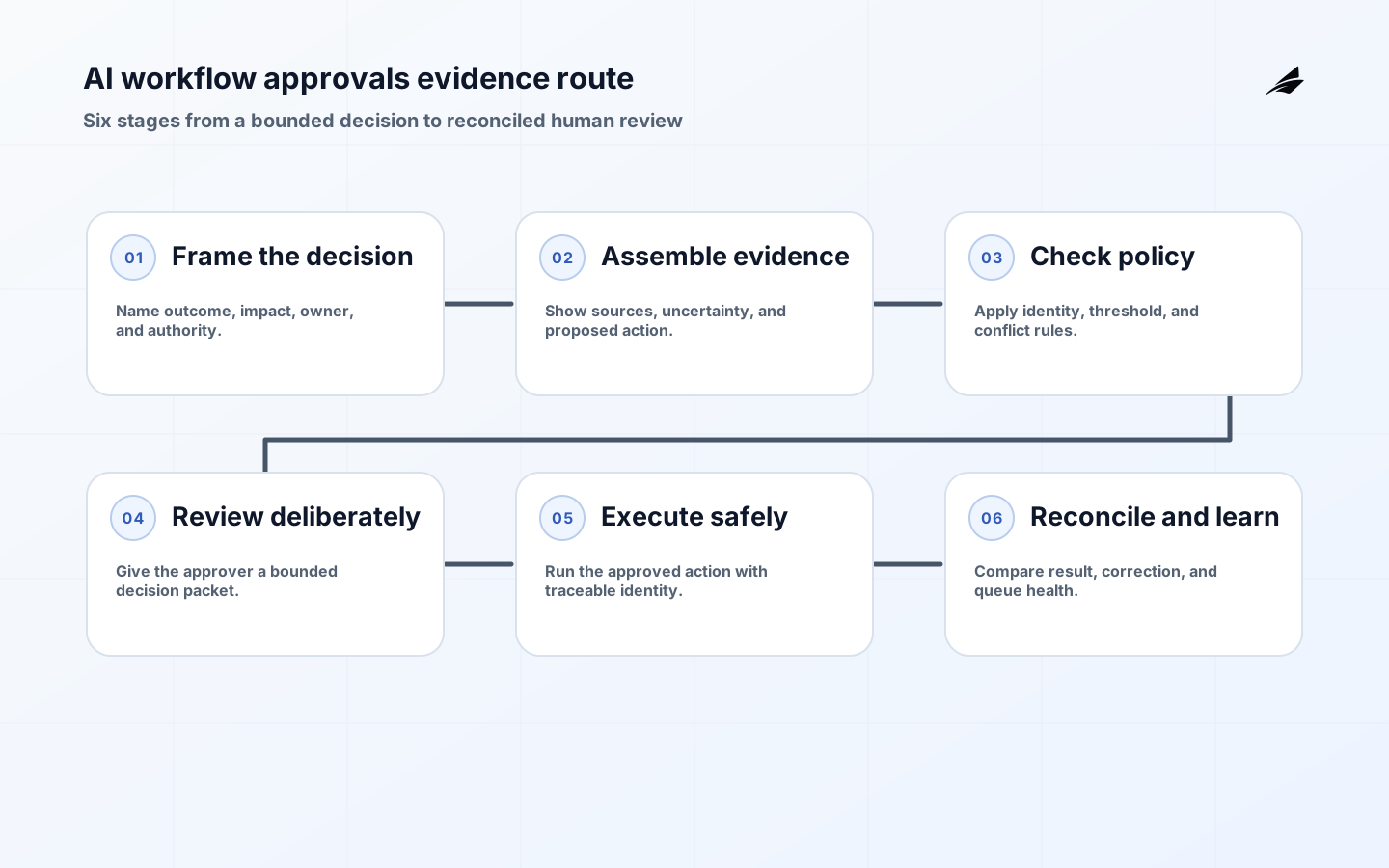
AI workflow approvals become important when a system's output can change a customer experience, financial record, access right, or operational commitment. The answer is not to put a person behind every generated sentence. It is to decide which actions need review, what evidence an approver needs, who holds decision rights, and how the workflow proceeds when no one responds. An approval step that asks a busy manager for an unexplained sign-off is theater; a workflow that makes every low-risk draft wait for review is friction. The NIST AI Risk Management Framework is a useful anchor because it connects governance to context and measurement. AI Workflow Approvals for AI Automation shows the operational side.
Production approval is a control over a decision, not a decorative human checkpoint. Define what the reviewer must confirm, which evidence is authoritative, and what happens when the reviewer is unavailable or sources conflict. The NIST AI Risk Management Framework offers a govern, map, measure, and manage lifecycle; its Generative AI Profile adds confabulation, privacy, human-AI configuration, and component-integration risks. The NCSC secure AI guidance assigns responsibility across design, deployment, and operation, while OWASP LLM guidance covers excessive agency, insecure output handling, and prompt injection. Compare Edilec human-in-the-loop automation, AI guardrails, and model evaluation. An evidence packet should show request, source records, model output, uncertainty, policy result, proposed action, and reviewer identity. Measure review accuracy, override rate, queue age, escalation, and downstream correction separately. A fast approval that cannot be explained later is weak; a bounded approval with a recoverable action is a durable production pattern.
Classify the decision, not the model
Set approval policy according to consequence, reversibility, uncertainty, and applicable obligations. A draft meeting summary might be sent to its author for optional review; a vendor-payment change should require an authorized finance decision with current supporting records. Classify decisions by business effect, not by whether a model was involved. Define what is informational, what is a recommendation, what creates a draft, and what commits an external action. For each class, state the minimum evidence, the accountable role, delegation limits, required separation of duties, expiry, and fallback. This design keeps teams from applying a single confidence threshold to very different kinds of risk.

| Decision tier | Example | Approval design |
|---|---|---|
| Informational | Summarize a completed support case | No approval; show sources and a correction route. |
| Reversible draft | Prepare a customer reply or purchase request | Named reviewer can edit, approve, or reject before release. |
| Material commitment | Change a contract, payment, or entitlement | Authenticated decision, evidence packet, policy checks, and audit record. |
| Prohibited or exceptional | Request conflicts with policy or lacks evidence | Block automation and route to an established exception process. |
Give approvers an evidence packet
A review screen should help a person make a decision, not force them to reconstruct the case from an AI summary. Show the proposed effect, the affected subject or record, source references, current state, policy rules, uncertainty or missing facts, and the exact action that will happen after approval. Support edit, reject, request-information, and delegate paths where the business needs them. Bind the sign-off to the authenticated actor, decision version, and a short validity period. When a material record changes after the review begins, refresh the evidence or require a new decision. This protects users from approving an action whose meaningful context has already changed.
- Make the proposed effect concrete enough that an approver can predict the result.
- Show primary evidence and current state instead of only a generated rationale.
- Use role, delegation, and separation-of-duties rules enforced by the workflow service.
- Expire approvals when time or state changes make the earlier review unreliable.
- Provide a defined escalation path for ambiguity, policy conflict, and unavailable approvers.
Keep approval outside the model
A model can suggest that approval is required, but it must not decide that an approval occurred or that it is sufficient. The approval service should enforce the policy, identity, state check, and audit record in conventional code. This protects the process from prompt injection, hallucinated status, and inconsistent interpretation. The OWASP Top 10 for LLM Applications is relevant because excessive agency can turn a weakly specified action into an unbounded one. If an agent uses tools to prepare a request, the tool should create a pending object with immutable evidence references; a later authorized action should consume that object only after validation. That sequence makes the boundary visible to users and operators.
Measure review quality and queue health
Monitor approval latency, timeout rate, approval and rejection reasons, overrides, reversals, and the share of actions that arrive without adequate evidence. Segment these metrics by decision tier; a slow low-risk queue and a slow emergency escalation need different remedies. Review whether approvers are correcting the same fields repeatedly, because that is a direct signal for improving source data, model instructions, or form design. The NIST Generative AI Profile supports documenting human oversight and post-deployment measurement. Approvals should create feedback, not merely a legal record: a rejected proposal can become a test case, an updated policy, or a rule that prevents needless future review.
| Queue signal | Interpretation | Response |
|---|---|---|
| High auto-approval rate | Review may be low value or rubber-stamped | Sample decisions and reconsider tiering or evidence quality. |
| Repeated edit before approval | Proposal is consistently incomplete | Improve the input contract or structured draft fields. |
| Expired approvals | Decision rights or staffing do not match workflow timing | Add delegation, service targets, or safe fallback. |
| Frequent reversals | The proposed effect or state validation is weak | Stop expansion and investigate the action boundary. |
Start with a bounded approval
Founders should begin where the decision is common, evidence is available, and a person already owns the outcome. Instrument the existing manual process before automating it so the team knows where time is spent and where errors occur. Release a draft-and-review path before permissioning autonomous execution. Train approvers on the evidence display and give them a way to flag confusing proposals. Keep ordinary non-AI routes available during rollout. The OpenAI agents guide can inform how an agent coordinates steps, but its behavior must remain subordinate to the organization's decision policy. Expansion should follow observed quality and queue health, not a desire to remove every human click.
Set service levels for review
A review queue is part of customer-facing reliability when it stands between a proposal and an important action. Report its health with the same seriousness as a service dependency, including ageing, ownership, escalation, and recovery from staffing gaps.
Review service levels should be visible to the people whose work depends on them. Show a request's tier, due time, current owner, and safe next step so frontline staff do not guess whether an AI proposal is waiting, denied, or ready for a conventional process. Pair that transparency with capacity reporting for approval owners. It improves trust in the workflow and discourages informal bypasses when a decision is genuinely time-sensitive.
Approval design needs service levels. Decide how quickly each tier must be reviewed, what happens when the target is missed, and who owns the queue at different times. Do not let a material customer request become invisible because it sits between an agent's proposal and an unavailable approver. Define reminders, delegation, escalation, and safe expiry. For urgent but high-impact decisions, create a distinct emergency policy with a smaller authorized group and stronger after-the-fact review rather than weakening every routine control. Measure whether service levels are realistic across regions, teams, and business cycles. A queue that routinely times out encourages workarounds, while an overstaffed low-risk queue wastes attention that should be spent on consequential review. Tie queue capacity to observed volume and decision complexity, then revisit tiers when the automation changes the shape of work.
- Publish target review times, escalation contacts, and safe expiry behavior for every approval tier.
- Use delegation only through recorded, time-bound authority that the workflow service can enforce.
- Separate urgent exception paths from ordinary approvals and audit their use more closely.
- Alert queue owners before a material decision exceeds its service target, not after it expires.
- Review approval volume and staffing by season, region, and decision type rather than using one global average.
- Treat repeated bypass requests as evidence that the decision tier or workflow needs redesign.
Frequently asked questions
Question: Which AI-assisted decisions need human approval? Answer: Require authenticated review when an action changes money, access, contractual terms, customer commitments, or another material state. Low-consequence drafts can use sampling or optional review when the evidence and recovery path are clear.
Question: What should an approval evidence packet contain? Answer: Show the proposed effect, affected record, authoritative sources, current state, policy result, uncertainty, model or workflow version, and the identity that will record the decision. The reviewer should not need to reconstruct the case from a summary.
Question: What happens when an approver is unavailable? Answer: Use time-bound delegation, reminders, escalation, and safe expiry. A high-impact request should pause or follow a separately authorized emergency route rather than silently becoming approved.
Does human review make an AI workflow safe? It can reduce risk, but only when the reviewer receives usable evidence, has real authority, and is not overwhelmed by volume. Can approval be delegated? Yes, when delegation is explicit, time-bound, and enforced by the system. What happens if an approver is unavailable? Define expiry, escalation, and a safe non-action outcome in advance. Should every confidence score trigger a different policy? Use scores as one signal, but classify by business consequence and evidence quality. For review-workflow design, human-in-the-loop automation is an especially relevant companion.
Key takeaways
- Design approvals around the consequence of a decision, not around AI novelty.
- Give reviewers an evidence packet, real decision rights, and explicit escalation paths.
- Record approval in an authenticated workflow service outside the model.
- Use queue and correction data to improve the proposal and reduce avoidable review load.
Conclusion
Approval queues need an operating contract. Set an age target, escalation threshold, reviewer substitution rule, and maximum number of pending decisions per workflow. Preserve the exact packet shown at approval time so later review is not forced to reconstruct a moving model response. If the underlying record changes, invalidate the approval or require a fresh review. Separate a reviewer declining a decision from a reviewer requesting better evidence; both are useful signals, but they imply different product changes. Reconcile approved actions with downstream records and sample cases where the user accepted an output without opening its evidence. The review surface is part of the control boundary.
A well-designed approval makes important AI-assisted actions easier to understand, challenge, and recover. Classify the decision, show the evidence, enforce the right authority, and learn from every rejection or reversal. That lets a founder increase useful automation without dissolving accountability.