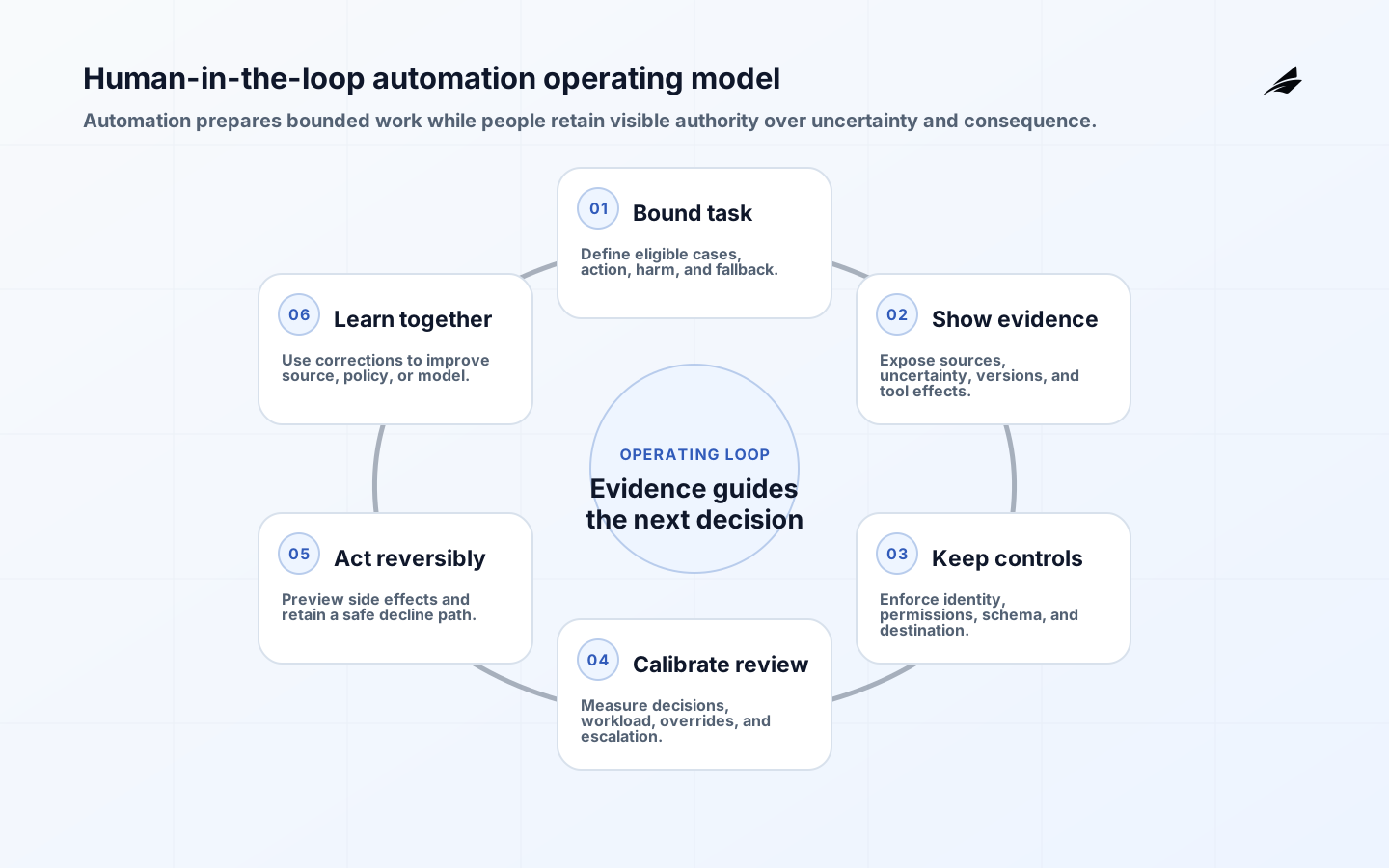
Human-in-the-loop automation is not a checkbox labelled “human review.” In production, it is a division of authority between software and people: the system prepares or recommends work, a person decides where consequence requires judgment, and the service records what happened. The NIST Generative AI Profile identifies human-AI configuration, confabulation, privacy, bias, and information integrity as context-dependent risks. The OpenAI evaluation guidance supports testing whether reviewers can see evidence, identify uncertainty, and make consistent decisions rather than approving output automatically.
Define the workflow before selecting a model. Is the system classifying an inbound request, drafting a response, proposing a code change, or initiating a transaction? The answer determines whether review is advisory, mandatory, sampled, or a genuine approval gate. Related Edilec guidance on embeddings, retrieval pipelines, and model evaluation helps separate evidence and evaluation choices from the human decision itself.
Set the decision boundary first
Name the actor, eligible cases, proposed action, unacceptable harm, and manual fallback. A reviewer must know what they are deciding, which facts are authoritative, what the model did not check, and what happens after approval. Avoid vague instructions such as “verify the answer.” Give reviewers a bounded question and an evidence view. If the action changes a customer record, access right, financial state, or external communication, the automation should not make the reviewer reconstruct the entire case from hidden context.
| Pattern | Suitable when | Control requirement |
|---|---|---|
| Review before action | A wrong action has material or irreversible consequence. | Named approver, evidence view, explicit accept or reject record. |
| Review exceptions | The normal path is low risk but uncertainty needs judgment. | Clear threshold, reason for escalation, queue ownership. |
| Sample after action | Volume is high and individual harm is bounded. | Representative sample, fast correction, trend review. |
| Two-person approval | Conflict of interest or high consequence demands separation. | Independent identities and auditable sequence. |
Design the reviewer role
A reviewer is not a decorative safety layer. Give them time, context, authority, and a usable way to disagree. Show input, output, source evidence, confidence or uncertainty, model and prompt version, policy checks, and any tool calls. Make “not enough evidence” a valid result. Define workload limits because queues create automation bias when people are asked to approve thousands of similar items without meaningful attention. Rotate or calibrate reviewers when the task involves subjective judgment, and preserve their rationale when it affects a later correction. The OpenAI Agents JS guide illustrates why tool use and handoffs need an explicit boundary around provenance, authority, and action.

Keep deterministic controls outside the model
Use the model for interpretation, drafting, or prioritization where it helps, but enforce identity, permissions, schemas, destinations, rate limits, and transaction rules in deterministic services. The NCSC secure AI guidance places threat modelling, supply-chain security, responsible release, logging, and maintenance across the lifecycle. Apply that structure to prompts, retrieval, tools, and reviewer interfaces. The reviewer should not be the only barrier against prompt injection, data leakage, unsafe output, or excessive agency; those failure modes need controls at the service boundary.
| Failure | Why a reviewer may miss it | Better evidence |
|---|---|---|
| Confidently wrong draft | Fluent wording hides weak or absent support. | Source spans, contradiction checks, and reject reason. |
| Wrong case context | A queue view omits tenant, date, or status. | Stable case identifier and authoritative record link. |
| Overloaded queue | Approvals become habitual clicks. | Decision time, override rate, sampling, and workload trend. |
| Unsafe downstream action | The reviewer sees text but not the tool effect. | Preview of payload, destination, permissions, and rollback. |
Evaluate decisions and reviewer behaviour
Evaluate both model output and the human-system interaction. Build cases with ambiguity, missing information, adversarial input, language variation, edge populations, and a correct “decline” outcome. Measure precision and recall where appropriate, but also reviewer agreement, time to decision, escalation quality, override reasons, correction rate, and harm avoided. Compare the assisted workflow with the previous manual process. A faster queue is not an improvement if errors move downstream or reviewers lose the ability to detect them.
Roll out with a reversible action surface
Start in shadow mode or draft-only mode when the consequence permits. Let reviewers compare the suggestion with the existing process, then enable a narrow action with an explicit fallback. Version prompts, model routes, retrieval settings, policies, and reviewer instructions together. Record releases and keep a kill switch that stops automated action without destroying the evidence queue. Test provider outage, stale context, duplicate submission, partial tool failure, and a reviewer who changes their mind after the action was accepted.
Operate the loop as a learning system
Assign product ownership for the workflow, domain ownership for the decision rule, platform ownership for reliability, and security or risk ownership for boundaries. Review false approvals, false escalations, queue aging, override patterns, sensitive-data exposure, and model changes. Feed reviewed failures into prompts, source data, policy, interface, or evaluation sets only after identifying the cause. Do not quietly retrain or retune to make a metric look better while leaving the reviewer unable to explain the result.
A useful operating drill is to present a reviewer with a plausible recommendation based on an outdated record and ask them to approve it under normal queue pressure. The system should expose date, source, uncertainty, and the action payload before approval. If the reviewer can approve without seeing those facts, the gap belongs in the interface and workflow contract. If the reviewer sees the facts but cannot stop the action, the gap belongs in authorization and release design.
Record the human decision contract
The human-in-the-loop contract should name who may approve, reject, edit, escalate, or reverse an action; what evidence they must inspect; what the model is allowed to propose; and what the system does when the reviewer does nothing. Include queue priority, service expectations, conflict handling, substitute approvers, and the record that proves the decision. This prevents a vague “human oversight” statement from becoming an unowned operational queue. It also makes it possible to compare the intended role with what reviewers actually do under time pressure.
Imagine an assistant drafting a customer refund response. It may summarise the case and propose a value, but the refund policy, customer identity, amount limit, and payment destination should be checked by deterministic services. The reviewer needs the original request, authoritative order state, policy version, proposed payload, and a clear choice to approve, edit, or escalate. If the customer record changed while the draft waited, the system should revalidate rather than quietly send stale work. This is a workflow design problem as much as a model problem.
Review the loop using a balanced sample of approvals, rejections, edits, escalations, and abandoned items. Look for fast approvals that correlate with later corrections, repeated reviewers who see the same class of uncertainty, and queues where the nominal approval time makes meaningful review impossible. Update the rubric or interface when reviewers disagree for a principled reason; update the model or source only when the evidence identifies that cause. A good cadence protects both safety and reviewer trust because it treats their work as evidence rather than as a decorative sign-off.
Calibrate the loop with disagreement
A strong human-in-the-loop design expects disagreement. Reviewers may reasonably differ when evidence is incomplete, policy language is ambiguous, or the cost of an error is asymmetric. Capture that disagreement with the case, rubric version, evidence, and final authority instead of silently selecting the majority label. Calibration sessions can then distinguish a model failure from a policy gap or a workflow that has no acceptable answer. The system should make uncertainty visible and route it to the person who can resolve the underlying rule.
Also test inactivity and interruption. A reviewer may lose access, close a queue, change their mind, or approve a draft after the underlying record has changed. Define expiry for pending decisions, revalidation before action, reassignment, and a safe result when the queue is unavailable. These details matter because a nominal reviewer does not help if the interface permits stale approval or if the fallback sends work through an unreviewed channel. The loop is complete only when the person, service, and source state remain aligned through the decision.
Ownership should follow the decision rather than stop at the review queue. The domain owner decides what a correct and acceptable outcome means; the product owner defines the user journey; the platform owner keeps the service reliable; and the risk owner helps test the boundary. Reviewers need an escalation route that reaches the person who can change policy or source data. Without that route, human-in-the-loop becomes a holding area for unresolved ambiguity, and the organisation may mistake queue closure for safe completion.
A useful maturity test is to remove the model suggestion from a sample of cases and ask whether the human workflow still works. If reviewers cannot complete the task without the model, the system may have created hidden dependency rather than assistance. Keep the original evidence, manual route, and correction path available. Reviewers should be able to explain why a suggestion was accepted or rejected and should not be penalised for escalating an uncertain case. When automation saves time, use that time to improve evidence and judgment rather than simply increasing queue volume. This keeps the human role meaningful as the system changes.
Key takeaways
- Define exactly what the person decides and what the system is allowed to do.
- Give reviewers authoritative evidence, uncertainty, workload capacity, and a real decline path.
- Keep permissions, schemas, destinations, and irreversible actions deterministic.
- Measure reviewer behaviour and downstream outcomes alongside model quality.
- Release in bounded stages with versioning, a kill switch, and a tested manual fallback.
Frequently asked questions
Question: What makes human review meaningful? Answer: The reviewer must see relevant evidence, have authority to decide, and be able to pause or reverse the action. Question: When can automation proceed without approval? Answer: Only when consequence, scope, and failure handling are bounded by an explicit policy.
What should a human reviewer own?
Answer: The reviewer should own the decision that cannot be safely reduced to a deterministic rule, with enough evidence to accept, edit, reject, or escalate the proposed result.
When should an automated workflow pause for review?
Answer: Pause when consequence, uncertainty, missing evidence, policy conflict, or reversibility crosses the threshold defined by the workflow owner.
How can reviewer quality be measured?
Answer: Track agreement with the decision contract, correction reasons, escalation quality, time to decision, and whether review prevented or contained material harm.
Does human-in-the-loop mean every item needs manual approval? No. The control can be pre-action review, exception routing, sampling, or a two-person decision depending on consequence. Is confidence enough to decide when to escalate? No; thresholds need validation on representative cases and should be combined with policy and data checks. How do teams prevent rubber-stamping? Limit queue pressure, show evidence and alternatives, track rationale, and sample approved work. When can automation expand? When the assisted workflow demonstrates safe outcomes, calibrated review, and a recoverable failure path.
Conclusion
Human-in-the-loop automation is dependable when human authority is concrete rather than ceremonial. Bound the task, make evidence and uncertainty visible, keep high-consequence controls outside the model, and use reviewer behaviour to improve the system. Production maturity is the ability to pause, explain, correct, and learn without pretending the model is the decision-maker.