AI Guardrails Security Review: A Layered Control and Evaluation Guide is for AI engineers, application security teams, product owners and risk leaders reviewing a generative-AI or agentic workflow. The aim is to show that policy boundaries are enforced at the right layer and continue to work under realistic misuse, ambiguity and system failure. That changes the planning question from “which tool or supplier looks impressive?” to “what operating result must be true, which boundaries carry risk, and what evidence will let accountable owners approve the next step?” A useful plan makes those choices inspectable before implementation and keeps them visible through release.
Estimate an AI guardrails security review from the work that creates uncertainty: the number of trust boundaries, policy categories, tool actions, sensitive data paths, model variants, evaluation cases and human review queues that controls must cover. Use ranges tied to assumptions and narrow them with targeted evidence; a generic schedule or price would conceal the very conditions the plan needs to test.
1. Define the outcome and a decision-ready scope
The scope boundary should include approved users and purposes, sensitive data, trusted and untrusted context, model capabilities, tool authority, prohibited outcomes, escalation rules and incident ownership. Write the boundary in operational language: who performs the work, what triggers it, which record is authoritative, what can fail, who handles an exception and what proves completion. This prevents a feature list from hiding the data, authorization, integration and support work that usually determines whether a system can be trusted.
The product owner defines allowed use; security translates abuse cases into requirements; engineering implements enforcement; tool and data owners approve authority; operations owns monitoring and containment. Record that division in decision and responsibility maps. A boundary is not truly out of scope until its owner accepts the dependency and the evidence expected from it.
- Record the current baseline and the desired behavioral change.
- Identify the first representative users, systems and data.
- Separate known constraints from assumptions that require testing.
- Define acceptance evidence for functional and nonfunctional behavior.
- Set a decision forum, escalation path and expiry date for unresolved risks.
2. Make architecture and data contracts reviewable
Draw the request path through identity, input checks, retrieved context, model, output validation, tool gateway and destination. Mark which content is untrusted and which decisions must be deterministic outside the model. Annotate ownership, failure behavior and retained evidence at each boundary so reviewers can reason about operation rather than merely recognize product icons.
| Decision area | What must be explicit | Minimum evidence |
|---|---|---|
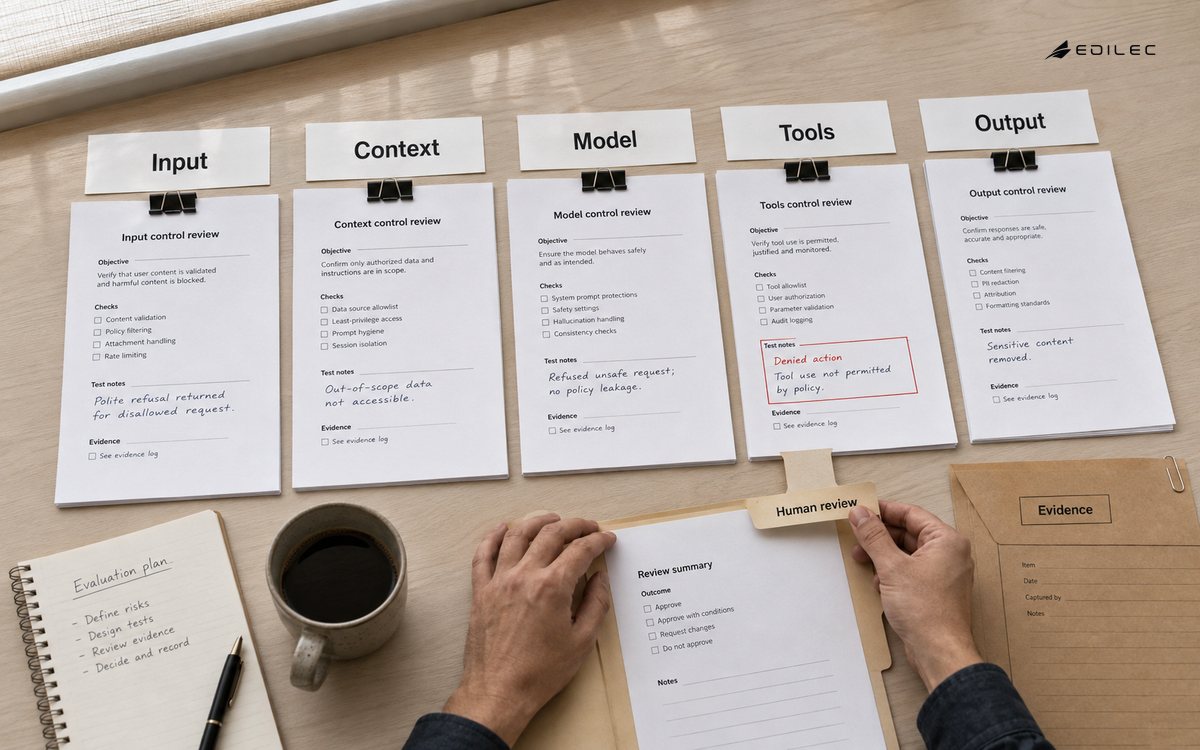
| Input | Identity, purpose, content and rate checks | Allowed and blocked test corpus |
| Context | Source allowlist, provenance and instruction separation | Poisoning and injection tests |
| Model | System rules and constrained response format | Behavioral evaluations |
| Tools | Schema, authorization, confirmation and limits | Denied-action evidence |
| Output | Policy, grounding, privacy and destination checks | Leakage and unsupported-claim tests |
Build a versioned corpus containing legitimate, ambiguous, malicious and dependency-failure cases. Verify safe denial, false-positive recovery, prompt-injection resistance, structured argument validation and authorization immediately before a side effect. Write the question and acceptance condition before building the proof, then preserve the result and changed decision. This keeps experimentation from turning into an unreviewed production component.
3. Build controls into the working path
Layer controls because no single prompt or classifier covers the system. Use deterministic schemas and permissions for actions, provenance rules for context, behavioral evaluations for model output and human confirmation where consequence is high. For every important risk, identify prevention, detection, response and the safe route for a legitimate exception; a policy statement alone cannot enforce or recover the workflow.
- Place deterministic authorization outside the model
- Apply least privilege to tools, data and destinations
- Keep instructions distinct from retrieved or user-controlled content
- Validate structured arguments before any side effect
- Use human approval for sensitive or irreversible actions
- Fail closed where harm matters and provide a safe recovery path
Guardrail services need only the data required for their decision, and tool execution must use scoped credentials. Protect exception consoles and break-glass overrides because they can bypass otherwise sound controls. Retain only the diagnostic evidence needed for support, assurance or investigation, protect it as sensitive data and verify both routine and emergency paths.
4. Deliver through evidence gates
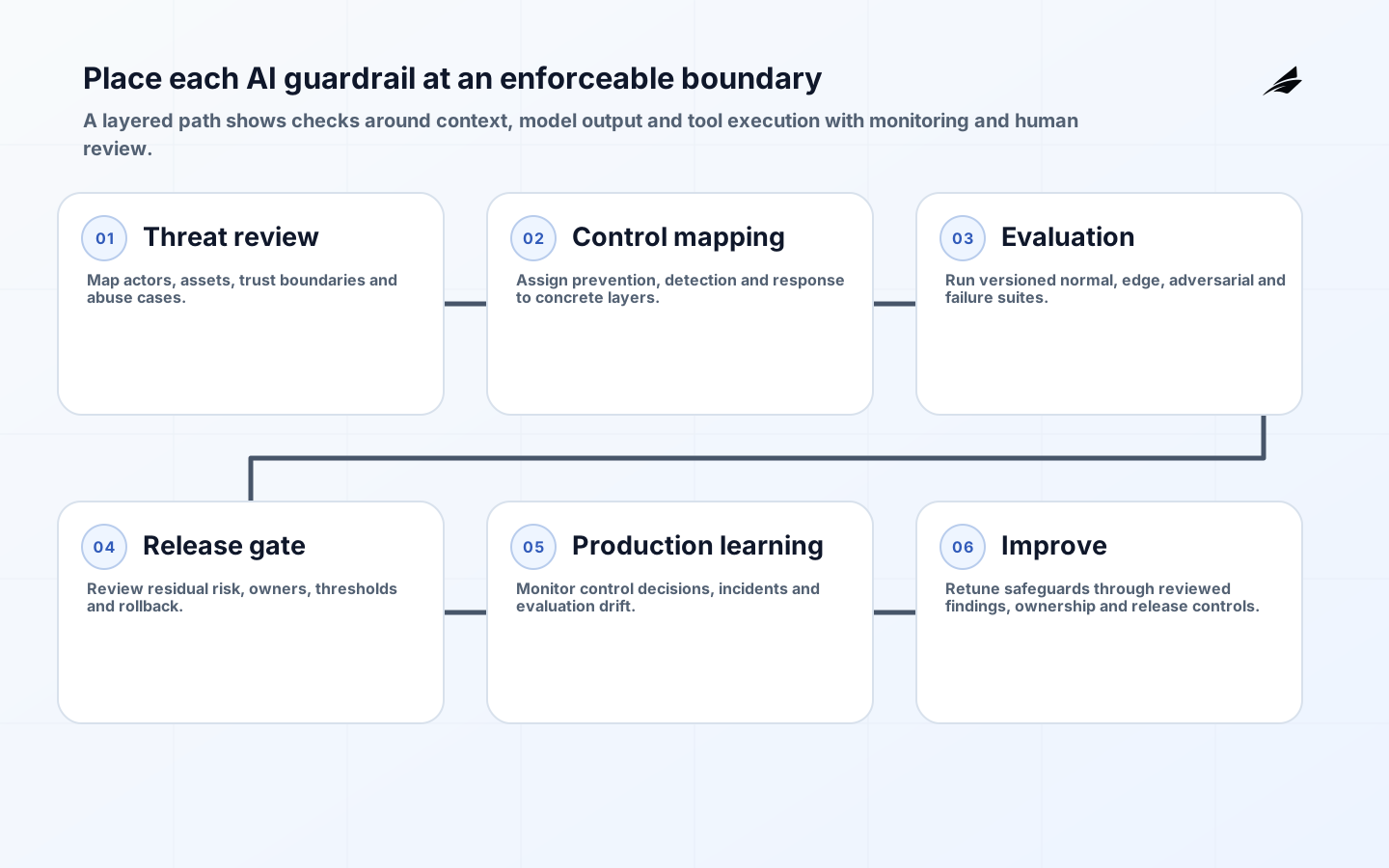
Begin with assets and abuse cases, map each risk to an enforcement layer, create evaluations, set release thresholds, then monitor control outcomes and revise cases from incidents and near misses. Each gate should name its decision owner, evidence, tolerated exceptions, stop condition and next reversible commitment, making progress depend on reduced uncertainty rather than completed components.
| Stage | Decision and evidence |
|---|---|
| Threat review | Map actors, assets, trust boundaries and abuse cases. |
| Control mapping | Assign prevention, detection and response to concrete layers. |
| Evaluation | Run versioned normal, edge, adversarial and failure suites. |
| Release gate | Review residual risk, owners, thresholds and rollback. |
| Production learning | Monitor control decisions, incidents and evaluation drift. |
Release first with low-risk tasks and human confirmation. Compare blocked and allowed decisions by policy class, keep a route for legitimate exceptions, and roll back the control or model version independently when possible. Wider exposure should follow observed evidence, not calendar confidence. Define who can stop expansion, what state must survive reversal and how affected users will be informed.
5. Explain cost through drivers and assumptions
Budget for classifier and model calls, evaluation maintenance, secure logging, review operations, red-team work and false-positive handling. A cheap guardrail that redirects large volumes to people may be costly in operation. State the unit or population behind variable charges and identify the evidence that would tighten uncertain ranges. This makes tradeoffs visible without inventing a universal budget.
For external products or reviewers, define acceptance through policy tests, bypass attempts and recovery evidence. Avoid a guarantee of safety; require documented residual risk, limitations and response ownership. Document assumptions about access, data, reviewers and third parties. When they fail, choose explicitly among scope, cost and timing instead of silently discarding testing or operational readiness.
6. Measure the system as an operated service
Measure unsafe cases blocked, legitimate cases allowed, unauthorized tool attempts denied, sensitive-data leakage tests, grounded-answer quality and review burden. Report false positives and false negatives separately. Define source, population, unit, exclusions, review cadence and the action attached to each threshold so the reporting supports a real operating decision.
| Signal to review | Decision it should support |
|---|---|
| unsafe requests correctly blocked | For this evaluation, name the accountable owner, supporting evidence, exception route, and next measurable check. |
| legitimate requests incorrectly blocked | Within this evaluation, name the accountable owner, supporting evidence, exception route, and next measurable check. |
| tool actions denied by policy | When implementing this evaluation, name the accountable owner, supporting evidence, exception route, and next measurable check. |
| sensitive-data exposure tests | Before releasing this evaluation, name the accountable owner, supporting evidence, exception route, and next measurable check. |
| grounded-answer performance on approved sources | While operating this evaluation, name the accountable owner, supporting evidence, exception route, and next measurable check. |
| time to contain and replay a guardrail incident | When changing this evaluation, name the accountable owner, supporting evidence, exception route, and next measurable check. |
Operators need to identify which layer made a decision, quarantine a session, revoke tools, preserve minimal evidence and replay the case against candidate fixes. Logs must remain useful without becoming a sensitive-data archive. Confirm recovery against user-visible behavior and authoritative records; a successful automation job or green infrastructure chart does not by itself prove the service is correct.
7. Expose common failure modes early
| Failure mode | Practical response |
|---|---|
| Prompt-only policy | Enforce permissions and side effects in application code. |
| Single classifier dependency | Layer controls and define classifier failure behavior. |
| Evaluation leakage | Separate development and release suites with versioned cases. |
| Silent false positives | Measure user impact and provide review paths. |
| Logs become a data leak | Minimize, protect and retain guardrail evidence deliberately. |
Track prompt injection, policy conflict, classifier outage, evaluation leakage, override abuse and control drift after model or tool changes. Each accepted gap needs scope, approver and a retest trigger. Keep these entries connected to architecture decisions, backlog work, tests and operating signals. Close them with evidence or carry them visibly with an accountable acceptance decision.
Key takeaways
- Start with the operating result: show that policy boundaries are enforced at the right layer and continue to work under realistic misuse, ambiguity and system failure.
- Define architecture through identity, data, trust, failure and ownership boundaries.
- Place controls where they can enforce a decision and retain proportionate evidence.
- Estimate from explicit drivers and assumptions; avoid universal price or schedule claims.
- Expand through bounded cohorts and prove that receiving teams can operate and recover.
Frequently asked questions
What should the first deliverable be?
The first deliverable is a control matrix linking assets and abuse scenarios to input, context, model, output, tool and human controls, with an owner and test case for each important boundary. Keep it concise enough to review and specific enough to reject a weak option. The next artifact should be the smallest proof capable of changing the decision.
Should the team select tools before architecture?
Choose guardrail libraries after defining policy and latency tolerance. A library can supply checks, but application code must still enforce identity, authorization, transaction limits and safe failure behavior. Compare candidates through a realistic path and inspect limits, failure behavior, portability and ownership; product selection cannot repair an undefined operating model.
When should security and operations join?
Security is central from threat modeling onward; operations and affected reviewers should shape thresholds and exception paths. Reassess after changes to models, prompts, retrieval sources, tools or destinations. Early participation should produce concrete requirements and tests, not a late request for policy approval after expensive boundaries have hardened.
How does the team know it is ready to scale?
Increase users or tool authority when evaluation thresholds hold on unseen cases, false-positive handling is sustainable, high-impact actions remain confirmed, incidents can be replayed and every control has an operational owner. Require that evidence across the whole workflow, including exceptions and recovery, rather than treating one successful demonstration or a quiet pilot as proof of readiness.
Conclusion
AI Guardrails Security Review: A Layered Control and Evaluation Guide should end in an operable decision system: clear authority, bounded architecture, enforceable controls, staged evidence and measurable service ownership. That foundation lets teams move quickly without hiding uncertainty. It also makes a stop, redesign or narrower release a legitimate outcome when evidence does not support expansion. The durable result is not merely delivered technology, but an organization that can explain, operate and improve it.