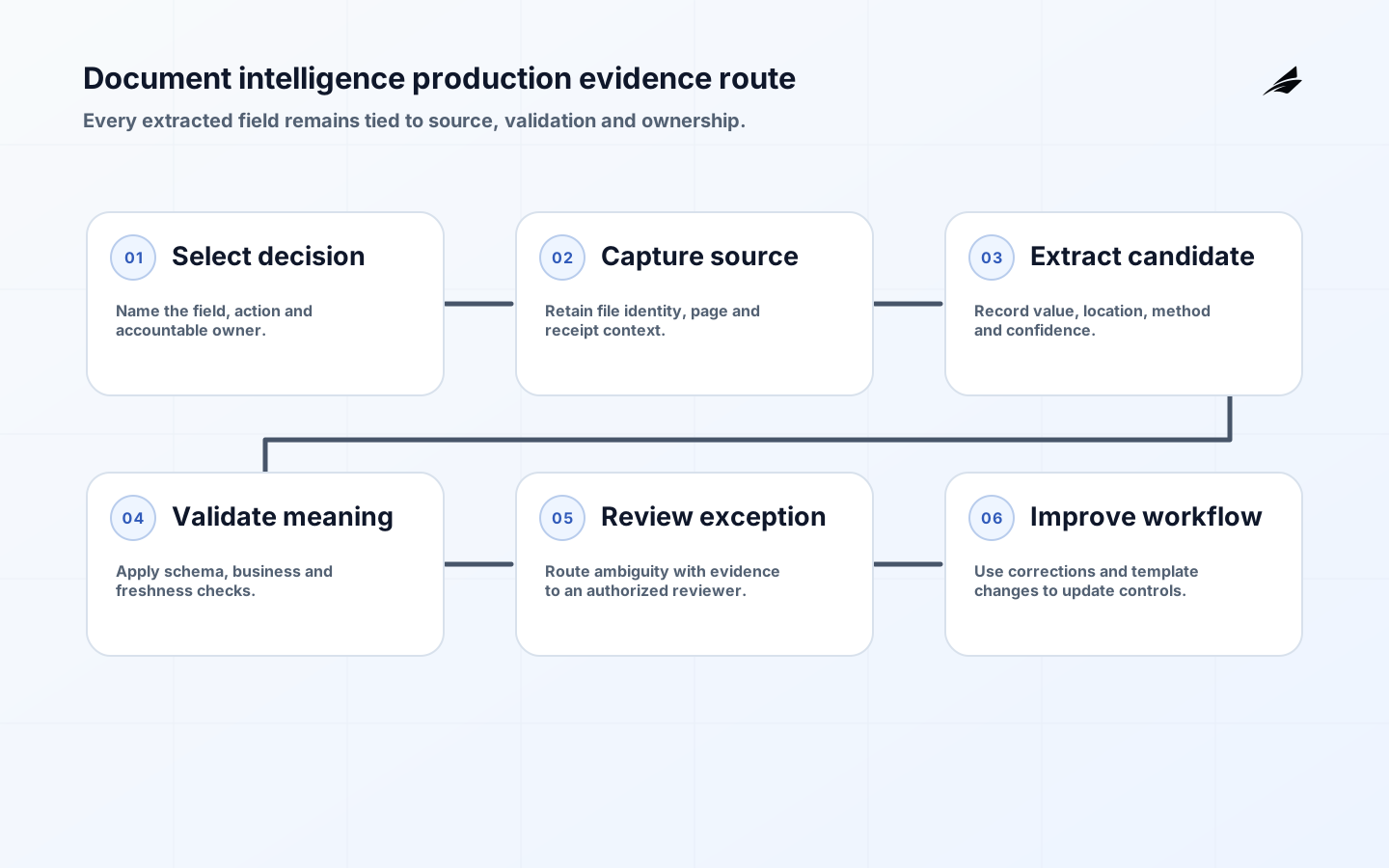
Document intelligence changes in production because extracted text stops being a convenience and starts informing a business record, a case decision, or a customer interaction. A system that reads an invoice amount incorrectly or treats a superseded contract appendix as current can create costly downstream work. The production objective is therefore evidence-preserving automation: identify the original file, page, extraction method, candidate value, validation result, and reviewer decision. A model may assist with interpretation, but it should not conceal the difference between what the document says, what the system inferred, and what a business rule allowed. The NIST Generative AI Profile is a useful reference for lifecycle risks. Document Intelligence for AI Automation provides related implementation context.
Choose a field and decision
Start with a bounded document decision, not a generic promise to understand files. Examples include extracting invoice number and due date for a payable queue, locating a renewal clause for a legal reviewer, or classifying an intake form for routing. Name the action that may follow, the record that owns it, the source formats, the tolerated error, and the route when evidence is missing or ambiguous. Separate capture from judgment: extracting a clause is different from deciding whether it authorizes an exception. This allows the team to apply targeted validation and preserve human authority where interpretation has material consequences. It also makes a baseline possible, because the current manual process can be measured against one defined outcome.
| Design question | Production answer | Why it matters |
|---|---|---|
| Original source | Immutable file identifier, page reference, and receipt time | Lets reviewers verify the result against the actual document. |
| Candidate field | Value, location, extraction method, and confidence | Prevents inferred data from being mistaken for a direct quote. |
| Business validation | Rules applied by the target workflow | Separates visual extraction from allowed action. |
| Exception | Queue, evidence packet, and accountable reviewer | Makes uncertainty a managed state rather than a silent guess. |
Build an evidence model
Represent every extracted field as an evidence-bearing object. Keep the source document hash or stable ID, page or region where possible, parser and model version, timestamp, language or format condition, normalized value, raw observation, and validation status. When documents arrive through email or third-party portals, retain enough chain-of-custody information to identify the intake path without exposing unnecessary content. This matters when people dispute a result. A reviewer should be able to open the relevant page and see why the system proposed a value instead of searching through a reconstructed conversation. It also supports repeatable reprocessing when an extraction model or rule changes. Treat derived indexes and summaries as disposable views of a durable source record.
- Keep the original file immutable and store transformations as separate, versioned artifacts.
- Link each field to a page, region, quote, or other reviewable evidence reference.
- Distinguish direct extraction, normalized data, inferred classification, and human correction.
- Apply tenant, retention, and access policy at document and field level where needed.
- Record parser, model, prompt, and rule versions so a result can be reproduced or re-evaluated.
Validate before creating effects
Validation should reflect the consequence of a field. Use deterministic checks for required format, arithmetic, controlled values, duplicate detection, vendor identity, and cross-record consistency. For example, compare invoice totals with line items and purchase-order limits before a document can create a payable request. Route conflicts and low-evidence fields to a reviewer rather than silently selecting the most plausible number. The OWASP Top 10 for LLM Applications is relevant when document content can inject instructions or cause an agent to misuse a connected tool. Documents are evidence, not executable policy. Ensure that external text cannot instruct the automation to widen access, skip validation, or take a side effect outside the declared workflow.
Evaluate by document condition
Build an evaluation set that reflects the documents the service will actually receive: clean digital files, scans, photographs, multi-column layouts, tables, handwritten notes, multiple languages, templates that change, and adversarial or irrelevant attachments. Score field precision and recall, citation accuracy, document classification, reviewer correction rate, and time to resolution. Segment results by document type and supplier or source channel; an average can hide a serious weakness in one format. The OpenAI evaluations guide is useful for organizing task-specific tests. Add production corrections to the reviewed set after privacy review so the system improves on the failure modes that cost staff time.
| Observed result | What to inspect | Likely improvement |
|---|---|---|
| Wrong number, correct page | Normalization or rule interpretation | Review currency, locale, and arithmetic validators. |
| Right field, wrong page | Layout handling or evidence locator | Improve page segmentation and citation display. |
| Missing field on scans | Image quality or OCR weakness | Route by quality and collect representative scan tests. |
| Reviewer rejects valid data | Workflow policy is unclear | Clarify the decision rule rather than retuning extraction. |
Operate an exception workbench
Govern document change
Keep change evidence beside the template or rule it affects. That means a reviewer can see which documents were tested, which field outcomes changed, and whether the exception workload moved after release. It makes a format update a reviewable operational change instead of an unexplained model adjustment.
Document workflows change even when application code does not. Suppliers alter layouts, business teams add a clause, scanners degrade, and a new intake channel introduces unexpected attachments. Establish a change register for high-volume templates, extraction rules, source channels, and downstream policy. When a known template changes, collect a reviewed sample before enabling automatic processing. When an unknown template appears, route it to a controlled review category until its behavior is understood. Track changes to validation logic separately from changes to extraction; the first changes a business decision while the second changes how evidence is found. Give document owners a way to announce policy or template changes before they produce a correction spike. This practice reduces the temptation to use a generic model update as a cure for every problem. Often the best fix is a source-specific rule, a clearer evidence display, or a decision to keep a document class in review.
- Maintain an inventory of recurring templates, source channels, owners, and observed failure modes.
- Require reviewed samples before a changed template can re-enter automatic processing.
- Separate extraction releases from business-rule releases in traceability and approval records.
- Route unknown formats, low-quality scans, and suspicious attachments into an explicit exception class.
- Alert document and workflow owners when corrections or queue age shift materially by source.
- Retire obsolete templates and rules so historical formats do not distort current processing.
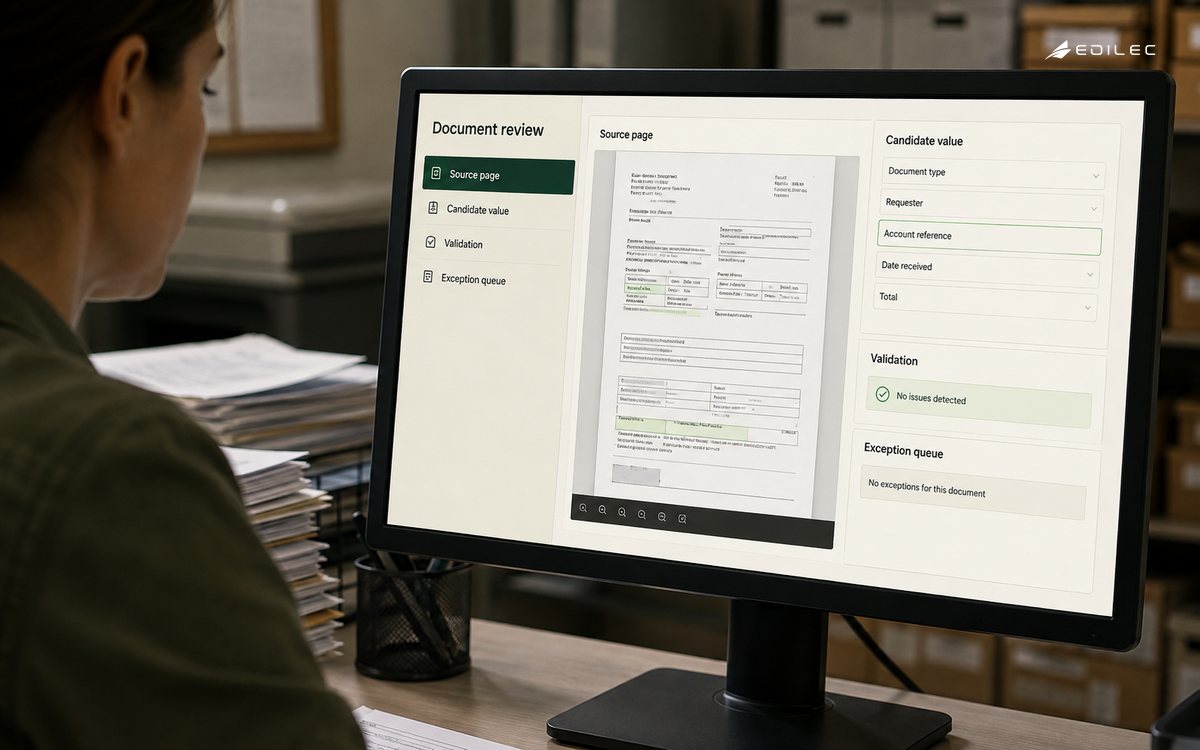
The reviewer experience is part of the system. Present the source page, extracted candidates, validation results, relevant record context, and the reason the item entered review. Let an authorized user correct or reject a field without losing the evidence trail. Track queue volume, ageing, corrections by cause, document channel, and downstream reversals. CTOs should also plan capacity for format changes: a new vendor template or scanner behavior can affect a large portion of work overnight. Version releases, stage them against known documents, and retain a conservative fallback that preserves intake without forcing risky automation. Document intelligence should make audit work shorter, not produce a second opaque record that must itself be investigated.
Frequently asked questions
Question: What provenance should document intelligence preserve? Answer: Retain the source document version, page or region, extraction method, confidence or validation result, timestamp, and downstream record affected. This lets a reviewer verify a value and repeat the decision after the document or model changes.
Question: How should ambiguous documents be handled? Answer: Validate file type, completeness, permissions, and field-level evidence before creating effects. Route uncertain or conflicting fields to an exception queue with the original document and a clear correction action.
Question: When is document automation safe to expand? Answer: Expand after representative documents show stable field quality, reviewers can resolve exceptions, downstream writes are reversible or reconciled, and changes to parsers or prompts are versioned and tested.
Can document intelligence replace human review? It can remove routine transcription and direct attention to uncertain fields, but material decisions still need a rule and an accountable owner. Should the system store every document forever? No. Apply the same retention and deletion rules that govern the business process. Is OCR accuracy the only metric? No. A usable system also needs field validation, evidence location, correct routing, and low downstream rework. How does retrieval help? Retrieval can find relevant clauses or precedents, but should preserve source citations and permissions; retrieval pipelines explains that discipline.
Key takeaways
- Begin with one document field and business decision that can be measured.
- Preserve original-file and page-level evidence for every meaningful extracted value.
- Validate before creating an effect and route uncertainty to an equipped reviewer.
- Evaluate by real document condition, then use correction data to strengthen the workflow.
Conclusion
Production document intelligence is trustworthy when it makes a document-derived decision easier to verify than the manual process it replaces. Preserve evidence, make validation explicit, and design the exception path with as much care as the happy path. That creates automation that can withstand a disputed field, a changed template, and an audit.
Run a production-readiness review
A useful review samples three documents from each important source: one clean example, one boundary case and one known exception. Compare the extracted field with the page location, the normalized value, the validation result and the final business action. This makes the review more diagnostic than a single accuracy number. If a scan is skewed, a template changed or a clause spans pages, the evidence should show where the workflow changes behavior. The NIST AI Risk Management Framework supports this lifecycle view, while Google Cloud Document AI and Amazon Textract illustrate why extraction, classification and structured fields should be treated as distinct capabilities.
Set a release threshold for the field that matters, a maximum exception age and an owner for each source channel. When a vendor changes its template, pause only the affected route if evidence supports that decision; preserve intake and queue the uncertain documents rather than silently accepting low-quality values. The record should also identify the model or parser version, source checksum, page number, reviewer action and downstream correction. For adjacent design choices, see the document intelligence guide, the multimodal AI guide, and retrieval in production.
Further Edilec context: The document intelligence guide, Multimodal AI guide, Retrieval in production. The production path applies those references specifically to document intelligence in production: provenance, exceptions and safe workflow.
Source trail: NIST AI RMF frames governance and measurement across the lifecycle; NIST Generative AI Profile adds generative-system risk considerations; Google Document AI and Amazon Textract describe complementary extraction capabilities. Use these references to keep provenance, validation and operational ownership distinct.