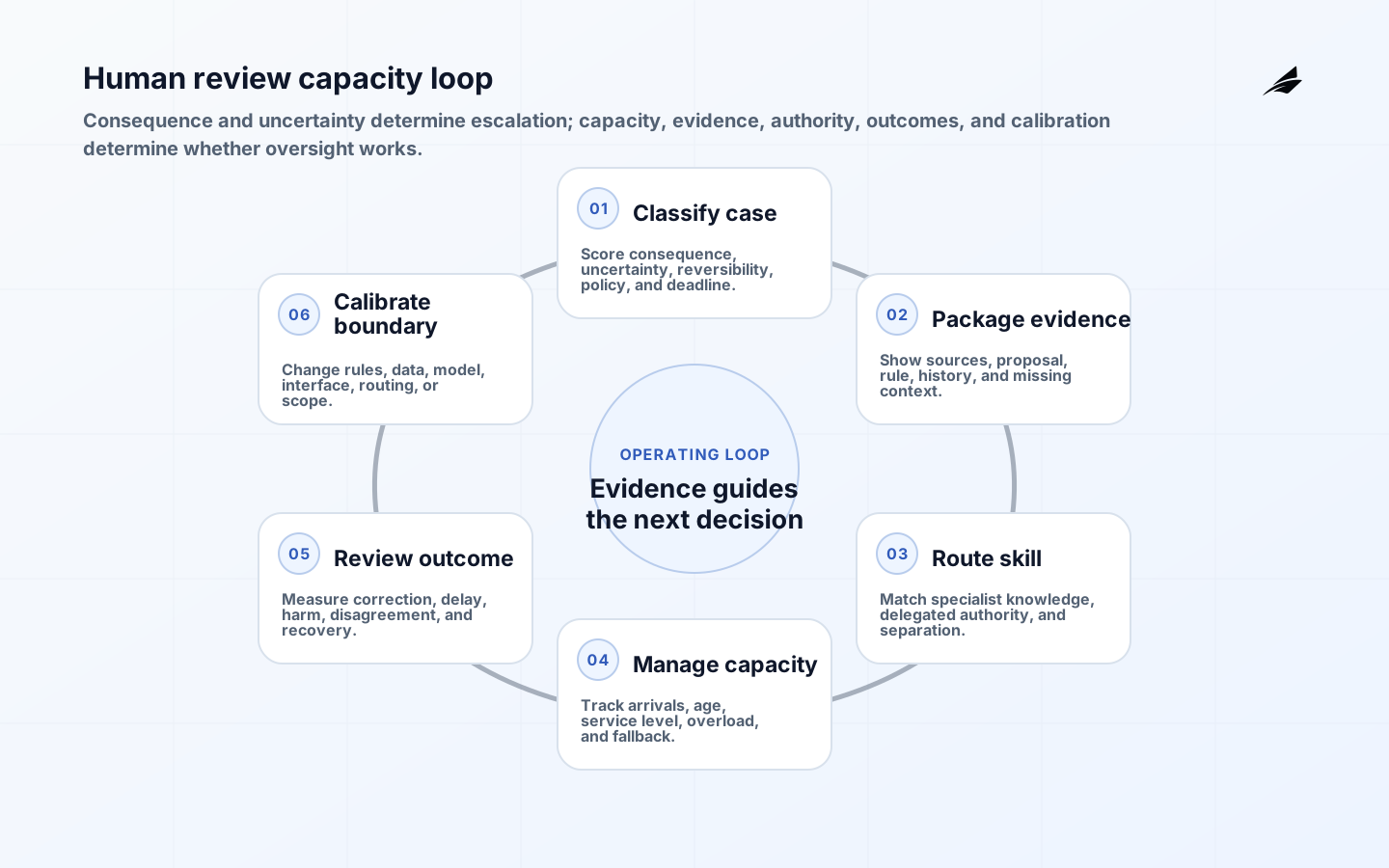
Human-in-the-loop automation works only when the person in the loop can materially change the result. Adding an approval button after an AI recommendation does not create oversight if the reviewer lacks evidence, authority, time, or a viable way to reject and recover the work. Operations leaders should design review as a service with demand, capacity, routing, skill, deadlines, and quality measures. The goal is not to send every case to a person. It is to automate routine and reversible work while escalating uncertainty, policy conflict, unusual impact, or irreversible action to an accountable role. This guide focuses on the operating model: how to classify cases, package evidence, manage queues, detect rubber-stamping, and use review outcomes to improve the system boundary.
The operating model follows the NIST AI Risk Management Framework, its Generative AI Profile, the OWASP Top 10 for LLM applications, and the UK NCSC secure AI development guidance. Edilec’s implementation guides for AI workflow approvals, AI guardrails, and human-in-the-loop implementation address the adjacent technical controls.
Start With the human-in-the-loop automation Decision
Write the job in one sentence, then write the unacceptable outcome beside it. For human-in-the-loop automation, the operating question is not whether the technology is impressive; it is whether a named person can complete a bounded task with appropriate evidence and control. Putting a person somewhere in the flow is not enough. Reviewers cannot catch errors they cannot see, and excessive review can create delay, fatigue, and untracked workarounds. The useful question is which cases require judgment, what evidence changes that judgment, and who owns the final record. The NIST AI Risk Management Framework supports this discipline by connecting intended context, measurement, governance, and management rather than treating risk as a late security review. How Engineering Teams Should Think About AI Guardrails is a useful adjacent reference, but it should not replace a local description of the decision owner and failure boundary.
| Decision element | Question to settle | Evidence to keep |
|---|---|---|
| User and outcome | Who uses human-in-the-loop automation, and what completed work changes for them? | A task definition, accountable owner, and a measurable acceptance condition. |
| Authority boundary | What may be read, drafted, proposed, submitted, or changed? | A policy rule, identity claim, approval record, and revocation path. |
| Failure response | What happens when evidence is absent, conflicting, stale, or unsafe? | A visible abstention, escalation route, and incident or correction record. |
Build an Evidence Boundary
Segment work by reversibility, customer impact, financial threshold, regulatory duty, and confidence in the available evidence. Define a stop condition for missing facts, conflicting policy, or unusual patterns; these are routing signals, not a failure of the operator. This is where seemingly small implementation choices become operational commitments. A source link or event record must remain meaningful after a deployment, an employee role change, or a correction. The UK National Cyber Security Centre guidance emphasizes secure design, development, deployment, and operation as connected activities. Use that lifecycle view to assign an owner to the inputs, the policy, and the response when human-in-the-loop automation behaves unexpectedly.
- Name the source systems, people, and decisions that human-in-the-loop automation depends on; do not bury them in configuration alone.
- Classify information and actions by consequence, then choose controls that operate at the boundary where the consequence occurs.
- Keep an inspectable record of the input, material context, policy result, and output or side effect for cases that matter.
- Design a correction path that can remove or repair a bad record and tell an operator what work may have been affected.
- Practice the uncertain case. A system that can only handle happy-path inputs has not yet earned autonomy.
Put Controls Where They Can Enforce
Give reviewers source links, policy context, proposed action, confidence caveats, and an explicit approve, edit, reject, or escalate choice. Capture the reason for material changes, preserve the before-and-after state, and avoid allowing an approver to review work outside their authority. The OWASP guidance for LLM applications is particularly relevant when untrusted content can influence model behaviour or tool use: controls need to survive hostile and malformed inputs, not merely ordinary requests. For human-in-the-loop automation, prefer deterministic enforcement for identity, limits, destinations, schemas, and approvals. A model can help interpret context; it should not be the final authority for a rule that a service can verify directly.

| Control layer | What it protects | Practical test |
|---|---|---|
| Identity and access | The requester, source, and action scope. | Change membership or role and confirm the prohibited result remains unavailable. |
| Data and context | Currency, completeness, and permitted use of evidence. | Inject an obsolete, conflicting, or incomplete record and verify the response routes appropriately. |
| Action and recovery | Side effects, spend, external calls, and correction. | Force a validation failure or denied approval and confirm the state is safe and observable. |
Measure the Work, Not Just Uptime
Measure queue age by risk tier, reversal rate, reviewer disagreement, override reasons, abandoned cases, and the time from a detected error to a policy or test update. Compare outcomes with a sampled non-automated baseline rather than assuming a faster queue is automatically better. Keep a small, versioned evaluation set close to the workflow and add real failures after review. Distinguish service availability from decision quality: a system can have low latency and still provide the wrong evidence or trigger costly rework. Review results with the people who understand the task, then turn recurring failure patterns into a test, a source repair, a product change, or a tighter boundary.
Release in Bounded Steps
Begin with a reversible recommendation, such as classifying a refund request for supervisor review. Do not automate release of funds until the organisation has enough labelled outcomes to understand exceptions and review burden. Define a rollback condition before release, including who can disable the capability and how a human completes the work during recovery. Small launches are valuable when they are instrumented and reviewed; they are not a license to skip permissions, source checks, or error handling. Record the decision to expand with the same care as the initial decision to use human-in-the-loop automation.
Operate human-in-the-loop automation as a Living Service
Operational review of a human-in-the-loop flow should ask whether review is improving the decision or merely absorbing uncertainty that the system never communicates. Look at edits by reason, cases that missed their service target, and decisions later reversed. Then compare the burden across reviewers and queues; a well-designed routing rule should not send every ambiguous item to the same expert. Periodically sample accepted recommendations and rejected recommendations, since only looking at errors overstates one side of performance. When a reviewer makes a repeatable correction, decide whether it belongs in training material, a source update, a deterministic validation rule, or the routing criteria. Preserve the option to reduce automation when the evidence says it is causing harm. The purpose of human-in-the-loop automation is a better accountable outcome, not the appearance of human involvement.
Keep Review Evidence Actionable
Ask reviewers what information they needed but did not receive. Missing source context, unclear decision rights, and poorly grouped queues are design defects that can be corrected before asking people to review more cases or work faster.
Assign Accountable Owners
Set ownership for both the queue and the policy behind it. An operations owner can improve staffing and service targets, while the business owner decides whether a case should be automated, reviewed, or escalated. Bring both perspectives to a regular sample of outcomes. Without that distinction, teams may optimize a queue while leaving the decision rule that created the queue untouched.
Model reviewer capacity before automation creates the queue
Estimate arrival rate by case type, expected review time, skill group, peak pattern, and deadline. A workflow that escalates five percent of ten thousand daily cases may create five hundred reviews; that is not a small exception path. Distinguish quick verification from specialist judgment and from high-authority approval because they consume different capacity. Define what happens when the queue approaches its service limit: narrow automation, route to a backup group, use a safe manual process, delay a non-urgent action, or stop accepting a risky case. Silent backlog is not a fallback. It converts model uncertainty into operational delay and can harm customers even when every eventual decision is correct.
Review quality needs its own evidence. Sample accepted and rejected proposals, compare them with downstream outcomes, examine override reasons, and watch for unusually fast approvals or reviewers who never disagree. Low override can mean a good system, but it can also mean automation bias, poor evidence, inaccessible controls, or workload pressure. NIST’s AI RMF Core calls for defined human roles and oversight in context; its human-AI interaction appendix warns that converting complex situations into measurable representations can remove important context. Build the interface so source material, policy, uncertainty, proposed action, and consequence are visible without requiring the reviewer to recreate the entire case. Then treat repeated corrections as signals to change the rule, source, model, routing, training, or product design.
| Case tier | Automation boundary | Operating commitment |
|---|---|---|
| Routine and reversible | Act automatically with sampling and easy correction | Monitor outcomes and keep rollback available |
| Low-impact ambiguity | Route to general operations review | Evidence bundle and short service target |
| Policy interpretation | Route to trained specialist before action | Policy version, rationale and escalation path |
| High-value commitment | Require delegated approver and transaction limit | Authority check and complete decision record |
| Safety, rights or irreversible impact | Use strict review or manual-first process | Qualified reviewer, separation of duties and contingency |
| Queue overload or missing evidence | Stop or degrade safely | Visible fallback, customer communication and recovery owner |
Key Takeaways
- Human-in-the-loop automation earns trust through a defined job and a named decision owner.
- Evidence, identity, and action boundaries must be explicit before a wider launch.
- Controls are strongest when enforced by deterministic services at the point of consequence.
- Evaluation should include difficult, absent, stale, and adversarial cases, not only successful examples.
- Expansion is a governed operating decision supported by outcomes, not a reward for a polished demo.
Frequently Asked Questions
A human review step is justified by consequence and uncertainty, not by a fixed confidence number. A low-impact typo may be automated; a high-impact decision may need review even when a system appears certain. The practical next step is to select one workflow, write its evidence and authority boundaries, and create a small set of cases a domain reviewer can judge. That produces much more useful learning than a broad rollout with no shared definition of success.
Conclusion
Human-in-the-loop automation becomes dependable when its operating constraints are visible: what it is for, what information it may use, what it may do, who can intervene, and how the organisation knows it is improving. Start with the consequential decision, preserve the evidence around it, and make uncertainty a safe state rather than something the system hides.