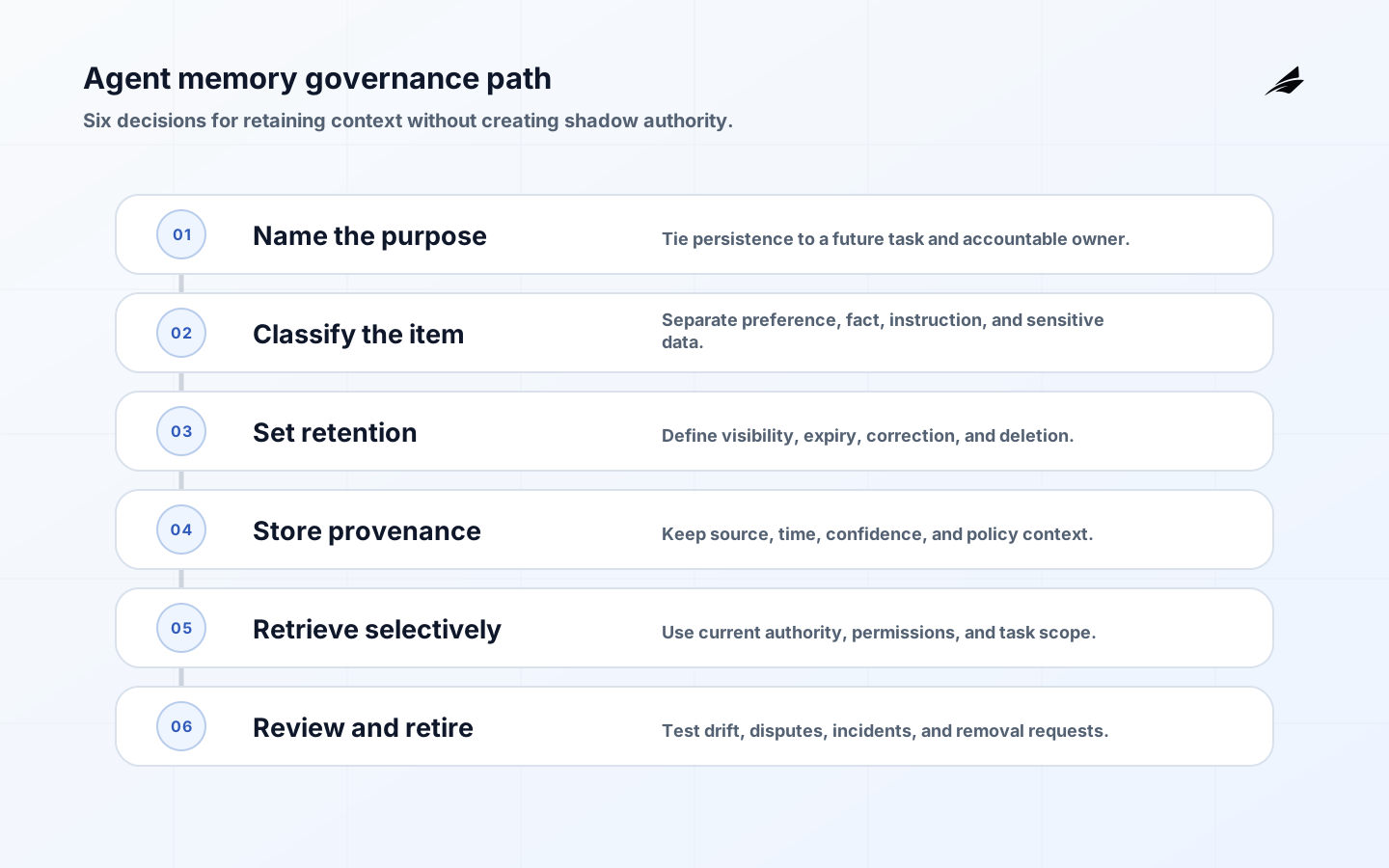
Agent memory deserves a design conversation before a prototype because it changes how work, evidence, and accountability move through a service. The first question is not which model or vendor to select. With agent memory, it is whether the team can state the decision the system will support, who is responsible for the source material, and how a person can challenge a bad result. OpenAI evaluation guide supplies the technical or protocol baseline; NIST AI Risk Management Framework is a useful companion for the risk and control lens. With agent memory, a limited first release should support one observable routine, keep the existing route available, and produce evidence that a manager can inspect after the fact. With agent memory, that keeps a promising capability from becoming an unowned dependency.
Define the agent memory decision
Write the operating statement in plain language: the system may retain a limited item of context that improves a future task without becoming shadow authority. With agent memory, name the user, the trigger, the authoritative inputs, the expected output or effect, and the condition that requires abstention or escalation. This statement does real engineering work. With agent memory, it separates a useful request from an ambition such as “make the process smarter,” and it gives security, operations, and product owners the same boundary to test. With agent memory, a decision that cannot be expressed without hand-waving is usually too broad for a first build. With agent memory, the smallest accountable scope often reveals the integration, data-quality, and ownership problems that would otherwise surface late in delivery.

Treat a memory item with subject, source, scope, purpose, expiry, and revision history as a governed operational asset, not incidental application state. With agent memory, it needs an owner, a change path, a retention expectation, and enough provenance to answer a basic incident question: why did this result or action occur at this time? With agent memory, the NIST AI Risk Management Framework emphasizes lifecycle risk management rather than a one-time compliance event. With agent memory, that perspective is useful even where the system is not regulated. With agent memory, it prompts teams to make assumptions visible, identify foreseeable failure, and define who acts when the system is wrong.
| Decision element | Question to settle before build | Evidence of readiness |
|---|---|---|
| Purpose | What bounded decision does agent memory support? | An accountable owner can describe the expected result and escalation route. |
| Authority | Which source or policy wins when records conflict? | The authoritative record and update owner are documented. |
| Boundary | What must the system never infer, reveal, or change? | Tests cover denied requests and safe failure behavior. |
| Recovery | How is a bad result corrected or reversed? | A practiced suppress use, correct derived copies, and retire the category if it is not demonstrably useful path exists. |
Define the memory control boundary
Agent memory should have a control boundary that survives fluent output, transient failures, and a change in personnel. In this case, do not treat memory as a substitute for live records, current permissions, or user correction. With agent memory, put that check in a service, policy engine, or resource boundary that can make a deterministic decision, rather than relying on a natural-language instruction to do security work. With agent memory, the OWASP guidance is a useful reminder that untrusted content, excessive permissions, and disclosure risks are system properties. With agent memory, a model or client can propose; trusted components must decide whether the proposal is allowed.
Controls also need to preserve useful work. With agent memory, start with the normal path and record the exceptions that deserve different treatment: missing evidence, a stale dependency, conflicting authority, unusually high consequence, or a request from a newly privileged actor. Avoid building an approval queue around every operation. Instead, match review to consequence and reversibility. With agent memory, a draft can be easy to edit, while a financial change, customer-facing commitment, or privileged access change may need stronger authentication, a second role, and a short validity window. With agent memory, that distinction keeps controls meaningful instead of encouraging workarounds. For agent memory, a retained preference may assist a low-risk task, while a live account status must be fetched from its system of record.
- Assign a named business owner and a technical owner for agent memory.
- Use the minimum data, scope, and permission needed for the stated decision.
- Keep an ordinary, non-automated route for the first release and for containment.
- Log the request, policy result, relevant version, outcome, and correction without indiscriminate sensitive-data capture.
- Set an expiry for exceptions, temporary access, and unreviewed assumptions.
Measure memory value in the user journey
A technically valid response or successful API call is not enough to prove that agent memory is helping. With agent memory, measure the workflow end to end: whether the person completed the task, whether evidence was sufficient, how often a reviewer changed the result, and whether the control boundary held under ordinary pressure. Track memory retrieval value, stale-use incidents, dispute rate, deletion completion, and cross-scope denials. With agent memory, use a stable set of representative cases before changing a prompt, model, policy, data source, or integration. With agent memory, the NIST Generative AI Profile source is particularly helpful for turning broad assurance claims into testable operating questions. With agent memory, pair automated checks with periodic human review where a judgment cannot be reduced to a fixed rule.
| Signal | What it can reveal | First investigation |
|---|---|---|
| Correction or reversal | The proposal or effect was not reliable enough for the workflow. | Review source authority, current state, and the case that escaped. |
| Denied request | A policy may be protecting a resource, or blocking legitimate work. | Check identity, scope, tenant, and the decision explanation. |
| Growing exception queue | The initial boundary does not match real work conditions. | Cluster causes before widening automation or access. |
| Version regression | A change altered behavior beyond its intended scope. | Compare representative cases and roll back the affected release. |
Operate memory changes and incidents
Release agent memory as a maintained service. With agent memory, record the version of the logic, protocol configuration, source set, and policy used for a material result. With agent memory, roll changes through a small cohort when the effect is difficult to predict, and define a stop condition before the release starts. With agent memory, a compact incident drill is worth more than a vague assertion that the team can “roll back”: verify that an authorized operator can identify the impacted request, contain new effects, preserve evidence, communicate the status, and use the fallback path. With agent memory, the OWASP Top 10 for LLM Applications source helps anchor that discipline in an established control framework rather than a product-specific checklist.
Connect memory to adjacent decisions
Agent memory rarely stands alone. With agent memory, it inherits risk from identity, source records, approvals, and the people who interpret its output. The related planning questions in AI Agents Before the First Build: Boundaries, Tools and Recovery and RAG Systems: Retrieval, Grounding and Evaluation help expose dependencies before they are disguised as implementation details. With agent memory, for example, a retrieval choice affects whether a response can show current evidence; an approval design affects whether a proposed action becomes a durable effect. With agent memory, make these connections explicit in the backlog, assign the owners, and test the combined path rather than assuming individually sensible components will compose safely.
Practical memory takeaways
- Begin agent memory with one named decision and one accountable owner.
- Keep authority, permissions, and mutable business state outside generative or client-side interpretation.
- Measure outcomes and failure severity, not only throughput or apparent accuracy.
- Make correction, revocation, and fallback part of the release definition.
- Use production evidence to narrow or expand scope deliberately.
Agent memory should be treated as retained context with a purpose, not as an invisible transcript that accumulates forever. The NIST AI Risk Management Framework connects trustworthy operation to accountable governance, and the NIST Generative AI Profile is a useful prompt to document data provenance, privacy, human oversight, and known limitations. The OWASP Top 10 for LLM Applications makes indirect prompt injection and sensitive-information exposure relevant to memory retrieval, not only to the model prompt. Finally, the OpenAI evaluations guide supports testing memory behavior with representative cases: a remembered fact should improve the task without silently changing authorization or overriding a current authoritative record.
A safe first memory feature has an explicit write rule, an allowed purpose, a visibility boundary, an expiry or review condition, and a correction path that a person can actually use. Test the same request with fresh and stale memory, conflicting preferences, a changed role, and a deletion request. For adjacent design context, compare AI agents before the first build, RAG systems before the first build, and agent context governance. Those links help frame the surrounding system, while the memory owner remains responsible for deciding what persistence is justified. These companion articles are AI Agents Before the First Build: Boundaries, Tools and Recovery, RAG Systems: Retrieval, Grounding and Evaluation, AI Workflow Approvals Decisions That Matter Before the First Build.
Frequently asked questions
Question: Should agent memory retain every conversation? Answer: No; retain only categories with a clear purpose, owner, expiry, and correction route. Question: Can memory replace a live system of record? Answer: No; mutable facts such as entitlement, balance, and incident status must be fetched from the authoritative source.
What should agent memory retain?
Answer: Retain only context that has a defined purpose, owner, source, access rule, correction path, and expiry or deletion policy. Conversational convenience is not enough.
How can memory stay permission-aware?
Answer: Recheck current identity, tenant, purpose, and record status at retrieval time instead of treating a stored memory as a standing authorization.
What happens when a memory is wrong?
Answer: Correct or quarantine it, trace dependent outputs, notify affected owners when needed, and prevent the stale item from returning until its status is resolved.
What should a first agent memory release include? Anchor the first release to one user-visible task, an authoritative source or policy boundary, instrumentation, a human escalation route, and a way to stop or reverse effects. Breadth is less valuable than an evidence trail that shows whether the workflow improved. With agent memory, How much automation is appropriate? Automate preparation and low-consequence steps first. With agent memory, increase autonomy only when tests, operating signals, and review show that the system handles normal and exceptional conditions within the agreed boundary. With agent memory, Who owns quality after launch? Set explicit accountability across the decision outcome, service behavior, and risk controls, then bring those owners together to review evidence and change scope. For agent memory, the accountable review meeting should examine one real exception, one decision explanation, and the next control change with the relevant owners present.
Before retaining a new memory category, test a role change, a user correction, an expiry event, and a live-record conflict. The design is not ready when a remembered summary can override a current authoritative fact.
Conclusion
Agent memory becomes dependable when a team can explain its decision boundary, prove what evidence or authority was used, and repair a failure without improvising. Build the small accountable workflow first. With agent memory, then use measured results, not confidence in a demo, to decide what deserves broader rollout.