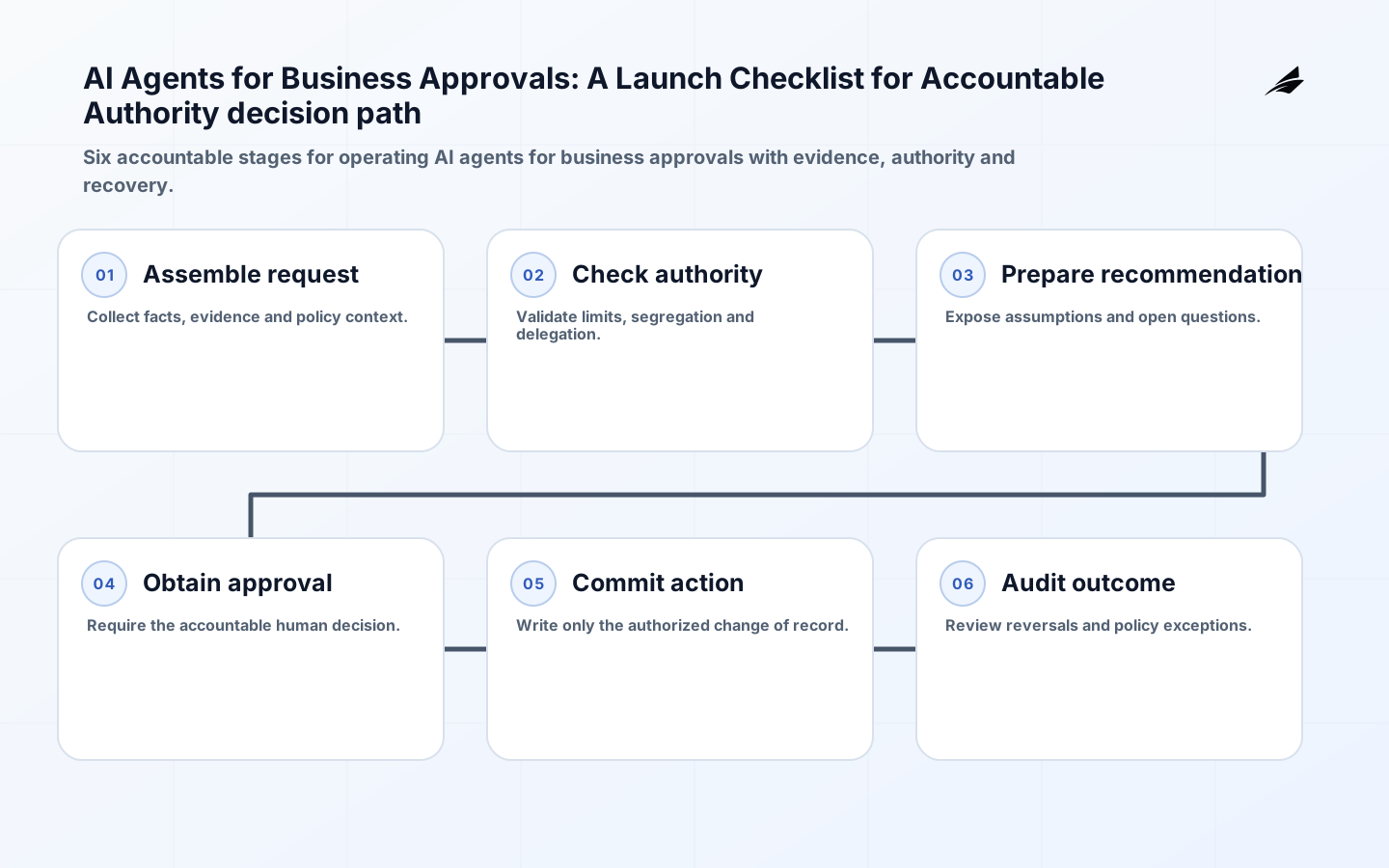
Deploying AI agents for business approvals is not a model-selection exercise. Founders, finance leaders and product teams launching a new product should plan the capability as an operating service with one accountable outcome: an agent prepares a complete approval case while the person with delegated authority remains accountable for the binding decision. Start with a real case, the people who currently resolve it and the systems that prove the result. This keeps the first release narrow enough to inspect. It also exposes where fluent output is irrelevant: a record can look plausible while it is stale, unauthorized, incomplete or routed to someone who cannot act. The useful design question is therefore not “can the model answer?” but “what evidence, authority and recovery are required before this workflow changes real work?”
Define the AI agents for business approvals decision boundary
Write the boundary as a case contract, not a feature list. For this guide, capture the request, policy and authority matrix, supporting evidence, agent recommendation, conflict checks, approver identity, final action and audit trail. Name the moment at which the case starts, the condition that permits it to advance and the person or service that owns each state. Walk through the awkward cases before interfaces are built: a persuasive summary omits a policy exception, a tool call changes a record before approval, delegated limits are stale or the agent routes a request to a manager who cannot authorize it. Those examples force distinctions that often disappear in a prototype, including draft versus committed fact, assistance versus authority, and delay versus failure. The boundary should also say what the system must refuse to do. A concise operating contract gives the business owner, engineers and reviewers the same answer when a case is incomplete, contested or late.

| Decision | Definition for this workflow | Evidence to retain |
|---|---|---|
| Case identity | A stable case that represents an agent prepares a complete approval case while the person with delegated authority remains accountable for the binding decision. | Source reference, timestamps and responsible owner. |
| Authoritative inputs | versioned policy clauses, request facts, source links, authority lookup, separation-of-duties checks, approval timestamp, approver rationale and committed record ID | Source version, access scope and validation result. |
| Decision gate | the agent may collect, compare and draft, but it must not infer financial or contractual authority; policy evaluation and permission checks should be deterministic services outside the model | Policy rule, authority check and final state. |
| Exception route | Handle a persuasive summary omits a policy exception, a tool call changes a record before approval, delegated limits are stale or the agent routes a request to a manager who cannot authorize it. | Reason, assignee, service clock and resolution. |
| Recovery | halt automatic commits, revoke the agent token if necessary, reverse only through the approved business process and examine the authority and evidence trail before relaunch | Linked corrective action and review record. |
Build an evidence chain that survives review
The service needs a durable chain from input to outcome. For AI agents for business approvals, that chain is versioned policy clauses, request facts, source links, authority lookup, separation-of-duties checks, approval timestamp, approver rationale and committed record ID. Keep source systems authoritative; an AI layer may prepare, rank or explain, but should not quietly become the master record. Give every handoff an identifier, define what happens on retry and require confirmation from the receiving system. Separate retained evidence from convenience telemetry, because prompts, logs and feedback can themselves be sensitive. Version the model, instructions, retrieval configuration and policy rules together so a reviewer can reconstruct why the workflow behaved as it did on a particular day. This is also how a team distinguishes a source-quality problem from a model, integration or operating-policy defect.
| Service component | Design question | Acceptance test |
|---|---|---|
| Inputs | What may enter this case and who owns it? | Test normal inputs plus a persuasive summary omits a policy exception, a tool call changes a record before approval, delegated limits are stale or the agent routes a request to a manager who cannot authorize it. |
| Evidence | Can a reviewer verify the recommendation? | Trace a result back to versioned policy clauses, request facts, source links, authority lookup, separation-of-duties checks, approval timestamp, approver rationale and committed record ID. |
| Authority | Who may make the binding decision? | Prove denied roles and expired delegations cannot advance the case. |
| Integration | What proves downstream completion? | Reconcile IDs, retries, duplicates and failed handoffs. |
| Operations | Who acts when the service is uncertain or unavailable? | Exercise: halt automatic commits, revoke the agent token if necessary, reverse only through the approved business process and examine the authority and evidence trail before relaunch. |
Apply controls proportional to the consequences
Controls should match the damage caused by a wrong result, not the novelty of AI agents for business approvals. The agent may collect, compare and draft, but it must not infer financial or contractual authority; policy evaluation and permission checks should be deterministic services outside the model. Treat user text, retrieved content, documents and external data as untrusted instructions until verified. Keep policy checks, identities, limits and permission decisions outside model output where a deterministic service can decide them. Route incomplete evidence, changed conditions and material impact to a named reviewer. The reviewer needs the original facts, the recommendation, the applicable rule and the ability to select a safe alternative. Escalation is a designed service, not a vague promise of human oversight: it has a queue, capacity, deadlines, backup ownership and a way to pause automation without losing the case.
- Classify actions by consequence, reversibility and required authority for AI agents for business approvals.
- Keep versioned policy clauses, request facts, source links, authority lookup, separation-of-duties checks, approval timestamp, approver rationale and committed record ID available beside the recommendation.
- Use deterministic validation for identity, access, limits, dates and system state.
- Record the reason, owner and deadline whenever a case is escalated.
- Test denied access, stale data, malformed inputs and dependency loss before release.
- Treat overrides, reversals and complaints as evidence for policy and evaluation changes.
Pilot with measures that change an operating decision
A pilot should answer whether the service improves a decision under real conditions. Establish a baseline, then measure complete-case rate, approval turnaround, missing-evidence detection, invalid-authority blocks, reversals, approver edits and policy-exception frequency. Pair speed with quality and control measures; a shorter average cycle can conceal a larger review queue or downstream cleanup. Segment results by case type, source, user role and risk tier so a healthy average does not hide an unsafe cohort. A single low-value approval category with draft recommendations, immutable audit records and a manual route for any policy conflict or missing authority data. Pre-agree expansion, pause and stop criteria with the business owner. During review, classify each failure before changing a threshold: was it missing source evidence, ambiguous policy, a retrieval problem, model behavior, integration failure or lack of reviewer capacity? That diagnosis protects the team from treating every operational problem as a prompt problem.
Key takeaways
- AI agents for business approvals start with one controlled outcome, not a general-purpose assistant.
- Make source evidence, authority checks and final actions traceable as one case history.
- Use deterministic controls where the organization already has firm rules.
- Staff escalation as a decision service with deadlines and backup ownership.
- Measure complete-case rate, approval turnaround, missing-evidence detection, invalid-authority blocks, reversals, approver edits and policy-exception frequency before expanding scope.
- Treat recovery and learning as release requirements, not incident afterthoughts.
Frequently asked questions
What belongs in the first release? A single low-value approval category with draft recommendations, immutable audit records and a manual route for any policy conflict or missing authority data. What should trigger human review? Use consequence, missing evidence, changed conditions, policy conflict and unavailable authority rather than a confidence score alone. Who owns the result? The business owner owns the policy and outcome; technical owners own security, reliability and observability; reviewers own decisions within their delegated limits. How do we know it is ready to grow? Confirm stable results across representative cases, controlled exceptions, a workable recovery path and improvement against complete-case rate, approval turnaround, missing-evidence detection, invalid-authority blocks, reversals, approver edits and policy-exception frequency. When those conditions are not met, narrow the service or repair the process before adding volume.
Conclusion
A dependable AI agents for business approvals service makes one important decision easier to inspect and safer to operate. Define the case around the request, policy and authority matrix, supporting evidence, agent recommendation, conflict checks, approver identity, final action and audit trail; preserve versioned policy clauses, request facts, source links, authority lookup, separation-of-duties checks, approval timestamp, approver rationale and committed record ID; and make the authority path explicit before a recommendation reaches a system of record. The practical proof comes from real work: can people understand the source, handle the difficult case, recover from failure and decide whether the result was worth the cost? Begin with the smallest complete route, hold it to the measures that matter, and expand only when the evidence supports that decision.