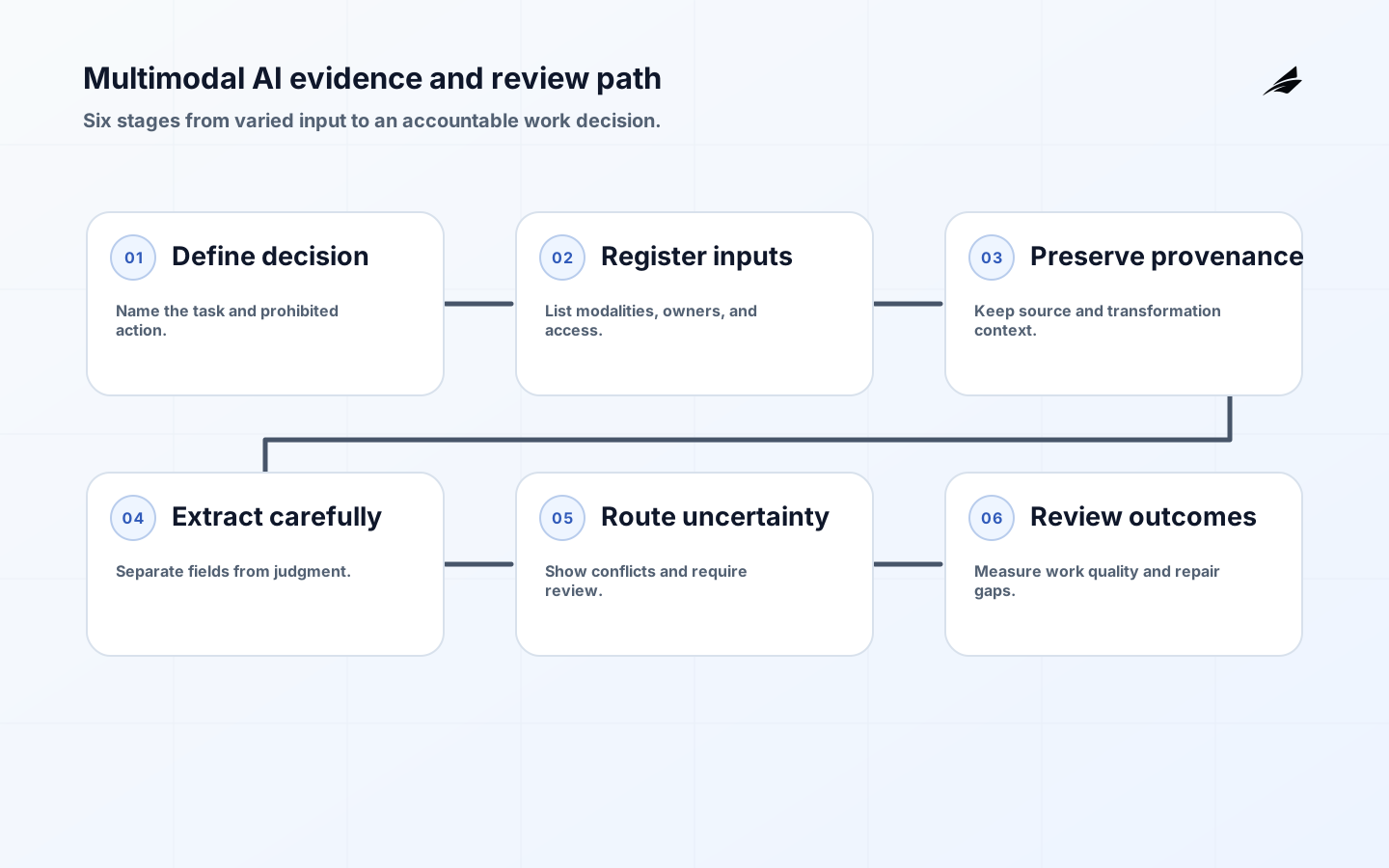
Multimodal AI is most useful when it helps a person complete a defined task with evidence that can be inspected. Multimodal AI automation may combine text, scans, photographs, audio, video, tables, and layout, but those inputs do not have the same provenance or failure modes. A photographed invoice can be incomplete; a call transcript can omit tone or context; a form can contain both machine-readable fields and handwritten corrections. The NIST Generative AI Profile frames risk across governance, provenance, testing, and incident disclosure. That is a useful operating lens: start with the decision, map each evidence source, measure failure, and keep a safe route when the system is uncertain.
Define the multimodal AI decision
Write the first use case as a bounded work instruction rather than a technology ambition. In claims intake, the system might extract a policy number from an image, compare it with a permitted record, identify missing pages, and route the case to a reviewer. It should not silently decide liability. State the trigger, allowed inputs, expected output, user who reviews it, and action that remains prohibited. A narrow contract makes it easier to decide what quality means and where a person must see the original artifact. For adjacent patterns, the document intelligence guide and retrieval pipelines guide show how component boundaries affect the larger workflow.
| Input modality | Good first contribution | Control question |
|---|---|---|
| Text and forms | Extract fields, clauses, identifiers, and stated dates. | Is the source version and access state preserved? |
| Image or scan | Read layout, condition, and visual fields. | Can a reviewer inspect quality and the original region? |
| Audio or video | Locate spoken context or a sequence of events. | Are consent, retention, and transcript uncertainty governed? |
Design the multimodal evidence boundary
Keep a common case identifier across modalities while preserving source location, capture time where available, transformation steps, and access policy. Separate extraction from judgment. A model can propose that a page contains a total or that a speaker requested a change; deterministic checks and a human reviewer should decide whether the proposal is sufficient for the next action. If provenance metadata exists, treat it as evidence to inspect rather than a guarantee that every part of an asset is authentic. The C2PA Technical Specification is relevant for provenance assertions, while the system still needs a route for missing, altered, or contested provenance.
The boundary also includes security. Input parsers, OCR services, transcription engines, and models all receive content that may be malicious or simply misleading. The OWASP Top 10 for Large Language Model Applications highlights risks such as prompt injection, insecure output handling, and excessive agency. Apply least privilege to tools, keep untrusted content separate from instructions, validate outputs before system-of-record updates, and make every external action attributable. A rich interface should not become a broad permission grant.
Place multimodal controls at consequence points
Controls work best where an incorrect result would change a real state. Require a reviewer for financial commitments, regulated decisions, safety actions, or irreversible updates. Use confidence and disagreement as routing signals, not as a promise of correctness. A second model can provide a useful check in some workflows, but it does not replace source inspection or accountable authority. The NCSC secure AI guidance recommends treating security as a lifecycle concern; in practice, that means threat modeling the input path, the model path, the tool path, and the update path before launch. Log the decision, evidence references, model and prompt versions, reviewer action, and reason for any override.
| Failure pattern | Visible symptom | Practical response |
|---|---|---|
| Poor capture quality | Fields are missing or visually ambiguous. | Request a better artifact or route to manual entry. |
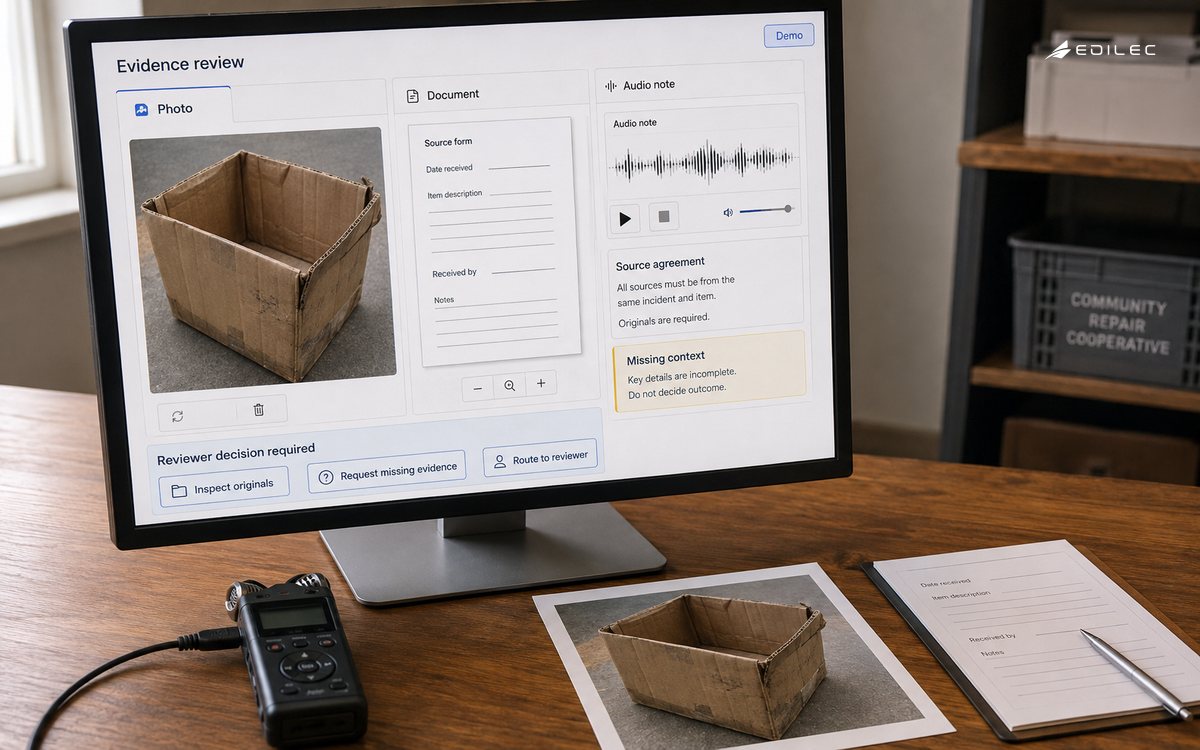
| Cross-modal disagreement | Image, transcript, and form imply different facts. | Show the conflict and require source-level review. |
| Prompt or content injection | Untrusted text changes tool or policy behavior. | Isolate content, constrain tools, and validate actions. |
| Provenance gap | The asset has no trusted origin or transformation trail. | Mark uncertainty and prohibit consequential automation. |
Measure the real workflow
Evaluate more than extraction accuracy. Measure whether the correct case was routed, how often a person had to reopen the source, whether reviewers caught model errors, how long a case waited, and whether automation created rework. Build test sets that represent different layouts, accents, image quality, languages, and edge cases seen in production. Record abstentions and escalations as outcomes, because a safe refusal can be better than a confident fabrication. The NIST profile recommends measuring context-specific risks rather than assuming one benchmark covers every use.
Release multimodal AI in bounded steps
Start with shadow evaluation or reviewer-assist mode. Let the system produce a proposal while the existing process remains authoritative. Compare the proposal with the final human result, classify the reason for disagreement, and repair the highest-value failure first. A pilot should have a start and stop date, a named owner, a review cadence, and a rollback route for model, prompt, parser, or policy changes. Avoid changing all modalities at once; adding audio or video can change storage, privacy, latency, and reviewer workload even when the user-facing feature appears small.
Operate multimodal AI as a living service
Production operation needs modality-aware telemetry. Track input quality, model route, latency, abstention, disagreement, tool use, reviewer corrections, and downstream outcome. Redact sensitive payloads and restrict trace access; keep references to source artifacts where possible instead of copying them into every log. The LLM observability guide is a useful companion for trace design. Recheck the system after source templates, camera devices, recording policies, or model versions change. A service can drift without a code deployment when the evidence it receives changes.
Ownership should follow the boundary of the work, not the novelty of the model. The operations lead can own the queue and review experience, the platform team can own shared inference and storage controls, and the domain team can own the acceptance rule and exception policy. Write those responsibilities into the service record. When an input type, source template, model route, or review threshold changes, require the owner to say what evidence was rechecked and which users could be affected. This keeps a multimodal capability from becoming an orphaned experiment after its first launch.
Cost and latency deserve the same deliberate treatment as accuracy. Image preprocessing, transcription, storage, and repeated retries can make a workflow more expensive than its text-only predecessor. Measure cost per completed case, not simply cost per model call. Set a maximum wait or escalation path for time-sensitive work, and make degraded modes explicit: a smaller input, a manual queue, or a source-only review may be preferable to an unbounded retry. Review those choices with the people who carry the operational consequence.
A useful change record names the evidence that was included, excluded, or transformed. Keep examples of ordinary and difficult inputs, but protect them according to their sensitivity. Record why a modality was added, why a tool was permitted, what reviewer action was expected, and how a person could contest the result. During a later incident, this short record is often more useful than a long model description because it connects a technical choice to a real work decision.
Plan retirement as carefully as expansion. A source system may change, a recording policy may end, or a model route may no longer meet the organization’s quality or privacy needs. Define how to stop accepting new inputs, finish or re-route open cases, preserve required evidence, remove derived data, and communicate the change. A bounded exit path gives leaders permission to learn from a pilot without turning every pilot into a permanent platform dependency.
Before scaling, confirm that each modality has a named owner for input quality, access, retention, and failure review. The system should make it easy to pause one input route without disabling every other route. That separation reduces blast radius when a camera feed, transcription vendor, or source template changes unexpectedly. It also gives the team a concrete way to improve the workflow without treating the whole service as one opaque model.
Design modality handoffs, not just model inputs
A multimodal workflow needs an explicit handoff between each perception step and the decision it supports. Preserve the original image region, audio timestamp, video interval, or page coordinate beside the extracted claim; a reviewer should be able to move from a doubtful value back to the evidence without reconstructing the pipeline. Normalize those claims into a case record with source type, quality state, confidence, and transformation history, but do not flatten away distinctions that affect interpretation. For example, a handwritten amount, a machine-printed amount, and an amount spoken during a call may all populate the same field while requiring different checks.
Cross-modal disagreement deserves its own route. If an invoice image, an OCR result, and a structured purchase record disagree, the system should identify the conflict and ask for the smallest useful intervention rather than average the values. For audio and video, test overlapping speakers, missing timestamps, silence, background speech, and clips that begin after the relevant event. For images, test glare, cropped pages, duplicate uploads, rotation, and mixed-language content. A modality-specific degraded mode can accept a case for manual handling while keeping unaffected routes operating. That makes the failure visible, limits unnecessary escalation, and gives the team a concrete backlog for improving capture quality or changing the model path.
Key takeaways
- Begin with one consequential work decision, not a catalogue of modalities.
- Preserve provenance, source location, and transformation history for every evidence path.
- Separate extraction from judgment and make abstention a supported outcome.
- Constrain tools and validate every output before it changes a system of record.
- Evaluate routing, review effort, rework, and safety outcomes alongside accuracy.
- Operate model, parser, policy, and evidence changes as one accountable service.
Frequently asked questions about multimodal AI automation
Question: What should teams define before using multimodal AI automation? Answer: Define the decision, input modalities, reviewer, permitted output, and refusal condition before choosing a model. Provenance and authority should be explicit at the point where a multimodal result can change work.
Can multimodal AI replace review? Usually not for consequential actions. It can reduce search and transcription effort while leaving judgment with a named reviewer. Is one confidence score enough? No. Confidence should be combined with source quality, disagreement, policy, and consequence. Should every modality be stored? Retain only what the purpose and policy require, with an inspectable reference when the original is needed. What is the safest first pilot? A reviewer-assist workflow with shadow comparison, bounded inputs, no irreversible writes, and a clear stop condition.
Conclusion
Multimodal AI automation becomes dependable when rich evidence is paired with modest authority. Define the decision, preserve where evidence came from, test the real work, and place human review at the consequence boundary. The strongest design is not the one that accepts every file, frame, or recording; it is the one that makes its limits visible and gives the team a safe next action.