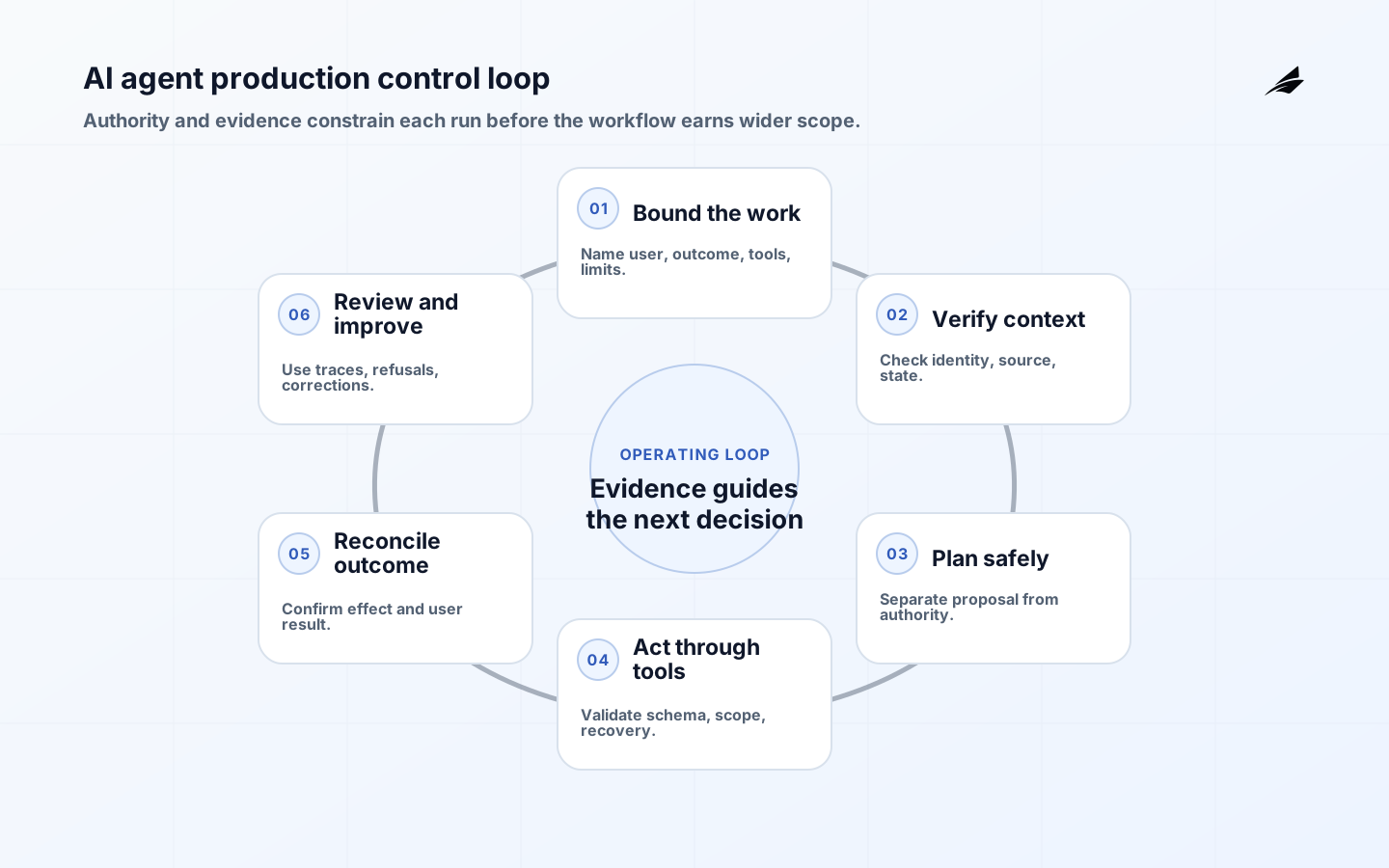
AI agents are best treated as an operating capability, not a product label. When they move into production, define the job, evidence, authority, and recovery path before expanding access. The operating model should make each action attributable and reversible.
Define the AI agents decision
Define one bounded job before designing an agent. Name the trigger, permitted systems, allowable actions, reviewer, and stop condition. A narrow contract makes evaluation and recovery concrete before the workflow receives broader authority.
| Agent capability | Production requirement | Evidence |
|---|---|---|
| Read and summarize | Permission-aware retrieval and citations. | Source IDs, access decision, and reviewer feedback. |
| Plan and prepare | Schema-bound proposal with clear owner. | Plan version, validation result, and approval state. |
| Act through tools | Least privilege, idempotency, and rollback. | Tool trace, transaction reference, and recovery record. |
Design the agent evidence boundary
Use an orchestration layer that carries an actor identity, run ID, workflow version, data classification, and policy result into every tool call. Keep memory purpose-limited and expirable. Separate durable business records from conversational context, and never let a past model message become a standing permission. Define idempotency, timeouts, compensation, and confirmation behavior for external operations. The result should be a traceable workflow with an agent inside it, not an opaque worker operating beside it. The OpenAI Agents SDK Guide is a useful technical reference, but implementation should remain accountable to the organization’s own sources, users, and consequences. Keep a short decision record for material design choices so later reviewers can understand why a source, tool, model route, or review gate was included.
- Name the user, outcome, and accountable owner for the AI agents workflow.
- Keep the authoritative source or system of record available to the user and reviewer.
- Make uncertainty, denial, and incomplete evidence visible states rather than silent failures.
- Record the versioned configuration that materially changes a result or action.
- Give operators a documented way to pause, correct, and recover affected work.
Enforce agent authority at the action boundary
Give each agent the minimum tool set and credential scope necessary for its assigned job. Validate operations server-side, constrain amounts and destinations, require approvals for higher-impact actions, and provide a kill switch that operators can use without redeploying the whole product. OWASP’s guidance on prompt injection, excessive agency, and insecure output handling is directly relevant: untrusted content can influence a model, but it must not gain the ability to alter what the system permits. The OWASP Top 10 for LLM applications should inform threat modeling, while the NCSC secure AI guidance helps connect those controls to design, deployment, and ongoing operation. The practical rule is simple: use a model to interpret context where it helps, but use deterministic enforcement for identity, permissions, schemas, destinations, and irreversible transactions.
| Failure condition | Safe response | Operator action |
|---|---|---|
| Tool unavailable | Stop or use an approved fallback; do not guess completion. | Inspect dependency status and retry policy. |
| Ambiguous request | Ask for clarification or route review. | Confirm decision owner and needed evidence. |
| Unsafe instruction in content | Treat it as data and block unauthorized action. | Preserve trace, assess exposure, and refine controls. |
Measure work quality and failure
Evaluate plans, tool selection, argument validity, action outcome, escalation quality, and recovery separately. A final answer can look good even when an agent chose an unnecessary or unsafe route. Build scenario tests for misleading retrieved text, unavailable tools, duplicate requests, partial completion, credential changes, and requests outside the intended scope. Store enough run evidence to reconstruct the decision path, while applying retention and privacy rules to prompts, retrieved content, and user data. Do not collapse these signals into a single “accuracy” number. A production decision needs both quality and control evidence: the right result for the right person, at an acceptable time, with a response that remains safe when the evidence is weak. Put reviewed failures into the next evaluation set and classify whether the correction belongs in the source, interface, workflow, model configuration, or policy.

Release agents in bounded steps
Launch with read-only investigation or draft creation before enabling writes. Limit user groups, tools, volume, and data domains; review traces daily during the pilot; and practice disabling a tool, memory feature, or workflow version. Establish a manual alternative for the business task before the first production action. This gives the team a safe way to pause, correct affected records, and learn from failure without making customers wait for a model fix. A small release is valuable when it is instrumented, reviewed, and reversible. It is not a waiver for access control, evaluation, or incident preparation. Use the early evidence to decide whether to expand, redesign, hold the boundary, or stop; all four can be rational outcomes when they protect users and the organization.
Operate AI agents as a Living Service
Production agent review should combine product signals with security and operational evidence: successful task completion, tool errors, policy denials, approval age, user corrections, unusual action volume, and incident findings. Revisit scope when a new integration or prompt source is added. The NCSC lifecycle guidance supports this approach because agent risk changes with deployment context and connected systems, not only with the underlying model. Keep a change log that links a release to the affected workflow, test evidence, owner, rollout date, and rollback condition. That record makes it possible to distinguish a genuine improvement from a silent shift in policy interpretation or user experience.
Distribute ownership across the agent workflow
The AI agents workflow needs clear ownership across product, source or data stewardship, identity and security, and day-to-day operations. The product owner accepts the workflow trade-off; the source owner defines what is authoritative; the platform owner keeps the system reliable; and the risk or security owner helps test the boundaries. Shared review is important because an incident often crosses these responsibilities. Ownership should be visible in the runbook, release decision, and escalation route, not inferred after a problem.
Review agent outcomes with workflow owners
Review agent traces as workflow evidence, not as model curiosities. Look for unnecessary tool calls, repeated plans, discarded handoffs, approval bottlenecks, and actions that operators had to reverse. Tie those patterns to product outcomes and incident tickets. The objective is not to make every run look autonomous; it is to shrink the difference between what the system was allowed to do, what it actually did, and what the business owner expected.
What an agent run must prove
A production agent run should leave behind a compact proof of what it was allowed to do and why it took the path it took. That proof starts with the request identity and workflow version, then connects the retrieved context, policy decisions, tool arguments, external response, approval state, and final business outcome. It does not require retaining every private token forever. It does require a durable reference to the source records and decisions that a reviewer needs to reconstruct a material case. When a tool call is denied, record the denial as a meaningful outcome rather than hiding it behind a generic failure. When a human edits or rejects a proposed action, retain that signal for evaluation. The distinction between an unsuccessful attempt, a safe refusal, and a completed action gives operators a much better basis for repair than a single success metric.
The same proof should support a small operational exercise before the agent receives broader authority. Choose a normal case, an ambiguous request, an unavailable dependency, a malicious instruction in retrieved content, and a partial external result. For each case, identify the expected model behavior, the deterministic control, the operator signal, and the user-facing fallback. Then verify that the person responsible can pause new runs, isolate a tool or source, identify affected work, and resume from a known state. This is where the production boundary becomes concrete. The NIST Generative AI Profile and NCSC secure AI guidance are useful anchors, but the evidence must be expressed in the language of the actual workflow.
Use the related AI workflow approvals guide, agent memory guide, and multimodal AI guide when those adjacent boundaries are part of the same service. Each link should lead to a concrete design question: who may approve, what state may persist, or what evidence is needed for non-text inputs. Keeping the questions connected prevents an agent from gaining effective authority through a neighboring component that was reviewed separately.
- Record identity, workflow version, tool policy, and outcome for every material run.
- Test refusal, partial completion, unavailable tools, and hostile retrieved content.
- Give operators a pause, isolation, investigation, and recovery path.
- Treat corrections and approvals as evaluation evidence, not noise.
For a connected Edilec reading path, see Edilec AI-0222, Edilec AI-0228, Edilec AI-0240. These related guides keep the implementation detail close to the operating decision and help teams compare ownership, evidence, and recovery across adjacent systems (for AI agent operations agent run).
Key takeaways
- AI agents should start with one bounded decision and a named owner.
- Evidence, authorization, and action scope must be explicit before wider adoption.
- Controls are strongest when a service can enforce them at the actual boundary.
- Evaluation needs difficult, absent, stale, and adversarial cases as well as normal work.
- Expansion is a governed operating decision supported by outcomes, not a reward for a convincing demo.
Frequently asked questions about AI agents
Question: What changes when AI agents enter production? Answer: Identity, tool authority, state, evidence, observability, recovery, and ownership become part of the product rather than prototype concerns. Question: What is a safe first production capability for an agent? Answer: Start with read-only investigation or drafting, limited tools, visible traces, a manual route, and an owner who can pause runs.
An AI agent is appropriate when a workflow benefits from model-based interpretation across a small, controlled set of tools and can tolerate residual uncertainty through boundaries and review. It is not a reason to give a model broad standing access. Start with a single job, a limited action surface, visible traces, and an owner who can stop or change the workflow. The sensible next step is to select a workflow with available evidence, clear ownership, and a recoverable outcome, then make a small evaluation set that domain reviewers can judge. That produces better information than a broad launch whose success criteria are unclear.
Conclusion
Production AI agents are accountable software systems, not autonomous colleagues. Scope their job, constrain their tools, preserve their traces, and make recovery as deliberate as execution. The durable pattern is to make the job, evidence, authority, controls, and learning loop visible enough for people to inspect and improve.
Practice the production review
Review one completed run, one safe refusal, and one human correction at each operating checkpoint. Ask whether the user could see the evidence, whether the tool authority matched the task, and whether the final state could be repaired without rewriting history. A refusal is a reliability outcome when authority or evidence is insufficient. Repeated corrections are signals to classify: source quality, policy, prompt, tool contract, interface, or training. This turns operator experience into a concrete improvement queue.
Keep the human route useful. Reviewers need source references, proposed effect, uncertainty, and recovery options; otherwise an approval gate becomes a rubber stamp. When a new tool or data domain is added, repeat the same normal, ambiguous, unavailable, and hostile cases before widening scope. The OpenAI Agents SDK guide explains agent composition, while the OWASP Top 10 keeps excessive agency and insecure handling visible. The local decision record should connect both to the actual business consequence.