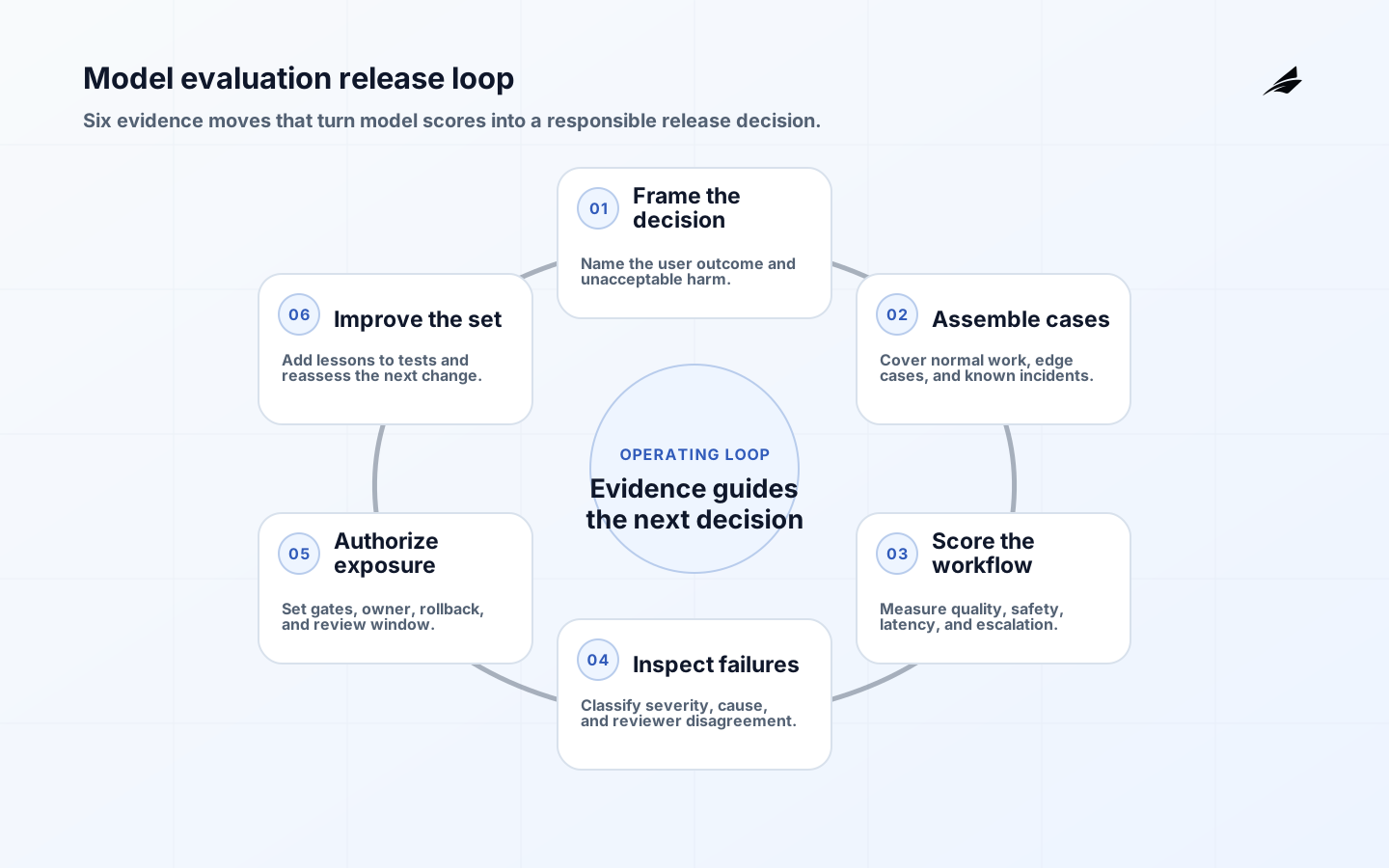
Model evaluation becomes serious in production because a product team must decide whether a workflow should be released, expanded, paused, or changed. That decision cannot rest on a few compelling outputs. It needs a shared definition of success, a set of representative cases, a way to score outcomes, and a record of material failures. The OpenAI evaluations guide provides useful methods for task-specific assessment, but the key principle is broader: evaluate the assembled product. Retrieval, instructions, tools, user interface, policy gates, and human review can each change the outcome. Model Evaluation for AI Automation is a helpful companion for teams establishing that practice.
Define success and harm
Begin with the user outcome and the unacceptable outcome. A case-routing assistant may be successful when it sends a request to the right queue with sufficient evidence; it may be harmful when it leaks a restricted note or delays urgent work with a plausible but wrong classification. Separate product metrics from model metrics. Completion rate and time saved matter, while supported claims, valid structured output, and correct escalation explain whether the system earned those results. Name the trade-offs explicitly. A system designed to abstain more often may reduce harm but create review load; a system tuned only for acceptance can hide systematic errors. The NIST AI RMF offers a useful frame for connecting those choices to governance and risk ownership.

| Outcome class | Example criterion | Who should review it |
|---|---|---|
| Task completion | Correct queue and required fields are produced | Workflow owner and operations reviewer. |
| Evidence quality | Every material claim cites an approved source | Domain expert or policy owner. |
| Safety | Restricted data and prohibited actions are refused | Security and product owners. |
| Experience | The result is timely, comprehensible, and correctable | Representative end users. |
Build a representative case set
A durable evaluation set comes from the work the product is meant to change. Sample ordinary cases, then deliberately add rare but consequential conditions: missing information, ambiguous phrasing, conflicting policies, stale records, adversarial instructions, permission denials, and expected failures. Store the case input, permitted context, expected outcome or rubric, relevant source version, and reviewer rationale. Remove or protect sensitive material rather than copying production data casually. Maintain separate development and holdout sets so a team cannot unconsciously optimize every known example. When a customer report or incident reveals a new failure, turn it into a reviewed case. This converts operational learning into a regression guard instead of a story that disappears after the retrospective.
- Represent normal volume and difficult edge conditions, not only polished demonstrations.
- Record why a result is acceptable, insufficient, unsafe, or in need of escalation.
- Version the case set with source and policy changes that affect expected behavior.
- Keep a holdout sample for release confidence after iterative prompt or model work.
- Use privacy review before retaining conversation or document material for evaluation.
Score what the workflow controls
Choose scoring methods that fit the decision. Exact-match checks work for schemas and controlled classifications; expert rubrics work for evidence-supported drafts; pairwise comparisons can help select between alternatives. Automated graders are useful accelerators but should be calibrated against human judgment, especially when safety or policy interpretation is involved. Inspect distribution and failure categories, not merely an average score. A small decline on rare high-severity cases may outweigh a broad improvement in style. The NIST Generative AI Profile emphasizes measurement and documentation as ongoing activities; retain enough detail to explain what was measured and what a score does not cover.
Test the full product path
Run end-to-end evaluations where the real workflow has dependencies. A model may produce the correct extraction while the document parser uses the wrong page, or select a valid tool while an authorization gate mishandles the caller. Include latency, cost, accessibility, and recovery behavior when they affect users. The OWASP Top 10 for LLM Applications also makes a strong case for testing misuse and injection paths rather than treating them as separate from quality. For staged releases, compare production samples with the evaluated baseline and investigate material divergence. Evaluation is not a substitute for monitoring; it is the controlled evidence that gives monitoring a reference point.
| Metric | Useful interpretation | Misleading use |
|---|---|---|
| Pass rate | Shows agreement with a defined criterion | Treating all failure severities as equal. |
| Reviewer edits | Reveals where the product creates rework | Counting edits without categorizing their reason. |
| Abstention rate | Shows uncertainty behavior and coverage gaps | Assuming fewer abstentions always means better quality. |
| Latency and cost | Shows whether the workflow is operable at scale | Optimizing speed while ignoring degraded correctness. |
Make release decisions explicit
For each material change, record the hypothesis, affected components, evaluation set version, metrics, unacceptable regressions, approvers, and rollout plan. Product teams often change prompts, models, retrieval, and interfaces together; a release record makes it possible to discover which change explains a shift in outcomes. Use narrow rollouts and predetermined stop conditions for higher-risk workflows. Let frontline reviewers report failures through a path that preserves the case and makes follow-up visible. This is not bureaucracy for its own sake. It protects the team from arguing from anecdotes when a new version performs differently for an important class of user.
Calibrate reviewers and graders
Evaluation quality depends on the people and systems applying the rubric. Run calibration sessions in which reviewers independently assess the same cases, compare reasoning, and refine ambiguous criteria. Record examples that define a pass, an acceptable abstention, a minor defect, and a release-blocking failure. If an automated grader is used, measure its agreement with qualified reviewers on a held-out sample and inspect disagreement patterns rather than accepting a score because it is convenient. Different reviewers can legitimately weigh style differently, but a production rubric must converge on evidence, policy, and outcome requirements. Schedule recalibration when a source policy changes, a new user segment is added, or incident patterns shift. This investment protects against a quiet form of drift in which the product improves against a metric while the meaning of the metric becomes less connected to the real job.
- Define severity categories before asking reviewers to score production-impacting failures.
- Sample automated-grader decisions regularly and investigate systematic disagreement with domain experts.
- Keep anonymized anchor examples that demonstrate acceptable evidence, escalation, and unsafe outcomes.
- Track reviewer agreement by task and segment to locate rubrics that are underspecified.
- Document rubric changes with effective dates so historical scores remain interpretable.
- Use calibration findings to improve the product contract, not merely to force reviewers into agreement.
Manage evaluation evidence
Evaluation evidence needs access and retention rules of its own. Case sets may include redacted customer scenarios, policy text, reviewer notes, or benchmark outputs that reveal product weaknesses. Give product, domain, and engineering reviewers the minimum access required for their role, and keep raw examples separate from broad metric dashboards. When a case is retired because its source policy changed or consent no longer applies, remove it from active scoring while retaining only the documented rationale that is still necessary. Audit changes to release thresholds and rubrics so an apparent improvement cannot be created by quietly weakening the test. This allows a product team to use difficult evidence honestly without turning the evaluation repository into an uncontrolled copy of sensitive production material.
- Separate aggregate quality reporting from access to raw evaluation cases and reviewer notes.
- Record why a case was added, revised, withheld, or retired from active scoring.
- Protect release thresholds and rubrics with reviewable change history.
- Use redacted or synthetic representations when they preserve the relevant failure condition.
- Limit exports of evaluation material and review external-tool processing before sharing cases.
- Recheck access when a new reviewer group, vendor, or product segment joins the program.
A production evaluation program is strongest when every score has a decision attached to it. The OpenAI evaluations guide distinguishes repeatable evaluation runs from informal inspection, while the NIST AI Risk Management Framework asks teams to connect measurement to governance and risk ownership. The NIST Generative AI Profile is especially useful for recording limitations, provenance, and residual risk; the OWASP Top 10 for LLM Applications keeps security failures visible alongside quality failures. Taken together, these sources support a practical rule: do not promote a model because its average looks good when a high-impact failure is unmeasured or unactionable.
Keep the release record legible to someone who did not build the system. It should show the evaluated workflow version, case-set version, scoring rubric, material failures, reviewer disagreement, and the owner who accepted the remaining risk. Teams extending this practice can compare the model evaluation guide, the AI cost controls guide, and AI workflow reliability guidance while keeping the release decision specific to their own users and consequences. These companion articles are Model Evaluation for AI Automation: a Practical Guide, How Product Teams Should Think About Retrieval Pipelines, How Founders Should Think About AI Cost Controls.
Frequently asked questions
Question: Is a production evaluation just a larger test set? Answer: No; it must represent the real workflow, user impact, safety boundaries, and operating conditions. Question: What earns expansion? Answer: Stable results on important slices, understandable failures, named owners, and a measured response to regressions.
How many evaluation cases are enough?
Answer: Enough to cover normal work, important segments, difficult boundaries, severe failures, and expected release risk. The right set is representative and reviewed, not simply large.
Can an automated grader replace human review?
Answer: It can accelerate repeatable checks, but human calibration and sampling remain necessary for ambiguous, high-impact, or safety-sensitive outcomes.
What should happen after a failed evaluation?
Answer: Classify the failure, identify the responsible layer, block or narrow the release when necessary, and add a reviewed regression case before trying again.
How many evaluation cases are enough? Enough to represent the decision, common volume, important edge cases, and release risk; there is no universal number. Can an LLM grade another LLM? It can accelerate review, but calibration and human sampling remain necessary. Should a team optimize a single score? No. Use a small balanced set of outcome, safety, experience, and operational measures. Where do cost controls fit? They belong in the release decision because an unaffordable quality improvement is not a sustainable product; AI cost controls offers useful questions.
Key takeaways
- Evaluate the user workflow and its effects, not a model response in isolation.
- Build a versioned case set from real work and turn incidents into regression tests.
- Use metrics with a clear decision threshold and inspect severe failures separately.
- Release evidence, monitoring, and human feedback should form one continuous learning loop.
Conclusion
Production model evaluation gives a product team a way to replace optimism with evidence. Define the outcome, preserve hard cases, inspect the complete path, and connect each score to a release decision. That makes improvement measurable even as models, data, and user expectations continue to change.