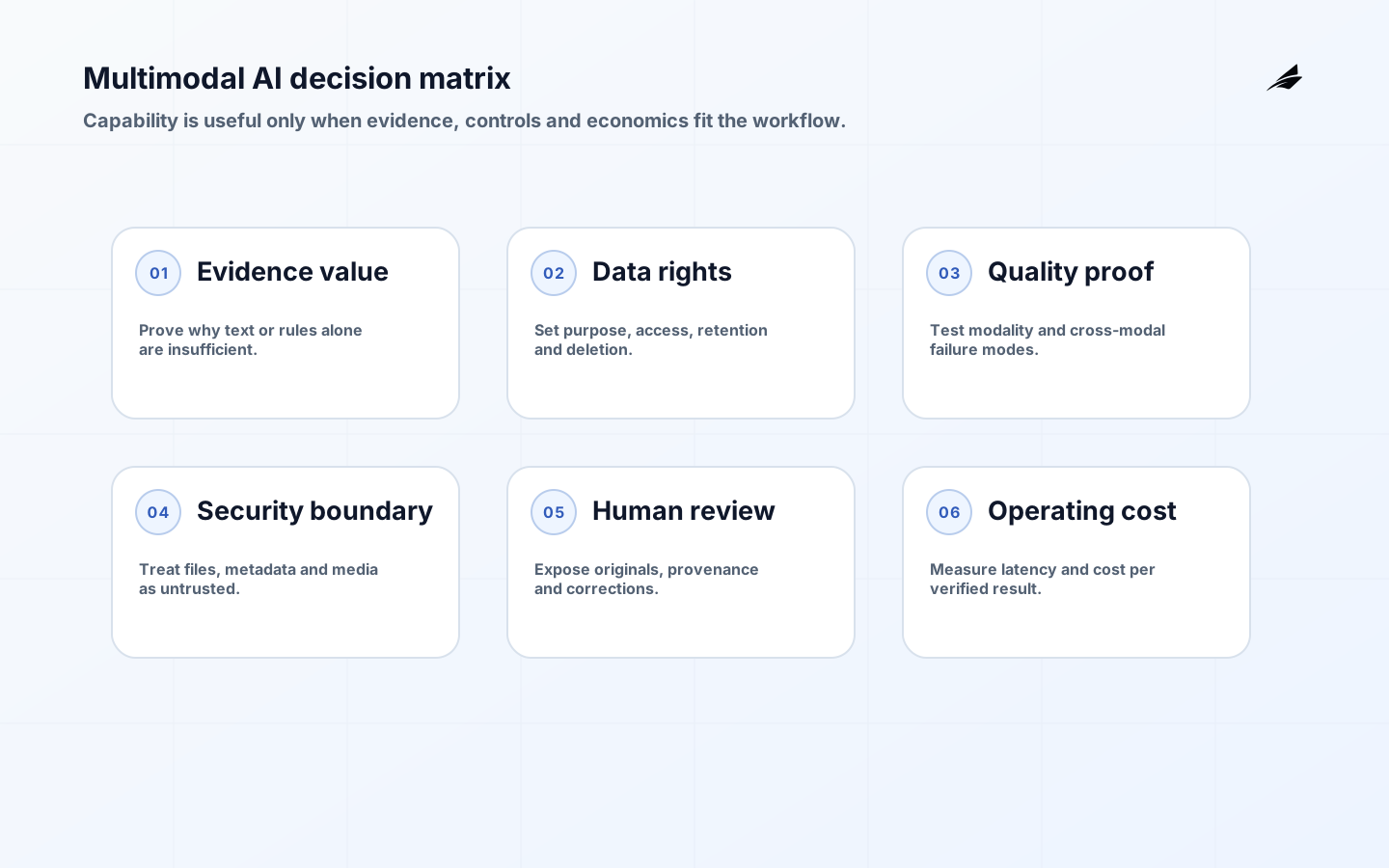
Multimodal AI allows one system to interpret combinations of text, images, audio, video or structured records. For a CTO, the key question is not whether a model can describe a sample image. It is whether a defined workflow benefits from evidence that text alone cannot carry, and whether the organization can govern that evidence from capture through inference, review, retention and deletion. Each modality introduces distinct quality, privacy, security, accessibility and cost concerns.
Connect strategy to implementation through Edilec's multimodal automation guide, document intelligence guide and model evaluation guide. A use case is ready only when its evidence and failure modes can be tested in the intended operating context.
Start with the multimodal AI decision
Write the job in one sentence, then write the unacceptable outcome beside it. For multimodal AI, the operating question is not whether the technology is impressive; it is whether a named person can complete a bounded task with appropriate evidence and control. A system may correctly read visible text but miss a handwritten amendment, confuse two similar components, accept a manipulated image, or expose a sensitive page to a service not approved for that data. Text-only checks do not cover these modality-specific failure modes. The NIST AI Risk Management Framework supports this discipline by connecting intended context, measurement, governance, and management rather than treating risk as a late security review. How Founders Should Think About AI Cost Controls is a useful adjacent reference, but it should not replace a local description of the decision owner and failure boundary.
| Decision element | Question to settle | Evidence to keep |
|---|---|---|
| User and outcome | Who uses multimodal AI, and what completed work changes for them? | A task definition, accountable owner, and a measurable acceptance condition. |
| Authority boundary | What may be read, drafted, proposed, submitted, or changed? | A policy rule, identity claim, approval record, and revocation path. |
| Failure response | What happens when evidence is absent, conflicting, stale, or unsafe? | A visible abstention, escalation route, and incident or correction record. |
Build an evidence boundary
For each input type, document what evidence is required, what transformations occur, which fields may be extracted, what may be retained, and where the authoritative original remains. Separate assistance such as draft extraction from decisions such as damage assessment or identity verification. This is where seemingly small implementation choices become operational commitments. A source link or event record must remain meaningful after a deployment, an employee role change, or a correction. The UK National Cyber Security Centre guidance emphasizes secure design, development, deployment, and operation as connected activities. Use that lifecycle view to assign an owner to the inputs, the policy, and the response when multimodal AI behaves unexpectedly.
- Name the source systems, people, and decisions that multimodal AI depends on; do not bury them in configuration alone.
- Classify information and actions by consequence, then choose controls that operate at the boundary where the consequence occurs.
- Keep an inspectable record of the input, material context, policy result, and output or side effect for cases that matter.
- Design a correction path that can remove or repair a bad record and tell an operator what work may have been affected.
- Practice the uncertain case. A system that can only handle happy-path inputs has not yet earned autonomy.
Put controls where they can enforce
Validate file type and size, strip or assess risky metadata, scan uploads, isolate processing, and restrict downstream tool access. Preserve page, region, timestamp, and source references for important claims. When a decision depends on a visual feature, show the reviewer the original evidence rather than only a model description. The OWASP guidance for LLM applications is particularly relevant when untrusted content can influence model behaviour or tool use: controls need to survive hostile and malformed inputs, not merely ordinary requests. For multimodal AI, prefer deterministic enforcement for identity, limits, destinations, schemas, and approvals. A model can help interpret context; it should not be the final authority for a rule that a service can verify directly.
| Control layer | What it protects | Practical test |
|---|---|---|
| Identity and access | The requester, source, and action scope. | Change membership or role and confirm the prohibited result remains unavailable. |
| Data and context | Currency, completeness, and permitted use of evidence. | Inject an obsolete, conflicting, or incomplete record and verify the response routes appropriately. |
| Action and recovery | Side effects, spend, external calls, and correction. | Force a validation failure or denied approval and confirm the state is safe and observable. |
Measure the work, not just uptime
Build evaluation sets by modality and condition: blurred scans, rotated pages, poor lighting, handwriting, multiple languages, similar objects, redactions, and adversarial overlays. Measure field-level extraction accuracy, unsupported visual claims, reviewer correction rate, processing delay, and privacy-control failures. Keep a small, versioned evaluation set close to the workflow and add real failures after review. Distinguish service availability from decision quality: a system can have low latency and still provide the wrong evidence or trigger costly rework. Review results with the people who understand the task, then turn recurring failure patterns into a test, a source repair, a product change, or a tighter boundary.
Release in bounded steps
Start with a constrained document type and an assistive outcome, such as extracting invoice fields for review. Expand to images or audio only after the organisation can test the inputs, retain evidence appropriately, and manage exceptions. Define a rollback condition before release, including who can disable the capability and how a human completes the work during recovery. Small launches are valuable when they are instrumented and reviewed; they are not a license to skip permissions, source checks, or error handling. Record the decision to expand with the same care as the initial decision to use multimodal AI.
Operate multimodal AI as a living service
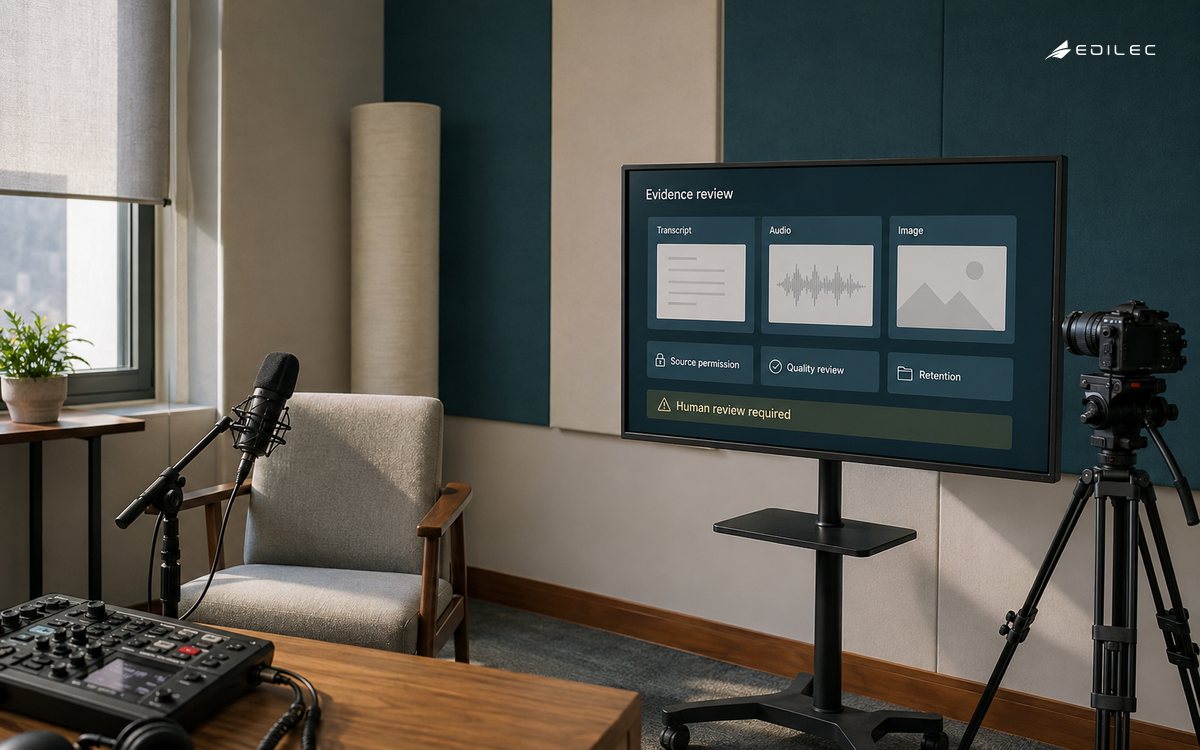
Multimodal review needs people who understand both the operational task and the captured artifact. A document specialist may spot a layout exception that a generic text evaluation misses; a field engineer may know that glare on a label makes a visual classification unsafe. Build feedback around the original artifact, the extraction, the proposed decision, and the eventual outcome so teams can identify whether the failure came from capture, preprocessing, interpretation, or workflow design. Reassess retention and access when new modalities are added, because an image or recording may contain information absent from the extracted text. This discipline prevents a common mistake: treating an apparently successful text summary as proof that the visual or audio evidence was correctly understood.
Keep review evidence actionable
Keep representative original artifacts in the controlled evaluation set when policy permits. Cropped screenshots and extracted text alone can hide the very layout, lighting, or context defect that changed the outcome, leaving the team unable to reproduce a user report.
Assign accountable owners
Assign modality expertise rather than treating every file as generic input. A document operations owner, privacy owner, and task expert may each need to approve a new input class. Their shared record should explain the capture conditions, fields used, retention rule, and review route. This makes it possible to add useful modalities without normalizing risky or poorly understood evidence.
Choose multimodal AI with a decision matrix
Begin with a decision that requires cross-modal evidence: inspect product damage while reading a shipment record, extract a field while preserving its table context, or summarize a recorded interaction with speaker and consent boundaries. Compare a multimodal model with simpler components such as OCR, barcode reading, speech recognition, deterministic image analysis or a human review queue. The more capable model is justified only if it improves the complete decision enough to offset wider data exposure, evaluation effort, latency and operating cost.
| Decision dimension | Question for the CTO | Required evidence |
|---|---|---|
| Unique value | Which information is lost in a text-only path? | Representative task comparison against simpler baselines |
| Data rights | May each modality be collected, combined and retained? | Purpose, consent or authority, classification and deletion route |
| Model quality | Which spatial, temporal or cross-modal errors matter? | Labeled normal, edge and adverse evaluation cases |
| Security | Can images, documents or audio carry hostile instructions? | Injection, metadata, parser and tool-boundary tests |
| Human review | Can a reviewer inspect the original and derived evidence? | Accessible provenance view and correction workflow |
| Economics | Does the outcome justify processing and review cost? | Cost per verified result by modality and cohort |
Visual Instruction Tuning is an important primary reference for instruction-following vision-language models, but benchmark capability is not production assurance. The NIST Generative AI Profile provides lifecycle risk guidance, and the UK NCSC secure AI system development guidelines connect secure design, development, deployment and operation. The OWASP LLM and generative AI guidance is relevant where untrusted content can influence models or tools.
Build modality-specific evaluation. For documents, test layout, handwriting, tables, stamps and missing pages. For images, test crop, scale, blur, lighting, occlusion and misleading overlays. For audio, test accents, noise, overlapping speakers and consent boundaries. For video, test temporal ordering and omitted frames. Segment outcomes by source device and affected group. Preserve original evidence, transformations, model version and reviewer correction under an approved retention policy. Release first as decision support with bounded inputs before allowing any automated action.
Key takeaways
- Multimodal AI earns trust through a defined job and a named decision owner.
- Evidence, identity, and action boundaries must be explicit before a wider launch.
- Controls are strongest when enforced by deterministic services at the point of consequence.
- Evaluation should include difficult, absent, stale, and adversarial cases, not only successful examples.
- Expansion is a governed operating decision supported by outcomes, not a reward for a polished demo.
Frequently asked questions
Multimodal AI is not automatically better than text processing. Use it when an additional modality carries information needed for the task, and evaluate it on the actual conditions in which that modality is captured. The practical next step is to select one workflow, write its evidence and authority boundaries, and create a small set of cases a domain reviewer can judge. That produces much more useful learning than a broad rollout with no shared definition of success.
Conclusion
Multimodal AI becomes dependable when its operating constraints are visible: what it is for, what information it may use, what it may do, who can intervene, and how the organisation knows it is improving. Start with the consequential decision, preserve the evidence around it, and make uncertainty a safe state rather than something the system hides.