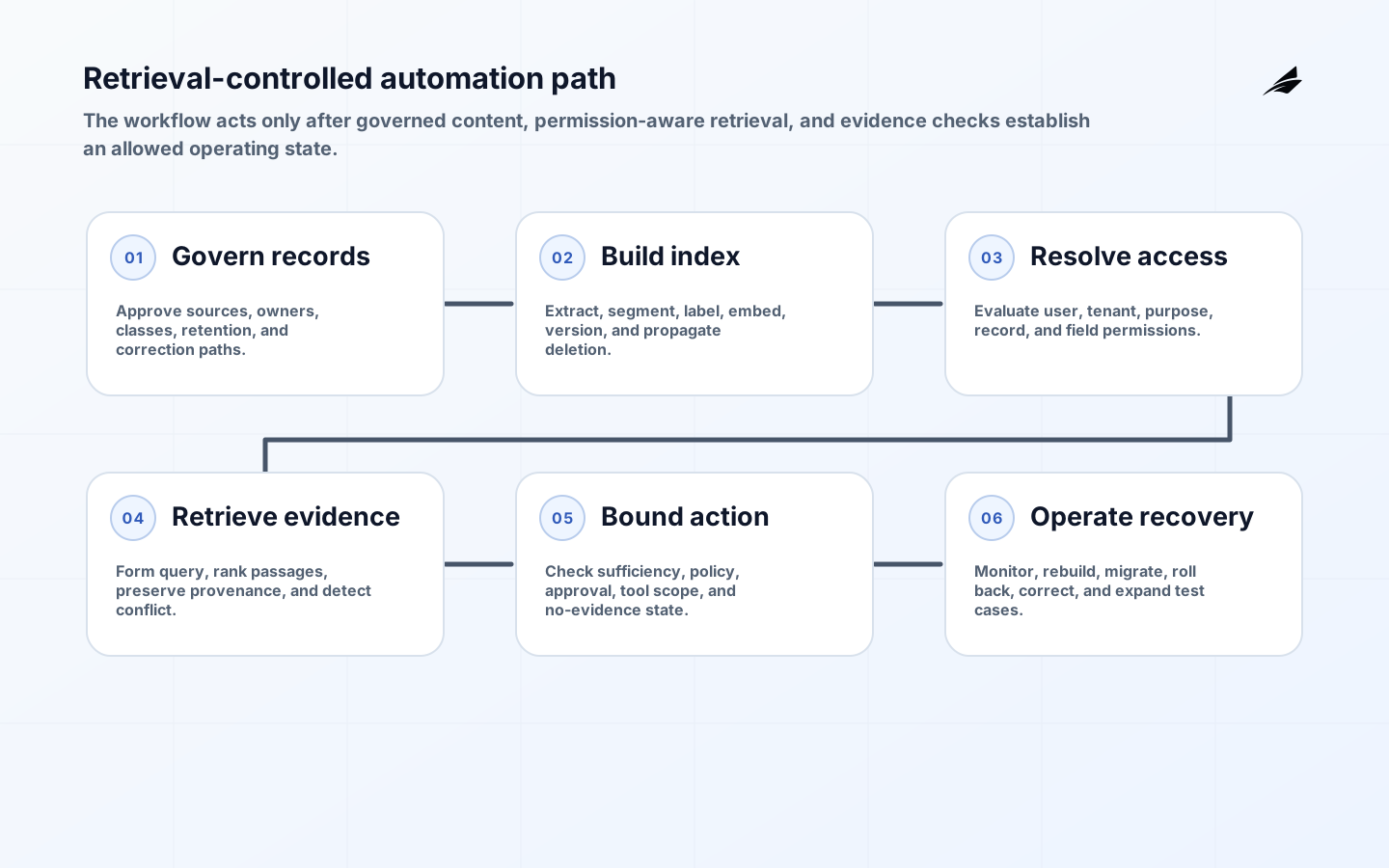
Retrieval pipelines for AI automation convert governed records into evidence that a workflow can find, cite, and use without silently crossing access or authority boundaries. The pipeline includes source selection, extraction, segmentation, metadata, embedding or indexing, permission filtering, query construction, ranking, context assembly, and deletion. In automation, retrieval quality is not only an answer-quality concern: a missing or poisoned passage can change an approval, tool call, message, or record update. The architecture must therefore connect evidence quality to action limits and human escalation.
Place retrieval inside a controlled automation boundary
Separate the evidence plane from the action plane. The retrieval service should return passages with source identifiers, versions, timestamps, and policy context; the workflow should then decide whether that evidence is sufficient for a proposed action. The original RAG paper established the combination of model generation and external memory, but production automation adds ownership, authorization, and recovery obligations. OWASP’s RAG Security Cheat Sheet covers controls from ingestion to downstream agent use, and its vector and embedding guidance describes data leakage and poisoning risks that are especially consequential when retrieved context can trigger tools.

Design a bounded no-evidence state. If required sources are unavailable, permissions cannot be evaluated, citations conflict, or retrieval confidence falls below the tested operating range, the workflow should pause, request more information, or route to a person. The NIST Generative AI Profile and NCSC secure AI guidance reinforce lifecycle controls, monitoring, and secure operation. Instrument source lag, ingestion failures, chunk counts, permission-filter outcomes, retrieval latency, relevant-evidence rate, citation support, no-answer frequency, tool blocks, overrides, and correction time. Rehearse deletion, index rebuild, embedding migration, dependency outage, and rollback.
| Automation condition | Retrieval response | Action control |
|---|---|---|
| Supported evidence | Return authorized passages with source, version, and freshness. | Allow only the action class covered by policy and evaluation. |
| Conflicting evidence | Expose the disagreement and affected sources. | Pause consequential action and request review. |
| Missing evidence | Return an explicit no-evidence state rather than filler context. | Ask for information, retry safely, or escalate. |
| Policy uncertainty | Do not retrieve until identity and access scope can be resolved. | Deny the action and record the control decision. |
Define the retrieval pipelines Decision
Start with a decision and a corpus boundary. A founder may want an assistant to help account managers answer product-policy questions, but that goal still requires named source systems, an owner for each source, and an explicit answer to whether drafts, archived documents, or customer-specific records belong in scope. Separate searchable relevance from authority. A record can be useful for exploration while remaining unsuitable as the governing basis for an automated answer. In practice, write the acceptance condition in the language of the work: what a user can complete, what evidence they can inspect, and what the system must never do. The relevant adjacent guides are semantic search guide, embeddings guide, RAG systems guide; each is useful when it clarifies a component of the workflow rather than substituting for a local decision boundary.
| Pipeline stage | Operational promise | Failure to detect |
|---|---|---|
| Acquire | Record source, owner, and intake time. | Unknown or duplicate origin. |
| Parse and enrich | Preserve structure, version, and policy metadata. | Detached clauses or missing access attributes. |
| Index and serve | Retrieve only permitted, current candidates. | Cross-boundary leakage or stale citations. |
Design the Evidence and System Boundary
Model ingestion as a chain of accountable transformations: acquire a source, validate format, preserve identifiers and structure, classify sensitivity, attach metadata, make permission-aware indexes, and expose citations. RAG research established retrieval as an external knowledge component, while operational pipelines must additionally handle connector failure, incremental updates, retention, and backfill. Keep the original location and version available so a reviewer can inspect what was actually retrieved. The Retrieval-Augmented Generation for Knowledge-Intensive NLP Tasks is a useful technical reference, but implementation should remain accountable to the organization’s own sources, users, and consequences. Keep a short decision record for material design choices so later reviewers can understand why a source, tool, model route, or review gate was included.
- Name the user, outcome, and accountable owner for the retrieval pipelines workflow.
- Keep the authoritative source or system of record available to the user and reviewer.
- Make uncertainty, denial, and incomplete evidence visible states rather than silent failures.
- Record the versioned configuration that materially changes a result or action.
- Give operators a documented way to pause, correct, and recover affected work.
Put Controls at the Point of Consequence
Apply access rules at retrieval time using authoritative identity and document attributes. Do not allow a general index to become a bypass around the source system. Treat imported files and connectors as supply-chain inputs: scan, validate, isolate failures, and record provenance. OWASP calls out vector and embedding weaknesses as an LLM application concern; tests should include metadata manipulation, poisoned documents, cross-tenant queries, and stale records that appear highly relevant. The OWASP Top 10 for LLM applications should inform threat modeling, while the NCSC secure AI guidance helps connect those controls to design, deployment, and ongoing operation. The practical rule is simple: use a model to interpret context where it helps, but use deterministic enforcement for identity, permissions, schemas, destinations, and irreversible transactions.
| Release check | Question | Evidence |
|---|---|---|
| Coverage | Did intended records arrive and parse? | Counts, rejected records, and source reconciliation. |
| Permission | Does role change take effect in retrieval? | Negative tests across roles and tenants. |
| Regression | Did relevance or citation behavior change? | Versioned judged-query comparison. |
Measure Work Quality and Failure
Measure pipeline health separately from answer quality. Track source freshness, parse success, indexing lag, deletion completion, metadata completeness, entitlement-filter denials, target-passage recall, citation resolution, and downstream reviewer judgment. Re-run a fixed set of difficult queries after any parser, chunking, embedding, reranking, or source-connector change. That comparison turns a retrieval change into a releasable engineering artifact rather than an invisible infrastructure adjustment. Do not collapse these signals into a single “accuracy” number. A production decision needs both quality and control evidence: the right result for the right person, at an acceptable time, with a response that remains safe when the evidence is weak. Put reviewed failures into the next evaluation set and classify whether the correction belongs in the source, interface, workflow, model configuration, or policy.
Release in Bounded Steps
Begin with one source class and a small population of permitted users. Compare pipeline output against the authoritative system, test removal and access revocation before broadening the corpus, and make a manual lookup available while the service learns. Have a rollback plan for an index version or connector release, including how to prevent new answers from relying on material already known to be malformed or out of date. A small release is valuable when it is instrumented, reviewed, and reversible. It is not a waiver for access control, evaluation, or incident preparation. Use the early evidence to decide whether to expand, redesign, hold the boundary, or stop; all four can be rational outcomes when they protect users and the organization.
Operate retrieval pipelines as a Living Service
Assign source ownership, pipeline ownership, and product ownership separately. The source owner decides validity; the pipeline owner keeps transformations and access behavior reliable; the product owner decides whether the result serves the workflow. Review exceptions together, because a relevance failure may actually be an ownership or document-quality failure. The NIST framework is a useful discipline for recording those assumptions, measurements, and corrective actions over time. Keep a change log that links a release to the affected workflow, test evidence, owner, rollout date, and rollback condition. That record makes it possible to distinguish a genuine improvement from a silent shift in policy interpretation or user experience.
Assign Accountable Owners
The retrieval pipelines workflow needs clear ownership across product, source or data stewardship, identity and security, and day-to-day operations. The product owner accepts the workflow trade-off; the source owner defines what is authoritative; the platform owner keeps the system reliable; and the risk or security owner helps test the boundaries. Shared review is important because an incident often crosses these responsibilities. Ownership should be visible in the runbook, release decision, and escalation route, not inferred after a problem.
Review Changes With the People Who Own the Work
A pipeline incident should produce a source-to-answer investigation, not just an infrastructure ticket. Identify which source revision entered the pipeline, how it was transformed, which index version served it, and which users or workflows relied on it. This evidence supports precise correction: remove or repair only the affected material, rebuild when necessary, and add the failure to the release test suite so a connector or parser fix does not repeat it.
Key Takeaways
- Retrieval pipelines should start with one bounded decision and a named owner.
- Evidence, authorization, and action scope must be explicit before wider adoption.
- Controls are strongest when a service can enforce them at the actual boundary.
- Evaluation needs difficult, absent, stale, and adversarial cases as well as normal work.
- Expansion is a governed operating decision supported by outcomes, not a reward for a convincing demo.
Frequently Asked Questions
A retrieval pipeline should preserve more than text chunks. It needs durable identifiers, source location, version, classification, effective date where relevant, and attributes that support access enforcement. This metadata is what lets an AI experience cite, filter, correct, and retire information instead of treating the corpus as a static pile of text. The sensible next step is to select a workflow with available evidence, clear ownership, and a recoverable outcome, then make a small evaluation set that domain reviewers can judge. That produces better information than a broad launch whose success criteria are unclear.
Conclusion
Reliable retrieval pipelines make the route from source record to user-facing evidence inspectable. Govern ingestion and change as seriously as ranking, because the corpus is part of the system’s authority. The durable pattern is to make the job, evidence, authority, controls, and learning loop visible enough for people to inspect and improve.