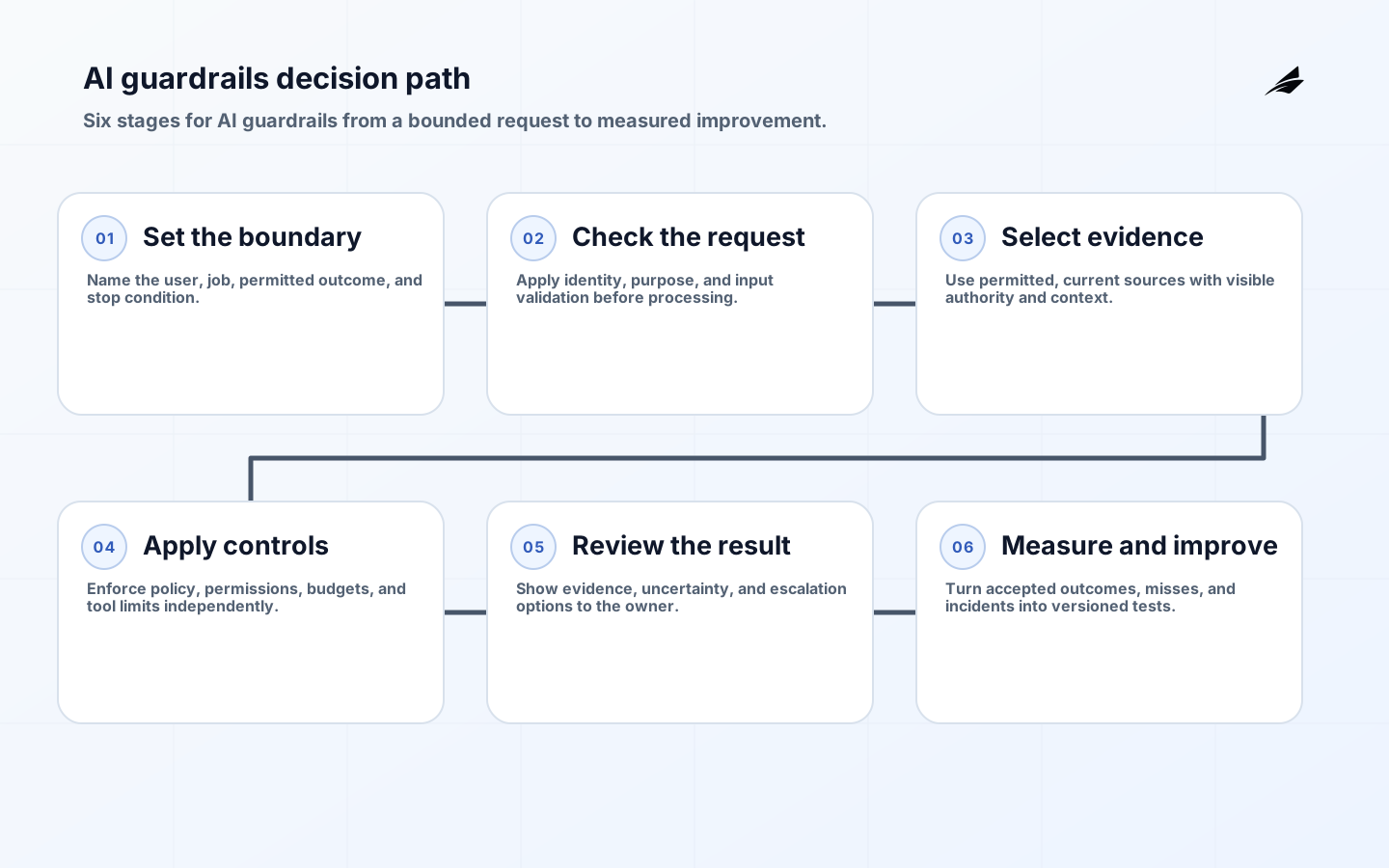
AI guardrails is useful only when it changes a bounded piece of work for a named person. Before a team chooses a model, index, or interface, it should be able to describe the job in one sentence: a service agent drafting a response from account and policy records. That framing prevents a familiar failure mode: a capable demonstration is mistaken for an operating service. The first build should make the input, permitted evidence, decision owner, and recovery route visible. This guide focuses on which limits belong in application policy rather than in a prompt. It treats quality, security, and cost as properties of the whole workflow rather than promises made by a model.
Define the AI guardrails boundary
Start with a decision contract. For this workflow, the allowed evidence is approved policy text and the minimum account facts needed for the request; the permitted outcome is to draft a response for review, never send, refund, or change an entitlement on its own. Write down who asks, who benefits, what information may enter, which records have authority, which side effects are prohibited, and who resolves an exception. The NIST AI Risk Management Framework organizes risk work around governing, mapping, measuring, and managing. That is practical here: a boundary converts abstract risk into a statement a product owner, security reviewer, and operator can test.

| Boundary question | Decision for this workflow | Evidence to retain |
|---|---|---|
| User and purpose | product teams handling a service agent drafting a response from account and policy records | Role, purpose, workflow owner, and request time. |
| Authoritative inputs | approved policy text and the minimum account facts needed for the request | Source identifier, version, owner, and access decision. |
| Permitted result | draft a response for review, never send, refund, or change an entitlement on its own | Output, cited evidence, and reviewer disposition. |
| Stop condition | Pause when a pleasant response can hide a rule violation or an unapproved action. | Reason code, escalation target, and recovery record. |
Choose evidence before implementation
The OWASP Top 10 for LLM Applications is a useful reminder that prompt injection, sensitive-data disclosure, and excessive agency are system-design problems, not merely wording problems. Treat every source as more than text: it needs an owner, a change process, a permission rule, and a clear status such as draft, approved, or superseded. A customer message may contain instructions that try to override policy. Treat it as untrusted input, keep tool permissions server-side, and require an accountable person for an external commitment. A relevant passage is not necessarily sufficient evidence. A result should preserve enough surrounding context for a reviewer to check the claim, and the system should say when it lacks enough authority or current information to proceed.
- Assign a content owner and freshness expectation to each source used by AI guardrails.
- Preserve source identifiers, effective dates, access decisions, and document status through ingestion and retrieval.
- Define how conflicting, missing, or superseded evidence is handled before an interface hides the conflict.
- Keep the established manual path available until the new route meets its agreed evaluation threshold.
Design the AI guardrails control points
The architecture should separate generated language or ranking from enforcement. Identity, tenant scope, approved tools, policy checks, budget limits, and approval state belong in independently testable application controls. A pleasant response can hide a rule violation or an unapproved action; a prompt or score is not a reliable authorization layer. The NIST Generative AI Profile identifies issues including information integrity, privacy, and human-AI configuration. Those concerns become tractable when controls are placed where data is exposed, a record changes, a tool is called, or a message could leave the organization.
| Control point | What it prevents | A concrete test |
|---|---|---|
| Identity and purpose | A plausible request exceeding its authorized use. | Change role, tenant, or stated purpose and verify the result changes correctly. |
| Evidence selection | Weak, stale, or private records shaping the result. | Sample lineage, authority, and freshness on judged cases. |
| Action boundary | A suggestion becoming an unapproved side effect. | Validate policy and tool scope on the server before execution. |
| Recovery route | A defect persisting without an owner or stop mechanism. | Exercise pause, fallback, notification, and restoration in a test environment. |
Evaluate AI guardrails on decisions, not demos
Build a versioned evaluation set from privacy-reviewed examples of the real task. Include routine cases, ambiguous requests, incomplete records, changed permissions, malformed inputs, and cases that must be declined or escalated. Track policy-block rate, reviewed exception rate, unauthorized-action attempts, and time to triage a failed control. Segment results by a condition that could change the outcome: source family, user role, request type, language, document status, or consequence. A strong aggregate score can conceal a serious failure in one slice. Reviewers should record accepted, corrected, rejected, and escalated results; confirmed failures become regression cases with the input, expected behavior, and responsible owner.
Release AI guardrails in controlled increments
Begin in a low-consequence, observable workflow with a defined fallback. Run in parallel with the current process long enough to compare outcomes, not just response speed. Release changes to content, embedding or model configuration, ranking, prompts, and policy as traceable versions. The UK National Cyber Security Centre guidance supports a secure-development mindset: define security requirements early, manage dependencies and data, and plan how the system will be monitored and maintained. Promote a change only when the evidence shows that it improves the agreed task without moving unmeasured risk to reviewers or support staff. For AI guardrails, stage policy changes behind audit-only checks first, then compare what the proposed rule would block with an accountable reviewer’s decision.
- Name a product owner, technical owner, source owner, and incident contact before the pilot begins.
- Set a rollback trigger for a material quality, security, latency, or cost regression.
- Log the versioned inputs, evidence references, control decisions, and final disposition needed for investigation.
- Use this related guide to compare the adjacent design choice without expanding the first release prematurely.
Put AI guardrails into an operating workflow
For AI guardrails, turn each material policy into a test that can fail independently of the model. A customer-facing draft may need checks for prohibited claims, account scope, regulated language, and a human approval before delivery. Log which control allowed, changed, or blocked the result. This gives a reviewer a way to distinguish a model failure from an enforcement failure and prevents later policy changes from becoming untraceable prompt edits.
Keep a AI guardrails decision record
Create a guardrail register that links each policy to its enforcement point, test fixture, owner, severity, and override route. For example, a rule that prohibits disclosure of one customer’s data to another belongs in authorization and response filtering, with a test using cross-tenant records. A rule about refund approval belongs in the transaction service, not in an instruction buried in a conversational prompt. The register makes it possible to review changes with security, legal, product, and operations colleagues using the same concrete artifact.
- Which policy must be enforced outside the model and why?
- Who may override a blocked result, with what evidence?
- Which tool call has the highest consequence if it is misused?
- How will the team test an untrusted instruction inside a user message?
- What audit record is needed for a customer-facing exception?
- Which reviewer can distinguish a legitimate exception from an attempted policy bypass before communication leaves the service?
- What evidence must accompany a manual guardrail override, and how will recurring overrides trigger a policy review?
Key takeaways
- AI guardrails should start with one accountable job, not a broad capability claim.
- Authority, freshness, permissions, and action limits must be represented in the workflow, not inferred from prose.
- A decision-quality evaluation set, including declines and exceptions, is the evidence needed for a responsible release.
- Instrumentation and a fallback route make improvement possible after launch.
AI guardrails FAQ
Should the first version automate an action? Usually no. Start by preparing evidence or a draft for a bounded task. Add an action only when its policy, authorization, rollback, and accountable owner are explicit and tested. For this use case, begin with a draft and an explicit reviewer decision; sending or changing an entitlement needs a separately authorized workflow.
What makes a useful quality metric? Use a metric tied to the job, such as policy-block rate, reviewed exception rate, unauthorized-action attempts, and time to triage a failed control. Pair it with sampled human review and inspect the evidence behind unusual changes rather than relying on a single average. Here, pair policy-block rate with sampled review of both blocked and allowed cases, because either can reveal a bad rule.
When should the team stop the pilot? Pause when a control fails, the source record cannot support a consequential result, a permission boundary is crossed, or the manual fallback cannot safely absorb the work. The point is to investigate and correct, not to normalize a near miss. In this workflow, pause when an untrusted input can influence an action, a control cannot be audited, or a reviewer cannot override safely.
Conclusion
A sound AI guardrails implementation is a designed operating decision, not a model feature. Make the job narrow, preserve the evidence and authority behind each result, enforce controls outside generated output, and evaluate the cases that expose uncertainty. With those pieces in place, a small release can generate useful evidence for the next decision. Without them, a larger build usually makes the same unanswered questions harder to see. For this team, the durable first-build artifact is a policy-to-test register, server-side enforcement points, and a trace of every blocked or approved action.