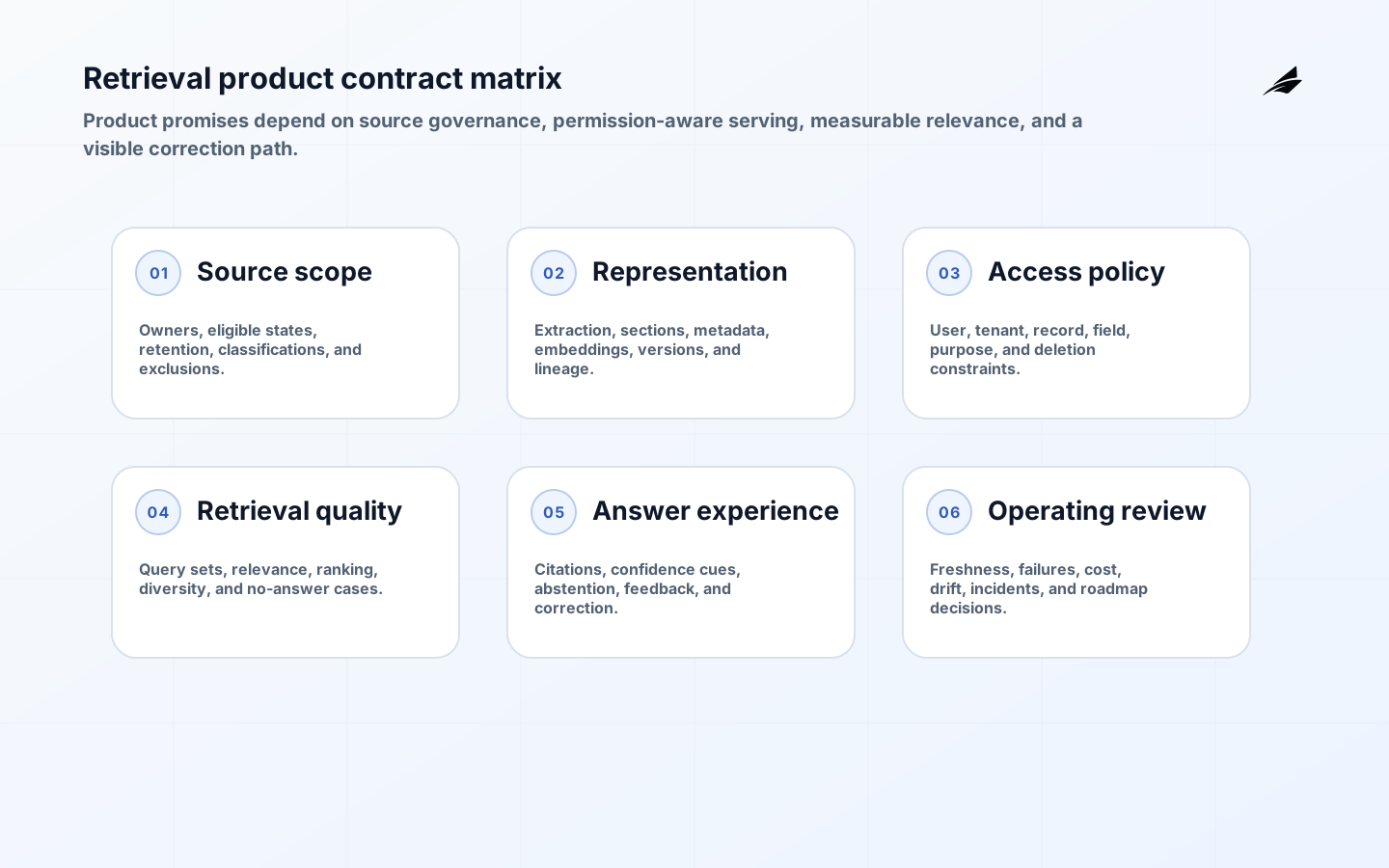
Retrieval pipelines for product teams are a product dependency: they decide which records can become evidence, how quickly changes appear, what a user is allowed to retrieve, and what the interface can cite when an answer is challenged. The visible search or AI experience may feel simple, but its quality depends on extraction, structure, metadata, permissions, indexing, query interpretation, ranking, context assembly, and deletion. Product ownership therefore extends beyond choosing a vector database or embedding model.
Define the retrieval product contract
Write a retrieval contract for one user task. Specify authoritative sources, eligible record states, freshness and deletion objectives, identity and tenant filters, expected query types, citation behavior, abstention, and the owner of corrections. The original retrieval-augmented generation paper introduced retrieval from explicit non-parametric memory partly to address provenance and updating limitations in parametric models. Product teams should preserve that inspectability by linking passages to the source record and version rather than presenting generated text as an independent authority.

Evaluate each layer separately before measuring the end-to-end answer. Ingestion tests should cover extraction, segmentation, metadata, duplicates, permissions, and deletion. Retrieval tests should measure whether relevant evidence appears and whether prohibited evidence never appears. Answer tests should measure support, citation correctness, usefulness, and safe abstention. OWASP’s RAG Security Cheat Sheet and vector and embedding guidance highlight poisoning and cross-context leakage. The NIST Generative AI Profile adds lifecycle risk-management context. Include difficult, ambiguous, stale, unauthorized, multilingual, and no-answer cases in the release set.
| Product promise | Pipeline obligation | Metric |
|---|---|---|
| Current evidence | Propagate source updates and deletions within a declared window. | Freshness lag and stale-result rate by source. |
| Authorized evidence | Apply identity, tenant, record, and field policy before context assembly. | Prohibited retrieval rate must remain zero in access tests. |
| Useful evidence | Retrieve enough relevant passages without drowning the model in noise. | Recall at k, ranking quality, answer support, and task success. |
| Inspectable evidence | Expose citations and a correction path tied to source ownership. | Citation validity, challenged-answer resolution, and correction time. |
Start With the retrieval pipelines Decision
Write the job in one sentence, then write the unacceptable outcome beside it. For retrieval pipelines, the operating question is not whether the technology is impressive; it is whether a named person can complete a bounded task with appropriate evidence and control. Adding documents until answers improve on a demo hides the hard work. A pipeline can be available while returning an old policy, omitting a table that changes the meaning, or exposing a result that should have been restricted to another team. The NIST AI Risk Management Framework supports this discipline by connecting intended context, measurement, governance, and management rather than treating risk as a late security review. How CTOs Should Think About Semantic Search is a useful adjacent reference, but it should not replace a local description of the decision owner and failure boundary.
| Decision element | Question to settle | Evidence to keep |
|---|---|---|
| User and outcome | Who uses retrieval pipelines, and what completed work changes for them? | A task definition, accountable owner, and a measurable acceptance condition. |
| Authority boundary | What may be read, drafted, proposed, submitted, or changed? | A policy rule, identity claim, approval record, and revocation path. |
| Failure response | What happens when evidence is absent, conflicting, stale, or unsafe? | A visible abstention, escalation route, and incident or correction record. |
Build an Evidence Boundary
Map each connector from source record to parser, normalizer, metadata store, index, query filter, and citation. At every handoff identify the system of record, owner, freshness target, identifier, and removal mechanism. Do not accept a collection without an accountable owner. This is where seemingly small implementation choices become operational commitments. A source link or event record must remain meaningful after a deployment, an employee role change, or a correction. The UK National Cyber Security Centre guidance emphasizes secure design, development, deployment, and operation as connected activities. Use that lifecycle view to assign an owner to the inputs, the policy, and the response when retrieval pipelines behaves unexpectedly.
- Name the source systems, people, and decisions that retrieval pipelines depend on; do not bury them in configuration alone.
- Classify information and actions by consequence, then choose controls that operate at the boundary where the consequence occurs.
- Keep an inspectable record of the input, material context, policy result, and output or side effect for cases that matter.
- Design a correction path that can remove or repair a bad record and tell an operator what work may have been affected.
- Practice the uncertain case. A system that can only handle happy-path inputs has not yet earned autonomy.
Put Controls Where They Can Enforce
Use idempotent ingestion, checksums or versions, quarantine for parsing failures, and a dead-letter path with a visible owner. Apply permissions from authoritative identity claims at query time, and make deletion, correction, and entitlement changes measurable service-level events. The OWASP guidance for LLM applications is particularly relevant when untrusted content can influence model behaviour or tool use: controls need to survive hostile and malformed inputs, not merely ordinary requests. For retrieval pipelines, prefer deterministic enforcement for identity, limits, destinations, schemas, and approvals. A model can help interpret context; it should not be the final authority for a rule that a service can verify directly.
| Control layer | What it protects | Practical test |
|---|---|---|
| Identity and access | The requester, source, and action scope. | Change membership or role and confirm the prohibited result remains unavailable. |
| Data and context | Currency, completeness, and permitted use of evidence. | Inject an obsolete, conflicting, or incomplete record and verify the response routes appropriately. |
| Action and recovery | Side effects, spend, external calls, and correction. | Force a validation failure or denied approval and confirm the state is safe and observable. |
Measure the Work, Not Just Uptime
Maintain a judged corpus and replay it before changes to parsers, chunking, rerankers, or connectors. Track ingestion lag, failed documents, duplicate rate, stale citations, retrieval quality by source class, and permission-filter test results. Keep a small, versioned evaluation set close to the workflow and add real failures after review. Distinguish service availability from decision quality: a system can have low latency and still provide the wrong evidence or trigger costly rework. Review results with the people who understand the task, then turn recurring failure patterns into a test, a source repair, a product change, or a tighter boundary.
Release in Bounded Steps
Ship one connector with a narrow question set first. A handbook collection with named owners is a better proving ground than a company-wide file share whose duplicates and permissions nobody can explain. Define a rollback condition before release, including who can disable the capability and how a human completes the work during recovery. Small launches are valuable when they are instrumented and reviewed; they are not a license to skip permissions, source checks, or error handling. Record the decision to expand with the same care as the initial decision to use retrieval pipelines.
Operate retrieval pipelines as a Living Service
Pipeline operations benefit from data-quality service levels that business owners can understand. Set a target for how quickly a changed record becomes searchable, how quickly a revoked entitlement takes effect, and how a failed parse is visible to the source owner. Sample documents with tables, images, headings, and unusual encodings because those are where a generic extractor tends to flatten meaning. When a collector changes, compare not only index counts but also document lineage and retrieval behaviour for the same judged queries. Require a plan for connector retirement, schema migration, and reprocessing before the next source is added. This keeps retrieval pipelines from accumulating invisible debt: each record has an origin, each transformation is explainable, and a correction can travel through the same path as the original data.
Keep Review Evidence Actionable
Publish an exception queue for records that fail parsing, lack an owner, or cannot carry required metadata. A visible queue prevents partial ingestion from becoming a hidden quality problem and gives product teams a clear path to resolve the most consequential defects first.
Assign Accountable Owners
Give every connector a service owner who can answer three questions quickly: what records entered, what records failed, and how a correction reaches the index. Pair that role with the business owner of the corpus. A technical team can restore a job, but only the source owner can decide whether a malformed or superseded record is acceptable evidence for a live workflow.
Key Takeaways
- Retrieval pipelines earn trust through a defined job and a named decision owner.
- Evidence, identity, and action boundaries must be explicit before a wider launch.
- Controls are strongest when enforced by deterministic services at the point of consequence.
- Evaluation should include difficult, absent, stale, and adversarial cases, not only successful examples.
- Expansion is a governed operating decision supported by outcomes, not a reward for a polished demo.
Frequently Asked Questions
A vector database is only one component of retrieval pipelines. In practice, source stewardship, parsing, metadata, identity, and evaluation usually decide whether the experience is trustworthy. The practical next step is to select one workflow, write its evidence and authority boundaries, and create a small set of cases a domain reviewer can judge. That produces much more useful learning than a broad rollout with no shared definition of success.
Conclusion
Retrieval pipelines become dependable when their operating constraints are visible: what they are for, what information they may use, what they may do, who can intervene, and how the organisation knows they are improving. Start with the consequential decision, preserve the evidence around it, and make uncertainty a safe state rather than something the system hides.