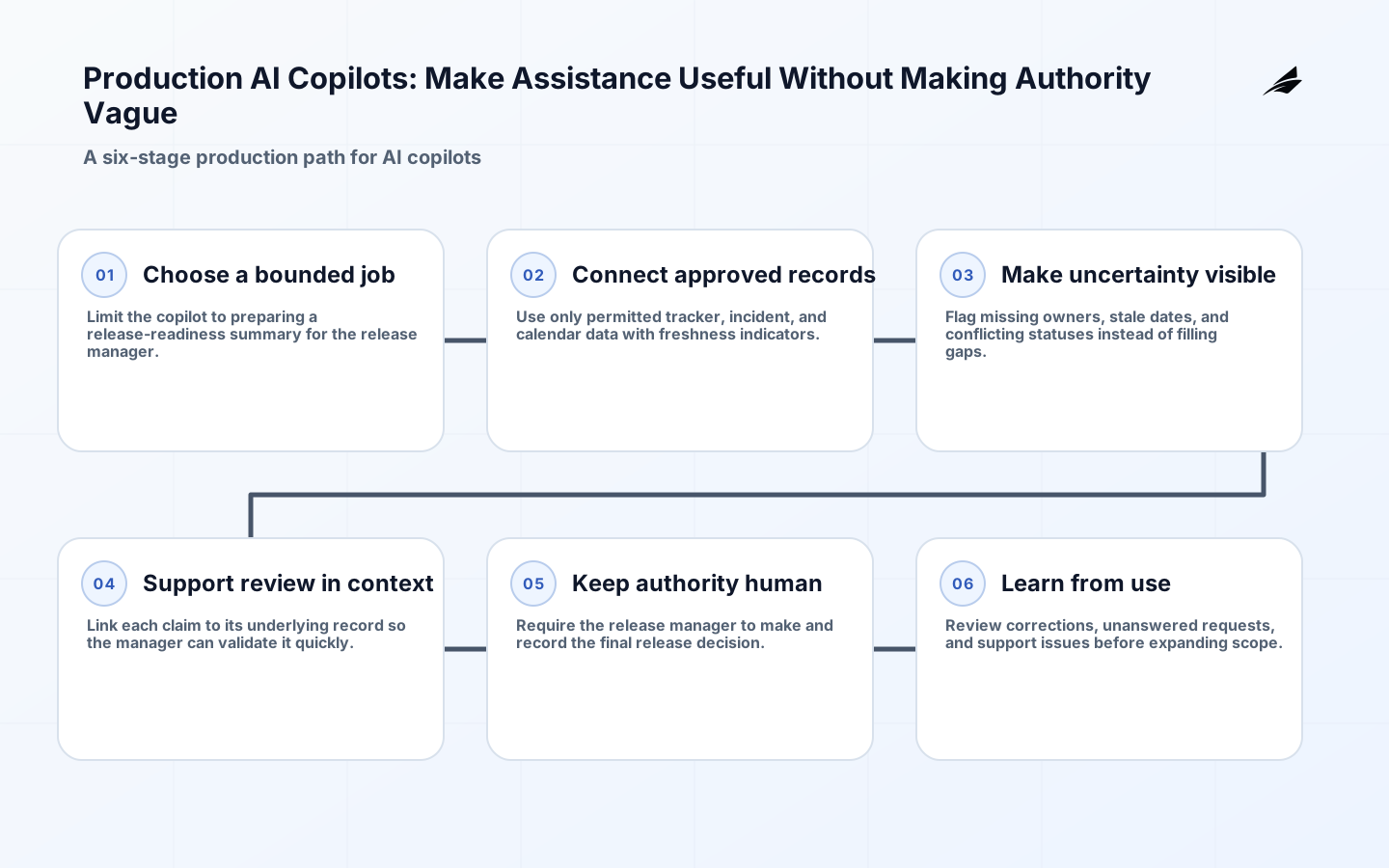
AI copilots changes character when it enters a live workflow. A prototype can look impressive while quietly relying on a builder's judgment, a forgiving test prompt, or records that will not be available to ordinary users. Production has different questions: who may use the capability, which record is authoritative, what happens when evidence is incomplete, and who can stop it. This guide uses a product operations copilot that prepares a release-readiness summary from approved work-tracking records as a concrete case. The goal is dependable assistance, not a theatrical display of automation. practical companion guide is useful background when the wider workflow needs a control model.
Set the production boundary for AI copilots
Begin with a short operating statement. In this case, the release tracker, incident register, and change calendar that teams already use is the system of record. The allowed inputs are approved project records, current status metadata, user role, and a defined summary template. The system may produce a draft release summary with linked records, missing-information prompts, and no implied approval. Crucially, the release manager owns the go or no-go decision and must resolve open risks. Put the excluded actions in writing as well: an omitted boundary is usually interpreted as permission during a busy incident. The AI Risk Management Framework organizes AI risk work around governing, mapping, measuring, and managing risk; that is a useful discipline here because the workflow, not the model alone, creates the outcome.

| Boundary question | Decision for this workflow | Evidence to retain |
|---|---|---|
| User and purpose | Support a product operations copilot that prepares a release-readiness summary from approved work-tracking records. | Named user role and process owner. |
| Authoritative record | the release tracker, incident register, and change calendar that teams already use | Record identifier, version, and access decision. |
| Permitted output | a draft release summary with linked records, missing-information prompts, and no implied approval | Example output and reviewer disposition. |
| Prohibited action | the release manager owns the go or no-go decision and must resolve open risks | Policy rule, escalation route, and audit event. |
Map the workflow and its evidence
Draw the current route before changing it. Mark where work enters, which facts are created or amended, where a person exercises judgment, and how an exception is closed. For a product operations copilot that prepares a release-readiness summary from approved work-tracking records, identify the record that supplies each important fact and the person who can correct it. The relevant question is not whether information can be reached; it is whether it is authorized, current, and interpretable in this decision. The Artificial Intelligence Risk Management Framework: Generative AI Profile calls attention to risks that emerge across the AI lifecycle, including confabulation, information integrity, and human-AI configuration. Those are practical prompts for a workflow map, not abstract compliance labels.
- Give every input a data owner, freshness expectation, and access rule before AI copilots consumes it.
- Preserve the source reference needed for a reviewer to verify a consequential claim or recommendation.
- Model ambiguity deliberately: missing records, conflicting values, and low-confidence results should have a route, not a hidden default.
- Keep the existing manual path usable until the new route has shown it can meet the stated operational threshold.
Design outputs for review, not just completion
A production interface should help a busy person see what the system used, what it recommends, and what remains unknown. With AI copilots, make the output a compact decision packet: a proposed result, the strongest evidence, exceptions, version information, and the next permitted action. Do not force a reviewer to reverse-engineer a fluent paragraph or search another application for the underlying record. When the system cannot support a claim, the correct behavior is to surface that gap and route it. A visible abstention is often more useful than a plausible answer that moves work in the wrong direction.
Separate model behavior from independent controls. In AI copilots, a model or retrieval component can create a candidate, but an application should enforce identity, authorization, schemas, business rules, and rate limits. This matters particularly where untrusted text can influence instructions or downstream requests. The OWASP Top 10 for Large Language Model Applications highlights prompt injection, sensitive-information disclosure, improper output handling, and excessive agency as application risks. Keep the checks that protect money, access, regulated data, or customer commitments outside the component that generates language.
Build AI copilots in narrow, observable increments
Start with one path that has enough volume to learn from but limited consequences when it is wrong. Baseline the current manual performance, then release behind a controlled audience or queue. Record the configuration version, the inputs actually used, the output, the reviewer decision, and any correction. That record lets the team distinguish a model change, a data change, a policy change, and a user-training issue. It also gives the product operations lead and release manager a concrete weekly review rather than a vague request to “watch the AI.” The Guidelines for Secure AI System Development is a useful reminder that secure AI development needs attention across design, development, deployment, and operation.
| Release stage | What to prove | Stop or expand decision |
|---|---|---|
| Offline review | Representative cases show the output has the required evidence and respects exclusions. | Hold when a material failure lacks a clear control. |
| Limited live use | Real users can review quickly and exceptions reach the right owner. | Expand only when the stated quality and support thresholds are met. |
| Controlled rollout | Signals remain stable across relevant request types and data conditions. | Pause when a material metric worsens or a new risk appears. |
| Routine operation | Owners can investigate, recover, and change the workflow without informal knowledge. | Reassess whenever scope, source data, or action authority changes. |
Evaluate the failure that matters
Evaluation of AI copilots should mimic the decision, not merely reward articulate output. Create a small but representative set of routine cases, ambiguous cases, missing-data cases, and high-impact exceptions. Specify expected handling before looking at the result. Then inspect results by meaningful slices, such as document type, user role, policy category, or integration state. A single aggregate score can conceal the very failure that an operator cares about. Ask reviewers to record why a result was accepted, corrected, rejected, or escalated; those reasons are much more actionable than a thumbs-up count.
- Use useful-summary rate, stale-reference reports, time saved after review, and support tickets by capability as operating signals, with a named owner and review cadence.
- Set a material-error definition in business terms before release, then make it a release blocker.
- Test negative cases and hostile or malformed inputs alongside routine examples.
- Re-evaluate after a change to models, prompts, sources, policies, access rules, integrations, or user population.
Give controls and escalation a human home
A useful control has an owner, a trigger, a decision, and a record. For AI copilots, the product operations lead and release manager should be able to answer who approves changes, who receives an exception, who can disable the capability, and where an investigation begins. Establish a normal operating rhythm: review material corrections, permission denials, user feedback, and new source changes. Make incident response specific. When a serious issue occurs, hide the affected capability, retain the underlying records, and return users to the established release checklist. Recovery must be rehearsed enough that it is possible under pressure, not merely described in an architecture diagram.
Operate with signals that lead to a decision
Do not collect telemetry simply because it is available. Each signal should connect to an operational question: Is the system helping? Is a protected boundary being challenged? Is quality shifting for a relevant group? Can the team reconstruct why a result appeared? For the example here, trend useful-summary rate, stale-reference reports, time saved after review, and support tickets by capability. Review samples alongside numerical signals, because a low-volume but serious error can be more important than an average. Keep the smallest data set that supports investigation, apply retention rules, and restrict access to operational records that may contain sensitive business context.
Key takeaways for AI copilots
- AI copilots is production-ready only when its business boundary and prohibited actions are explicit.
- Keep authorization, policy checks, and consequential approval outside generative behavior.
- Make evidence, uncertainty, and version information visible to the person accountable for the decision.
- Use representative evaluation and operating signals to decide whether to expand, pause, or recover.
- Treat corrections and incidents as inputs to the next test set and operating rule.
Frequently asked questions about AI copilots
What is the first production step for AI copilots?
Choose one repeatable decision with a named owner and a reliable existing process. For AI copilots, define the user, authoritative record, allowed inputs, output, excluded actions, and recovery route. That small statement prevents a pilot from becoming a general-purpose path before the team knows how to evaluate it.
Does human review make the workflow safe?
Not by itself. For AI copilots, review is useful when the reviewer has the authority, time, source evidence, and a meaningful choice. A person who sees only a polished recommendation, cannot inspect the underlying record, or is measured only on speed may become a rubber stamp. Build the review experience around the actual decision and capture corrections.
When should the team re-evaluate?
Re-evaluate AI copilots whenever the workflow’s scope changes: a new model, instruction, tool, data source, access policy, action, or user group can invalidate prior evidence. Also investigate a sustained shift in quality, unusual access denials, material corrections, or a change in the business policy that defines a correct outcome.
Conclusion
The production question for AI copilots is not whether it can generate a convincing result. It is whether the surrounding system can use that result responsibly on an ordinary Tuesday and recover on a difficult one. Start with a bounded job, preserve evidence, retain independent controls, measure the failures that matter, and give people clear authority to pause or correct the workflow. That is how AI automation becomes operationally useful rather than merely novel.