Vector search for AI automation retrieves items whose numerical representations are close to a query representation. It can find semantically related language even when exact words differ, making it useful for knowledge assistants, document triage, recommendation and retrieval-augmented generation. Similarity is not truth, permission or business relevance. A production design must combine embeddings with document structure, metadata, lexical evidence, authorization, evaluation and a correction process.
Begin with the retrieval decision: what item must be found, for which user and downstream task, within which latency and error tolerance? A support answer needs a current, permitted policy passage; duplicate detection needs a candidate set for human review; routing needs the correct class and escalation. Use Edilec's related guides to RAG systems, embeddings and document intelligence to connect retrieval with generation and document processing.
Define the retrieval unit and relevance
Choose what the index returns: whole document, section, paragraph, message, product, image region or event. The unit should carry enough context to be useful and remain small enough to rank precisely. For long documents, chunk along semantic and structural boundaries such as headings, clauses or procedures. Preserve parent document, section path, page or timestamp, source authority, version, permissions and stable identifier. Overlapping fixed windows are easy to implement but can duplicate results, split tables and mix unrelated concepts.
Define relevance from the user's task, not from embedding distance. A document can be semantically similar yet obsolete, unauthoritative, in the wrong jurisdiction or about a different product version. Write graded judgments such as directly answers, useful context, weakly related and harmful distraction. Include cases where no result should be returned. For automation, label whether a result is safe for display, safe as model context, or sufficient to support an action. Those thresholds may differ.
| Use case | Retrieval unit | Critical relevance condition |
|---|---|---|
| Policy assistant | Versioned clause or section | Current, applicable and permissioned |
| Support similarity | Resolved case summary | Same product, symptom and resolution context |
| Document routing | Document or page | Correct class with escalation for ambiguity |
| Product recommendation | Product or variant | Eligible, available and suitable constraints |
| Code search | Function, symbol or documentation block | Repository, language and version match |
| Duplicate detection | Record or media item | High recall with reviewable evidence |
Build a governed ingestion contract
Indexing begins with source authority and lifecycle. Record how content is discovered, parsed, normalized, chunked, embedded, versioned and deleted. Reject or quarantine unreadable and unsupported content rather than silently indexing an empty body. Preserve source and transformation checksums so operators can identify what changed. Keep the original text available for display and citation; vectors alone are not a human-auditable record. Protect the ingestion path because poisoned documents can influence every later answer.
Permissions and metadata belong in the indexing contract. Store tenant, owner, classification, effective date, language, product, jurisdiction and lifecycle state where they affect retrieval. Decide which filters are mandatory and which are ranking features. Propagate source permission changes and deletions to every index and cache within a defined objective. Re-embedding creates a new retrieval version; keep enough metadata to compare and roll back. Avoid combining embeddings from incompatible models in one field unless the system deliberately handles separate spaces.
Combine lexical and vector retrieval
Lexical search is strong for exact identifiers, error codes, names and rare terms. Vector search is strong for paraphrase and conceptual similarity. Hybrid retrieval often produces a better candidate set by combining both. OpenSearch hybrid search documentation describes score normalization and rank-based fusion approaches; Elasticsearch vector search supports vector, text, filters and hybrid retrieval. The implementation choice matters less than evaluating the fusion on real queries.
Scores from different retrieval methods are not directly comparable. Normalize, weight or use reciprocal rank fusion, then tune with a fixed evaluation set. Apply mandatory authorization and eligibility filters before a result can enter downstream context. Approximate nearest-neighbor indexes trade recall, latency and memory; parameters must be tested at expected corpus size and filter selectivity. A fast index that loses the only applicable policy document is not a useful optimization.
- Preserve exact-match retrieval for identifiers, codes and quoted phrases.
- Use vector candidates for paraphrase and conceptual similarity.
- Apply tenant and record permissions before results leave retrieval.
- Rerank only a bounded candidate set with measured latency and value.
- Diversify repeated chunks from the same parent when context breadth matters.
- Return no result when evidence does not meet the task threshold.
Apply filters, reranking and context assembly
Pre-filtering prevents ineligible records from competing and is usually required for authorization. Post-filtering can produce too few results or leak aggregate signals if an unauthorized candidate influenced ranking. Verify the search engine's behavior under selective filters and approximate indexes. Keep authorization in a trusted service rather than allowing a model to invent filter expressions. Log the effective filter policy without exposing sensitive values to ordinary analytics.
A reranker can consider the query and candidate text more deeply, but it adds latency, cost and another model version. Measure whether it improves task-level results, not only a generic benchmark. Context assembly may merge adjacent sections, remove duplicate chunks and enforce token budgets. Preserve source boundaries and order. Do not concatenate content from different tenants, versions or conflicting policies merely because the chunks are individually relevant. For RAG, the generator should receive citation identifiers that resolve to the exact retrieved version.
| Failure pattern | Likely cause | Correction |
|---|---|---|
| Exact code not found | Vector-only retrieval | Add lexical candidate and exact-field boost |
| Many repeated passages | Chunk overlap dominates top results | Deduplicate and diversify by parent |
| Wrong product version | Missing lifecycle metadata | Filter or boost current applicable version |
| Unauthorized result | Permissions applied after retrieval | Enforce pre-filter at trusted boundary |
| Broad but shallow context | Chunks too small or unrelated | Merge structural neighbors with limits |
| Good benchmark, poor users | Test queries do not represent workflow | Rebuild judgments from production task categories |
Evaluate retrieval independently and end to end
Create a query set across intents, languages, short and long phrasing, rare identifiers, ambiguous requests, denied records and no-answer cases. Have domain reviewers judge candidates. Measure recall at a candidate cutoff when missing a relevant item is costly, precision when irrelevant context creates harm, ranking metrics for order, and coverage by query class. The BEIR benchmark demonstrates that retrieval performance varies across heterogeneous tasks; local evaluation remains essential.
Evaluate the downstream workflow separately. Better retrieval metrics may not improve answer accuracy if the generator ignores evidence, and a lower retrieval score may be acceptable if human review remains effective. Record grounded answer rate, citation support, user correction, successful resolution and harmful confident answers. Compare lexical, vector and hybrid baselines. Review regressions by query segment after changing embedding model, chunking, index parameters, fusion, reranker or corpus.
Operate freshness, cost and failure
Monitor source-to-index delay, parse failures, embedding failures, permission lag, deletion lag, index size, query latency, candidate counts, filter selectivity, empty results and retrieval version. Distinguish a healthy search endpoint from a healthy corpus. Alert when a material source stops updating or a permission feed lags. Provide an index inventory and a rebuild path. Blue-green or versioned indexes make model and schema migrations safer because traffic can shift back after evaluation.
Plan dependency failure. If embedding generation is unavailable, queue ingestion without losing source events. If vector search is unavailable, a lexical fallback may serve exact lookup with a visible degraded state. If authorization cannot be evaluated, fail closed for protected records. Limit query and reranking budgets, cache only under correct user and version keys, and protect search from unbounded input. pgvector and PostgreSQL full-text search can support a compact combined stack, but operational fit should be tested rather than assumed from product category.
Use a traceable retrieval flow
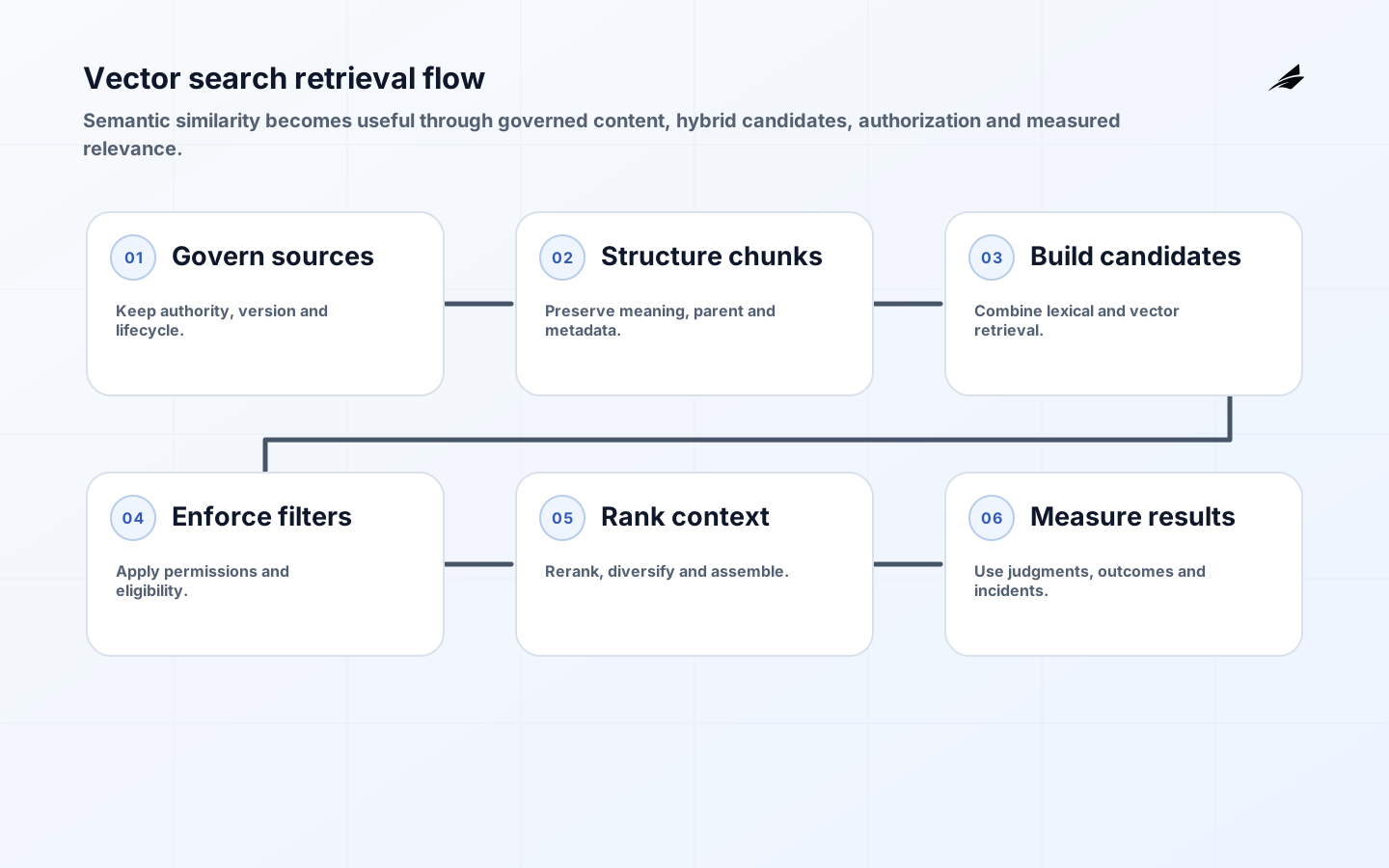
The diagram follows governed source content into structured chunks and embeddings, then combines lexical and vector candidates, applies mandatory filters, reranks and assembles context, and feeds judgments and operating signals back into the next version. Each stage has an identifier and owner. That trace allows a team to explain why a result appeared and determine whether a defect came from source content, parsing, model representation, filtering, ranking or downstream use.

Expose that trace selectively to support and domain reviewers. A practical investigation view shows the normalized query, effective filters, candidate sources, ranks, selected passages, corpus version and downstream result without revealing records the reviewer cannot access. This shortens relevance debugging and keeps tuning grounded in specific, reproducible failures rather than guesses about the embedding model.
Key takeaways
- Define the retrieval unit and relevance from the downstream decision.
- Preserve source, structure, lifecycle, permissions and transformation version during ingestion.
- Combine lexical precision and vector similarity where evaluation supports it.
- Enforce authorization and eligibility before results reach models or users.
- Measure retrieval by query class and then measure the complete workflow.
- Operate freshness, deletion, migration, cost and fallback as production concerns.
Frequently asked questions
Do we need a dedicated vector database?
Not always. Existing search or relational platforms may meet corpus, filtering and latency needs. Choose from measured scale, operational ownership, hybrid retrieval, backup and authorization requirements rather than the label.
What is the best chunk size?
There is no universal size. Start from document structure and the evidence a user needs, then evaluate alternatives. Preserve parent context and avoid splitting tables, procedures and clauses without a reconstruction path.
Is a high cosine score proof of relevance?
No. It indicates closeness in one embedding space. Applicability, authority, freshness, permission and task relevance require metadata, policy and evaluation beyond the similarity value.
Conclusion
Vector search is valuable when semantic similarity is treated as one signal in a governed retrieval system. Define useful units, preserve authority and lifecycle, combine retrieval methods deliberately, enforce permissions, evaluate representative queries and observe corpus health. The result gives AI automation relevant evidence without confusing nearest neighbors with correct or authorized answers.