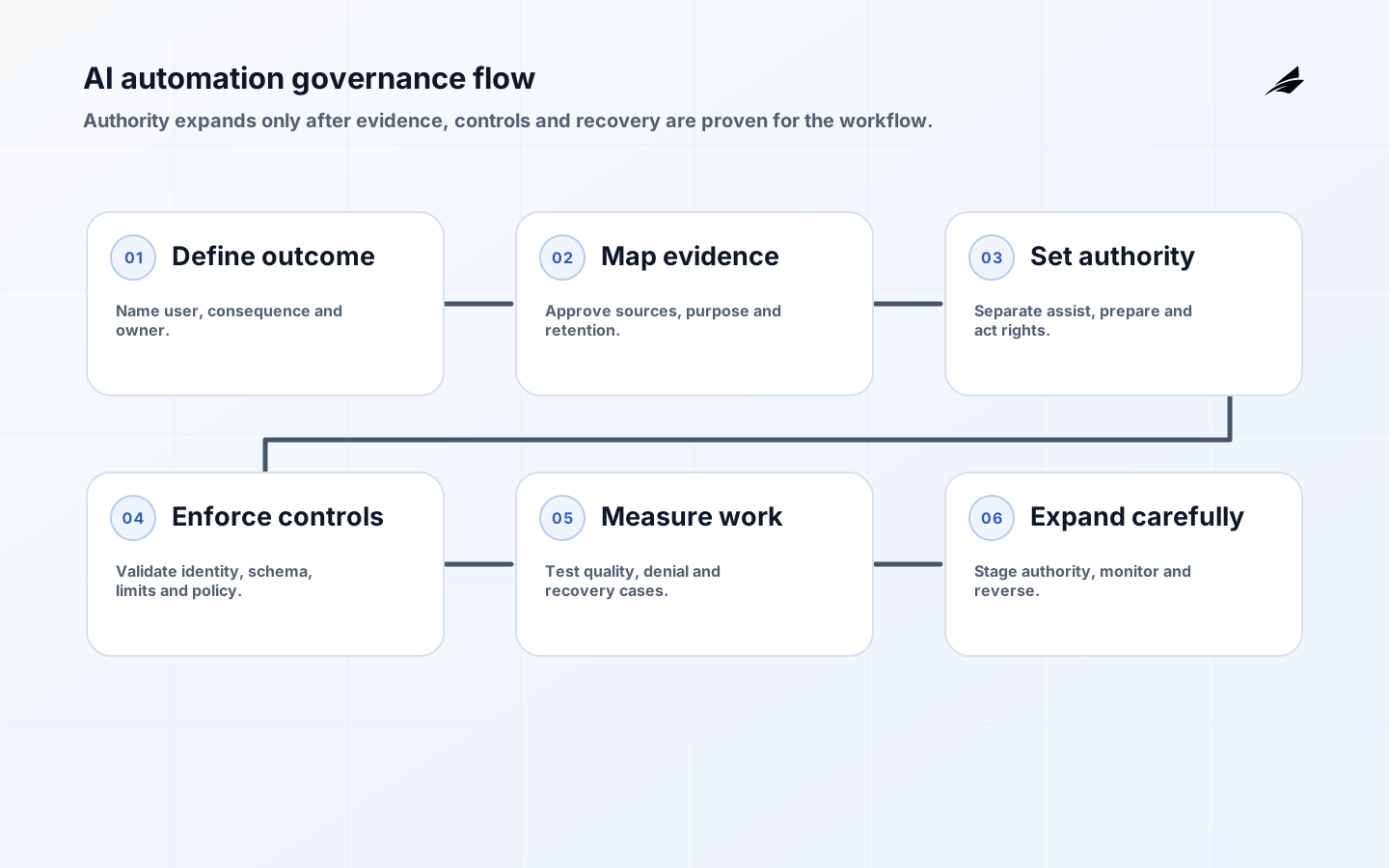
AI guardrails for automation are the policy, technical and operating controls that keep an AI-enabled workflow within its intended purpose and authority. Product teams should begin with the consequence: who is affected, what evidence supports the task, which actions remain human decisions and how the service recovers when confidence or a dependency fails. A guardrail can be a permission boundary, input rule, approved source, schema check, review gate, transaction limit, monitoring signal or disable path. No single filter makes a system safe. The useful design is a layered operating model that remains effective when the model is mistaken, manipulated, changed or unavailable.
For connected implementation decisions, see Tool Calling for AI Automation, AI Workflow Approvals for AI Automation, LLM Observability for AI Automation, and Human-in-the-loop Automation for AI Automation. These guides are most useful when their controls are adapted to the same records, owners and consequences rather than applied as independent checklists.
Match guardrails to workflow consequence
Classify the capability as assist, prepare or act. An assistant that summarizes approved text can usually operate with no side effect; a service that prepares a transaction needs schema and review; a service that executes requires current authorization, transaction limits, confirmation and recovery. The NIST AI RMF organizes work through Govern, Map, Measure and Manage, while the Generative AI Profile applies that lifecycle to risks such as confabulation, data privacy, information integrity and human-AI configuration. Convert those concerns into owners, tests and release evidence for this particular workflow.
Security remains a product responsibility across the lifecycle. The NCSC secure AI guidelines address design, development, deployment, operation and maintenance. The OWASP GenAI Top 10 highlights prompt injection, improper output handling and excessive agency; mitigate them with untrusted-input separation, minimum tool functionality, minimum permissions and minimum autonomy. Use consistent observability concepts from OpenTelemetry semantic conventions while limiting sensitive prompt and response capture.
Define the AI guardrails Decision
Classify the workflow by consequence and reversibility before choosing safeguards. Drafting an internal note has a different boundary from changing a customer record or approving a payment. Name what the assistant may read, propose, submit, or execute, then list the prohibited outcomes. This is the practical version of risk mapping: a team can only test a limit when it has stated who owns the decision and where the consequence occurs. In practice, write the acceptance condition in the language of the work: what a user can complete, what evidence they can inspect, and what the system must never do. The relevant adjacent guides are tool calling guide, AI workflow approvals guide, LLM observability guide; each is useful when it clarifies a component of the workflow rather than substituting for a local decision boundary.
| Workflow level | Useful autonomy | Required boundary |
|---|---|---|
| Assist | Draft or summarize for a user. | No direct side effect; cite evidence and label uncertainty. |
| Prepare | Create a structured proposal or tool request. | Schema validation and accountable human approval. |
| Act | Write to a business system or contact an external party. | Least privilege, server-side policy, logs, and rollback. |
Design the Evidence and System Boundary
Put a policy layer around model use rather than treating the model as the policy engine. Separate request classification, sensitive-data handling, tool selection, argument validation, approval, and delivery. The Agents SDK documentation describes agents as systems that combine model behavior with tools and handoffs; that architecture is a reason to make each handoff explicit. A model can interpret ambiguous language, while services enforce schemas, scopes, amounts, destinations, and approvals. The OpenAI Agents SDK Guide is a useful technical reference, but implementation should remain accountable to the organization’s own sources, users, and consequences. Keep a short decision record for material design choices so later reviewers can understand why a source, tool, model route, or review gate was included.
- Name the user, outcome, and accountable owner for the AI guardrails workflow.
- Keep the authoritative source or system of record available to the user and reviewer.
- Make uncertainty, denial, and incomplete evidence visible states rather than silent failures.
- Record the versioned configuration that materially changes a result or action.
- Give operators a documented way to pause, correct, and recover affected work.
Put Controls at the Point of Consequence
Use allowlisted tools with narrowly scoped credentials, validate every tool argument against server-side rules, and require a fresh authorization decision at the execution boundary. Sanitize output before it reaches a browser, database, shell, or downstream API. OWASP identifies prompt injection and improper output handling as material LLM application risks. Treat retrieved text, attachments, web content, and user instructions as untrusted inputs that never gain authority merely by being included in context. The OWASP Top 10 for LLM applications should inform threat modeling, while the NCSC secure AI guidance helps connect those controls to design, deployment, and ongoing operation. The practical rule is simple: use a model to interpret context where it helps, but use deterministic enforcement for identity, permissions, schemas, destinations, and irreversible transactions.
| Guardrail point | Control | Evidence |
|---|---|---|
| Before the model | Classify request and minimize context. | Authorization decision and data category. |
| At the tool | Allowlist operation and validate arguments. | Tool name, scope, validation result, and actor. |
| After the action | Confirm outcome and expose recovery. | Transaction reference, user notice, and incident link. |
Measure Work Quality and Failure
Test guardrails with representative normal requests and deliberate failures: conflicting instructions, malformed arguments, restricted records, expired permissions, unusual volumes, and an unavailable dependency. Capture whether the system stopped safely, what it showed the user, and whether the trace exposes enough detail to investigate without retaining unnecessary sensitive content. A blocked action is successful only when the operator can understand the reason and recover through a defined path. Do not collapse these signals into a single “accuracy” number. A production decision needs both quality and control evidence: the right result for the right person, at an acceptable time, with a response that remains safe when the evidence is weak. Put reviewed failures into the next evaluation set and classify whether the correction belongs in the source, interface, workflow, model configuration, or policy.
Release in Bounded Steps
Release one capability at a time. Begin with a read-only or draft-only workflow, exercise the exception path with the people who own it, then expand authority after evidence shows the controls are operating. Pair every spending, communication, or write privilege with a named approver and a revocation method. The NCSC secure-development guidance supports this lifecycle view: secure design, deployment, and operations all matter when models connect to real systems. A small release is valuable when it is instrumented, reviewed, and reversible. It is not a waiver for access control, evaluation, or incident preparation. Use the early evidence to decide whether to expand, redesign, hold the boundary, or stop; all four can be rational outcomes when they protect users and the organization.
Operate AI guardrails as a Living Service
Review policy denials, tool-call failures, approval overrides, and attempted unsafe actions as product feedback. Some patterns reveal an unclear user experience; others reveal a rule that belongs in a deterministic service. Reassess tool scopes when roles, systems, or workflows change. Guardrails are credible when they are exercised during ordinary releases and incident response, not only described in an architecture review. Keep a change log that links a release to the affected workflow, test evidence, owner, rollout date, and rollback condition. That record makes it possible to distinguish a genuine improvement from a silent shift in policy interpretation or user experience.
Assign Accountable Owners
The AI guardrails workflow needs clear ownership across product, source or data stewardship, identity and security, and day-to-day operations. The product owner accepts the workflow trade-off; the source owner defines what is authoritative; the platform owner keeps the system reliable; and the risk or security owner helps test the boundaries. Shared review is important because an incident often crosses these responsibilities. Ownership should be visible in the runbook, release decision, and escalation route, not inferred after a problem.
Review Changes With the People Who Own the Work
Run a guardrail review after every material tool, data-source, or policy change. Ask whether the new path adds a privilege, changes the meaning of an approval, or creates a new route for untrusted content to reach an action. Include product, security, and workflow owners in the review. That small discipline catches the common failure where an individually reasonable integration quietly changes the authority of the whole system.
Govern an invoice exception assistant
An accounts-payable assistant compares an invoice with a purchase order and receipt. It may explain a mismatch and prepare a resolution, but only a finance owner can approve a material exception. The service retrieves records using the employee’s current entitlements, keeps supplier text separate from system instructions and returns a structured comparison with evidence IDs. Deterministic rules verify currency, amount, supplier, duplicate status and approval threshold. The model cannot add a supplier, change payment details or mark the invoice approved because those operations are absent from its tool set.

The rollout begins in shadow mode, comparing proposals with final human decisions. Product and risk owners review false matches, unsupported explanations, missed duplicates, abstentions, review time and user corrections. When quality is stable, the service may prepare a draft exception for exact-record approval. A later execution right should be considered separately and receive its own limits, approval and recovery test. If a source is unavailable or an evaluation threshold degrades, the capability falls back to the existing queue. This graduated authority gives leaders evidence for each expansion instead of treating the first demonstration as permission for full automation.
| Authority tier | Permitted behavior | Evidence required to expand |
|---|---|---|
| Observe | Compare cases without user-visible output | Representative baseline and failure taxonomy |
| Assist | Summarize or explain approved evidence | Citation quality, abstention and user correction |
| Prepare | Create a structured draft with no effect | Schema validity and exact-record review |
| Act with approval | Execute the transaction a person confirmed | Fresh authorization, receipt and reversal test |
| Bounded autonomy | Handle low-consequence cases within limits | Stable outcomes, incidents, drift and kill-switch rehearsal |
Key Takeaways
- AI guardrails should start with one bounded decision and a named owner.
- Evidence, authorization, and action scope must be explicit before wider adoption.
- Controls are strongest when a service can enforce them at the actual boundary.
- Evaluation needs difficult, absent, stale, and adversarial cases as well as normal work.
- Expansion is a governed operating decision supported by outcomes, not a reward for a convincing demo.
Frequently Asked Questions
Guardrails do not make a language model perfectly reliable or remove residual prompt-injection risk. Their purpose is to contain consequences: restrict data, tools, and destinations; validate actions independently; make approvals visible; and preserve evidence for recovery. The safest first use case has a small action surface and a clear human owner. The sensible next step is to select a workflow with available evidence, clear ownership, and a recoverable outcome, then make a small evaluation set that domain reviewers can judge. That produces better information than a broad launch whose success criteria are unclear.
Conclusion
AI guardrails work when the decisive checks live where actions happen. Build them as enforceable system behavior, then test the awkward cases that a polished demonstration rarely reaches. The durable pattern is to make the job, evidence, authority, controls, and learning loop visible enough for people to inspect and improve.