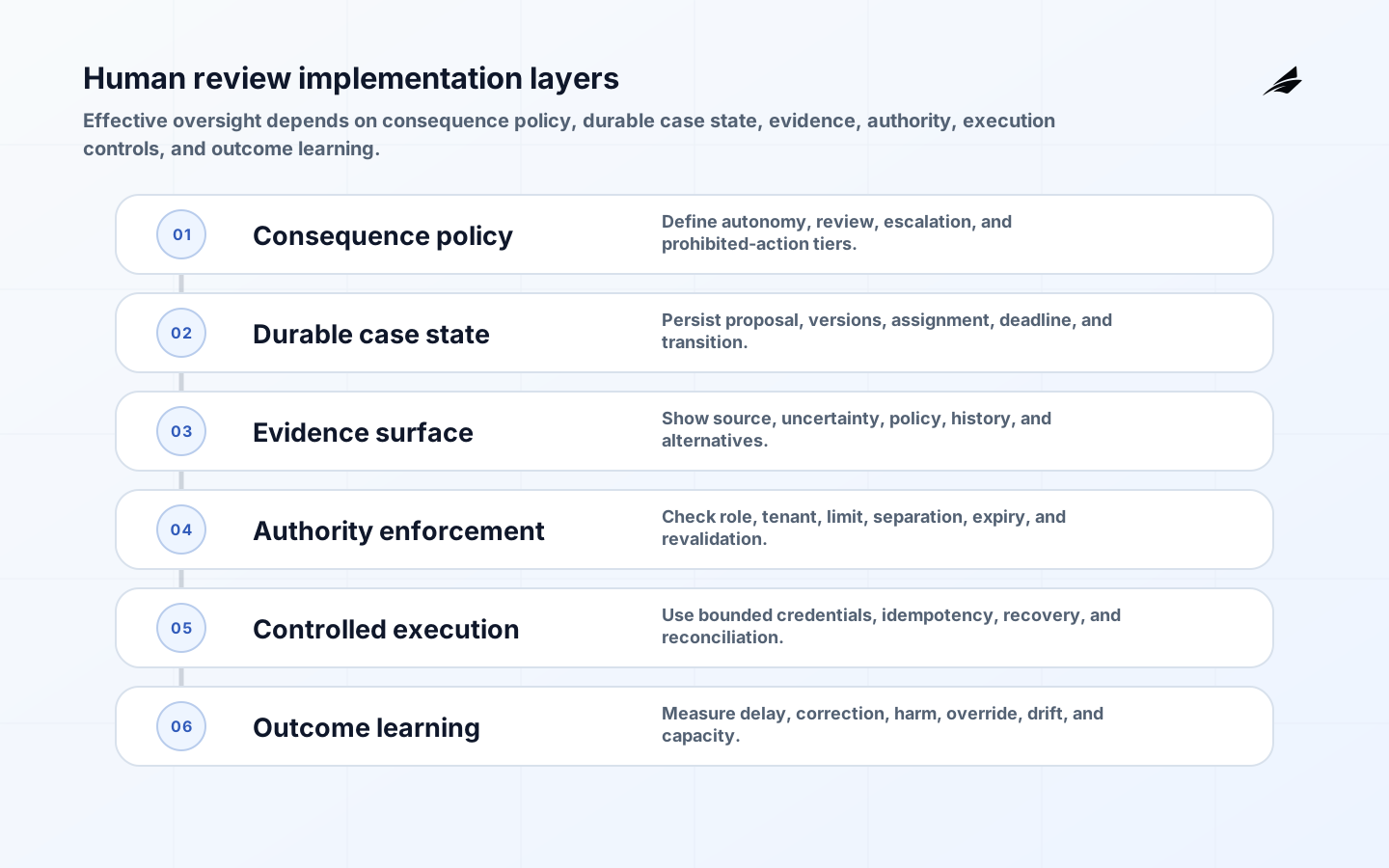
Human-in-the-loop automation implementation begins with decisions that cannot safely be delegated end to end. The human role must be specific: inspect evidence, resolve ambiguity, apply policy, exercise delegated authority, or handle an exception. A person who only confirms a preselected answer under time pressure is not an effective control. The system needs explicit consequence tiers, review states, evidence bundles, role and limit checks, service targets, fallback behavior, and an outcome record that can improve future decisions. This practical guide moves from architecture to rollout, showing how IT managers can build a review workflow that remains useful when volume rises, dependencies fail, and the model or business policy changes.
The implementation uses the lifecycle actions in the NIST Generative AI Profile, the NCSC secure AI system development guidelines, the OWASP Top 10 for LLM applications, and the NIST AI RMF resources. Related Edilec guides explain AI workflow approvals, LLM observability, and production AI guardrails.
Define the human-in-the-loop automation Decision
Choose review points from consequence, uncertainty, reversibility, and the cost of delay. A model may sort routine intake, propose fields, or prepare a response; a specialist may approve a high-value exception, safety-sensitive recommendation, or external commitment. Define the handoff in operational terms: which cases route to whom, what information the reviewer sees, what response time is expected, and what happens if nobody acts. This avoids queues that quietly turn into unowned risk. In practice, write the acceptance condition in the language of the work: what a user can complete, what evidence they can inspect, and what the system must never do. The relevant adjacent guides are AI workflow approvals guide, AI copilots guide, LLM observability guide; each is useful when it clarifies a component of the workflow rather than substituting for a local decision boundary.
| Case characteristic | Routing choice | Reviewer needs |
|---|---|---|
| Routine and reversible | Automate with sampled review. | Outcome status and an easy correction path. |
| Ambiguous or policy-bound | Require specialist review before action. | Source evidence, policy version, and rationale field. |
| High-impact or irreversible | Require accountable approval and dual control where appropriate. | Authority check, full context, and rollback plan. |
Design the Evidence and System Boundary
Design the review surface as carefully as the model interaction. Show the original request, relevant sources, model proposal, confidence or uncertainty signals, policy result, prior actions, and choices available to the reviewer. The NIST Generative AI Profile emphasizes documenting context and measuring risks throughout the lifecycle. For a reviewer, that becomes a clear explanation of what evidence was used and what remains uncertain, rather than an opaque score that demands blind trust. The AI Risk Management Framework: Generative AI Profile is a useful technical reference, but implementation should remain accountable to the organization’s own sources, users, and consequences. Keep a short decision record for material design choices so later reviewers can understand why a source, tool, model route, or review gate was included.

- Name the user, outcome, and accountable owner for the human-in-the-loop automation workflow.
- Keep the authoritative source or system of record available to the user and reviewer.
- Make uncertainty, denial, and incomplete evidence visible states rather than silent failures.
- Record the versioned configuration that materially changes a result or action.
- Give operators a documented way to pause, correct, and recover affected work.
Put Controls at the Point of Consequence
Use role-based routing, separation of duties, and time-bounded approvals. A reviewer should not approve a transaction outside their delegated amount or override a safety rule without an auditable reason. Preserve edits and the rationale, but do not mistake a click for meaningful oversight. Controls should detect rubber-stamping, excessive queue age, duplicate review, and escalation failures. The NCSC recommends integrating AI work into secure development and operations, including incident management and monitoring after deployment. The OWASP Top 10 for LLM applications should inform threat modeling, while the NCSC secure AI guidance helps connect those controls to design, deployment, and ongoing operation. The practical rule is simple: use a model to interpret context where it helps, but use deterministic enforcement for identity, permissions, schemas, destinations, and irreversible transactions.
| Review signal | Why it matters | Response |
|---|---|---|
| Queue age | Delayed judgment can become a service failure. | Rebalance work, narrow intake, or provide a safe fallback. |
| Override rate | Shows disagreement or weak proposals. | Sample reasons and adjust rules, data, or routing. |
| Outcome error | Connects approval to real-world effects. | Correct affected cases and update evaluation coverage. |
Measure Work Quality and Failure
Evaluate the whole human-and-system loop. Measure decision accuracy by case segment, correction rate, review time, queue age, override patterns, missed escalations, and downstream outcomes. Include ambiguous and adversarial cases in testing because a review process is most valuable when the system is unsure or the policy is contested. Compare review quality with the existing manual process, not only with the model proposal, so automation does not hide a deterioration in service. Do not collapse these signals into a single “accuracy” number. A production decision needs both quality and control evidence: the right result for the right person, at an acceptable time, with a response that remains safe when the evidence is weak. Put reviewed failures into the next evaluation set and classify whether the correction belongs in the source, interface, workflow, model configuration, or policy.
Release in Bounded Steps
Pilot with a small reviewer group and a workflow whose consequences are understandable. Run in shadow mode or draft-only mode, rehearse unavailable-reviewer and system-outage paths, and agree on service levels before increasing volume. Feed recurring reviewer edits back into product rules, source repair, training examples, or routing criteria. Do not turn those edits automatically into model learning without checking privacy, quality, and representativeness. A small release is valuable when it is instrumented, reviewed, and reversible. It is not a waiver for access control, evaluation, or incident preparation. Use the early evidence to decide whether to expand, redesign, hold the boundary, or stop; all four can be rational outcomes when they protect users and the organization.
Operate human-in-the-loop automation as a Living Service
Review the queue with the business owner and the people doing the review. A growing exception rate may mean the boundary is too broad, source data is poor, or the workflow needs another deterministic rule. A very low override rate can mean the system is well calibrated, but it can also mean reviewers lack time or confidence to challenge it. Keep the distinction visible through sampling and outcome review. Keep a change log that links a release to the affected workflow, test evidence, owner, rollout date, and rollback condition. That record makes it possible to distinguish a genuine improvement from a silent shift in policy interpretation or user experience.
Assign Accountable Owners
The human-in-the-loop automation workflow needs clear ownership across product, source or data stewardship, identity and security, and day-to-day operations. The product owner accepts the workflow trade-off; the source owner defines what is authoritative; the platform owner keeps the system reliable; and the risk or security owner helps test the boundaries. Shared review is important because an incident often crosses these responsibilities. Ownership should be visible in the runbook, release decision, and escalation route, not inferred after a problem.
Review Changes With the People Who Own the Work
Treat reviewer experience as an operating signal. If a queue becomes slow, people may develop workarounds; if the evidence is unclear, they may accept a proposal simply to move work forward. Interview reviewers, sample decisions, and compare their stated rationale with logged behavior. Changes to routing thresholds or reviewer authority should be released and evaluated like any other production change because they alter the practical control boundary.
Implement review as an explicit state machine
Represent review in workflow state rather than a transient modal. A case can move from proposed to awaiting-review, assigned, approved, rejected, correction-requested, expired, escalated, executing, reconciled, or failed. Each transition should name who can perform it, the evidence required, the deadline, the next system action, and whether the transition is reversible. Store the policy and configuration version that produced the proposal so a reviewer can understand it after a later release. Prevent an old browser tab from approving a case whose source or state has changed by checking a version or state token at commit time. These details turn human oversight into dependable distributed-systems behavior.
Design for unavailable people and unavailable services. If the assigned reviewer is absent, route according to delegated authority rather than to any available administrator. If the evidence source is stale, pause or expose the limitation instead of presenting the proposal as complete. If the downstream transaction fails after approval, retain approval context but do not assume it remains valid forever; define an expiry and revalidation rule. NIST’s AI RMF Core calls for documented human-AI roles, while the NCSC secure AI guidance connects secure operation to monitoring and incident management across the lifecycle. The implementation should therefore include queue telemetry, access reviews, release tests, incident playbooks, and a way to suspend automation without losing in-flight cases.
| Review state | Required system behaviour | Control evidence |
|---|---|---|
| Awaiting review | Freeze the proposed version and calculate deadline | Case, model/configuration, source and policy versions |
| Assigned | Route to qualified role with delegated scope | Reviewer identity, assignment and service target |
| Approved or rejected | Validate current state and capture meaningful rationale | Decision, authority, edits and timestamp |
| Expired or escalated | Block stale action and move to defined fallback | Expiry rule, route and notification |
| Executing | Use bounded credentials and idempotent transaction | Approval reference, request key and dependency status |
| Reconciled or failed | Confirm outcome, compensate or reopen the case | Authoritative result, correction and closure owner |
Key Takeaways
- Human-in-the-loop automation should start with one bounded decision and a named owner.
- Evidence, authorization, and action scope must be explicit before wider adoption.
- Controls are strongest when a service can enforce them at the actual boundary.
- Evaluation needs difficult, absent, stale, and adversarial cases as well as normal work.
- Expansion is a governed operating decision supported by outcomes, not a reward for a convincing demo.
Frequently Asked Questions
A human in the loop is needed when the decision carries material impact, policy interpretation, unusual context, or a nontrivial recovery burden. Lower-risk work can be automated more deeply when it remains observable and reversible. The point is proportional oversight: give people authority where human judgment changes the outcome, rather than asking them to rubber-stamp every routine case. The sensible next step is to select a workflow with available evidence, clear ownership, and a recoverable outcome, then make a small evaluation set that domain reviewers can judge. That produces better information than a broad launch whose success criteria are unclear.
Conclusion
Human-in-the-loop automation earns its name when the reviewer can see, challenge, and change the work. Build the queue, evidence, authority, and escalation path as first-class parts of the system. The durable pattern is to make the job, evidence, authority, controls, and learning loop visible enough for people to inspect and improve.