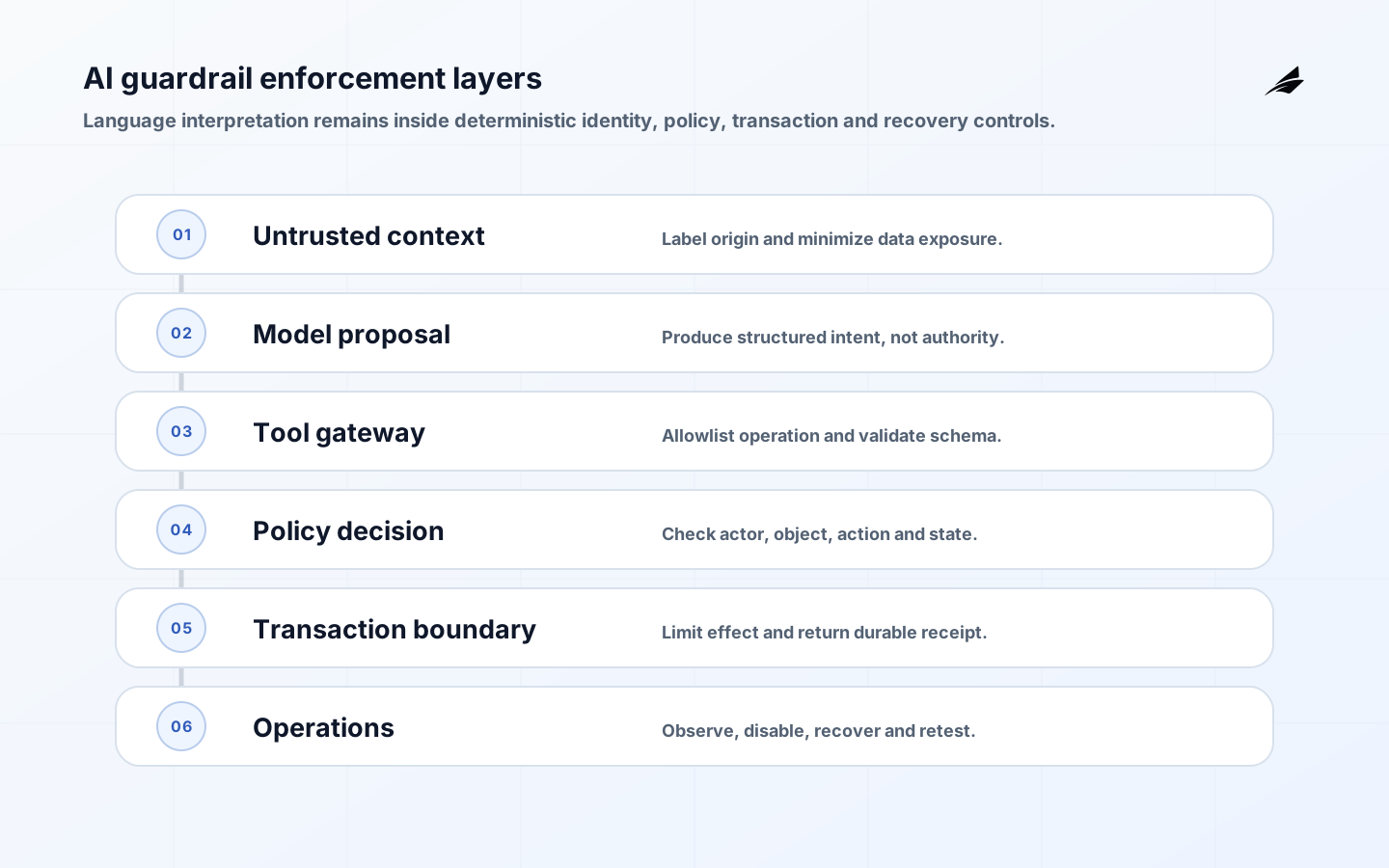
Engineering teams should treat AI guardrails as enforceable system boundaries, not as instructions that ask a model to behave. The model may classify intent, propose a tool or draft structured arguments, but trusted services must authenticate the actor, authorize the object and action, validate data, constrain resources, commit transactions and expose recovery. This distinction matters because model output can be mistaken, manipulated or shaped by untrusted retrieved content. A guardrail architecture therefore combines conventional application security with AI-specific evaluation: minimize authority, make consequential transitions deterministic, test adversarial paths and preserve enough evidence to understand what happened without logging sensitive content indiscriminately.
For connected implementation decisions, see How CTOs Should Think About Semantic Search, AI Guardrails for AI Automation, AI Workflow Approvals for AI Automation, and How Operations Leaders Should Think About Human-in-the-loop Automation. These guides are most useful when their controls are adapted to the same records, owners and consequences rather than applied as independent checklists.
Build guardrails at enforceable boundaries
Map the request path before choosing filters. Mark trust boundaries among the user, application, model, retrieved content, tool broker and target system. The OWASP GenAI Top 10 covers prompt injection, improper output handling, excessive agency and vector weaknesses; these are system problems because untrusted language can influence later components. Use allowlisted tools, operation-specific schemas, server-side authorization, transaction limits and safe output encoding. A model-selected tool name or a statement such as “the user approved” is data to verify, never proof of authority.
Threat modeling and evaluation should share cases. MITRE ATLAS gives teams a knowledge base for adversarial tactics and techniques, while the NCSC secure AI guidelines organize responsibilities across secure design, development, deployment and operation. The NIST Generative AI Profile keeps governance, context mapping, measurement and management connected. Instrument control decisions using consistent concepts such as those in OpenTelemetry semantic conventions, but redact prompts, arguments and results according to data risk.
Start With the AI guardrails Decision
Write the job in one sentence, then write the unacceptable outcome beside it. For AI guardrails, the operating question is not whether the technology is impressive; it is whether a named person can complete a bounded task with appropriate evidence and control. Teams commonly rely on a system message to refuse unsafe requests, then give the same model broad credentials and unbounded tools. Indirect instructions in retrieved files, malformed tool arguments, and confused identities can then bypass the intended policy. The NIST AI Risk Management Framework supports this discipline by connecting intended context, measurement, governance, and management rather than treating risk as a late security review. How CTOs Should Think About Semantic Search is a useful adjacent reference, but it should not replace a local description of the decision owner and failure boundary.
| Decision element | Question to settle | Evidence to keep |
|---|---|---|
| User and outcome | Who uses AI guardrails, and what completed work changes for them? | A task definition, accountable owner, and a measurable acceptance condition. |
| Authority boundary | What may be read, drafted, proposed, submitted, or changed? | A policy rule, identity claim, approval record, and revocation path. |
| Failure response | What happens when evidence is absent, conflicting, stale, or unsafe? | A visible abstention, escalation route, and incident or correction record. |
Build an Evidence Boundary
Write an action inventory. For every capability, state the caller, data classes, permitted target, spending or change limit, required approver, audit record, and revocation path. Separate read, draft, submit, and execute actions because they have different consequences. This is where seemingly small implementation choices become operational commitments. A source link or event record must remain meaningful after a deployment, an employee role change, or a correction. The UK National Cyber Security Centre guidance emphasizes secure design, development, deployment, and operation as connected activities. Use that lifecycle view to assign an owner to the inputs, the policy, and the response when AI guardrails behaves unexpectedly.
- Name the source systems, people, and decisions that AI guardrails depends on; do not bury them in configuration alone.
- Classify information and actions by consequence, then choose controls that operate at the boundary where the consequence occurs.
- Keep an inspectable record of the input, material context, policy result, and output or side effect for cases that matter.
- Design a correction path that can remove or repair a bad record and tell an operator what work may have been affected.
- Practice the uncertain case. A system that can only handle happy-path inputs has not yet earned autonomy.
Put Controls Where They Can Enforce
Enforce authorization in the tool layer, validate structured arguments against schemas, constrain destinations with allowlists, and use narrow, short-lived credentials. Log the policy decision and tool result together so an investigation can reconstruct what actually occurred. The OWASP guidance for LLM applications is particularly relevant when untrusted content can influence model behaviour or tool use: controls need to survive hostile and malformed inputs, not merely ordinary requests. For AI guardrails, prefer deterministic enforcement for identity, limits, destinations, schemas, and approvals. A model can help interpret context; it should not be the final authority for a rule that a service can verify directly.
| Control layer | What it protects | Practical test |
|---|---|---|
| Identity and access | The requester, source, and action scope. | Change membership or role and confirm the prohibited result remains unavailable. |
| Data and context | Currency, completeness, and permitted use of evidence. | Inject an obsolete, conflicting, or incomplete record and verify the response routes appropriately. |
| Action and recovery | Side effects, spend, external calls, and correction. | Force a validation failure or denied approval and confirm the state is safe and observable. |
Measure the Work, Not Just Uptime
Test attacks as part of ordinary delivery: direct and indirect prompt injection, secret-seeking requests, cross-tenant references, malformed arguments, retry storms, and a denied approval. Measure blocked unsafe actions, false blocks, policy coverage, override age, and time to revoke a capability. Keep a small, versioned evaluation set close to the workflow and add real failures after review. Distinguish service availability from decision quality: a system can have low latency and still provide the wrong evidence or trigger costly rework. Review results with the people who understand the task, then turn recurring failure patterns into a test, a source repair, a product change, or a tighter boundary.
Release in Bounded Steps
Launch the lowest-impact action first, such as drafting a ticket with no submit permission. Add a single controlled execution only after operators can inspect the evidence, cancel the run, and explain the authorization decision. Define a rollback condition before release, including who can disable the capability and how a human completes the work during recovery. Small launches are valuable when they are instrumented and reviewed; they are not a license to skip permissions, source checks, or error handling. Record the decision to expand with the same care as the initial decision to use AI guardrails.
Operate AI guardrails as a Living Service
The guardrail review should look at actual attempted actions, not only the rules written in a design document. Group blocked and overridden cases by tool, identity, data class, and consequence. A cluster of false blocks may indicate an overly broad policy or a missing workflow state; a cluster of near misses may show that an external service exposes more power than the assistant needs. Review emergency overrides separately and expire them deliberately. Engineering teams should rehearse a policy change, credential revocation, and audit investigation so the response is known before a live incident. Include product owners, security, and the operators who receive escalations, because each sees a different form of failure. This is how AI guardrails stay connected to the work they are meant to protect: they evolve through observed misuse and legitimate edge cases, while the transaction boundary remains deterministic and accountable.
Keep Review Evidence Actionable
Make the review evidence usable during an incident. A responder should be able to locate the policy version, caller identity, tool arguments, approval state, and external result without reconstructing the event from model prose. That is the practical test of an enforceable guardrail.
Assign Accountable Owners
Name a policy owner for each meaningful tool capability and give that owner a simple way to inspect denied actions and approved exceptions. The team should know who can change a rule, who can authorize a temporary override, and who closes the loop when a tool or external dependency behaves unexpectedly. Clear ownership turns a collection of technical checks into a control that can be operated under pressure.
Threat-model an email-to-ticket agent
An agent reads a support mailbox, summarizes messages and may create tickets. An attacker sends an email whose body instructs the agent to ignore policy, search prior messages and attach sensitive content. The email is untrusted data even though it arrived through an approved connector. The model may still propose a dangerous action. The tool broker should expose only ticket creation for this workflow, reject attachment reads, validate tenant and requester fields, cap text size, and require the application to set the destination queue. The target API independently checks the service identity and allowed operation.
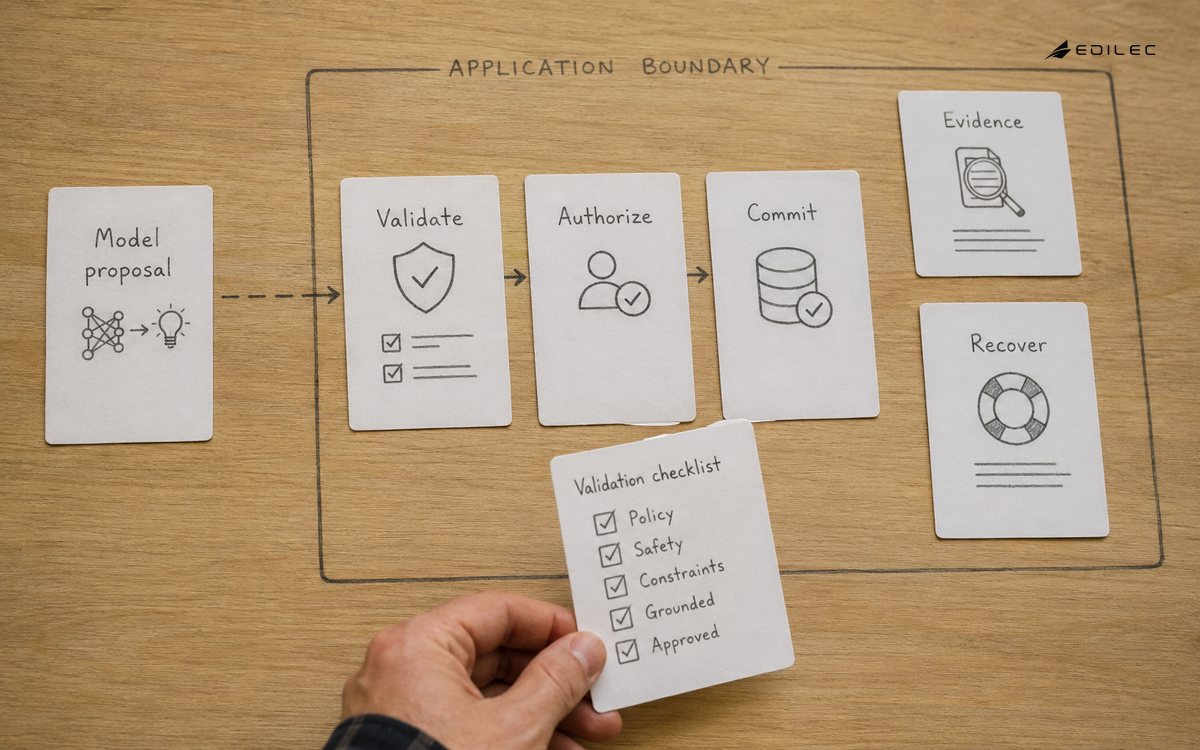
The evaluation should preserve the full control outcome: malicious instruction present, prohibited tool unavailable, permitted ticket created only with sanitized fields, user-visible warning where appropriate, and trace sufficient for investigation. Also test ordinary failures such as malformed arguments, connector timeouts, duplicate messages and expired credentials. Provide a kill switch that removes tool authority without taking the entire support application offline. A successful guardrail does not mean every hostile input is perfectly classified; it means misclassification cannot silently cross a consequential boundary.
| Boundary | Deterministic guardrail | Failure test |
|---|---|---|
| Context intake | Classify source and minimize included data | Indirect instruction inside retrieved content |
| Tool selection | Expose only workflow-specific operations | Model requests an unavailable privileged tool |
| Arguments | Validate schema, scope and business invariants | Destination or tenant is manipulated |
| Execution | Authenticate service and authorize current action | Expired role or changed object state |
| Output | Encode, redact and confirm result | Tool returns active content or sensitive data |
| Operations | Rate-limit, trace, disable and recover | Loop, outage or suspected compromise |
Key Takeaways
- AI guardrails earns trust through a defined job and a named decision owner.
- Evidence, identity, and action boundaries must be explicit before a wider launch.
- Controls are strongest when enforced by deterministic services at the point of consequence.
- Evaluation should include difficult, absent, stale, and adversarial cases, not only successful examples.
- Expansion is a governed operating decision supported by outcomes, not a reward for a polished demo.
Frequently Asked Questions
Guardrails do not make a model intrinsically safe. They reduce exposure by moving important checks into deterministic systems with clear owners, tests, and logs. The practical next step is to select one workflow, write its evidence and authority boundaries, and create a small set of cases a domain reviewer can judge. That produces much more useful learning than a broad rollout with no shared definition of success.
Conclusion
AI guardrails becomes dependable when its operating constraints are visible: what it is for, what information it may use, what it may do, who can intervene, and how the organisation knows it is improving. Start with the consequential decision, preserve the evidence around it, and make uncertainty a safe state rather than something the system hides.