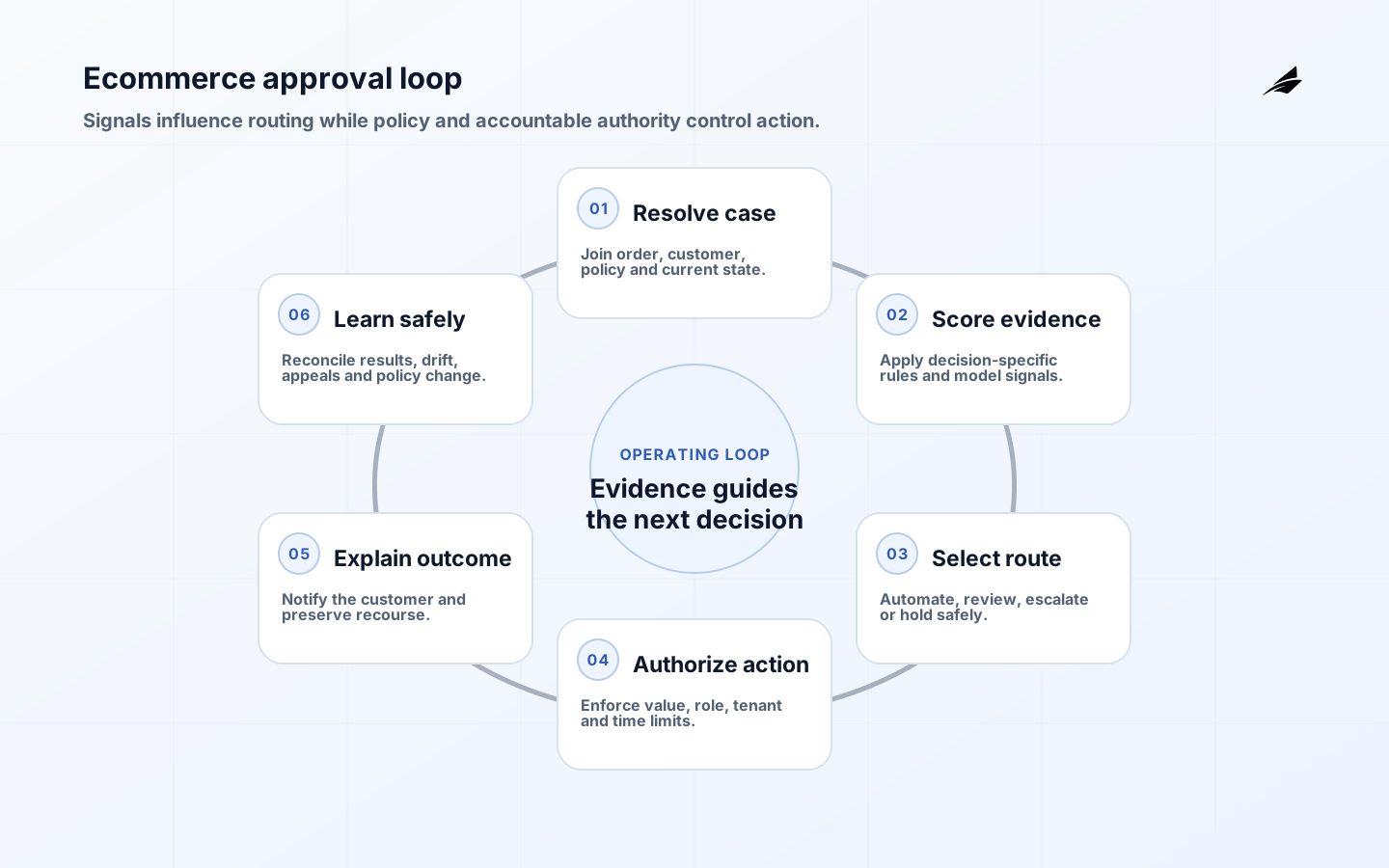
AI approval routing automation for ecommerce is a decision-support system that sends an order, refund, promotion, listing or account action to the right automated path or human reviewer. It should reduce queue time and inconsistency without allowing a probabilistic model to invent policy or quietly exercise unlimited commercial authority. The design problem is broader than model accuracy: teams must define which decisions exist, what evidence is available at decision time, who may approve each consequence, how customers obtain recourse and how outcomes feed back into policy.
This FAQ complements Edilec's ecommerce approval routing guide, general approval automation plan and production review-gate guide. Use it to shape requirements and acceptance evidence. It does not replace legal review of consumer, payments, marketplace, employment or sector-specific obligations in the jurisdictions where the store operates.
What ecommerce decisions should the workflow cover?
Begin with a decision inventory. Common candidates include suspected payment fraud, unusually large refunds, price overrides, promotional exceptions, seller onboarding, prohibited-item review, chargeback evidence, reshipments and account restrictions. Record the decision owner, monetary or customer consequence, current policy, evidence inputs, maximum wait and appeal route. Separate routing from approval: a model may estimate risk and choose a queue while a deterministic policy still decides whether an action can proceed. Low-consequence tasks can be automated earlier than irreversible account or payment actions.
Avoid one universal risk score. An order-fraud signal, refund-abuse signal and listing-safety signal describe different events, populations and costs. Each needs its own outcome definition and evaluation set. The NIST AI Risk Management Framework organizes work around Govern, Map, Measure and Manage; apply those functions per decision rather than declaring the whole workflow low risk. Include customers, support agents, fraud specialists, finance, trust and safety, privacy, security and legal stakeholders when mapping impact.
| Decision | Default path | Escalation evidence |
|---|---|---|
| Routine refund within policy | Rules-based approval | Order age, value, delivery and prior refund history |
| High-value or unusual refund | Specialist review | Customer context, item evidence and policy exception |
| Payment risk | Hold or step-up check | Payment signals, identity context and device history |
| Seller listing concern | Trust-and-safety review | Listing content, category, jurisdiction and reports |
| Account restriction | Senior human approval | Pattern evidence, policy clause and recourse route |
How should the approval architecture work?
Create a versioned decision service between commerce events and operational actions. It validates the event, resolves customer and order state, applies hard eligibility and suppression rules, requests model signals where appropriate, selects a route and records the complete decision envelope. Keep policy, model and workflow versions separate so an outcome can be reconstructed. The workflow engine should enforce deadlines, segregation of duties and fallback queues. Execution adapters should expose narrow actions such as hold, refund up to a limit or request evidence rather than broad administrative access.

Treat product descriptions, messages, attachments and retrieved content as untrusted inputs. The OWASP agentic threat guidance highlights risks such as tool misuse, identity abuse and goal manipulation. Do not let text from a seller or customer redefine approval policy or call tools directly. Validate structured outputs against schemas, authorize each action server-side, bind the acting identity and tenant, cap value and frequency, and require fresh state before execution. Queue the case safely if a model, dependency or evidence source is unavailable.
When is human review necessary?
Require human review when consequences are material, evidence conflicts, policy is ambiguous, confidence is outside the validated range or the case belongs to a protected or sensitive context. Human review is not a control if the reviewer receives only a model verdict. Show the relevant evidence, applicable policy, uncertainty, prior actions and allowed choices. Randomize some presentation or withhold the recommendation initially when measuring automation bias. Give reviewers enough time and authority to disagree, and monitor overturns by route, customer segment, product and reviewer.
Design workload before launch. Forecast arrival rates, peak events, service deadlines and handling times by queue. Reserve capacity for campaign spikes and incidents, and prevent low-value cases from crowding out urgent customer harm. An expedited path needs stricter eligibility and later sampling. Never use silent timeout approval for material refunds or account actions merely to meet an SLA. If review cannot finish, move to a reversible state, communicate clearly and preserve the customer's ability to continue or appeal.
How do fairness, disclosure and recourse fit?
Evaluate performance on the populations and conditions the workflow actually serves. Compare false holds, false approvals, delay and overturn rates across meaningful cohorts, channels, geographies, device conditions and order types where lawful and appropriate. Investigate differences; do not infer that equal averages prove fair treatment. The NIST Generative AI Profile recommends roles, independent evaluation and feedback mechanisms proportionate to risk. Use a review group independent from model builders for high-impact changes.
Tell customers what action occurred, what information they can provide and how to obtain review. Avoid making unsupported claims about fraud or intent. The CISA Secure by Design initiative emphasizes reducing customer burden through safer product design; in approval workflows, that means secure defaults, understandable choices and no dependence on customers discovering hidden safeguards. Keep approval records aligned with published terms. Recourse should reach a person or process with authority to correct the outcome, not loop the customer through the same automated decision.
What identity and security controls are required?
Authenticate employees, services and customers at a strength appropriate to the action. The current NIST Digital Identity Guidelines provide a risk-based framework for identity proofing, authentication and federation. Separate ordinary support access from refund, price, seller and account authority. Use short-lived service credentials, scoped permissions and dual control for exceptional values. Record who or what requested, recommended, approved and executed an action; a shared automation account erases accountability.
Threat-model event forgery, replay, queue tampering, prompt injection, compromised reviewer accounts, leaked customer evidence and manipulated feedback labels. Sign or otherwise authenticate important events, enforce idempotency and prevent a retry from issuing a second refund. Minimize evidence shown to each reviewer and redact payment secrets. Protect model features and labels from unauthorized alteration. Test deny paths and degraded modes, not only successful approvals. Incident runbooks should support suspending a model or route without stopping all commerce.
How should teams measure and roll out the system?
Establish a policy-only baseline before measuring an AI-assisted route. Track decision quality, customer impact, operational flow and control health together. Offline precision or recall is insufficient because it ignores review capacity, delayed truth and the cost asymmetry between outcomes. Shadow the proposed route without acting, compare it with actual decisions, then assist a small trained reviewer group. Automate only a narrow reversible class after evidence meets thresholds. Preserve a holdout or recurring manual sample to detect drift and changed customer behavior.
| Measure | Why it matters | Guardrail |
|---|---|---|
| False hold and false approval | Captures both customer and loss cost | Set limits per decision class |
| Time to qualified decision | Measures customer and queue delay | Exclude acknowledgement-only timing |
| Reviewer overturn rate | Reveals weak routing or automation bias | Segment by route and model version |
| Appeal correction rate | Tests customer recourse and explanation | Investigate repeat failure patterns |
| Unreconciled actions | Detects workflow-execution mismatch | Zero tolerance for duplicate financial action |
| Drift and coverage | Shows whether inputs left the validated range | Fallback outside approved operating bounds |
Govern model and policy changes as separate releases. A fraud team may need to change a threshold immediately while a new model requires evaluation and staged deployment. Record the effective period of each policy, feature set, model and route. Backtest proposed changes on representative historical cases without treating labels as perfect truth; chargebacks arrive late, manual outcomes can be biased and customer context changes. Require independent approval for changes that materially alter auto-approval coverage or customer restrictions.
Include commercial and seasonal operations in the design. Product launches, holiday peaks and promotional campaigns alter order mix, fraud pressure, stockouts and support demand. Share forecasts with review owners and model monitors. Temporarily narrowing automation can be safer than accepting behavior outside the validated range. After the event, reconcile financial actions, investigate queue abandonment and compare customer contacts with decisions. Use that evidence to update staffing, scenario tests and policy before the next peak.
Finally, audit the workflow as a decision system. Sample cases from input through signal, route, review, action, notification and appeal. Verify that records match systems of truth and that deleted or corrected customer information is not retained in unmanaged features or prompts. Report control failures by consequence and recurrence, require remediation evidence before expanding automation coverage, and retain the record for accountable production review.
Key takeaways
- Inventory ecommerce decisions and consequences before selecting a model.
- Keep deterministic authority and server-side controls outside probabilistic output.
- Give reviewers evidence, policy, time and real power to disagree.
- Measure customer delay, false actions, appeals and reconciliation alongside model quality.
- Roll out reversible decision classes first and preserve a tested manual path.
Frequently asked questions
Should AI approve refunds automatically? Only bounded, reversible cases that meet explicit policy and validated risk thresholds. Can a confidence score define the path? Not alone; consequence, evidence quality and policy exceptions also matter. Must customers be told a model was used? Disclosure duties vary, but customers should always receive a useful explanation of the action and recourse. How often should rules be reviewed? On a fixed cadence and after material loss, campaign, product or policy changes. What happens during model failure? Hard rules and queues continue, high-risk actions pause, and no broad permission is granted by default.
Conclusion
Good ecommerce approval automation shortens the path to a justified decision without hiding authority. By separating signals from policy, limiting execution rights, designing viable human queues and measuring recourse, teams can gain speed while retaining customer trust. The system is ready only when every consequential action can be reconstructed, challenged, corrected and safely stopped.