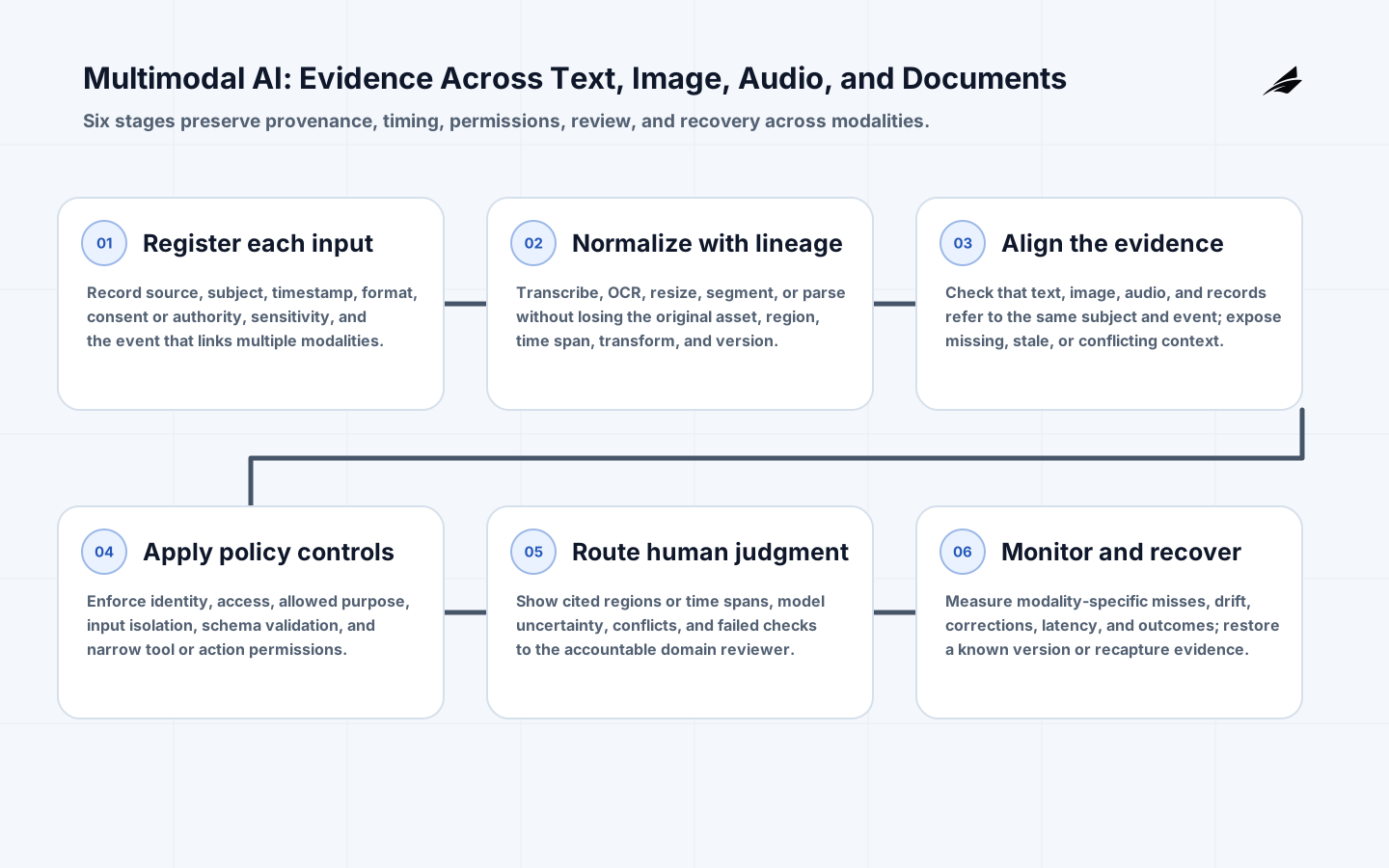
Multimodal AI is most useful when it helps a person make a specific decision from mixed evidence: a photograph and a work order, a call recording and a case record, or a scanned form and an approval policy. The production question is not whether a model can describe each input. It is whether the workflow can show what was received, what was extracted, what remains uncertain, and who is allowed to act. This guide sets out an operating design for that chain, with practical controls for evidence, review, security, and recovery. NIST's Generative AI Profile is a useful governance reference because it treats provenance, testing, oversight, and incident learning as ongoing responsibilities.
Start With a Decision, Not a Modality
Begin by naming the decision the workflow supports. For example, a claims team may need to decide whether a submitted photograph contains enough visible damage for a human adjuster to open the right review path. The model can classify the image, read a related document, and draft a summary; it should not silently settle coverage or authorize a payment. A narrow decision gives the team a testable boundary and makes it possible to define a safe refusal.
Scope the Journey
| Design question | Working answer | Evidence to retain |
|---|---|---|
| What enters the workflow? | List accepted file types, recording sources, image resolution limits, languages, and the business event that starts processing. | Input identifier, receipt time, source system, consent or permission state, and a rejection reason when the input is outside scope. |
| What may the system produce? | Separate extraction, classification, retrieval, summarization, recommendation, and execution. Give each output a named consumer. | Structured output, model and prompt versions, confidence caveats, retrieved references, and the destination where the result was written. |
| What requires a person? | Set review gates for missing evidence, conflicting modalities, sensitive content, low-quality capture, and consequential actions. | Reviewer identity, decision, correction, reason code, timestamp, and the original artifact or location inspected. |
| What happens when processing fails? | Return the case to a queue, preserve the original, and make a manual route available without asking the user to resubmit blindly. | Failure category, retry count, service version, queue assignment, and final disposition. |
This boundary also prevents a common design mistake: treating all modalities as interchangeable. A transcript is a derived representation of an audio recording, not a replacement for it. A text layer extracted from a PDF may omit stamps, layout, handwriting, or annotations. A caption may identify an object while missing the condition that matters to a specialist. Preserve the source and make the route back to the relevant page, frame, timestamp, or region easy to follow.
Build an Evidence Chain
An evidence chain connects the original asset to every derived representation and decision. Store a stable asset ID, source owner, capture time when available, processing stage, transformation version, and access classification. For a document, that might include the original PDF, page images, OCR output, field extraction, and a reviewer correction. For audio, retain the recording reference, transcript version, speaker or time segment when known, and any redaction applied before analysis. The record does not need to expose sensitive material to every operator; it does need to make custody and permissions auditable.
Use a Layered Architecture
- Ingress validates file type, size, malware status, retention class, and the identity of the submitting system before a model sees the content.
- Normalization creates modality-specific representations such as page images, a timestamped transcript, or a bounded image crop while retaining a link to the original.
- Extraction produces typed fields and locations. An amount should remain an amount, a date should remain a date, and an uncertain value should be explicitly null or flagged rather than guessed.
- Retrieval supplies policy passages or case context from sources the requesting identity may use. The original RAG research is a useful reminder that retrieved memory and model memory are different components.
- Decision support combines evidence into a recommendation or draft, but deterministic policy checks and the system of record retain authority over permissions and state changes.
- Review and recovery route low-quality, conflicting, unauthorized, or high-impact cases to a named queue with enough evidence for a person to resolve the case efficiently.
Keep the boundaries observable. A single end-to-end score can hide whether the problem came from capture, OCR, speaker separation, retrieval, generation, or a downstream mapping. Log stage-level outcomes and correlation IDs so an operator can reproduce the path without copying private content into an ad hoc prompt. Version the model, parser, prompt, retrieval configuration, policy rules, and destination contract together in the release record. Teams designing the retrieval layer can pair this with RAG for company knowledge and support, while broader tool-loop design is covered in how AI agents work in business workflows.
Control Access and Authority
Multimodal inputs often contain more information than the immediate task requires. Apply least privilege to both humans and services: a transcription worker may read audio but not update a customer account; an analyst may inspect the original image while an automated process receives only extracted fields. Redact or minimize before sending data to an external model when the task does not need the full asset. Make retention and deletion rules explicit for originals, derived artifacts, prompts, logs, and reviewer notes.
| Control point | Implementation detail | Failure signal |
|---|---|---|
| Identity | Attach the calling user or service identity to every retrieval and tool request; do not infer authorization from the content of a document or message. | A result includes records outside the requester's permitted case, tenant, geography, or role. |
| Input handling | Treat text in an image, PDF, web page, or transcript as data to analyze, not as instructions that can rewrite system policy. | An uploaded artifact causes the workflow to ignore its task boundary, reveal hidden context, or invoke an unrelated tool. |
| Output validation | Validate schema, ranges, required fields, referential IDs, and allowed state transitions before writing downstream. | Malformed values, invented identifiers, or a recommendation is accepted because it sounds plausible. |
| Human review | Show the proposed result beside the relevant source location and require a reason when a reviewer overrides a material field. | Reviewers approve without opening the source or cannot explain which evidence supported the decision. |
| Change management | Test model, parser, prompt, policy, and source-index changes against a fixed regression set before production release. | A vendor or configuration update changes extraction, refusal, citation, or latency behavior without an owner noticing. |
The OWASP Top 10 for LLM Applications is particularly relevant when a multimodal assistant can call tools. Prompt injection can arrive through a document, image text, or audio transcript, and excessive agency can turn a plausible interpretation into an unauthorized action. Keep tool selection outside the model where possible, expose narrow function contracts, and require a separate authorization check immediately before any consequential write.
Evaluate the Whole Workflow
Build an evaluation set from real operating variation, with sensitive data handled under the organization's approved process. Include clean and degraded scans, rotated pages, handwriting, accents, overlapping speakers, background noise, multiple languages, cropped images, ambiguous references, missing fields, conflicting sources, and malicious instructions embedded in an artifact. Measure field accuracy and citation quality, but also measure whether the system refused when it should, routed the case correctly, preserved the source, and avoided an unauthorized write.

Measure Useful Outcomes
| Metric | Why it matters | How to use it |
|---|---|---|
| Accepted field rate | Shows how often extracted fields are usable without correction for the defined population. | Break it down by modality, source, language, document type, and release so a local defect is not hidden by an average. |
| Material correction rate | Reveals errors that change routing, money, eligibility, safety, or customer communication. | Review the correction reasons and add recurring patterns to the regression set; do not treat all corrections as equal. |
| Evidence-to-decision time | Tests whether showing the right page, frame, or segment makes review faster without weakening scrutiny. | Compare normal cases with exceptions and inspect whether time falls because evidence is clearer or because reviewers are skipping it. |
| Unsupported assertion rate | Captures claims that cannot be traced to an accepted source or approved business rule. | Sample outputs by risk tier and block release when the rate rises in a high-impact journey. |
| Recovery completion | Shows whether failed cases reach a human or alternate process instead of disappearing in retries. | Track queue age, owner, final disposition, and repeat failure category during an operating review. |
Scenario: Service-Visit Evidence
Imagine a field-service company receiving a technician's voice note, three photos, and a work-order PDF. The workflow first checks that the work order belongs to the technician and customer context, then creates a transcript and labels each photo with its asset ID. It extracts the reported part number and requested follow-up, compares them with the work order, and drafts a completion note. If the photo is too dark, the part number conflicts with the document, or the note proposes a safety-sensitive action, the case moves to a supervisor queue with the exact source segments highlighted. Only the supervisor or an approved deterministic rule can close the work order.
This design creates a useful feedback loop. A supervisor correction can identify a capture problem, a parser defect, a taxonomy gap, or a policy ambiguity. The owner then fixes the right layer and reruns representative cases. A model prompt change is not an adequate response to every error; some failures belong in the capture interface, source data, validation rule, or training for reviewers.
Pre-Launch Checklist
- Name the supported decision, excluded decisions, affected users, owner, and manual fallback.
- Inventory original assets, derived artifacts, permissions, retention periods, and external processing boundaries.
- Define typed outputs, source locations, confidence limitations, refusal conditions, and approval gates.
- Test degraded, conflicting, multilingual, adversarial, unauthorized, and unavailable-input cases.
- Record model, prompt, parser, retrieval, policy, and destination versions for every production result.
- Set review metrics, queue service levels, rollback triggers, and an incident route before expanding coverage.
Key takeaways
- Start with one mixed-evidence decision and define which modality, source location, and business record supports each conclusion.
- Preserve original assets and trace every transcript, extraction, crop, summary, and correction back to its source and access policy.
- Keep model interpretation separate from application authority; deterministic controls and named reviewers should govern consequential actions.
- Test missing, low-quality, conflicting, and malicious inputs across modalities, then use reviewer corrections and incidents to improve the workflow.
Frequently Asked Questions
Is a confidence score enough to approve a multimodal result?
No. Confidence can help prioritize review, but approval should also consider source quality, business impact, authorization, conflicting evidence, and the reversibility of the action.
Should the transcript replace the audio recording?
No. Use the transcript for search and navigation, then retain a controlled route to the audio and relevant timestamp. A reviewer needs the original when wording, tone, speaker identity, or transcription uncertainty matters.
What is the best first use case?
Choose a repetitive, bounded task where a person already reviews evidence and where a wrong recommendation can be stopped. That creates a measurable baseline and a practical fallback while the team learns where each modality fails.
Conclusion: Make Evidence Inspectable
A mature multimodal AI workflow does not hide complexity behind a polished answer. It preserves the original, labels derived evidence, enforces identity and authority, measures material errors, and gives people a fast recovery route. Start with one decision, prove the evidence chain, and expand only when the operating team can explain both successful results and the cases it refused.